By Gabby Bashizi
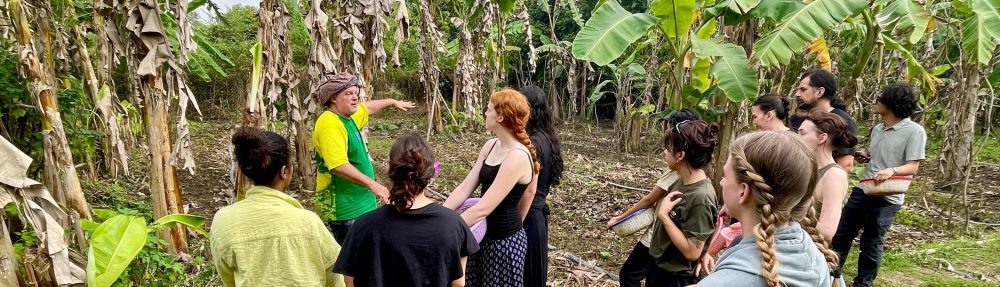
Geologist Giulio has a very matter-of-fact way of speaking. He’s short. He’s Italian. And he cares deeply about water management.
These are the things that our group learned about Giulio within 5 minutes of the beginning of our lecture. The first question he asked us was where we were all from. “You might all have a particular story with water,” he said, eyes alight. “I’ll try to incorporate these special relationships into my talk today.”
What is water management? This is the question that drove our lecture, which was one suitable for both water-beginners and water experts. Here’s what we learned:
Auroville sits on a ridge. That means that rainfall that comes down over the territory goes somewhere, it doesn’t stay sitting still on the surface. The place this water goes to is called an aquifer. An aquifer is an underground layer of water-bearing permeable rock or unconsolidated materials, like gravel, sand, or silt. These materials allow the water to stay underground for later access through wells, or other similar means. Auroville soil is part Cuddalore Sandstone, which is very porous. It also contains sections of Manaveli Clay and Kadaperi Kuppam Limestone. Each of these materials invites unique flows of water: the sandstone allows for flow directly into a lower layer, while the clay’s non-porous structure means that when water falls on it, it runs according to topography. That direction is away from Auroville and into the surrounding villages. Only 13% of rainfall even reaches the groundwater, meaning that over-extraction of these resources will not be replenished quickly. The aquifer that lies under the Vanur Sandstone has gone down significantly. Soon they will hit granite. Aquifers act as temporary storage for water sources, but they are not to be considered to be “water management”. That task requires far more intricate thinking.

Giulio called back to an ancient Tamilian system of water management: a large system of interconnected lakes and ponds at varying topographic elevations that allowed for rainfall to be collected and distributed using gravity to other parts of the bioregion. This strategy, he concluded, is much more akin to a system of management, and we should look to these techniques in our search for more effective water design.
The broader point to this Auroville-specific water story is that water access depends heavily on geographic location. Water management means accumulating a knowledge of geology, politics, and engineering to understand how to allocate equal access to water, regardless of unfortunate geographic positioning.

There are so many issues that accompany poor water management. Over-extraction leads to depleted groundwater reserves. This leads to two major issues, especially in Tamil Nadu. The first is subsidence, which is when the ground begins to sink due to a lack of solid material supporting it, and an excess of weight on top of it. The lack of material can be attributed to hollow ground with the absence of water supporting it. The second is salt-water intrusion, which occurs mainly in areas close to sea level and near the coast. When the groundwater storage is depleted, it leaves an empty space for the ocean to percolate through the ground and fill up the area. The drinking water becomes salinized and ruins the supply for everyone extracting from the same place. Giulio grimly added: “Nature will prevail, we are nothing on this planet. No matter what, nature will prevail.” This sentiment, though dark, is certainly true. We are powerless to stop water, we must work within the confines of its movement to get the best that we can from it.
These problems go uncontrolled by legislation. When asked about the existing sources of legislation in Tamil Nadu, and in India as a whole, Giulio just shook his head. He lamented the absolute lack of water legislation on a state and national level. The current rule, he said, is “I own the land and whatever water is above, on, or below the land is mine”. This paints a grim picture of resource availability in the future. If we continue to abuse our power to extract water, there may very soon be none left. The phenomenon is not concentrated in India, either. On a global level, governments and their people are struggling to strike a balance between personal profit and longevity. This will persist until creative people with a passion for sustainability take up arms in the fight to protect water and ensure it for everyone.
Giulio concluded his talk with this line: “When you think of water, think of life.”
Nothing more accurate could have been said, and it truly left us all thinking about our water usage and the role that we should play in making sure abuses stop and sustainability prevails. Think about your water, think about your life.
 AUP Sustainable Development Practicum in Auroville, India