By Justin Kauppi
In 1959, the Sri Aurobindo Ashram Paper Factory opened in Pondicherry, India. Ever since, it has been creating beautifully textured paper that has been crafted into products such as notebooks and wedding invitations among many others. When many think of where paper comes from, they think of trees. Yet at the Sri Aurobindo Ashram Paper Factory, that’s just one of the many origins. As Gaurav, the Operations Manager of six years gathered us at the entrance of the raw material processing room, he explained that the paper at the factory comes from eucalyptus, bamboo, pineapple leaves, banana fiber, sugarcane, and more. However, one of the most used sources for paper at the factory is cotton. Due to its ability to create any color, as well as its durability due to its strong fibers, cotton reigns supreme within the wails of the factory.
In order for the cotton to become paper, it first has to go through several steps. First, the raw cotton material is sourced from a local textile industry which Gaurav says would otherwise end up in a landfill. After being cut into long strips, and sifted through for the right sizes, the cotton is then beaten into a paste which Gaurav likens to a chutney-type substance. Several employees of the more than 100 hired workers, many of whom have years of experience, beat the rags until they are at the right stage to be sent to the next step. A stage which is indecipherable to the inexperienced onlooker. After being treated with local well water, and even coconut water, the paste is then delicately poured over a mold before being tightly pressed in a special vice before it is peeled and hung to dry.
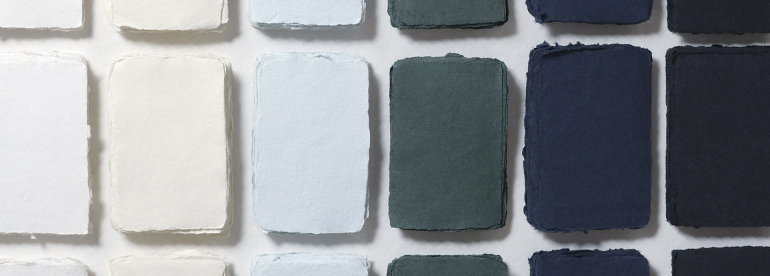
Handmade Deckle Edge Paper featured on http://www.sriaurobindopaper.com
Although much of the paper comes out white, there are many techniques used at the factory to create the most vibrant of patterns full of color. As Gaurav led us into one of the drying rooms, we were immediately surrounded by paper of vivid yellows, reds, and purples that swirled in together in ways that rival the works of Van Gogh and other Post-Impressionist painters. Gaurav explained that this type of technique of what is known as “marbling” originated from Japan but was adopted by the factory and has become one of the factory’s best-selling products.
At the end of the tour, we were taken to the factory’s gift shop where we could see all of the finished products on display and available for sale. Items such as deckle edge invitations and origami tree ornaments make up just some of the unique and affordable gifts available at the shop. However, if you can’t visit the shop in person, you can buy online at http://www.sriaurobindopaper.com.
 AUP Sustainable Development Practicum in Auroville, India