By Carolyn Franano
Started in 1983, Auroville Village Action Group (AVAG) is one of the oldest village outreach groups in Auroville. AVAG is a non-profit organization dedicated to improving the livelihoods of, and solidarity between, the members of the villages surrounding Auroville. AVAG serves the Vanur block of the Villupuram district. The communities living in the 75 settlements in this area face a myriad of interconnected issues including poverty, illiteracy, alcoholism, and discrimination based on caste, class, religion, and gender. AVAG works with all ages and sexes and is committed to taking on these challenges using a participatory, holistic, empowering, and inclusive development approach. They have four main areas of intervention: community development, economic development, capacity building, and psychosocial services.
Economic and Community Development
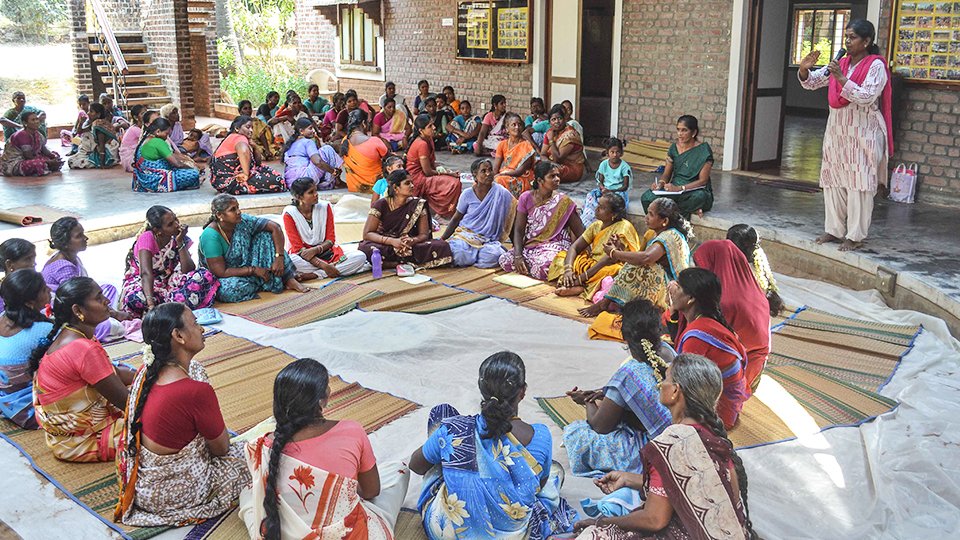
AVAG’s community development program is centered around unity and well-being. Its goal is to foster community, solidarity, and ownership in the villages they serve, particularly for the women. AVAG works with over 8000 women, acting as a mentor for the approximately 225 women’s groups in the bioregion. Their community development work includes health initiatives, inclusive sports initiatives, caste exchange programs, linking villages to government welfare schemes, micro-development projects, women’s festivals, insurance programs, and more. It is very linked to their economic development program, which aims to improve the livelihood of villagers by increasing economic opportunities through financial inclusion and the promotion of fair practices. For example, AVAG runs an adjunct enterprise called AVAL, a brand selling handmade clothing, bags, and crochet items made by village women for the benefit of village women. The economic development program is mostly implemented through local women’s and men’s groups and involves social entrepreneurship development, livelihood skills training, higher education scholarship programs, credit and savings programs, linking villages with financial institutions, entrepreneurship training, and the revolving fund. AVAG’s revolving fund supplies loans to women in the villages at an 18% interest rate, helping them escape the cycle of debt created by tough to access government loans and the often turned to loan sharks, who provide loans at a 60% interest rate. The revolving fund helps women raise funds for building homes, paying for girl’s education through the AVVAI program, and funding small business enterprises—it is a vital piece of AVAG’s work.
Capacity Building and Psychosocial Services
The economic and community development programs are supported by the capacity building and psychosocial services AVAG provides. AVAG’s capacity building program promotes social harmony and nurtures self-empowerment and social changes via integral education. They offer many different programs to accomplish this in areas such as personality development, creativity, legal rights, sports, social issues, agriculture, health, emergency response, and environment. Anbu, the project director at AVAG, says:
“Capacity building is an inevitable part of participatory development which provides an ability to work across sectors, mobilization of additional resources, transfer of skills and knowledge and creation of sustainable delivery capacity. It assists the local communities for collective action and gives greater sense of ownership” (villageaction.in).
In addition to empowering the capacity of the members of the villages in the bioregion, AVAG also cares for their mental health. According to Anbu, before adding the provision of psychosocial services to AVAG’s areas of intervention, suicide rates were high among members the bioregion’s women’s groups. In response, AVAG trained its staff in somatic therapy services and implemented a mental health program which brought down suicide rates in the women’s groups to 0-1%. According to AVAG, their four areas of intervention—community development, economic development, capacity building, and psychosocial services—aim to help the Vanur block achieve the UN Sustainable Development Goals as well as India’s development goals. AVAG’s work align with all these goals, but have made particularly impressive progress towards #1: no poverty, #4: good education, #5: gender equality, #8: decent work and economic growth, and #10: reduced inequalities.

Participatory Development
AVAG is a pillar of the bioregion. What is absolutely incredible, is that AVAG is able to accomplish all of this work with a team of only 20 people. When asked how this is possible, Anbu replied that while AVAG’s core team is very small, their participatory development approach rooted in solidarity, cooperation, and collaboration means their team actually expands to the entire community they serve. In development communications, the participatory development model stresses the importance of involving the local communities being served in the decision-making about how to improve their livelihoods via development schemes. Rather than a top-down strategy, participatory development employs an inclusive and empowering bottom-up approach. AVAG’s team always asks the communities they are serving what they feel they need before implementing new projects. The local communities are involved in every step of the development process from brainstorming, to budgeting, to project implementation. AVAG is truly a model for how to serve local communities in an empowering and impactful way; their model of solidarity, community, and cooperation is something we can all learn from.

Learn more on AVAG’s website: https://www.villageaction.in
 AUP Sustainable Development Practicum in Auroville, India