By Noelle Dillman
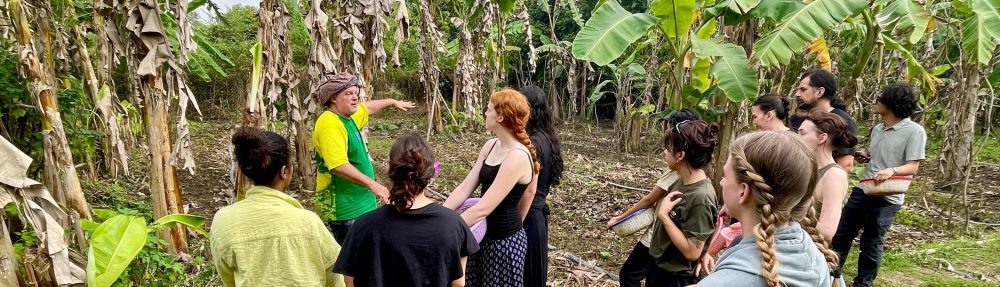
AUP students had a special guest teacher for our nature walk through Revelation Forest- Malia Elder, a passionate forester who also happens to be our professor’s daughter. With Malia’s guidance, we wandered underneath the shaded canopies, learned what makes this forest unique, and marveled at the abundance of life present all around us.
The ecosystem in Auroville is known as Tropical Dry Evergreen Forest (TDEF), which is a rare type of forest indigenous to South East India. Auroville is home to the largest Tropical Dry Evergreen Forests in the world, and Revelation Forest spans an impressive 84 acres. What is remarkable about the land that is now teeming with life at every turn is that it was once a barren plateau.
The forest’s history is intimately tied to colonization and human intrusion is to blame for the degradation of the original land. Humans encroached upon the natural resources offered by the forest such as the Ebonum tree, a dark-wooded tree that was a source of timber, to the point of almost complete depletion. The consequences of over-extraction have been difficult to remedy. Nevertheless, the trees in the forest stand tall with a renewed vitality today thanks to decades of rehabilitation from dedicated foresters and Aurovillians, reflecting a strong commitment to sustainable development goal number 15, life on land.
According to Malia, Revelation Forest is currently really the “fetus” of a forest- it will take many years for the forest to reach maturity and Aurovillians are still actively working to revive the land. Revelation forester Arun Ambathy explains that bringing back a forest “requires consistent intergenerational land use management”, and that is precisely the undertaking of foresters at this particular site (Ambathy). He explains that TDEF is actually a transitory stage, and the ultimate goal of foresters at Revelation is to nurture the land to eventually reach a Tropical Wet Evergreen Forest, but the landscape will need to be consistently maintained over the course of at least 200 years (Ambathy).
The work being done at Revelation forest calls upon us to consider two valuable points. First of all, the history of the forest reminds us of the consequences of anthropocentrism. As humans, we have a responsibility to protect the environment; we are not at liberty to exploit its resources and recklessly destroy it as we see fit. We must acknowledge that our home on earth is shared, and we have a duty to respect its other inhabitants. Secondly, Revelation serves as a reminder that when it comes to achieving the sustainable development goals, we are playing the long game. Preserving and restoring our environment will require consistent cultivation and a genuine commitment to building a sustainable future- from all of us.


References-
Arun Ambathy (Auroville forester), interviewed by Carolyn Franano, January 3rd, 2024.
 AUP Sustainable Development Practicum in Auroville, India