By Carolyn Franano
“We imagine city as a collective space which belongs to all those who live in it, who have the right to find there the conditions for their political, social, economic and ecological fulfillment at the same time assuming duties of solidarity. This concept of the city is blocked by capitalist dialectic based on difference in public and private good. From these two poles State and Market emerge as the only two subjects. We want to escape this dialectic, not to focus on eventually ‘third subject,’ but on a group of collective subjectivities and the commons that they produce”
–Pulska Grupa Kommunal Urbanism Social Charter qtd. in Bollier Think Like a Commoner p. 57-58
Globalized Commodification
The global majority is being strangled by commodification—when I say global, I am not generalizing or exaggerating. In the 1980s, the United States and Britain leveraged the debt of postcolonial states in order to restructure the economies of the global South through neoliberal policy, establishing a global capitalist system in a process known as economic globalization. One of the most troubling and dehumanizing aspects of capitalism is its commodification of basic human needs. Under capitalism, basic human needs are distributed under a false and mythic meritocratic system. Under this system, food, shelter, clean air and water, clothing, and healthcare are not human rights, but rather private goods that one must earn the right to through the accumulation of capital. They are goods to be bought and sold, commodities to be owned, objects of the market to be “earned” through labor. If you are unable to be economically productive enough to pay for these goods, it is your fault. You can’t buy food? Starve. You can’t afford a winter coat? Freeze. Be better. Work harder. You’re lazy. You’re stupid. You’re worthless. You’re worse than the rest of us who have these things and that’s why you don’t. This is the ethos of the capitalist system. This is the story it tells. In this system, humans are reduced to pawns in a market scheme that 99% of people have no power over, and the handle to the door which opens to change it disappears every time you reach. So what has Auroville done? They knocked down the damn door and made it an open window.
Creating Points of Rupture
Capitalism thrives and maintains itself by propagating the idea that any alternative is impossible. Somehow, many have come to believe that a world in which no human is without their basic needs is impossible—and the idea that no one should ever be deprived of these needs has become radical. However, nothing is ever impossible until we believe it to be. This is why it is so vital to cultivate—even on the smallest community level—practices and ways of organizing social, political, and economic life that create points of rupture in what is, making possible what could be. Auroville’s Free Store and Pour Tous Distribution Centre (PTDC), projects of anti-capitalist praxis, exemplify this crucial task.
The Auroville Free Store
The Auroville Free Store was founded over 50 years ago by some of the original Aurovillians—it was one of Auroville’s first social enterprises. It is founded in the belief that basic needs should not—and need not—be entirely commodified. According to one of the Kamala Raman, it is an experiment in “how to sustain yourself in a more conscious way”. The Free Store is a local Auroville shop which provides clothing, toys, books, kitchen items, and other basic goods via a collective approach which aims to ensure that all Aurovillians’ needs are met while nothing is wasted. Aptly named, everything in the store is free. This is an act of decommodification in which goods that are typically bought and sold in the market become collectively owned by the community. The Free Store transforms private property into common property. It is important here to distinguish between public property—which is owned by the public, but organized and distributed by the government—and common property: which is owned, organized, and distributed by the people. Public property, through the public approach of organizing resources, is a top-down approach whereas common property, through the commons approach to organizing resources, is a bottom-up approach. The commons approach provides agency and autonomy to the community and utilizes vital local knowledge.

The Free Store aims to cultivate the joy of giving through what they call “a circle of joy” in which everything is shared and everyone helps to meet each other’s needs. This is a cooperative system of community sustenance. The store’s collective approach to minimizing community members’ inability to meet their wants and needs with their available resources is radical opposition to the globally dominant scarcity-based economics of capitalism. It provides a balancing of “wealth”, aligning beautifully with one of the tenets of Marxist theory from his 1875 Critique of the Gotha Programme: “From each according to his ability, to each according to his need”. The Free Store is founded in such a simple idea, but it plays an incredibly important role in the community. According to Kalsang Dolma, who played a key role in re-establishing the store in the 90s, over half of the Auroville community is dependent on the free store. Everything in the store is incredibly high quality, and it is clear that its smooth functioning comes from the intentional love and care its stewards put into it. In the words of Kalsang,
“Every community should have a free store. If you learn how to use the Free Store, you start to live in content. It also opens a very different mindset. You become conscious. You have this awareness of, ‘okay, how much am I going to use? Do I need it? It gives you some clarity”
–Kalsang Dolma
The Pour Tous Distribution Centre
The Pour Tous Distribution Centre (PTDC) was started 17 years ago by members of the community. It is a store that provides food, toiletries, medical supplies, ready-made meals, and other important items. What makes the PTDC unique? None of the items have prices; the store subsists off of monthly contributions. Each voluntary member of the PTDC member is given information on how much they consume from the store each month, and then they decide how much they want to contribute to the sustaining fund. Similarly to the Free Store, the PTDC’s the lack of prices makes consumption more conscious—people only take what they need. Around 72-75% of Aurville families are members. You may think this structure would create a free rider problem, but it does not. In addition, members do not ever try to claim excess contributions that they don’t “spend”—the excess goes to whoever needs it. This system functions smoothly because the PTDC is founded in an ethos of care and community. This transforms members’ relationship to consumption by promoting the practice of thinking in terms of the collective rather than the individual. Even the spatial organization of the store is collective—it is not organized in aisles—it has an open floor plan. In this way, the PTDC becomes a common space for community members to interact and form communal social bonds.
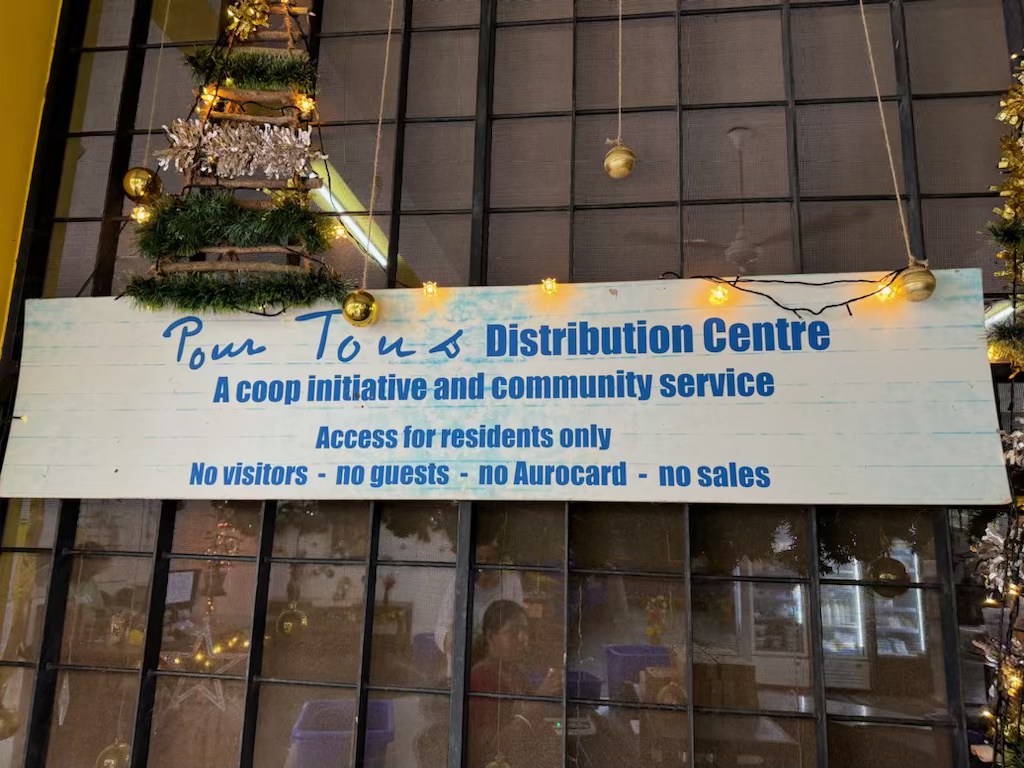
By refusing to put a price tag on food, clothing, books, kitchen products, and other basic items, the Free Store and the Pour Tous Distribution Centre decommodify these material goods and transform them into a collectively driven means to ensuring the basic needs of all community members are met.

References
Bollier, David. Think Like a Commoner: A Short Introduction to the Life of the Commons. New Society Publishers, 2014.
Marx, Karl. “Critique of the Gotha Programme,” in Karl Marx and Frederick Engels, Collected Works, vol. 24. New York: International Pub., 75-99. 1989.
 AUP Sustainable Development Practicum in Auroville, India