By Rafaela Marinello
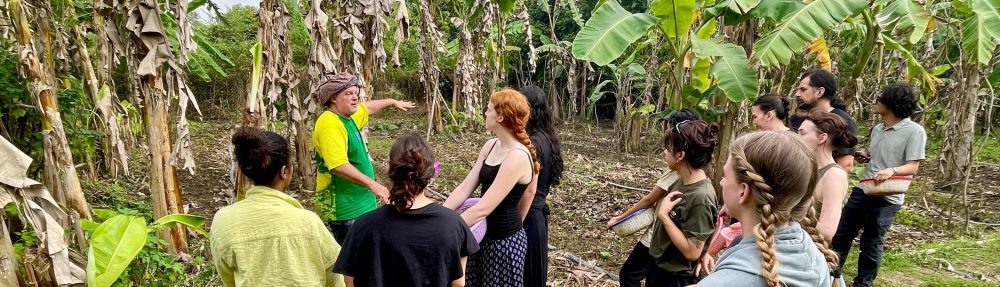
Walking through Pitchandikulam Forest, it is hard to believe that this lush, verdant forest was once a dry, desolate piece of land, with only a few palm trees dotting an otherwise empty landscape. Yet through over 50 years of reforestation work, the Pitchandikulum Forest team were able to revive the local land, transforming it into a sprawling 75-acre forest with over 800 species of plants and a rich wildlife.
Founded in the 1970s, Pitchandikulam Forest is an environmental organization based in Auroville whose mission is to restore, protect, and preserve the bioregion’s indigenous Tropical Dry Evergreen Forest (TDEF)—one of the rarest and most diverse wild ecosystems in India. Pitchandikulam does this through a variety of mediums, including educational programs, community outreach, research, and art. By blending education and entertainment, they implement a practice called entertainment-education—an approach to development which communication for social change scholar Thomas Tufte defines as “the use of entertainment as a communicative practice crafted to strategically communicate about development issues” (Tufte 162). As Tufte argues, entertainment-education “is not just about conveying information but about involving people in changing society” (Tufte 172). Through fun, educational activities such as plant species treasure hunts and other interactive games, Pitchandikulam brings joy into restoration ecology and invites people of all ages to participate in reforestation. Ultimately, the purpose of these activities is to refamiliarize local communities with nature, which in turn helps to foster a deeper sense of place and shared identity.
By reviving the local flora and fauna, Pitchandikulam also helps to restore local culture and practices which, like the plants, suffered from the damaging effects of colonialism. One of Pitchandikulam’s main initiatives is protecting and promoting indigenous medicinal plants which play a central role within traditional Tamil culture. The preservation of local medicinal plants is directly tied to the restoration of the traditional practices and knowledge passed down over centuries. By educating the next generation in the cultivation and use of traditional forms of medicine, Pitchandikulam ensures that these practices continue to survive and are not forgotten. According to Pitchandikulam, these initiatives are part of an overall effort to “restore the material indigenous forest and the intangible traditional knowledge that supports and nourishes the local ecosystem.”
As the world increasingly suffers from deforestation and natural disasters as a result of climate change, it is more important than ever to find ways to revive local ecosystems and protect them from future destruction—not only because they are critical to sustaining life on our planet, but also because they play a crucial role in the preservation of local cultures and identities. Pitchandikulam’s unique combination of entertainment-education and reforestation serves as a valuable model for how organizations can tackle the tangible, as well as intangible, aspects of reforestation and ensure the continued survival of local lands and cultures for generations to come.


Learn more about Pitchandikulam by visiting their website.
Works Cited:
Tufte, Thomas. “Entertainment-Education in Development Communication: Between Marketing Behaviors and Empowering People.” Media and Glocal Change: Rethinking Communication for Development, edited by Oscar Hemer and Thomas Tufte, CLASCO, 2005, pp. 159–74.

