Among the Roots

What is sustainability? As we visited over two dozen NGOs and projects in Auroville, our class was fortunate enough to witness a diverse collection of groups, individuals and their endeavours to reach a sustainable system of supporting their projects, enterprises and businesses.

When we keep in mind that the concept of sustainability is most promising when it is applied not only to environmental and business development, but also to the people involved and their well being and ability to provide for themselves, the approaches we take in attempt to reach sustainable systems become more challenging, more intricate and more demanding of slow and careful consideration.

There were many NGO’s and projects that were inspiring and tempting to work with, my first plan was to work in the Pitchandilkulan forest, with the social enterprise and business Amirtha Herbal. This was still my plan even after being exposed to so many other inspiring options, and it’s proven to be a wonderful decision. Amirtha Herbal is a woman’s social enterprise before it is a business, and it’s three highest priorities are working towards the empowerment of local woman, creating opportunities for financial independence, and working to integrate traditional indigenous healing knowledge into local healthcare practices. The prioritisation of the local woman’s welfare has been impressive in that it demonstrates an action-based, and not simply theory or label-based commitment to those whose wisdom, knowledge, time and work make Amirtha Herbals possible in the first place. I have seen a truly sustainable motion towards supporting and evolving their project.

Amirtha Herbal, in addition to being a sustainable social enterprise, business and support of indigenous woman, is also a part of the beautiful Pitchandikulam Forest restoration site which includes a bio-resource center, an ethno-medicinal collection of 300 plants, and community outreach activities and workshops that are offered to all and others particularly for the local indigenous communities. Approaching all business endeavours primarily as human-concerned, love-based social enterprises, as Amirtha has, would be a benefit to all involved and to those watching at a distance; that is an experienced and observed sense of sustainability, or at least a strive towards it. The success of Amirtha Herbal has recently been mentioned on the cover page of the Auroville Today Newspaper in the article Heeding the Call: Sustainability for South India and Beyond.

Sustainability, just as it is exemplified in nature, begins in the roots, and is woven through each element of the whole. Perhaps it is time to see that people are among the roots of everything that we, as people, create. And not only in theory but in practice, both when eyes are watching and when they are not.

The one who stayed in India – AUP
Roots

I am a seasoned traveler and have tried to adapt to the culture that I am immersed in. Living in Auroville, you get used to the mosquitos, the sound of spiritual music at 6am, the cows in the road, and the spice in the food. You get used to your life in that place. But can you truly immerse yourself in a different culture?

I believe you can’t go to India without it changing you, without some poi ritual reflection on how you are living your life and how you can improve. There is some sort of magic in this place that allows you the meditation to truly examine who you are inside.

Auroville, prides itself on being a sustainable change from normal towns and cities, a new approach to how to live and involving all of their citizens into this change for what they believe to be a better future. Everyone here, are all citizens of the world, citizens of their home bit of also Auroville, meaning that maybe a heart can belong in several places at once. I have a good portion of my life trying to forget where I came from and attempting to adopt a new place for my heart to belong.

When we first arrived we were informed of snakes, scorpions, and other poisonous creatures to look out for. “Snakes are no big deal,” is what they try to assure us. Auroville, is a place where you get closer to nature, you live amongst all living things. But growing up in a city, snakes are to be feared and killed. In the city, you are not trying to become one with nature, you are trying to overpower nature. Just when I thought I had accepted this new natural lifestyle, a snake slithered out of a yoga mat one morning. In a blink that mat was dropped to the ground and two of us went flying out of the room screaming. This is not how you act when you are one with nature.

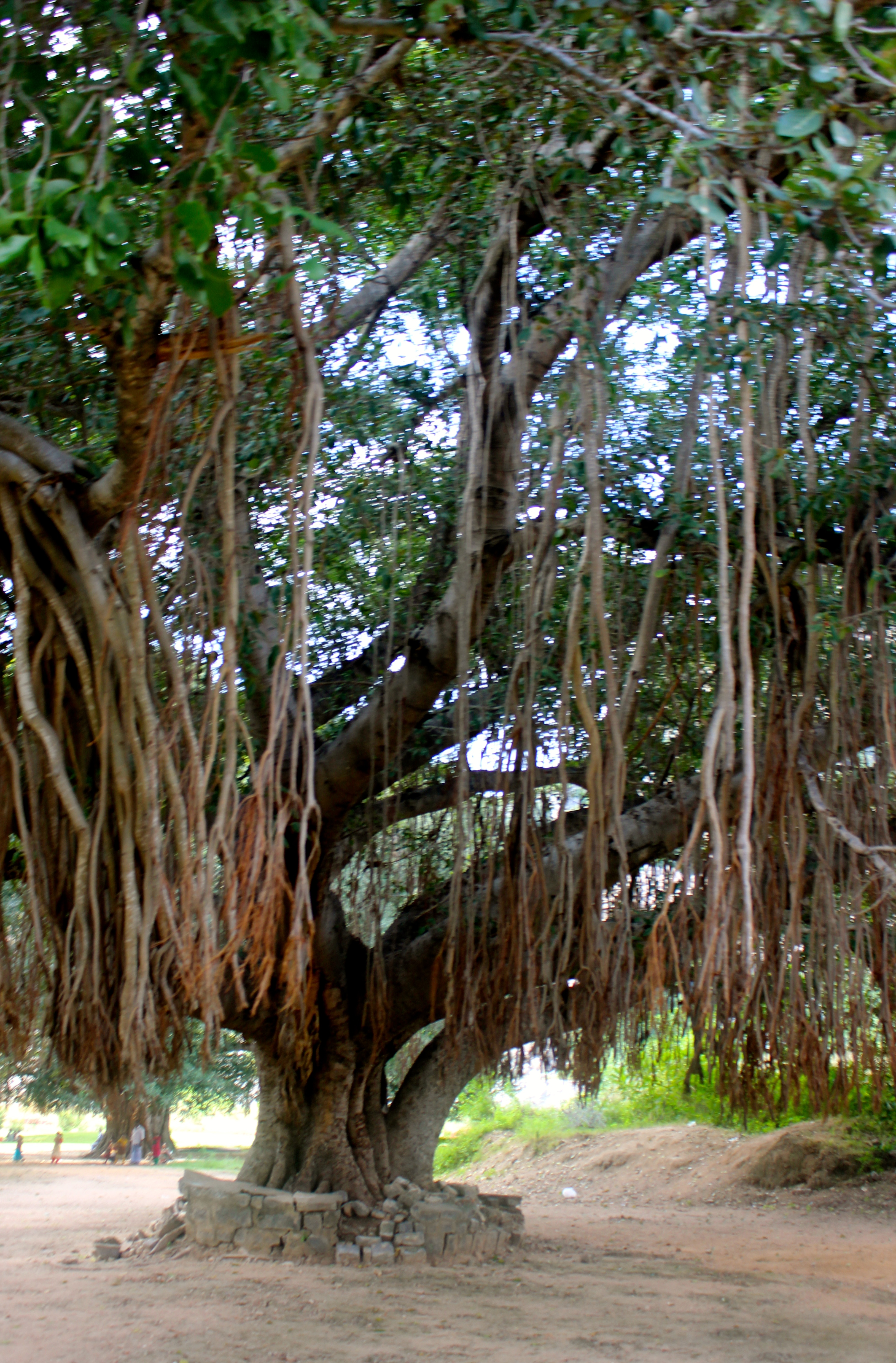
In a split second, I was sent back to my roots. But maybe that’s what Auroville was supposed to teach me. Just like a tree, your roots keep you planted when the wind blows and they strengthen you to grow taller. Without roots, would I be able to stand at all? So maybe, Auroville has the right idea, one’s heart can belong to many places but keeping your roots is a essential for a strong foundation.

Namaste,

IMG_6958

Kara Ferguson

American University of Paris

Holistic Approach

Organisationen

A lot of the lectures I have attended here in Auroville frequently mentions the importance of thinking holistically. Essentially it would mean not trying to implement sanctions against a problems as soon as you see it arise but rather research to get to the root level or to see what is actually causing the problems in the first place. Many initiatives in Auroville attempts to think more about all of the aspects the intitiative or project might have an effect on. I think of it like the cyclical events that governs all  events in nature beyond man’s control. To me it makes sense to incorporate this thinking into all ventures we engage in as it would be more viable long-term as I see our current systems of long-term thinking failing all the time, they do not solve the problems they say they will, i.e development goals etc.

Today many areas of development are still too concentrated on to the short-term way of thinking of economics which limits it’s scope to taking into consideration the  long-term perspective. The lectures continually brought up the long-term economic benefits of ones actions as less money would be spent trying to fixe the new problems that aroses from not analyzing in deepth  the root problems.

I am thinking specifically about the Pondicherry Harbor which is supposed to stand for development, but actually caused a lot of environmental damage because it disturbed the natural distribution of sand along the coastline. This sand is what constantly recreates the shoreline, or the beach. The beach is needed to stop the ocean from eroding land mass higher up from   the beach. This also apparently led to more salt water leaking in to underwater aquifers which is used by people in general and in agriculture. This also meant the soil became less fertile due to increased salt levels. The solutions at first were to build sea-walls which solved the problem along one part of the beach but then added to erosion further up the beach thus adding to the problem.

A lot of money was spent trying to mitigate all of these side effects instead of actually seeing the root cause of the problem, which was the harbor itself. Problem however is that even if the root problems is identified it is still not being taken care of because the harbor is needed for “development”. However the cost to solve this problem far exceeds what it would cost to adress the root problem. As a consequence of one act carried out in the name of development thousands of people are loosing their livelihood that was dependant on the beach. To this must be added the innumerable effects it will have  on the agriculture side. My point is that it would be far more economically viable to scrap the ideas of constructing harbors in favor of finding a better solution that does not damage the natural occuring processes that we inevitably depend on.

//Joel Hellström

Linnaeus University

Presenting Change

January 10th was a deadline, but also a monument of our trip. We presented the projects we had created for the varied organizations of Auroville and Pondicherry, explaining the process of working with them and adapting ourselves to their missions and needs. It called for reflection on what the experience had meant to us, if we thought we’d contributed to lifting them up into the light of the public eye. Everyone seemed a tad nervous, and excited, as we trickled into the auditorium.

What was clear with each slide was that everyone’s experience was unique. There were dozens of frustrations and disappointments that had had to overcome. Our reactions to these had gone from hopelessness to inspiration. The way we maneuvered around them was our own.

Every organization had specific assumptions of what it needed, and some that had clearer planning and understanding of the public perception guided us students very easily in what seemed to be the most effective campaign or publicity for them. Others had sat back, presented themselves and let us evaluate how we could best create an image to represent them in all their virtue with freedom. The best would have been a perfect match. “We need you to do this!” says the NGO. “Perfect, that’s what exactly I wanted to do!”

But no, everyone had negotiated. They’d sat down with their developmental clients, their limited knowledge and resources, and figured out how best to proceed with the situation at hand. Like most change-builders in action, they had to confront a problem that was holding the world back and find a solution.

As students trying to contribute, we were handling all of these negotiations with our projects and NGOs at the same time that we were negotiating with ourselves, asking, “Can I do this? Is this the best way to help?” Exploring our interest in mediums and sympathy with fellow activists. It was a personal development that we faced in these challenges, as much as sustainable development.

At the end of it, no matter what, everybody’s enlightened, just a little bit more. Everyone has a slightly clearer picture of another side of the world. We’ve made friends, we’ve faced fears. We’ve laughed off the little quirks of new countries and built campaigns to serve a higher purpose. How do you fit that in a PowerPoint?

There can only be so many…

Today was the last day of visits. That means that tomorrow we have to decide what NGO we’re going to work with. Which in turn means complete confusion. So instead of making specific decisions right now I’ve decided to reflect upon something that I’ve come to think about during all of these visits.

India is a country that has a lot of Self-help groups for empowerment; they especially focus on women’s empowerment. These groups are usually provided with education opportunities, vocational training and micro loans. This means that women, through these initiatives, will be able to sustain themselves by becoming entrepreneurs and run their own businesses that they started with the micro loan, producing something that they learnt during period of vocational training or from the educational opportunities they were given.

Basically, I’ve had two reflections concerning these self-help groups, or SHGs as they’re called. First of all, even though I definitely like the idea of women becoming entrepreneurs and being empowered through small-scale business development, I question why women’s empowerment is linked to women starting businesses. After these days visiting NGOs I feel like there is an alternative missing in regards to empowerment. I mean, is the option for a woman who wants to be empowered really only to start her own business?

The issue and focus on entrepreneurship can be viewed in different ways. One of the ways is linked to my second reflection/observation on SHGs, which is the skills and the kind of business that the women are starting up. Every SHG that we have visited that offer vocational training offers it within different kinds of arts and crafts; making dolls, doormats, sewing, making soaps and oils and so on. So I ask myself, how sustainable is it to teach all these women the same things and make them business owners? There can only be so many businesses that make doormats, which would mean that after a while the women will start to compete with each other. The women will almost have their own market, and with that segregation they will probably rarely, if not never, participate in the mainstream market and in the same platforms as men.

Which brings me to my second concern, the actual skills. Not only from the idea of letting the women create sustainable businesses, but also from a pure feminist perspective, why are the women only taught those specific skills? Where are the self-help groups that teach women about electricity, IT, mechanics, construction and so on? Like I said before, it feels like the women are being maneuvered into their own market. The fact that they are not being given the chance to enter the male-dominated arena of work makes the empowerment of women through self-help groups seem like a façade. They are empowered to some extent, for example because are able to develop their own livelihood. But will they ever fully reach the male dominated sectors? If not it could be seen as though they’re still less than men, below and beneath, not worth as much.

The conclusion I draw is that if I were to start my own self-help group, I would give the women other practical skills to help them reach another market if they wanted to, and not for the women to be forced to be handicraft entrepreneurs. I do realize that we have only seen an extremely small portion of the SHG’s available in India, my thoughts on this matter is therefore solely based on what we have experienced here and not SHG’s in India in general. So based on what we have seen, it frustrates me that a man can be respected for having any job but a woman is “only” empowered when she’s an entrepreneur within a market based on arts and crafts.

Malin Persson, Linnaeus University (From 2014-12-29)

Participating in a process

This is the last day of internship work. Tomorrow we present the output of our projects. I cannot wait to see all of what we have been able to achieve in 10 days. 10 days!! Many of us set out worrying that might not be enough time to do anything substantial; we needed more time to make any kind of impact.

My perspective changed earlier this week when I met to interview Gijs, director of Unltd Tamil Nadu, an organisation that supports social enterprises to anchor and scale their investments. When discussing the objectives of Auroville, he said that the ultimate aim is to participate in the process of human evolution. We do not know what the human race will evolve into or if the process will ever come to an end and so the most we can do is cherish the opportunity to participate in something meaningful towards that evolution.

It is not about the results at the end of the process; it is about what we have been able to contribute to the process.

A new website, updated social media, a fundraising campaign launched, a new package design, a documentary video or even an information brochure… that is us participating in the remarkable things these organisations are doing.

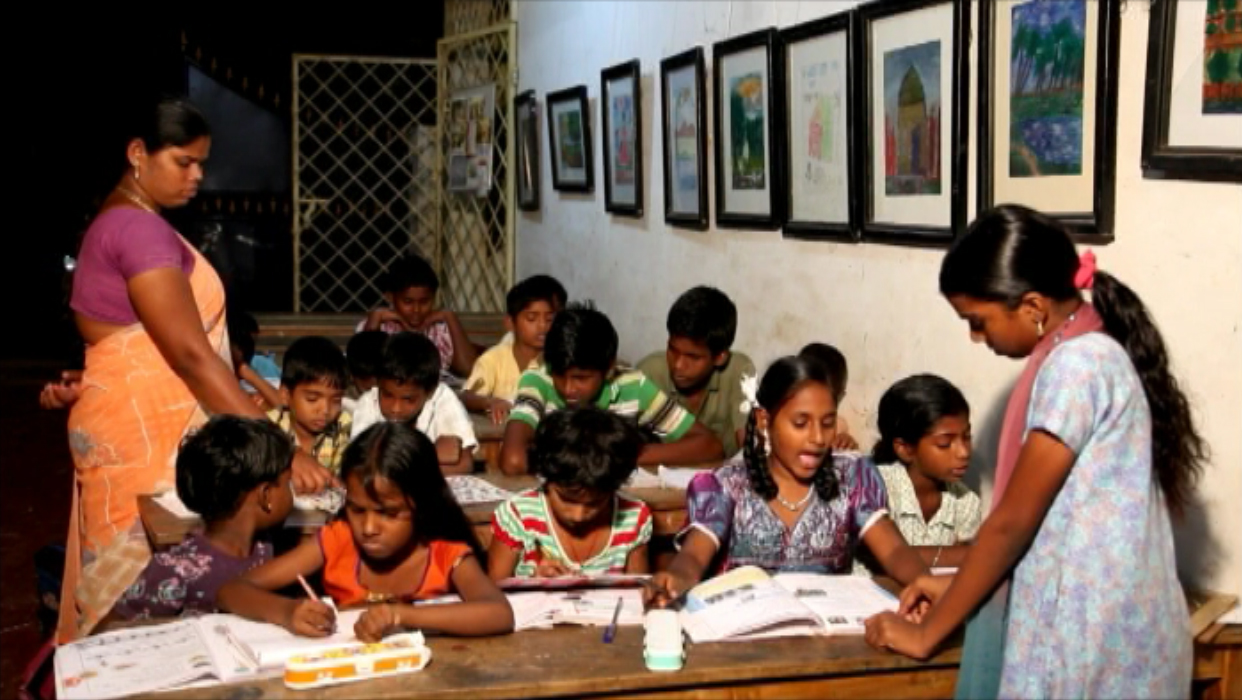
My internship assignment is to Yatra; a two-pronged organisation. One arm is the Arts Foundation that teaches Indian traditional singing and dance, gives painting lessons and offers evening tuition classes to village children at no cost. These activities are funded by the other arm, Yatra Multimedia that is engaged in film making and community theatre with the motive to educate for social change.

Evening tuition class at Yatra

Evening tuition class at Yatra (Courtesy photo)

The founder, Yatra Srinivassan, is an artist who confesses inability to discuss money. So he works more than he is paid and then what he earns he puts into his village outreach through the Arts Foundation. Why bother? Srini says he does it for the love of the children and his village, Kuilapalayam. As a child, he had to go to Pondicherry for dance and drama lessons and he knows it is too far and expensive for the children who would want a similar opportunity. Yatra Arts Foundation is his way of bringing the service closer to them. It is something meaningful – the children have somewhere to get help with their homework and an opportunity to learn the arts of their ancestry.

I realise that what I am contributing to Yatra, like the volunteers before me is like a drop of rain to patched ground; they need so much, we have time to do so little. It is frustrating to not watch over the implementation of the various proposals we have made, to evaluate and revise them to ensure the most impact. However, like Gijs says,

“Just doing something of value is worthwhile.”

I don’t have to witness what Yatra will evolve into; I simply have to do something meaningful towards the process of their evolution. That is both comforting and energising.

-P.Otali

Internal economy of Auroville

eco economy

Auroville attempts to distance itself from the conventional sense of economics by having implemented their own debit card system. The Aurocard, as it is named, serves to eliminate the use of cash in everyday life transactions. The philosophy behind it seems to be that by eliminating the use of cash and thereby reducing the negative visual/psychological impacts that money can bring. The way it works is that you visit Auroville’s financial center to charge your card whenever you need it. This money can then be used at any of the enterprises that are a part of Auroville. For the Indian people I am sure that this has it’s positive impacts. But for me as a foreigner visiting Auroville, the use of the Aurocard essentially just replaces the card I use back home.

To further distance itself from the conventional economy, Auroville has a few cooperatives to encourage a deeper sense of community. One is in the form of a sort of supermarket store where people who want to be a part of parallel/alternative economic system contributes a certain amount on a monthly. This enables members to shop entirely for free without ever seeing a price tag on anything. It works by encouraging and building on a recognition of needs before greeds/desires,. This means that people that are a part of the cooperation shifts their thinking more towards a needs based economy. People are also encouraged to contribute by donating excess products for others to consume.

It is an interesting social experiment of sorts where conventional consumerism is questioned by actually initiating reflection on the origin for the different products that comes from your own community. It makes one think more carefully about the production process and that you actually contribute your money towards your own community. This was a very interesting initiative that contrasts with the intense consumerism culture back at home where most people don’t think that much about the origin of the things that they buy. Perhaps there will bemore similar initiatives all over the world to bring us back to a point where we no longer over-use the resources which are far from contributing to a sustainable future.

//Joel Hellström

Linnaeus University Sweden

The Role of Sexuality in Indian Society

Britain came to India in the 17th century. For over 300 years the British ruled India, exerting enormous influence over the economy, the laws, and the ways of thinking of one of the world’s oldest civilizations. Then they just up and left (more or less).

Now India has had to live with that colonial influence and Western way of life while still trying to hold on to their own culture, which has played out quite interestingly in the rights of the Indian population to be homosexual or transgender.

It is legal to be transgender, but illegal to be homosexual.

The legal acceptance of transgender stems from that fact that it is not viewed as sexuality, but simply a matter of gender: male or female. However, just because the law has made it so (even going so far as to declare transgenders to be a third gender) does not mean that society has accepted transgenders with open arms.

Homosexuality is an entirely different matter. It is a subject that is quite sexual in nature and simply a question of being either of the male or female gender. Intercourse between two men is considered to “against nature;” a violent act; and therefore even a consenting adult can be put in jail for up to 10 years simply for having sex with someone of the same gender.

In the Indian Penal Code, the 377 law, established during the British colonial era in 1860, criminalizes homosexuality as “carnal acts against the order of nature.” The LGBT community in India saw a hope for their rights though in 2009 when the Delhi High Court ruled that this law was a violation of fundamental rights. The victory was unfortunately short lived though as four years later the Supreme Court reversed the lower court’s decision, citing that it was a matter for Parliament to decide and not the justice system.

So besides being a taboo subject, since being homosexual is illegal it is therefore very hard for organizations to even form to help those in need. To provide information on safe sex practices, a safe space to simply discuss, or even just a place to be where someone doesn’t have to hide who they are. An organization we visited here in India, Sahodaran Community Oriented Health Development Society (SCHOD), is trying to do just that though.

At the moment SCHOD focus is to educate the LGBT community in regards to safe sex practices to lessen the cases of sexually transmitted infections and HIV/AIDS. However, the ultimate goal is the rights of the minority community they belong to. Our presenter, Sheetal, formally Rajesh, provided us with an eye-opening story of her life and her freedom of being able to transform from the male body she was born into to the female she was meant to be. However Sheetal and her organization have a long fight ahead of them.

So, in a nation determined to be still developing, though it claims to have the world’s largest democracy, where is the line drawn on what the government can and cannot tell its citizens they are allowed or not allowed to do? Should individuals of a country stand by and allow a government to tell us who we are and are not allowed to love?

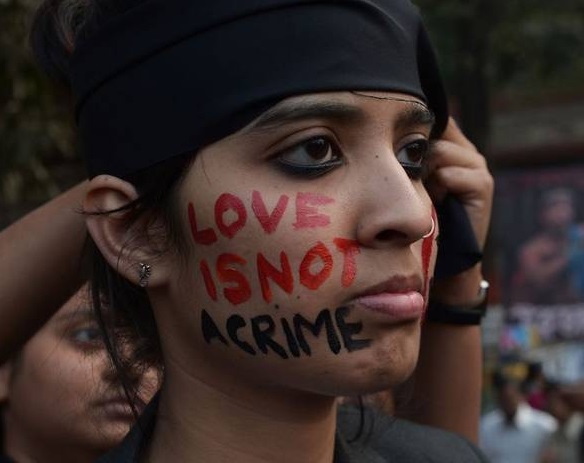
Love is Not a CrimeThe Independent

This subject though is really an issue of fundamental human rights. I cannot imagine how frustrating it must be for people of one country to look at those of another and be envious of the rights afforded to them (I am specifically thinking of India and the United States, though the US is by no means perfect). It is a complex problem of allowing each country to uphold its own traditions, customs, culture, etc. However, there are certain fundamental human rights that should globally be the same.

If you would like to read more on the subject, check out these articles.


– JLH

Rukshana and Article 377

IMG_5761

Rukshana is a Muslim and a transgender. Her family always knew that she was different than other boys her own age and she was therefore kept inside the house of her parents throughout most of her childhood. She wanted to become a teacher, but when she went to Chennai in order to pursue her dream, some of her old classmates told her parents that she had gone to Chennai just to undergo the sex reassignment surgery (SRS). When she came home to her family after a couple of weeks in Chennai they all turned against her. She was forbidden to go back to Chennai and at home she was tortured on a regular basis, beaten by her father and brothers, she was often not allowed in the house and she was deprived of both food and water. Thus, she was forced to move, and as many other transgender men, she moved to Mumbai, where she was quickly inducted into the “transgender community”. This is a harsh community run by gangsters, and due to lack of education, social acceptance and her looks, she was forced into prostitution. She managed to escape and moved back to Pondicherry. Her neighbors in Pondicherry were, however, far from welcoming. One evening in Auroville seven of them attacked her, took her into a cashew field, held a knife to her throat and raped her. They told her that she deserved it and that “this was the way she should have sex with men.” After years of low-wage jobs in Pondicherry, she finally saved up the money for the SRS procedure. After coming home to Pondicherry from the operation in Mumbai, her neighbors were standing outside the building waiting for her to come home. They ripped the drain out of her stomach and beat her to the point where she could no longer stand on her feet. She was thrown on the streets covered in blood and it was made clear that she was not welcomed in the house again. At that point, Rukshana was ready to commit suicide. But instead she called Sheetal, who saved her. And her life has not been the same since. At Sahodaran she has found a place where she belongs, a place that accepts her for who she is and for the first time of her life, she has found real friends. Sheetal, the founder of Sahodaran, has helped her to get an identity card as a transgender, she has helped her to get a job and first and foremost she, and the community at Sahodaran, has helped her heal the psychological scars her life has left her with. When her father died a couple of years ago she was not allowed to attend the funeral. She came anyway, and as a consequence a grave was dug next to her fathers and her family told her that this grave was for her and if she ever came back, they would kill her.

“Everyday was a struggle and I wanted to kill myself, because I thought that society didn’t want me. Sahodaran has given me a reason to live. They’ve given me an identity. For that I’m forever grateful.”

Article 377 of the Indian Penal Code is the law against “unnatural offences.”—Whoever voluntarily has carnal intercourse against the order of nature with any man, woman or animal, shall be punished with imprisonment for life, or with imprisonment of either description for a term which may extend to ten years, and shall also be liable to fine.

Article 377 entails the complete prohibition of the penetrative sexual acts engaged in by homosexual men, which initially criminalizes their sexual expression and identity. Furthermore, article 377 has a severe impact on their dignity and self-worth. Police harassment, social exclusion and legal discrimination have become everyday-life for most homosexuals in India. As in the case of Rukshana, homosexuals are often shunned by their families when they come out to their parents and they are often forced to live in the streets. It is very hard for homosexuals to enter the job market and discrimination on the workplace and by employers is common. This often forces them into prostitution and begging in the streets.

The stigma and prejudice has fostered a culture of silence around homosexuality, which results in a vast number of male rapes and male prostitutes in India. Before Rukshana became a woman, she was stopped one night by the police in the streets of Pondicherry, where they ordered her to take off all of her clothes in front of a crowd of people. The police officers pocked her genitals with their knight sticks and made fun of her to great amusement for the surrounding bystanders. Sadly this situation is far from unique. Thus, many are forced to hide their sexuality because they are afraid. However, hiding one’s sexuality is difficult and often the family will find out eventually. One week ago Sheetal helped save a boy from a middle class family in Pondicherry, whose parents had wrapped him in a fishing-net with the intention of setting fire to him and drop him into the sea. Luckily he escaped.

Please help Rukshana and Sahodaran raise awareness of the devastation article 377 has caused homosexuals in India by making a small contribution to their Rainbow Walk! 

https://www.indiegogo.com/campaigns/lgbt-rights-in-india/edit/#/?tab=story

One gender, and two half-genders?

Once upon a time in India, and no this is not a tale, a person that was transgender (or the “third gender”) was met by great respect. They are mentioned in the ancient Hindu scripts and they played a prominent role in the royal courts during medieval India. Today, the situation is extremely different. People who are transgender in India today usually live on the outskirts of society and often in poverty. It is hard to find someone who would employ people that are transgender and most families in India would not accept if their son became a transgender, and a lot of the times they get disowned or evicted. The main ways of making a living for transgendered people is therefore working as dancers, prostitutes or begging.

In mid-April this year, 2014, the Supreme Court in India recognized transgender as a third gender, which hopefully will help mainstream transgender issues in Indian society. According to a UNDP report from 2012 this was the third suggestion that they had concerning how to go about legally recognizing the transgender community. The three options were to either have transgender identify as men or women, secondly to recognize transgenders as a separate, i.e. third gender or to recognize transgendered people based on their own choice; male, female or transgender. Why this was such a contentious issues was due to the legal consequences and rights associated with the issues especially, since India has specific laws concerning men and women.

I feel like the transgender debates therefore automatically should have facilitated two debates in India. It should also have raised the issues of women’s rights when talking about whether the transgender community would be able to choose their own gender. The issues for the transgender community can be summarized to: would transgender community choose to become men just to get the privileges of a man? And what happens to the privileges of a man if he becomes a woman? I strongly believe that the attitude against women in India is something that in turn hinders the further development for transgender rights.

It is extremely important for families in India today to have a boy in the family, for many reasons. Three of them being that instead of paying dowry when getting married they receive dowry, a son can also more easily get a paying job and look after the family and finally a son will light the funeral fire when the parents die. With this in mind, the idea of a family’s only son being transgender is devastating. However, if there was no dowry to be paid and if women could have the same possibility to get an education and to work, maybe there would not be as great a resistance to having a son that is transgender.

This is an extremely complex issue, but nevertheless one thing seems obvious to me. When the Indian government was discussing the issue of transgender and making a third gender, the issues of women’s right should also have been brought to the table! India now has a third gender, but when not discussing the rights of women, can India really claim 3 genders or do they only have 1 gender and two half-genders?

Malin Persson – Linnaeus University in Sweden