As an intentional community located in Tamil Nadu on the Bay of Bengal, Auroville is a place to experiment and bring forth innovative ideas working towards all aspects of sustainable development. Aside from the beliefs and values held within the Auroville Charter, it is also a microscopic model of how communities can operate collaboratively to achieve many of the sustainable development goals as outlined by the United Nations. The priorities and values of Aurovillians is admirable and desirable in my view as someone from a Western upbringing striving to work in International Development, however is this microscopic laboratory a replicable model throughout India and other communities in the Global South?
After visiting about thirty non-profit organizations in and around Auroville over the span of seven days, we have been exposed to a broad array of inspirational projects that are working towards one or many of the sustainable development goals. They ranged from environmental and agricultural sustainability, to social development issues promoting education, equality and empowerment. In Auroville specifically, many of these organizations and the people involved work as an interdependent public to support their overall common goals of sustainability and development. For example, several organizations that utilize recycled or reusable materials and have a zero-waste policy such as Upcycle Studio, Eco Femme and WELL Paper are supporting the primary efforts of the organization WasteLess whose main objective is to raise awareness and education on harmful habits that threaten the environment. Auroville Village Action Group (AVAG) and WELL Paper are also both working to empower women through skills training and autonomous self help groups, or SHGs. AVAG assists in the selection process for the women who will be trained in creating eco-friendly products for WELL Paper. All of these are Auroville based NGOs, and there are many other instances of visible support and collaboration between the NGOs here.
It is clear that the organizations within Auroville support each other’s visions towards a common goal through various projects. However, even between Aurovillian NGOs and NGOs that we visited in Pondycherry, such interdependency and support is not so apparent. Therefore, can this model of networked NGOs who support and promote one another to succeed in their goals be applied in other areas of India and the Global South? Like anything in the field of development, it would need to be adapted for each particular culture and context. And it is likely that this is already the case in some communities, but perhaps not to the extent and concentration of Auroville…at least not to my knowledge.
While NGOs around India and globally likely do support one another within their realm of development, this high concentration of sustainability and development in almost every aspect of daily life and business that is visible in Auroville seems out of reach given the international complex systems of government, political views, social issues, and the corporate world…just to name a few. This paradox continues to follow me during my time here in Auroville, however I do remain optimistic as a future professional in the field that progress within NGOs and towards a healthy networked NGO model can be made as long as cultural context is first and foremost in assessing the development needs of any community.
-Cristina Castello
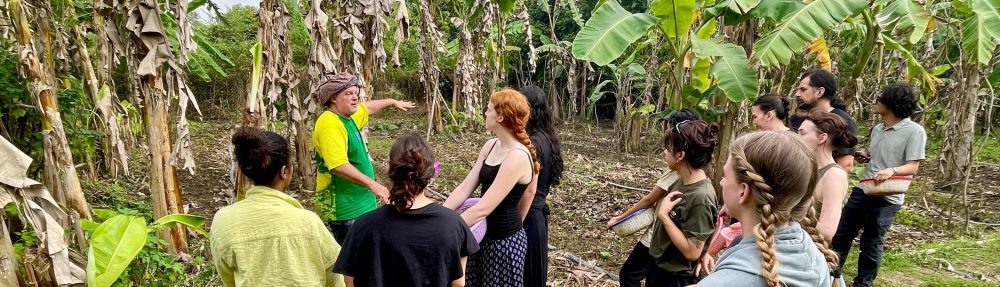
 AUP Sustainable Development Practicum in Auroville, India