MGEcoduties/Probiotics House, Natural Care

Image result for probiotics house auroville

Her Story

Margarita, founder of MGEcoduties, a.k.a. Probiotics House, started her presentation off with one of the most profound stories of all of the NGO introductions.

She made a made powerful introductory statement that “women are weapons in war”. She was referring to the mistreatment, rape, and abuse of women during wartime and highlighted that this plight and destruction is not ever addressed in the aftermath of war when considering casualties. I wondered what this had to do with probiotics.

She shared further that she herself had been a victim of rape and torture, and a prisoner of war for over 4 weeks. This experience resulted in extensive psychological and physical damage, that could not be healed with time or with treatment offered by professionals.

Despite the tragedies that Margarita experienced, she moved on to earn two graduate degrees, became the COO of Coca Cola South America, and was successful in the corporate world. How she came about founding MGEcoduties was somewhat accidental and resulted primarily from spiritual intervention.

She had already been to 66 countries and needed a vacation, a travel agency suggested that she visit India, starting in the South and then up to the North, unexcited, she agreed. She ended up in Auroville, a culture shock, as she was unfamiliar with the living conditions and closeness to nature and wildlife as she had been a corporate executive, use to luxury travel.

Margarita had been in Aurovillve for a few weeks, and would fall asleep in public places to be awoken by a presence and a tap on the shoulder, only to find that no one was actually there. She saw this as a spiritual sign, a sign that she should stay in Auroville. Her weeklong vacation turned into a 21 year long journey, and she has yet to make it to North India to visit the Taj Mahal.

Image result for probiotics house auroville


Probiotics

Probiotics are simply as live bacteria and yeast introduced into the body for the stimulation of growth of microorganisms with beneficial qualities. 

According to Margarita, the top foods from which to obtain probiotics naturally are chickory, asparagus, onion, and beetroot.

Margarita stated that the human body is 90% bacteria, however, the human body is actually only made up of 3%  bacteria by body mass. Human DNA however is 90% synonymous with bacteria and about 10% non-similar DNA, every organism on the planet is +/- 90% the same in genetic code. Most of the genetic code is made up of regulatory regions for basic cellular metabolic functions, so this isn’t surprising. Though not directly stated, I think that she used this similarity as a defense for why microorganisms are one of the best ways to provide healing properties to the body.

She started working with probiotics in Auroville when she realized two major South Indian issues: a polluted septic system and too much plastic waste. She then began to produce household cleaning products that would clear the drains by getting “good” bacteria into the plumbing systems to help solve the water problem. Then, she moved on to soaps for the body, they smelled good and the soap would go down the drain when people washed themselves, therefore users would unintentionally and consistently contribute to solving septic system issues. However, these products were not enough. Margarita did not just want to solve systematic issues in plumbing, she wanted to use probiotics to solve issues in the system of the human body. After all, she herself had been suffering of physical pain from her past traumas. The development of the probiotic bracelet would follow this realization.

Margarita learned about probiotic technology through a Japanese physics professor, Dr. Higa, who worked with microorganisms and figured out how bacteria could survive in clay heated to 1000 degrees Celsius. This ability is astonishing considering bacteria stop reproducing at about 39 degrees celsius and start to die around 52 degrees celsius. Naturally, most of the proteins that make up DNA and bacteria denature at a similar point. She shared that due to this temperature dependent life cycle, powder probiotic pills which go through an extensive heating process are less effective and are generally placebos; liquid probiotics kept in cool environments are more effective. Dr. Higa’s inspiration to achieve his goal of harvesting and encapsulating bacteria came from top secret news from NASA that bacteria from the human mouth survived for years on the moon in a camera lens.

Margarita and Dr. Higa were able to capture and harvest probiotic bacteria, put it into clay beads through much processing, and then make the beads into bracelets to be worn by people to promote overall health. The clay material surrounding the beads protects the bacteria from UV radiation, which would kill the bacteria. The bacteria is collected only at the event of the Major Moon in the ocean between India and Sri Lanka, making the bacteria difficult and dangerous to collect. Why this particular bacteria is collected was not very clear. Once the bacteria is inside of the clay pods and made into bracelet form, they can be used for eternity, Margarita even suggested passing probiotic bracelets down through generations. Maintenance of the bracelet is simple; the beads should be washed with water and then placed in the sun to dry, the UV radiation does not get in, but infrared rays do and they allow the bacteria to “recharge”.

Her Message 

Maragrita has experienced personal healing from wearing her probiotic bracelet and using other probiotic products. While Margarita’s message is promote overall health through probiotics, she wants MGEcoduties to be recognized for its role as the organization responsible for clearing the septic systems in Auroville and for initiating a movement that caused Auroville to become 0% reliant on plastics and maintain a refillable and reusable system. She also wishes to share a message of human unity and equality, this can be seen in the organizational structure at Probiotics House, where everyone works on the same level and receives equal pay. While Margarita has been receiving partnership opportunities from large profitable corporations like Tata and Badger, she places her ethical and sustainable values over the potential for profit.

Overall, I think that the probiotic products provided by Margarita and her team are revolutionary and spiritually meaningful. However, the the science behind the product and how it works to effectively promote health is not clear. I do not understand how wearing probiotics inside of clay beads can have an effect on overall wellness. Also, Margarita did not explain the role of her partner Guidelma in the story, and it would be interesting to know more about their partnership. Her life story and ability to stay true to herself was very empowering. And so, for anyone looking to be the next head of Probiotics House, Margarita is in search of a worthy successor!


By: Shannon K. Henry
Turning off the Tap

Cam Bartlett


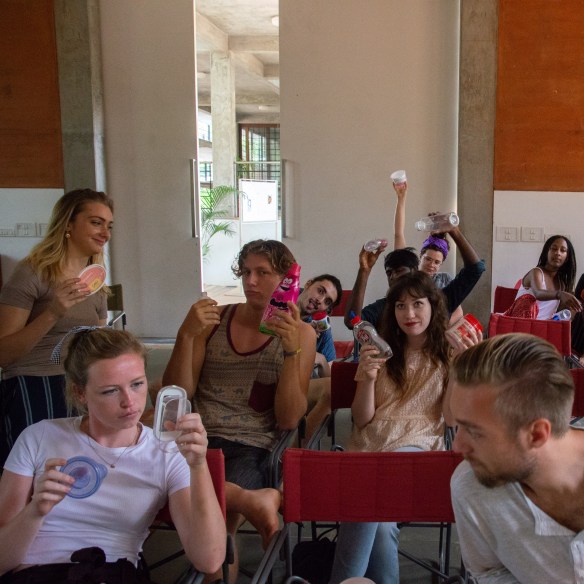
wasteless“If you walked into a room flooded with water, would you first start mopping the water, or would you turn the tap off.” This was the question that Wasteless posed to us at the beginning of their talk to us on December 28th. Wasteless seeks to educate young students about their plastic use habits through fun, interactive activities. One of these methods is Garbology 101, which includes a number of illustrated games and activities. They provide this game for free for low-income schools in exchange for their feedback to improve the game. In this way their communication model is somewhat participatory and involves a dialogue between Wasteless and the communities they are trying to educate. They utilize a dialogic communications process—a process where the aims of a communication aren’t completely decided beforehand—to help shape their communications process. They also rely heavily on edutainment to keep children involved in lessons on waste management, using memory games and relay races to teach sustainable practices. Their communications outreach, at least as it was shown in their presentation, seemed to focus on Window 2 of the Jahari window: Wasteless’s hidden knowledge. This knowledge includes information about recycling practices and plastic use, as well as the harmful effects of some plastics on human health and the environment.
Wasteless seeks to mainly address three different Sustainable Development Goals. The first is 3: Good Health and Well-Being, and they address this by educating children and communities on the harmful effects of numbers 1, 3, 6, and 7 plastics on human health. This goal comes directly from the language in India’s Sustainable Development Goal 3: “By 2030, substantially reduce the number of deaths and illnesses from hazardous chemicals and air, water, and soil pollution and contamination.”

Wasteless also seeks to address SDG 11: Sustainable Cities and Communities, and 12: Responsible Consumption and Production. Throughout their presentations they emphasized the present and future states of the local communities through both raw and photoshopped pictures. The photo of them dining at the dump shows how out of hand and unsustainable current waste management strategies are in India, while the photo of the beach completely covered in trash elicited a response of alarm for the future of these communities and their beloved beaches.

What struck me most about Wasteless’s approach is the extent they were willing to do research to fine-tune their messages and games for children. They spent many extra hours testing their games to make sure their messages were received as they intended them. This led them to some insights. One of these insights was that children perceived the background color as contributing to the meaning of the cards in the memory game. However, I would have liked to hear more information about how they framed their communications, and if they used a social marketing approach to understand how to frame their information for the greatest impact.

At some times it can seem frustrating that the generation in charge isn’t doing enough to curb our effect on the environment and our local communities. Their response seems to be to hang their hope for change on the younger generations, who aren’t as set in their ways and are likely to adopt sustainable practices and bring them to their homes. With their outreach, Wasteless hopes that soon we can all collectively decide to finally turn off the tap.

Sristi Village (Joachim)

In India, the intellectually disabled are often relegated to the shadows. Unseen and unheard, families fear the disgrace that may come with the birth of an intellectually disabled child. Within Hindu culture, there is a strongly held belief of re-incarnation. An individual is not their mind, or their body, but their soul. The body and mind that an individual occupies within the material world, is a supposed reflection of a past life. For many, the birth of an disabled child is an indicator of wrongs committed in a past life, and so that fear of disgrace exists. It has assured that the disabled persons of India live under the constant threat of discrimination. It has assured that this portion of society struggles to acquire the treatment they so need, treatment mandated by the U.N. Convention on the Rights of Persons with Disabilities, a convention which was ratified by India in 2007. Ratified, but not yet followed in full.
The Sristi Foundation, or Sristi Village, was founded by G. Karthikeyan with a vivid awareness in the disparity of living, between the intellectually disabled and the rest of society. Karthikeyan was raised in an orphanage which mixed intellectually disabled children with non-disabled children. In their youth, there was no difference, they lived, played and ate together as equals. But as Karthikeyan grew older, more mature, he saw the disparity deepen. As non-disabled children grew, preparing for adult life with employment, education and marriage, the disabled-children remained attached to a child-like state of affairs. They weren’t being prepared for adult life, they weren’t being guided to a purpose in life. According to Karthikeyan. With that void of purpose, the disabled would turn to aggression amongst each other, or they would fall into states of outright discontent and depression. These where his siblings, his family, their struggles touched him as much as anyone’s would. One such brother, wanted to live his life as an auto-mobile mechanic. He was skilled and capable, yet when the time came for employment, his disability assured it wasn’t possible. Karthikeyan attributes that story as the catalyst to his life’s pursuit, to give a place and purpose to the disabled.
Through farming, Karthikeyan sought to create a place where the disabled may find a purpose in life. After nine years as the director of the orphanage he, himself was raised in, he sought to create a place that didn’t help disabled children, there was enough of that, but a place which helped disabled adults. He realized the help disabled adults needed, was help finding a purpose. The answer to his inquiry came with a single sprout. Before Sristi farms came into fruition, as it is today, Karthikeyan showed on of his disabled companions a seed. He tried explaining the seemingly divine process of a seed sprouting, how a seed could become a tree. Shortly after, his companion returned to him in a burst of excitement. He planted a seed, watered it, and days after that seed became a sprout. For Karthikeyan, that excitement solidified the idea which would grow into Sristi Village. The purpose he sought to provide would through farming, he would teach disabled adults to farm, and he would do it in an environment where they would live side by side amongst each other, and non-disabled adults.
Now, the idea continues to grow, Sristi Village continues to thrive in its pursuit. Karithikeyan has successfully achieved a unique form of social development in an area where it is direly needed. With that success, Sristi Village has become a template for future organizations to learn from, in India and beyond. The fact of the matter is, the whole world could learn from Sristi. Intellectually disabled persons have been relegated to the back drops of society the whole world over. Karthikeyan has made it clear that the best course of action, is perhaps not treatment, medication or isolation, but purpose.

The Caring Cotton: A Natural Approach to Fashion

By Sanna Rasmussen

Fashion is the second most polluting industry on the planet, after the oil industry. This astonishing fact can be explained, because many of the garments in our closets are made from synthetic fibers and synthetic chemical dyes, better known as, petroleum derivatives. We rarely associate clothing with oil, but in fact, every man made fiber of clothing starts as petroleum, therefore feeding into the global pollution caused by the oil industry. With this information, it is no surprise that the fashion industry follows oil in levels of pollution, as there are an unimaginable number of garments produced around the world every day. What is even more startling, is that these synthetically produced garments will never decompose, adding to the vast amounts of non-recyclable material already occupying landfills around the world.

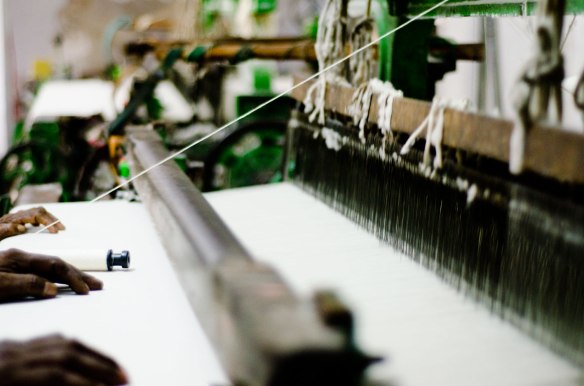
The Caring Cotton is a start-up located in Auroville, Tamil Nadu, that acts as a bridge between artisanal Indian textile handcraft practices and fashion designers around the world. Working with high quality natural fibers and natural dyes, The Caring Cotton is making sustainability in the fashion industry globally accessible.

people

In 2011, the idea for The Caring Cotton was conceived by Ruby and Erik, in Barcelona, Spain. The couple behind the brand, were living in Spain, and saw the lack of understanding Western designers had between natural and synthetic dyes. Ruby, a fashion designer, had developed a passion for natural dyes while working in Auroville for over ten years. She knew that she could bring high quality textiles made with natural fibers and dyes to the European market, while also informing her clients of all the benefits offered by choosing natural over synthetic. For instance, the skin is our bodies largest organ, and functions by absorbing what we put on it. That includes our clothing. Our skin absorbs the chemicals used in the synthetic dyeing process, even after the garment is washed numerous times. An environmental problem that arises from wearing synthetic garments, is that when they are washed, microplastics are extracted from the clothing and enter into the water discarded by the washing machine, which ultimately ends up in oceans and rivers. These microplastics are then ingested by microorganisms, then small fish, and ultimately by consumers eating fish and other marine life.

embroidary

Overall, the production and consumption of cheap, synthetic clothing is not a sustainable option for our planet. The Caring Cotton works to address this issue by advocating for a slower fashion cycle, and supporting textile mills and dyers who are adjusting their methods to more sustainable options. The Caring Cotton currently sells organic cotton yarns, undyed fabrics, natural dyed fabrics, sustainably dyed fabrics (low impact chemical dyes), and offers to connect global designers with garment production in India. From Ruby’s 15 years’ experience in the Indian textile industry, she has personally vetted every step of her supply chain, including factories and warehouses, and guarantees that every employee involved is treated and paid fairly. Furthermore, every aspect of the supply chain is located within the Indian state of Tamil Nadu, and is regularly visited by Ruby and her partner.

weaving

The Caring Cotton officially launched in August 2018, after Ruby attended Texworld in New York City, NY, a global textile fair where producers and suppliers can connect with designers and fashion houses. Since August, The Caring Cotton has received numerous inquiries about their sustainable textiles, and is using this momentum to further establish their goals as a fashion supplier within the climate of fast fashion. As consumers are starting to demand fashion brands to provide traceability of their clothing, fashion brands, in turn, are beginning to reach out of those who can provide them with quality, natural, fair trade textiles. The Caring Cotton is providing just that; quality textiles with an emphasis on doing good for people and planet.

Picture Credit: thecaringcotton.com

Auroville Dental Centre


unknown.jpgDr. Jacques Verre, who founded Auroville Dental Centre in 1982, introduced us to two main projects that he is using to transform not only the lives of children in the villages surrounding Auroville but the dentists as well. They both center around “0 Concept”.  The concept is centered around the idea to strive for “the absence of need”.
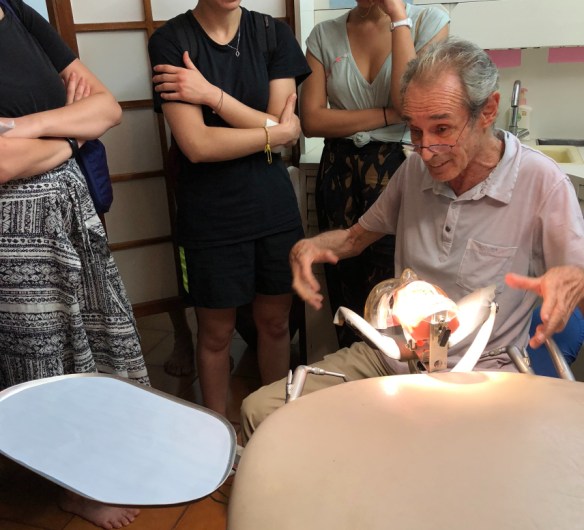
After a few years of practice, Dr. Verre was starting to develop bad back pains from his dental equipment and body position when he worked on his patients. Soon after his pain started, he was exposed to Japanese equipment that introduced to him a new way of conducting his dental work. This new equipment changes the positioning of the dentist and the patient to prevent strain on the dentist’s back. Auroville Dental Centre is the only dental clinic in India that uses the Japanese concept of having the patient lie down flat on their back while the doctor sits behind them.

It is a simple change but is a practice that helps provide comfort to both the patient and the dentist. The Human Performance Institute in Japan donated this equipment to Dr. Verre to help create comfort and confidence for those using the equipment at his office. The 0 concept aspect of his equipment is the idea that 0 represents optimal conditions and balance. 0 means “all” or “nothing”, and encourages medical professionals to focus on having complete control and comfort in order to provide their patients with the best service possible. The machines, designed in the 0 concept way, are based on natural human comfort and the harmony between mind and body.


unknown.jpgWhile Dr. Verre was changing the way he worked in Auroville, he was also noticing that the villages around it lacked dental care. Discovering that 95% of Indians have oral problems he knew he had a social responsibility to those around him who were unable to have proper access to dental care. There was a very small amount of dental education and a huge need for cheap care for all. He wanted to reach out to the rural population, especially the children, to help promote oral health.
With the help of Mrs. Suriyagandhi, a nurse, they developed care methods for reaching the children in the villages, and the ADCERRA (Auroville Dental Centre Education Research Rural Action) was started. An example of the work ADCERRA does is the one-week oral health camp that they conducted in Bharuch. During this camp, over one thousand children were given check-ups and oral health education. They were also given treatments when needed.

On top of going into the villages to help the children, Dr. Verre is making sure his work is sustainable by training village women to do small treatments. 76% of the children that they gave checkups to and needed treatment could be treated by the trained village women with basic equipment. The 0 concept also means the absence of need for care. By providing education and by training women, Dr. Verre is reaching towards the symbolic goal of perfect health.

He is putting in place procedures and giving those in the villages the means to care for themselves and not be dependant on his work. This means that once the camps and checkups are finished, they are no longer needing to rely completely on Dr. Verre for dental care. This is so important with the current fad of voluntourism that often comes in to help communities and then abandons them without putting in place measures that help the community continue to grow. The children are educated, and some women are trained to help when there are problems. He is putting effort into building communities so that they aren’t forced to turn to expensive dental work but instead can treat small problems themselves.

The Auroville Dental Centre works to accomplish the third sustainable development goal of ensuring healthy lives and promoting well-being for all ages through the ADCERRA. Dr. Verre works on healing not only those in the villages who are in need of oral care but also the doctors who are working on the patients, by focusing on prevention and education. In the future, Dr. Verre wants to make the center self-sustaining, and he wants to train more women in the villages to do simple procedures.

unknown.jpg

Amirtha Herbals: Prelude to a New Dream of Wellbeing

“Les humains rêvent en permanence. Avant notre naissance, les humains nous précédant ont créé un grand rêve extérieur que l’on appelle le rêve de la société ou le rêve de la planète.” — Don Miguel Ruiz

IMG_9269.jpeg

When visiting Amirtha Herbals and learning about the organization, I cannot help but to recall author of Toltec spirituality and shamanism, Don Miguel Ruiz’s Rêve de la Planète in which he explains that the collective dream results from billions of individual dreams that together form the dream of the family, the dream of the community, the dream of the city, the dream of the country, and finally, the dream of all humanity.

This, though, is an illusion, or maya, as known in Indian Hindu culture. The belief goes: the world as we know it is an illusion of reality. Everything around you that you call life was made up by people no smarter than you. You can change it. You can put a dent in the universe. That being said, should we continue to accept a ‘dream’ that is harming ourselves, other species and the planet?

After touring Pitchandkulam Forest, it is my understanding that Amirtha is overcoming the maya that has become a universal nightmare and detriment to existence, and here’s why.

A Capitalist Cauchemar.

Let’s talk neoliberalism. This Western dream became a global nightmare when renegades Ronald Reagan and Margaret Thatcher introduced policies like outsourcing abroad, privatization and deregulation—an economy redesigned to benefit big business and capitalist gurus. The problem is, it was successful: neoliberal-capital became the main cultural identity and exotic products and spiritual customs became commodities for profit. Jeremy Carrette in his work Selling Spirituality: The Silent Takeover of Religion describes the shift towards free-market capitalism:

“Neoliberal ideology seeps into the very fabric of how we think, indeed into the very possibilities of our thinking to such an extent that people now live as if the corporate capitalist structures of our world are the truth of our existence. Capital determines thought, like Newspeak in Orwell’s Nineteen Eighty-Four, and the very act of thinking otherwise becomes ever more difficult.” 

But doesn’t free-market capitalism mean freedom of trade? More consumer purchasing power? And economic growth? Does it not mean Western opportunity for underprivileged 3rd world countries? Does it not mean development and cultivation of rudimentary economies and ‘savage’ cultures? More wealth opportunity? Does it not?

Here’s the other side of the coin.

The ugly reality looks like global exploitation and subjugation of peoples and cultures all over the world for their resources—whether its diamonds in Sierra Leone, bananas in Honduras, or crude oil in Nigeria. It looks like the Dow chemical spill in Bhopal where no compensation was offered to the thousands of local people dead and injured. It looks like 300,000 and counting suicides of Indian farmers after Monsanto pressured them into loans for genetically modified seeds that didn’t reproduce, promising them dreams of Western success.  

“Living is easy with eyes closed, misunderstanding all you see.”

John Lennon famously sang these words and now, some four decades later, the message could not be more urgent.

We can’t afford to live with eyes closed anymore. In an age where there is more trash in the sea than fish; in a an age, where in cities like Dehli, there is more gray smog than blue sky, it’s the time for an awakening.

Awakening, or samvegana in Indian Hindu culture, is when an individual undergoes a paradigm shift in his awareness and thinking. Samvegana is what happened to Buddha when he left the luxury and comfort of his palace to discover the sickness and suffering in the streets of Kapilavastu. Similarly, samvegana is what happened to Jesus when he confronted temptation in the desert for 40 days and 40 nights.

How Amirtha reenvisions sustainability in holistic wellness, beauty and community.

IMG_9256

In India, the people practice a ritual called puja, worship of the Divine through idols performed to keep us in harmony with cosmic forces, our true nature. Not disregarding the idols, what matters here is the manner of executing the ritual, the way in which the people say: I love you, my God. Auroville was created to realize the ideal of the Karma Yoga of work. Through servitude, we achieve yoga’s goal of yuj, unison with the divine. Through work, we love and fulfill our dharma.

On that notion, Noam Chomsky in Requiem for the American Dream says, “The way things change is because lots of people are working all the timein their communities, workplace, or wherever they happen to be, building up the basis for popular movements, which are going to make changes.” And Amirtha Herbals is doing just that.

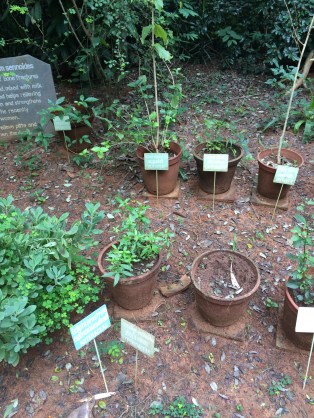
The NGO promotes the sharing and cultivation of traditional, local “elder knowledge” in reliance on nature for sustainment. By building up the Pitchandikulam Forest with local vegetation, they created an “agroforrest” that supports their culture and practice in a sustainable and holistic way where food is medicine, no chemicals are used and composting is eco-friendly degradation and fertilizer.

The NGO’s team asks questions like can you eat your toothpaste? Can you ingest the shampoo you use on your hair, or the make-up you put on your face? The skin is the largest organ of the body the body and with contemporary products we are constantly absorbing dangerous chemicals and washing them away into the water system.

Not only is Amirtha addressing sustainability through wellness, but also beauty. The organization works to shift the paradigm around the idealization of western white beauty in Indian culture, and the dangerous effects of skin bleaching. In their Dark Is Beautiful campaign, they educate on the evolution of skin color, explain the beauty of the soul, heart and person, and work to change the mentality of dark skin.

But it doesn’t stop there. They are planting the seeds that give back to future generations. The NGO employs rural women as a sustainable social enterprise; children plant and make their own food;  jobs are provided for locals; and traditional Tamil healers distribute herbal medicines not only to people but also cattle.

IMG_9257.jpeg

In a land that was once barren 50 years before, the Pitchandikulam forest serves an exemplary model of sustainable development of and organizations like Amirtha’s Herbals working in unison with the rich biodiversity of nature, not against it. After all, when it comes to designing solutions to the problems of the future, authors Terry Irwin, Gideon Kossoff & Cameron Tonkinwise, in the article “Transition Design Provocation” argue that sustainable development should look to “design solutions that protect and restore both social and natural ecosystems.”


A prelude to a new dream: collectivism.

Just as Krishna is working to share his dream on sustainable farming and food, just as Upasana is redesigning the harsh reality of the fashion industry, Amirtha Herbals is tackling the wicked problem of harmful products for wellbeing in beauty.

Through community, solidarity, and advocacy, the people possess powerful agency to make change and restructure the future. After all, that is how society has accomplished many great changes before—from freedom of speech to women’s rights—people worked tirelessly in their communities and outside the commonly accepted infrastructure created by an in-egalitarian system. Chomsky claims the power ultimately rests in the hands of the governed, in which he advocates, “What matters is the countless small deeds of unknown people who lay the basis for the significant events that enter history. They’re the ones who have done things in the past. They’re the ones who will do things in the future.”

So, my friends, imagine. John Lennon has asked us to do it before. I’m asking you to do it now. Be a dreamer. Imagine how you, we, can work towards a sustainable world.

 “Imagine all the people sharing all the world/You may say I’m a dreamer/But I’m not the only one/I hope someday you’ll join us/And the world will live as one.”

IMG_9255.jpeg

By Marissia Tiller

Life Education Center

Life Education Center

Devi says it is a calling.

She used to be a software engineer in California and went from a hectic work routine to going back and forth from Auroville to Berkeley. After feeling disgusted by a money-ruled world and missing being connected to nature, she decided to move permanently to Auroville and work with the people of Tamil Nadu. She founded the Life Education Center, a program that educates women and seeks to empower them, make them independent and proud. The program has a holistic approach, meaning their ways evolve depending on the people they work with. The program helps women develop their mind, body, spirituality and their will to learn as well as want more in life. It makes them conscious human beings. The program offers different levels and types of schooling. They hold weekly meetings where women can talk freely about everything and anything. These meetings constitute a safe space in which women can get peer support and relief.

In the last 25 years, India experienced a big cultural shift. Traditions used to be carried through generations and had a very important in society. However, lately, rituals became a way to show-off. People started borrowing money at very high interest rates to throw grand ceremonies, that is why LEC focuses a lot on making women financially independent so they can support themselves and their families. They offer a lot of different classes such as yoga, ayurvedic healing, yoga for menstruation problems, zen tangling (music, drawing and meditation), basic geography, cooking work-shops, sari work-shops and hand decorations. The goal is for these women to expand their knowledge and curiosity. However, since these women go to these classes and workshops, it raises a question of time and work/personal life balance. How do they manage to make a living and realize themselves? That is the matter Devi is trying to solve with them. These women then manage to go to classes, work and be women by themselves in a society that is still prevalently masculine and patriarchal.

Sharana: Social and Development Organization

Today we met Ms. Vandana, the CEO of Sharana, which is a social and development organization based in Pondicherry, India. Before I get into detail about the organization, I have to address how impressed I was with Ms. Vandana’s strong and passionate presence. From the moment she started talking it was clear she genuinely cared about every program she shared with us as well as the individual people within her community. I was even more intrigued when she explained her strong support towards the “exit policy”. She explained, the intentions of the organization are not to replace the parents or the government but to work closely with and build a bridge between children, parents and the government. The main goal is not to offer life-long assistance which is why their organizational model is focused in sustainable development and therefore, programs often change to help communities evolve so they can eventually “exit”. For her, the moment they finish a program they feel accomplished. This entire concept is amazing. Her dedication towards sustainable development is one of the many reasons I believe she has helped so many people through Sharana.

Saharana.png

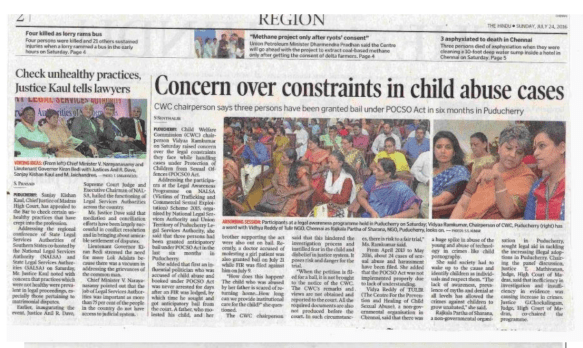
(Photo Source: Sharana Official Website) Annual Report of Gayatri House

Sharan was established in July 2000 based on the belief that all human beings are equal in rights and dignity, and everyone is entitled to food, clothing, and shelter. Sharana is committed to enable children to fully claim their right to education and  strives toward complete transparency and accountability to its donors and sponsors. The organization maintains meticulous records and shares annual reports on their website to ensure donors are aware of the impact they are donating to and also to ensure the funds collected are used as efficiently as possible, to the direct benefit of children and other individuals in need.

Through a variety of programs, they address the critical educational needs of socio-economically disadvantaged children and communities in urban Pondicherry and its surrounding villages. The biggest program they currently have is Street & Slum Children Program, a daycare center called The Gayatri House, which provides a safe haven for children of the streets and slums at high risk of exploitation. According to their website,

“Before Sharana’s intervention, many of these children were forced into child labour or begging on the streets to contribute to the family income and many of them suffered from substance and sexual abuse, nutritional deficiencies, and sleep deprivation.”

I find the organizations strategy within this program to be particularly interesting. I think it’s important to realize how the organization truly does stick to its sustainable development model for each program. One might question why children would be allowed to live with parents who allow their children to suffer in these ways and wonder if Sharana plans to expand The Gayatri House into a residential care facility for the children to live. Understanding the importance of keeping the children with their parents this program works closely with parents and social workers to ensure emotional and psychological needs of the children are addressed. This strategy allows the primary responsibility of a child’s upbringing to remain with the parents providing a stable and sustainable environment for the child and parents to grow.

Sharana in News 1.png

Sharana in the News 2.png

Photo Source: Sharana Official Website) Sharana in the News

The Gayatri House is more than a daycare. In addition to providing shelter for children and support to the families of the slums they also provide education, art therapy, medical care, nutritional care and psychological support. As I mentioned earlier, this is just one of many programs that Sharana offers to its communities. This organization doesn’t simply type out a set of values in efforts to get donors, the values are brought to life and lived by through its employees and its programs.

Writers ByLine Peacock Plume.PNG

Mohanam: Keeping Local Culture Alive

By Jessica Voorhees

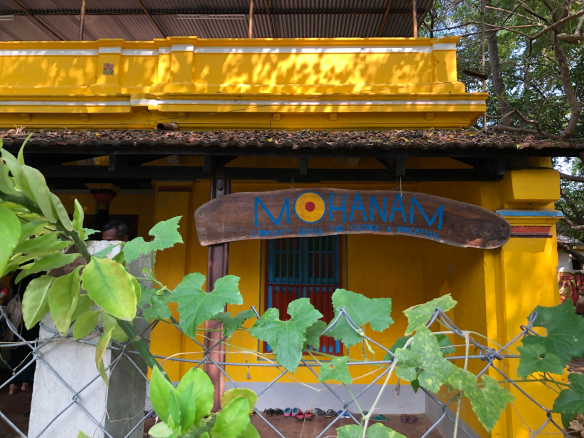
The day after Christmas, we boarded the bus early to drive to the Mohanam Village Heritage Centre, a non-profit that works to build a bridge between Auroville and its surrounding villages through knowledge and cultural exchange. Mohanam also works to keep alive rural Tamil cultural heritage through workshops, classes, and events.

Established in 2001 by young people from the villages, Mohanam is the first center of its kind in this bioregion. With walls papered by animal stickers and hand-drawn maps of India, the colorful building where Mohanam holds many of its activities is one of the oldest houses in the village.

Balasundharam, the founder and director of Mohanam, greeted us upon arrival and told us about the center’s history and goals.

The continuing effects of globalization and a history of imperialism in Tamil Nadu have caused major changes to ways of life that have trickled into the villages surrounding Auroville. The influence of Pondicherry and various development initiatives have caused further changes throughout the years.

Noticing these changes, Balasundharam wants to ensure the incredible cultural heritage in these villages is not only preserved but also cherished by future generations. He seeks to inspire the next generation of young villagers through cultural activities at the center.

Mohanam also encompasses a Montessori-style kindergarten for 90 village children. Balasundharam told us many schools in India don’t include creative education, such as classes in music, dance, and painting. He sees Mohanam as a space for people to explore all their interests and find a connection with their roots.

Balasundharam said he listens to the needs and wants of people in the village, and Mohanam responds and works to meet their desires. The center also gathers local artisans and community members together each year for a Cultural Heritage Festival.

Keeping Village Art and Culture Alive

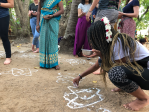
After the presentation from Balasundharam, one of the teachers at the center provided a short workshop on drawing kolams. Kolams are intricate floor designs drawn with rice flour by village women every morning before sunrise and again at sunset.

We learned that the rice flour, which is eaten by insects and birds, shows reverence for life. The kolams are often drawn with white flour, but they can become large, colorful and intricate during certain festivals. The kolams also serve as a signal to Sadhus that they can expect food at a certain house, and a household without a kolam drawn outside may be going through a hard time.

Mohanam offers kolam workshops, as well as cooking classes and other cultural experiences, to people from Auroville and beyond to showcase the ancient practices and knowledge from Tamil traditional culture.

Balasundharam seeks to reignite the value of Tamil cultural heritage, as he’s noticed many young people from the villages overlooking and forgetting ancient knowledge in favor of modern alternatives. Mohanam offers Indian traditional dance classes to children to foster a love for the art form, as well as keep the practice alive in the community.

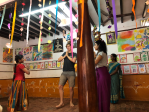
After the workshop, we watched dance performances by girls who take classes at the center, and then, we enjoyed a traditional Tamil lunch on banana leaves.

Working Toward Sustainable Development

Mohanam meets several of the United Nations’ Sustainable Development Goals.

Through its work to provide villagers access to clean drinking water, it meets the UN’s sixth goal of clean water and sanitation for all. The organization addresses the fourth goal of quality education through its progressive kindergarten for children from six villages. Through its village women groups, the center works toward the fifth goal of gender equality.

Additionally, Mohanam seeks to foster responsible tourism in the villages. The organization is creating a “learning village,” where visitors can come to discover Tamil traditional knowledge and cultural practices. They also plan to offer homestay experiences, so travelers can enjoy an intimate taste of local Tamil life.

Mohanam works to keep an open dialogue between villagers and those working in development, so the local community’s needs are met and voices are heard.

Through all its activities and outreach work, the center plays an important role in meeting the challenge of globalization’s impact on traditional Tamil communities, which hold valuable knowledge and rich cultural traditions that risk becoming forgotten.

Balasundharam’s talk and the performances at the center highlighted the incredible value of Tamil cultural heritage. These practices and beliefs hold just as much importance to the local community as Auroville’s knowledge on sustainability, and Mohanam is doing important work in bringing these two communities together.

As the world becomes increasingly interconnected through globalization and development, it’s important to remain respectful of other’s cultures, as each hold value from which we can learn.

Yatra Arts Foundation: Preserving the Heart of Tamil Nadu

Greetings from Auroville, Tamil Nadu, India! My name is Madelaine VanDerHeyden and I am a candidate for a Master’s of Arts in Global Communications for International Development. This practicum in India marks my first opportunity to observe and understand development work in the field and to connect classroom ideas with real-world practice. On our second day in Auroville we started touring NGOs in the Tamil Nadu area. After visiting the Auroville Village Action Group, we arrived at Yatra Arts Foundation. Yatra has been serving the Tamil Nadu region with a mission to encourage positive social change through creativity.

Yatra focuses on using art, dance, and media to educate communities on health, social, and cultural issues. It has specialized programs for children but seeks to include all community members in its outreach efforts in order to foster positive social change among generations. In Sanskrit, yatra means pilgrimage, a meaning that guides the foundation’s vision in seeing culture and development as journeys. Many people we have met in Tamil Nadu have expressed concern over Tamil culture being lost in the midst of India’s industrialization and growth. As a result, groups like Yatra are passionate about keeping traditions alive through engaging with the local communities, especially youth.

Upon arriving we were offered a ceremonious pottu, a red dot placed in the forehead between the eyes. In the Hindu religion, this spot is the most important pressure point that houses energy and concentration, the Ajna chakra,  It’s more commonly known as a bindi in Hindi, but pottu is the term here in Tamil Nadu. 

Yatra’s founder, Yatra Srinivassan, welcomed us and was clearly very proud to show us his foundation’s work. To demonstrate the types of cultural expressions Yatra upholds, his  daughters performed two songs played on a veena, an Indian instrument common in traditional Tamil music, and three bharatanatyam dances. Bharatanatyam is a classical Indian dance that originated in Tamil Nadu more than 2,000 years ago. I couldn’t help but smile during the performances: The moves, facial expressions, clothing, and music were so beautiful and captivating. Dance has always been personally a particularly moving art to watch and this experience was no different.

A more personal note: In watching these performances, I unexpectedly found myself experiencing a deep sense of loss and a strong desire for belonging. Growing up in the United States, I never felt connected to any of my ancestral cultures. My family hails from northern Europe and we have practiced some traditions, though only during the holiday season and without real intention. We’ve set out our shoes in anticipation for the arrival of Sinterklaas (Holland’s Santa Claus) and served traditional British meals for Christmas dinner. But I’ve never mastered the languages/dialects, dances, cuisines, or histories of my family. For that reason I have felt extremely disconnected from the idea of “culture” that is so honored here in India. It’s a disconnect I’ve had to reckon with in my studies by recognizing the integral role culture has in the success and sustainability of development projects. It’s been a challenge to my own identity, which I see as grounded in change rather than tradition. Seeing the pride for one’s heritage here in India has really changed my perspective on tradition’s relationship with modernity. It’s clear the two are not mutually exclusive; it is possible for both to exist and to thrive in different ways. 

We saw this possibility most clearly in several of Yatra’s films, which we would classify as “edutainment” in development jargon. Edutainment concerns educational materials that are produced in the form of films, television programs, games, theatre, etc. — basically anything that makes learning more fun. Srini’s background is in filmmaking so the films were exceptionally made. They’re can be a mix of comedies, dramas, or more artistic, but they each had a central message that was meant to practically inform the viewer and touch them personally. Srini and the Yatra theater group also holds street theatre performances in local communities and there are opportunities for the local people to participate and improvise. Below are a few examples of Yatra’s films and outreach work:

Yatra prides itself on providing community members with opportunities to develop integral social skills, cultural connections, networks outside their homes (many of which are low-income), and artistic interests. Its films are poignant, clever, and carry deep meaning. It’s clear that the communities value Yatra’s work and the culture it honors, which has translated into creating a vibrant, sustainable Tamil Nadu.