Mohanam is Tamil Nadu’s Cultural Hub – Where Tradition and Evolution Coexist

By Noelle Dillman

Mohanam Village Heritage Centre is all about preserving, sharing and being part of the evolution of Tamil Nadu culture. The organization provides a place where community members of all ages can connect; the old pass down local traditions and the young infuse the community with new ways of seeing what it means to be South Indian. Started in 2001 by Mr. Balasundaram and friends from villages surrounding Auroville, Mohanam’s efforts continue to make an impact in the bioregion today.

Why are the practices of Tamil Nadu culture waning in the first place? What does the loss of local culture mean for the people in this region? Cultural identity can be described as the shared language, values, customs and beliefs that create a sense of belonging within a local group (Faiz 10-11). The destruction of cultural identity is argued by some to be a consequence of globalization, and non-western and developing countries are positioned as most under threat. While globalization promotes cross-cultural exchange, it also poses the risk of cultural homogenization, favoring the dominance of western culture and leaving non-western cultural practices vulnerable to extinction (Faiz 14). Tamil Nadu’s history is also marked by numerous waves of colonization from the Dutch, British and French. Under colonial rule external cultural norms and practices are imposed upon those colonized and they are often forced to abandon local customs and language. In the post colonial context, cultural identity becomes complex and necessitates a negotiation between traditional and modern practices (Faiz 12).

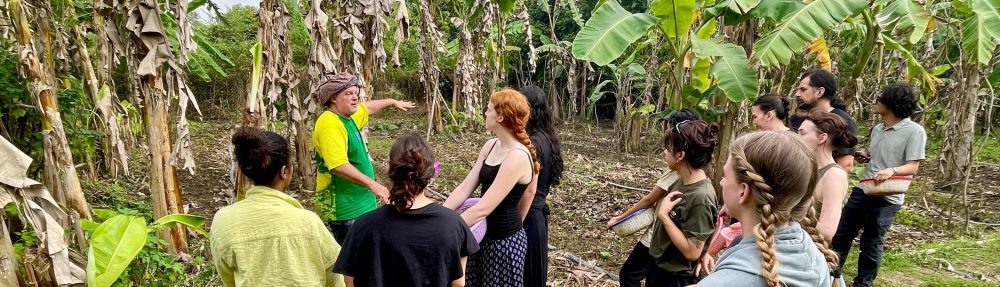
To adapt to the ever-changing, interconnected global landscape and alleviate the threats to loss of cultural identity, Mohanam has centered itself as a hub for Tamil Nadu arts, culture and education. During our visit, AUP students were able to say hello to the children learning yoga and a traditional South Indian dance from an experienced instructor. We visited their shop and admired the handcrafted products made by local women entrepreneurs. Some of us played a few notes on traditional percussion instruments made from materials found in the bioregion. We enjoyed a stroll through the peaceful bamboo forest garden.

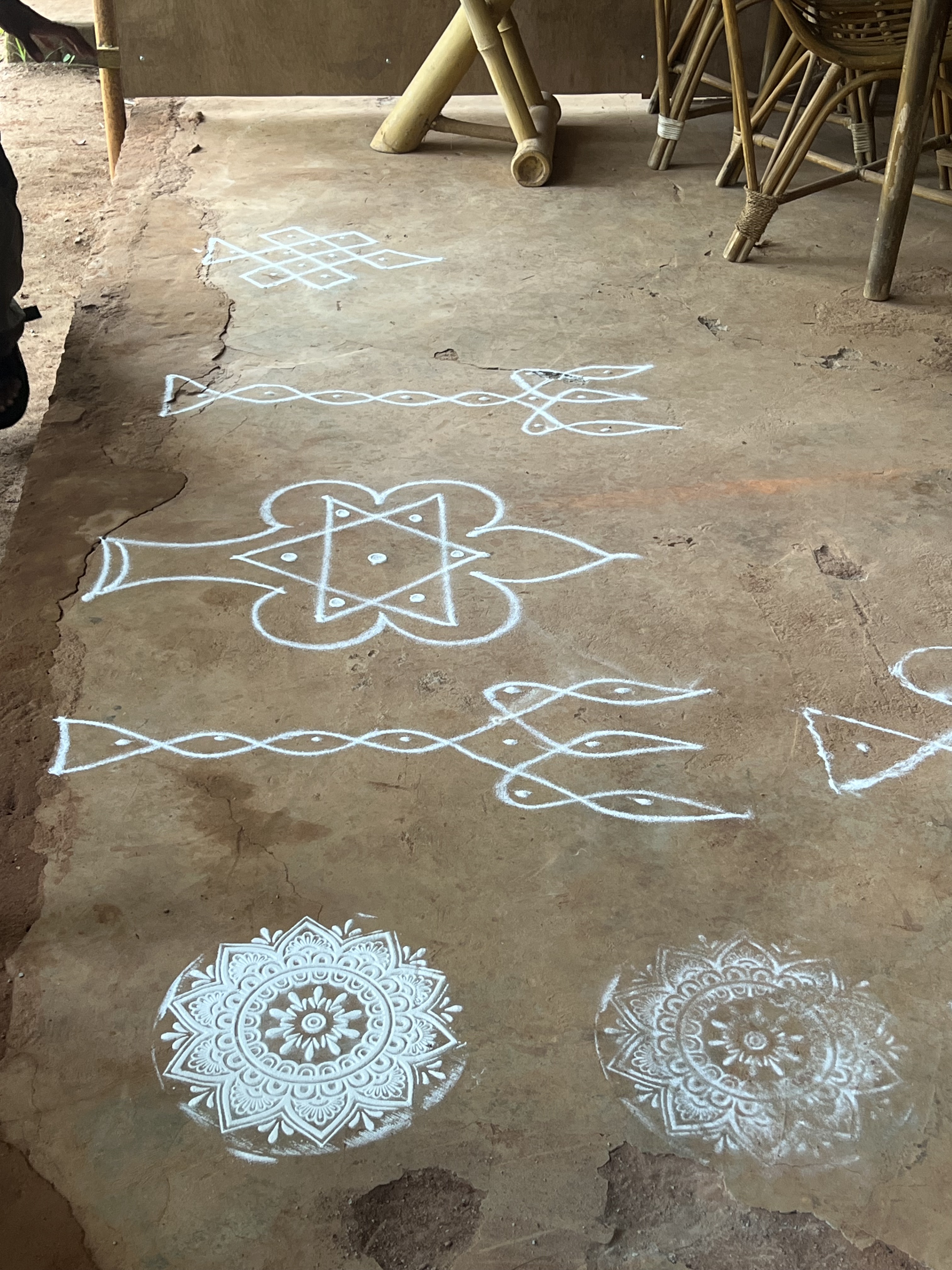
Our group of AUP students were lucky enough to see the process of the traditional art of Kolam and even try it out for ourselves. In the Tamil language, the word Kolam means form and beauty and the practice dates back 5,000 years (Sampratishta). In the morning, women draw kolams outside in front of their homes on the ground using rice flour. Taking a pinch of rice flour at a time, they swiftly create intricate geometric designs composed of lines, dots and curves. A few of our students tried making a simple design and were quickly humbled. The process takes skill, a steady hand, and muscle memory, especially for large patterns. Over the course of the day the kolams get swept away from people walking on them or from insects and birds that feed on the flour, which creates a harmonious relationship to nature (Sampratishta). The following day they are drawn again.

Mohanam’s efforts in the community are wide-reaching and align with numerous sustainable development goals. Their educational programs and cultural activities for youth correlates with SDG number 4, quality education. Promoting gender equality, SDG number 5, can be seen across their training for women’s entrepreneurship program and various women’s groups. Their extensive work with reforestation and reviving the local landscape over the past decade reflects a commitment to number 15, life on land. The organization is an excellent example of how the sustainable development goals intersect and allow communities to thrive.
References-

Faiz, Ahmed. “Understanding Cultural Identity in a Globalized World.” Journal of Social Signs Review, vol. 2, no. 4, Oct. 2024.

“Significance of Kolam.” Sampratishta School of Fine Arts And Design, October 18, 2023.
https://sampratishta.org/significance-of-kolam-culture/
The Colours of Nature: Raising the Bar of Conscious Fashion

By Naydeline Mejia

Located at the edge of Auroville sits an epicenter for conscious fashion. The Colours of Nature, founded by Spanish-born Aurovilian Jesús Ciriza Larraona in 1993, is reviving indigenous dyeing practices one garment at a time. The environmentally-friendly clothing brand is a true changemaker in natural dyeing production, providing sustainable solutions to a largely unsustainable textile industry. (For your information, the fashion industry is the second largest consumer of water resources and is responsible for up to 8-percent of global carbon emissions, per Geneva Environment Network.) Marigold, pomegranate, upcycled jackfruit tree sawdust, acacia, and madder are just a few plants the organization works with to deliver their high-quality, vibrantly-hued garments. Nevertheless, no technique is as striking as their 100-percent natural indigo dyeing process. 

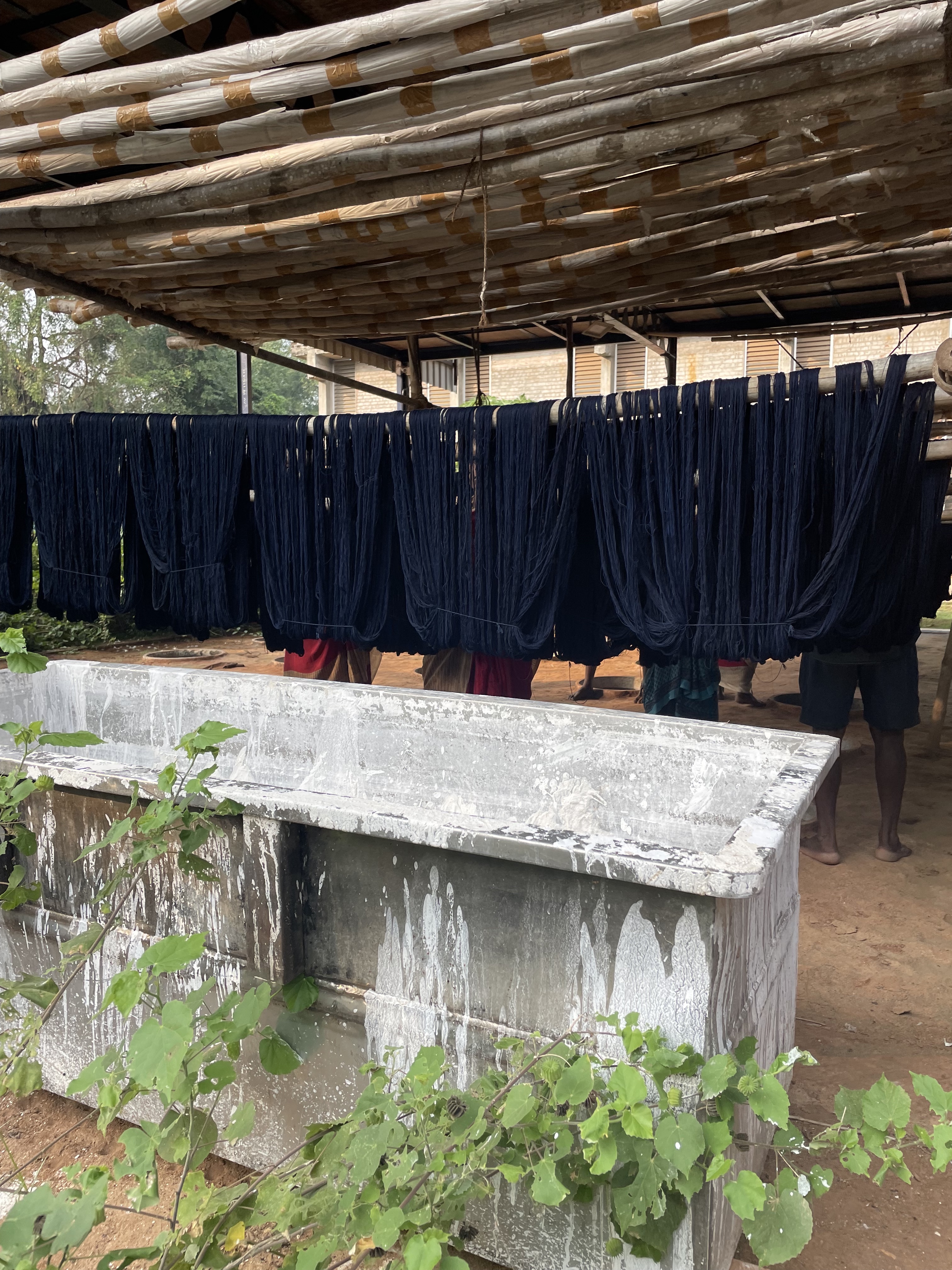
Indigo dyed threads hanging to dry at The Colours of Nature.

Atop a powdery, smooth hazel-colored floor composed of cow dung sits an array of 62 vats, each with a capacity of 1,000 liters, where the fully natural indigo fermentation process takes place. Traditionally, indigo for dyeing requires a fermentation process—either through “staled” urine or by introducing naturally-occurring microbial communities. At The Colours of Nature they utilize bacteria to initiate and maintain the fermenting process. Looking into the full vats, one notices tiny, metallic blue bubbles, which signifies the final stages of the fermentation process. If left for too long, the liquid will overferment—changing hues from a neon blue to army green (Kabish et al.). After fermenting in the vat and being properly mixed with warm water, an employee who has been with the brand for over 29 years smells the final indigo solution to ensure the pH is correct before the dyeing process can begin. Smelling the indigo, one is taken on an olfactory trip to a farm pasture, bringing the mind and body back to the cow manure under one’s feet. The experience mirrors the closed-loop system The Colours of Nature is aiming to achieve—and they’re nearly there. 

Employees mixing the indigo dye inside the fermentation vats.

Earlier this year the organization set new benchmarks in sustainable water management with the installation of an upgraded wastewater treatment system. The canonical tank filters are able to manage gray water from dye operations—extracting solid pigments from liquids—and sanitation to significantly reduce overall water usage and prevent environmental pollution. The goal is to reduce dependency on external freshwater sources by using recycled water that meets the brand’s needs. The entire project is expected to decrease the organization’s freshwater consumption by 30 to 40 percent, and reduce overall costs. Speaking about how the water filtration system works, one notices a sparkle in Jesús’s eyes. The Colours of Nature was born out of wanting to improve clean water management in the textile industry, says Petra, one of the brand’s employees, making this initiative a giant victory for them. 

The Colours of Nature’s new wastewater filtration system separates solid pigments from liquids.

Not only is the organization one step closer to a closed-loop system within their brand, but they’re also helping to reverse the misuse and overconsumption of fresh water within fashion itself—setting an industry standard that’s worth taking notice of.

Learn more about The Colours of Nature and shop their items here: https://thecoloursofnature.com/

Thamarai: an Educational Project of Equity and Growth

By Lucie Reed

Thamarai’s welcome sign in chalk, where students write their ideas and hopes for their lessons and activities (22 December 2024).

In a world which chronically praises individual performances over communal and empathetic advancement, education is the decisive tool to curate sustainable development and growth. Thamarai is an educational STEM learning center grounded in equity and youth empowerment. Nestled in the small village of Alankuppam just outside of the international township, Auroville, Thamarai challenges the rigid framework of traditional schooling through an integrative and centred approach to learning. They model their method of ‘integral education’ from the philosophies of Sri Aurobindo and the Mother, which seeks to strengthen the physical, refine the vital, advance the mental, uplift the psychic, and contact with the spiritual. The school’s name, Thamarai, symbolises the ‘lotus flower’ in Tamil – an enduring image of growth through unity and wholeness which is curated by the students’ desires, not the facilitators. True to Auroville’s hope to act as a bridge between cultures and people, the past and the future, and eternal learning, Thamarai has purposefully rooted itself in a marginalised community. Here, challenges such as addiction, inadequate literacy and social skills, debt, and abuses are brought to the surface. Thamarai is able to address these systemic struggles through after-school programs and outreach that nurtures the full potential of children, parents, and the community as a whole. Since its founding in 2006, Thamarai has helped roughly ninety students annually. Their most remarkable contribution lies in their conscious effort to dismantle entrenched social biases. Using an integrated education model, Thamarai fosters an inclusive environment where they report that caste and non-caste students share a space at Thamarai in nearly equal proportions –  an inspiring testament to its mission to promote unity, growth, and equity.

With a foundation rooted in the ethos of Auroville and philosophy of integral education, Thamarai’s work becomes a powerful case study for how grassroots educational models can contribute to pressing global challenges. Particularly, their work aligns with the aspirations outlined by the United National Sustainable Development Goals (SDGs) such as Quality Education (SDG 4), Gender Equality (SDG 5), and Reduced Inequalities (SDG 10). Thamarai exemplifies the transformative power of education through more equitable and sustainable communities, and proves that these goals to foster sustainable futures are beautifully possible. Additionally, their educational experiment is increasingly relevant in today’s context, as it directly addresses inequities in access to quality education and reimagines the role of schools to nurture the whole, not a part. However, as their innovative education receives much praise it also poses questions of what lessons larger institutions can draw from their system, and how can their model be scaled to balance the systemic needs of a large community with an interpersonal approach to learning? 

Image of a Christmas tree decorated by Thamarai students during their holiday celebration (26 December 2024).

Thamarai’s educational model molds their students into a “flexible shape so that he may be able to face challenges and meet the changing and growing needs of complex life”1 by aligning with many SDGs. In the context of  SDG 4, quality education, Thamarai is a schooling model centred on sustainable development of the self in all planes. This ensures steady growth through the duration of their students’ lives in all subjects. Sustainable growth cannot come without first the individual having a centred and balanced education, which Thamarai provides through their integral education model. They ensure that schooling teaches one how to live, not simply recite. Thamarai noted that their STEM model “subtly breaks down barriers” of caste, gender, and more, and can be tailored to each student by individually allowing them to express creativity while simultaneously speaking a language full of equity. Their sports programs, especially their all-girls frisbee team and football programs which integrate each gender together, breaks down stigmatising gender barriers and reflects SDG 5, gender equality. 

Thamarai is a vessel through which love and acceptance can be poured out, and a testament to the transformative power of holistic education. Sustainably created in every aspect and driven through solar power and acute environmental awareness, Thamarai provides a safe place which enhances government education and teaches a student how to understand all parts of living: the physical, mental, psychic, spiritual, and vital. It additionally challenges us to rethink how schools can move beyond education, and also heal, unite, and empower communities. The question still remains: how can lessons from Thamarai and the philosophy of integral education ensure no child is left behind in the pursuit of sustainability and equity in all contexts?

Thamarai Website: https://thamarai.org

  1. Seikh, H. A. (2020). Philosophical thoughts of Aurobindo: Its impact on modern educational system. International Journal of Engineering Applied Sciences and Technology5(8), 232-234. ↩︎

The Overuse of Concrete: A Call for Sustainable Alternatives, Auroville Earth Institute

By: Antonio Galarza & Sachi Hauser

Concrete is one of the most widely used construction materials in the world, but its environmental impact is staggering. The production of cement, a key ingredient in concrete, accounts for approximately 8% of global carbon dioxide emissions, making it a significant contributor to climate change. Additionally, the heavy reliance on sand as a resource for concrete is depleting ecosystems and causing severe environmental degradation. The Guardian

In India, where rapid urbanization demands vast amounts of construction materials, this overuse of concrete has far-reaching consequences. It exacerbates climate change, depletes resources, and increases costs for vulnerable communities. Organizations like the Auroville Earth Institute are addressing this problem by developing sustainable building materials and practices that align with global sustainability goals.

Supporting the United Nations Sustainable Development Goals

The work of the Auroville Earth Institute directly contributes to several Sustainable Development Goals (SDGs):

– **SDG 11: Sustainable Cities and Communities**
  By promoting the use of locally sourced materials like compressed earth blocks, the institute fosters sustainable urban development. Their techniques reduce the carbon footprint of construction while making housing more affordable and accessible.

– **SDG 12: Responsible Consumption and Production**
  The institute’s emphasis on resource efficiency and minimizing waste addresses the need for sustainable production practices. By using alternatives to concrete, they help conserve natural resources like sand and reduce environmental degradation.

– **SDG 13: Climate Action**
  Through the development of low-carbon building materials, the Auroville Earth Institute mitigates the environmental impact of construction. Their innovations are essential for reducing greenhouse gas emissions in the building sector.The Guardian

Making an Impact in India

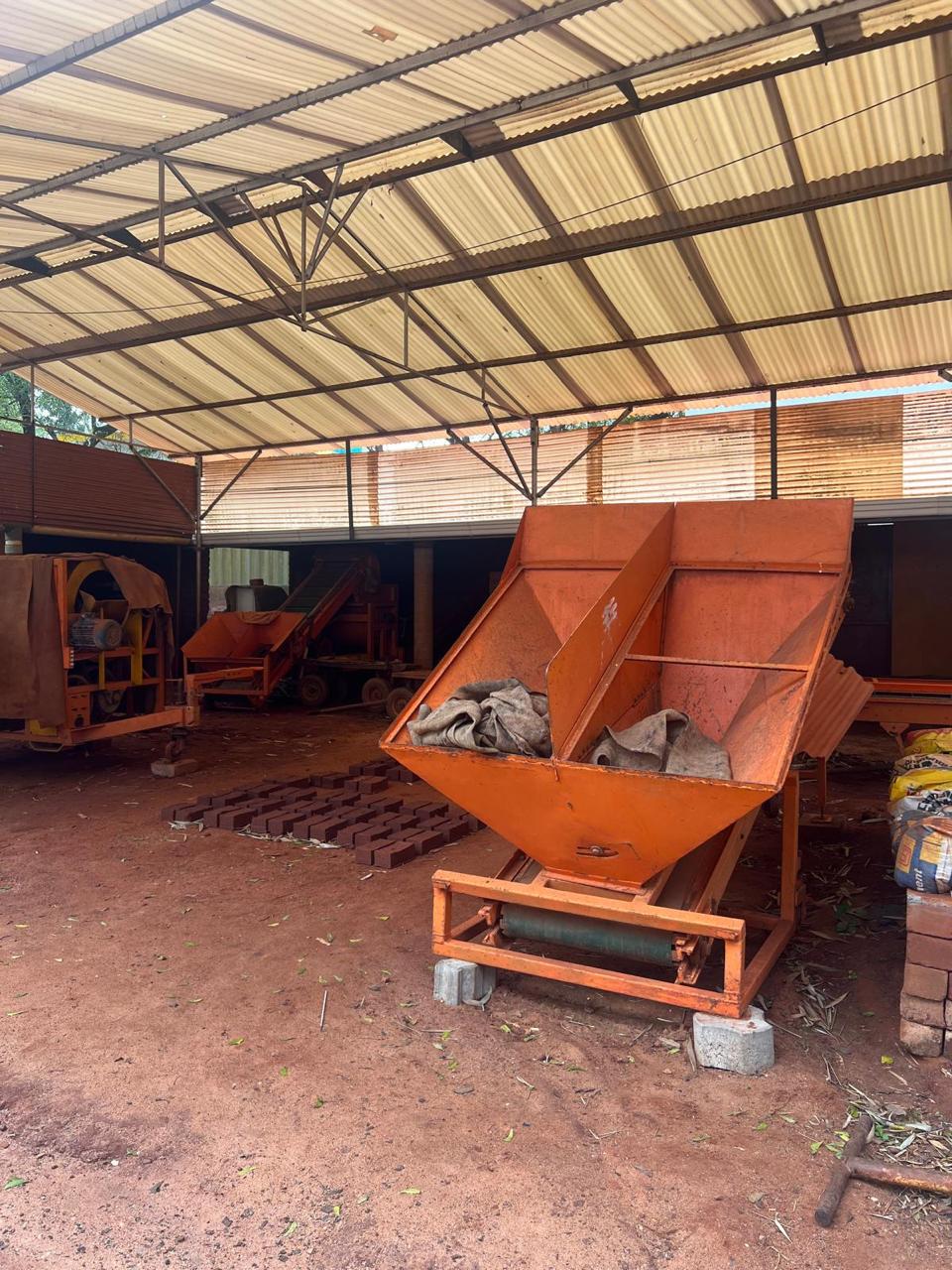
During our visit, we had the unique opportunity to make and use the blocks ourselves. This hands-on experience demonstrated how accessible these building methods are, even for individuals with no prior construction experience. The simplicity of the process ensures that surrounding villages can adopt these techniques with minimal training, empowering communities to create their own sustainable housing solutions.

The Auroville Earth Institute has been a pioneer in sustainable construction in India. Their work spans multiple areas, including:

– **Education and Training:** The institute trains architects, engineers, and masons from around the world in sustainable construction techniques. This knowledge-sharing creates a ripple effect, spreading eco-friendly practices far beyond India’s borders.

– **Innovative Materials:** The use of compressed earth blocks (CSEBs) and other alternatives reduces the need for concrete, cutting costs and emissions. These materials are not only durable but also thermally efficient, making buildings more energy-efficient.

– **Community Development:** By using locally sourced materials and involving local labor, the institute supports economic growth in rural areas. Their projects empower communities to build affordable, sustainable housing while preserving the environment.

A Model for the Future

The Auroville Earth Institute’s work offers a blueprint for addressing the environmental challenges posed by traditional construction. By reducing the reliance on concrete, they are proving that sustainable alternatives are both practical and impactful.

For more information on the environmental impact of concrete, check out these sources:
BBC Future    ScienceDirect

Bridging Hope and Reality: The Work of the Sharana Foundation in Pondicherry

By Alexandra Henzl

Nestled in the vibrant yet deeply divided city of Pondicherry, India, the Sharana Foundation works tirelessly to uplift marginalized communities, addressing systemic issues through education, livelihood programs, and social awareness initiatives. With an emphasis on ethical intervention and sustainable impact, Sharana has become a beacon of hope in areas often overshadowed by poverty and exploitation.

The Sharana Foundation is a non-governmental organization (NGO) based in Pondicherry, India, that works to improve the lives of marginalized communities, particularly children and women. It was established in July 2000 to address the critical educational needs of socio-economically disadvantaged children and communities in urban Pondicherry and its surrounding villages. Founded to assist families living in extreme poverty, Sharana’s programs have expanded over the last six years to include specialized support for women. Their work is guided by one principle: actions based solely on the needs of the community. In regions like Solal Nagar and Angalakuppam, where poverty is both pervasive and systemic, the Foundation offers critical services such as homework help centers, rehabilitation programs, and vocational training. Sharana’s primary focus areas are firstly education, by which they provide quality education to children, including those who have dropped out of school. Secondly, skill development, where they focus on empowering women through skill-based training and microfinance initiatives. Thirdly, community development, centered around building strong, resilient communities through social centers and community engagement programs. Lastly, advocacy, where they are raising awareness about social issues and advocating for policy changes. Their approach stands out for its sensitivity to ethical concerns. Sharana actively resists the voyeuristic tendencies of poverty tourism and the exploitation of suffering for profit or pity. Instead, they champion the dignity of the communities they serve, reframing their work as a partnership rather than charity.

The challenges Sharana confronts are vast and complex. Alcoholism, for instance, affects 99% of the families they support, with government-operated liquor shops making alcohol alarmingly accessible. This vice, coupled with high levels of debt (with interest rates as high as 10% daily), traps families in cycles of poverty and despair. Education, often hailed as a ladder out of poverty, is frequently interrupted, especially for girls. Cultural norms often push parents to withdraw daughters from school upon reaching puberty, leaving them vulnerable to exploitation. Sharana’s initiatives, such as their drop-in centers and free computer literacy courses, aim to bridge these gaps, offering children and women pathways to regain control over their futures. The COVID-19 pandemic compounded these issues. Schools in Pondicherry remained closed for two years, and many children never returned to their education. This disruption fueled existing crises, such as child exploitation and substance abuse, further endangering already vulnerable communities.                                     

(Image: Sharana Daycare Facility – Anupama Kundoo Architects)    

The stark realities of life in Pondicherry’s slums are harrowing. Limited access to basic amenities like water, toilets, and safe shelter exposes families, particularly young girls, to daily risks. Tragically, the death of a nine-year-old girl in March of 2024, underscored the urgent need for systemic change. She   was raped and murdered in her neighborhood, a crime emblematic of broader systemic failures, including inadequate police presence and unsafe communal spaces. In response, Sharana has doubled down on its commitment to child safety. As part of the Child Safe Movement, they’ve implemented measures to protect children from exploitation, including discouraging photo opportunities and casual visits that can strip beneficiaries of their dignity. Women’s empowerment is at the heart of Sharana’s work. The Foundation provides grants to help women escape debt cycles and vocational training to establish sustainable livelihoods. To date, they’ve issued 246 loans to women, enabling them to regain financial independence and stability. Sharana’s social centers also act as sanctuaries for recovery and growth. Fathers struggling with addiction find support in rehabilitation programs which offer painting classes to help fathers feel more connected to their past childhood and give them a greater appreciation for their own families, while children benefit from after-school centers that offer safety and educational support.

Sharana’s mission aligns with several Sustainable Development Goals (SDGs). The organization directly addresses Goal 1: No Poverty by providing financial assistance, livelihood training, and microfinance to empower women and help families escape poverty cycles. Additionally, they offer essential services like food, shelter, and healthcare to vulnerable populations. Sharana supports Goal 4: Quality Education by ensuring inclusive and equitable quality education, providing access to education for children, including school dropouts, and promoting lifelong learning through vocational training for youth and adults. In line with Goal 5: Gender Equality, Sharana empowers women by offering financial assistance, vocational training, and support to achieve economic independence while addressing gender-based discrimination. They promote Goal 8: Decent Work and Economic Growth through vocational training, job creation, and supporting women entrepreneurs via microfinance and business development initiatives. To reduce inequalities, Sharana’s initiatives address Goal 10: Reduced Inequalities by promoting social inclusion and ensuring equitable access to education, healthcare, and other essential services for marginalized communities. The organization contributes to Goal 11: Sustainable Cities and Communities by improving living conditions, addressing access to water, sanitation, and safe housing, and fostering resilient communities through social centers. Sharana also indirectly supports Goal 16: Peace, Justice, and Strong Institutions by advocating for policy changes and raising awareness about social issues. Their child safety measures protect against exploitation and violence, creating a safer environment for the most vulnerable members of the community.

Looking ahead, Sharana plans to expand its reach, bolstered by international funding and partnerships. A forthcoming project supported by the French government aims to integrate sports into community development, fostering teamwork and confidence among youth. Despite the overwhelming challenges, Sharana’s work remains a testament to what can be achieved through ethical, community-driven efforts. In a city where stark inequalities persist and despite the numerous challenges, Sharana Foundation remains steadfast in its mission. With the support of dedicated volunteers, donors, and partners, the organization offers a model of hope, compassion, and resilience, paving the way for a brighter future for Pondicherry’s most vulnerable residents. By addressing the root causes of poverty, inequality, and social injustice, Sharana Foundation is not only providing immediate relief but also building a sustainable future for generations to come.

Sharon Foundation Website: https://sharana.org