Storytelling in Sanjeevi Nagar

By André Lavergne

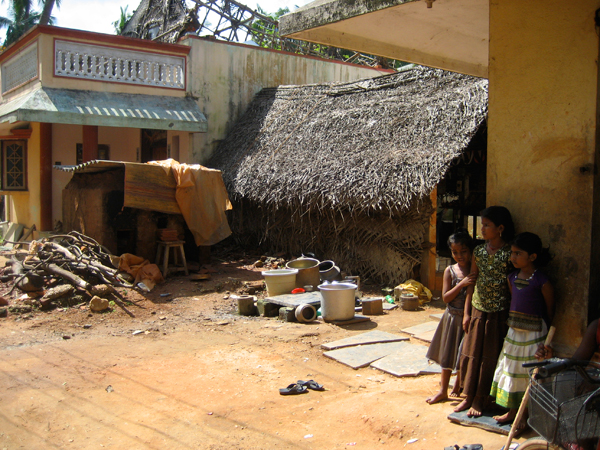
Sanjeevi Nagar is a village of roughly 1000 homes located in the cyclone-affected area of southeast India, just a few kilometers northwest of Auroville. When we arrived there to start work less than a week after the storm hit, the village was still without electriciy and so we found its residents far less busy than they care to be. While neighbouring villages were still clearing roads, the fallen trees of Sanjeevi Nagar had already been arranged in piles by the side of the road. While it’s true that the village held up to the winds better than many others, good fortune is only part of the story. That short work was made of the clean up here, is no surprise to the residents themselves. With or without electricity, Sanjeevi Nagar prides itself on its work ethic, entrepreneurial spirit and skilled craftsmen.

The village is the birthplace of Balu, perhaps one of the most entrepreneurial people we’ve met in Auroville. He heads not one, but two of the non-governmental organizations with which AUP is working. As director of the Mohanam Cultural Center, he has helped provide programs which engage local youth in the cultural vitality of Sanjeevi Nagar and make it possible to share its art, music, dance and cuisine with the outside world. Balu has more ideas than he has time to implement, including some very big plans for his home town. This is where we come in.

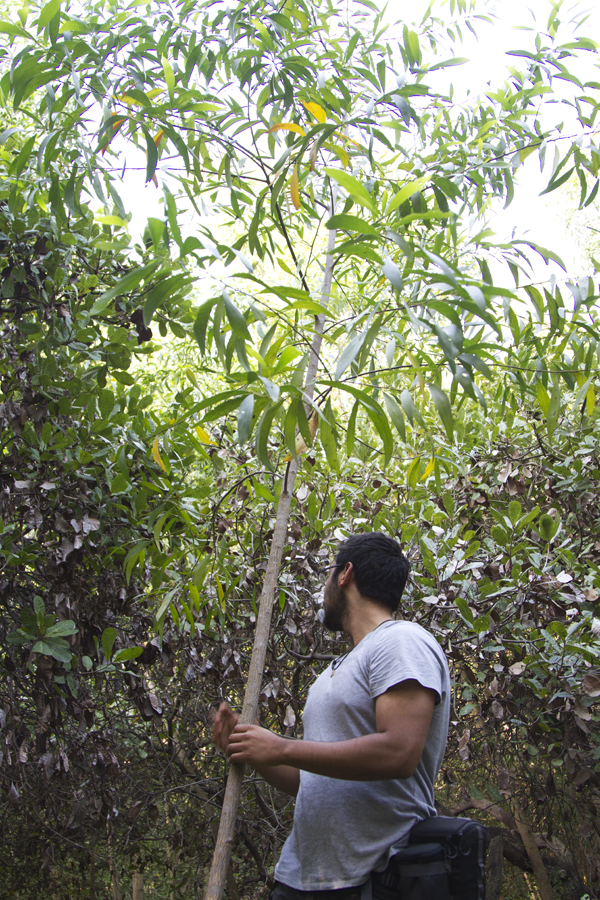
Katie and I have undertaken the first step in a longer term village branding project aimed at communicating Sanjeevi Nagar’s culture, knowledge and values. Phase one focuses heavily on listening and storytelling, and will result in the creation of an ongoing participatory online compendium of stories from the village. This morning marked the first of a series of loosely scheduled village walks. The plan is to meet with as many villagers as we can while we are here, in order to gather their impressions and stories of life in Sanjeevi Nagar. Accompanying us are Murugan, Madhu and Raja, three twenty-something alumni of the Mohanam Cultural Center’s youth programs. Their involvement from the start is crucial both as contributors with their own stories to tell and as the keepers of this living online resource. Fortunately for us, they are exceptionally qualified for the job. Murugan is a trusted member of Balu’s Bamboo Research Center team. And Madhu and Raja are both students in Visual Communication at Achariya Arts and Science College.

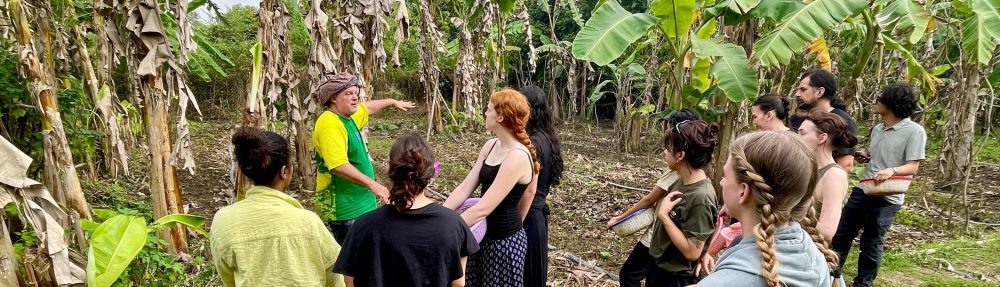
Our first village walk this morning introduced us to husband and wife entrepreneurs and a team of ten artisans, all working in terra cotta, with over thirty years of experience between them. Tomorrow, we will meet stone carvers, the day after that, leather workers, and this weekend, a local healer and expert in traditional medicine. Of the countless stories these streets could tell, we will likely only be able to experience a handful. But our hope is that the pieces will be in place for the storytelling to go on, long after we’ve gone.
From the Edge of the Sphere: Progress as development of modernity.

by Andrés Del Castillo 

El Progreso

“There is no Route to Peace, Peace is the Route” M. Gandhi: As I reread this introductory quote, an ant climbed on to the screen of my laptop; I squish it with my finger. Now there is one fewer ant to kill, or a battle has begun.

2012 began for us without electricity, which means without technology: low battery in the camera, no internet, and no social networks.  Little by little, I realized how dependant we are on technology and the automatic link between development and progress.

Indeed, progress means to go forward, but it is not a synonym for technology or modernity. Modernity is a hand that uses the lantern, which is technology, to show us the way to follow, but leaves the context in darkness. (Baudelaire?)

On the other hand, development is not a goal; it is a process toward progress, not toward modernity. In Kant´s words, progress involves “chronological unfairness.”

Progress takes many resources, which leaves fewer for those in the future, who will actually reap the benefits.  It also demands labor and innovation from those in the past, who do not get to enjoy the fruits of their works. It is unfair to the past and future generations. In an attempt to compensate for future generations, sustainable development is one of the ways to mitigate the chronological injustice.

Kant argued that progress is not a measure of prosperity or knowledge, but rather a necessary step toward enlightened culture and the abolition of the war, which in others words means a culture of peace.

I squish another ant with my finger.

Sustainable development is just one side of the coin. On the other side, there is the culture of peace. As human-centred approach to address current global challenges, the concepts of culture of peace and sustainable development are intrinsically linked. Peace must not be considered as the mere absence of war, but as an environment where human rights are observed and where every person has the possibility to realize his or her potential.

The core elements of peace and sustainable development are the respect of life, human rights, dignity, freedom, stability, social harmony, duty of forgiveness, justice, tolerance, mutual respect, solidarity, gender equality, and a lasting and sincere dialogue.

In my reflection, I have done my best to try to explain (or confuse) the difference between modernity, progress, technology and development. This practicum is our time to act, stopping occasionally to think about the meaning of the words that we wish implement.

The unfortunate ants were stuck between a rock and a hard place, or between the screen – technology and my finger – humanity.

MacBook, MacBook Everywhere, nor Any Plug in Sight

Jeomar Montelon

For those of us from developed nations, it’s unusual to think about our world without the “basic amenities” in life. By “basic amenities” I mean technology and Web 2.0. They have undeniably become our source of information, formed our social cohesions, and kept us engaged with the onslaught of our friends’ Facebook status updates. As Global Communication students, access to technology is at the very heart of our academic and professional existence.

But what happens when you’re living in a developing country far away, and you happen to be in the midst of a natural disaster? How do you remain informed and able to carry out tasks when needed? That’s what happened to us last week. On the night of December 29th, Auroville and the surrounding area witnessed one of the worst storms in decades that leveled villages, destroyed 70% of the natural vegetation, and left us completely off the grid.

There we were, a group of communications students incapable of beginning our projects because we lacked the necessities needed to see us through our work. Without electricity we can’t charge our computers. Without computers, we can’t work on our projects and utilize the Internet. Without the Internet…well, we might as well be drawing paintings on a cave wall.  As the days dragged on, some of us began to develop a type of “island fever.” With trees knocked-down, blocking access to the outside, we were in a sense, trapped. “Why are we even here?” some of us began to ask ourselves. We found ourselves questioning whether or not our projects would even commence, and a feeling of uncertainty began to linger in the air. What about food; would we eat that day? –Not a concern. Was there enough water to shower, let alone drink? –It didn’t matter. Our main priority was getting ourselves back on the grid.

In retrospect, it’s weird – almost embarrassing to be so preoccupied with feeling inadequate due to lack of technology when there are villages less than 3km away lacking food, water and even shelter. But should we feel bad? We were here for a specific purpose, so what do our needs have to do with the needs of others? Is it my fault I was born an American, automatically making my values different from others in this situation? These are questions I asked myself with nothing to be done but stare at the flame of a burning candle.

Unfortunately, this story ends well only for the Practicum students. While our technological amenities were eventually restored, we don’t know if those most in need received their real amenities. And you know what – we probably never will.

Eco-tainment: Open Air Cinema in Sadhana Forest

by Deborah First-Quao

Today started like all other days except the 3am temple music. Barking dogs, alarm clocks, shuffling feet, and blazing sun you can’t keep out of the blinds. I had started on my website for the PSDF (People’s Social Development Foundation), an NGO in Pondicherry which aimed at improving the socio-economic welfare of the Dhalit community and fought for their basic human rights as well. By the afternoon I was already putting together a slideshow of the cyclone’s damage to Dhalit villages which could be used as an appeal for donations for their cyclone relief fund.

After a simple lunch of ratatouille and rice accompanied with a glass of lemonade at Town Hall, I rode my pedal bike over to Visitor’s Center for a huge glass of strawberry, vanilla, and coffee crunch ice cream. Just when I thought my day couldn’t get better, at 2:19pm I received the following text:

“Sadhana Forest! Tonight! Cool Deep eco space. Two departure times: 4pm for visit, meal, movie. 6pm for movie and meal. Aurorville Bus departs from Solar Kitchen. 200 rupee donation.”

There was no way I was going to get the the 4h30 bus by the time I had finished talking to my roommate Sorana about her amazing experience volunteering with an NGO called Maximo Nivel in Costa Rica, building a room in a church. At 6 0 clock I was on the bus, my mind filled with images of tree houses, huts and gypsies. After a 20 minute bus ride from Solar Kitchen we arrived. Sadhana Forest was pretty at night. All the houses were big open bamboo huts. They were all welcoming, but a bit troubling to me because they didn’t seem like one could get any privacy in them.

The first thing on the programme was the film. The title was BORN FREE, a true story of a British couple, Joy and George Adamson. In the beginning, George, is sent on an assignment to hunt down a man-eating lion in the Baran region of Uganda. While searching they are unexpectedly attacked by the lioness of the maneating lion. In their surprise they shoot her, realizing later that she had only attacked them to protect her sleeping cubs. In his guilt, George takes the 3 cubs home to his wife and they end up raising the cubs. Plans are eventually made to send them to the zoo. Troubled by his wife’s attachment to Elsa, the smallest, most curious and most playful cub, George decides she would be the perfect companion for his barren wife.

After raising Elsa for until adulthood things inevitably start to wrong as Elsa realizes life outside the household and nature’s urges steer her to realize her true calling. George and Joy are then faced with a difficult decision: to send Elsa to the zoo, where will live out her days in a cage but the receive the care she is used to, or to attempt to teach Elsa how to fend for herself in the wild where she can live free, but face the agony not knowing whether she was well equipped enough to survive.

The movie in many ways paralleled the purpose of the creation of Sadhana Forest and their efforts at reviving the forest. Sadhana Forest was initiallyh created in 2003 as an initiative to revive severely eroded land on the outskirts of Auroville and recreate and indigenous Dry Evergreen Forest.

The movie in many ways paralleled the purpose of the creation of Sadhana Forest and their efforts at reviving the forest. Sadhana Forest was initiallyh created in 2003 as an initiative to revive severely eroded land on the outskirts of Auroville and recreate and indigenous Dry Evergreen Forest.

The dilemma raised in the movie is a question I walked away with as the bus pulled away from the hippy go green community. Can what man has interfered with ever be restored to its original state? Apparantly the inhabitants of Sadhana Forest have often had to learn the hard way, standing by as indigenous trees have died in front of their eyes, not being able to survive the climate and competition with other species. What then, is the solution?

For the 1000 or so residents of Sadhana is in living our lives in accordance with nature. Everything they do reflects this principle including building eco-friendly homes from bamboo, using compost toilets, minimizing waste of water (only 50 litres of water per person is used a day), eating vegan cuisine, and using ash and vinegar to clean dirty utensils, all in an effort to minimize harm to the environment. Can this lifestyle catch on, as like in Auroville, people get tired of their mundane lives and seek a different lifestyle in the Forest of Sadhana? Can humanity move from following the trendy bio lifestyle to leading lives that function in accordance with the biology of the Earth?

This is a question for serious meditation, and I look forward to doing just that at the much publicized night of Tibetan Meditation taking place at at the Tibetan Pavilion on the day of the full moon. Perhaps, if I am lucky, I may I may get an audience with the famous Man in the moon.

Tree Planting – Carbon Offsetting

by Puxan
SDP Practicum 2009/10 // Media coordinator 2011/12

This year marks my third consecutive participation in the AUP Sustainable Development Practicum in Auroville. With each new practicum comes a different set of ideas, perceptions and experiences to the city of Dawn. While the energy and contribution of the AUP group differ from year to year, all contribute to building a unique relationship between the American University of Paris and the universal township of Paris. In my opinion, the biggest similarity between AUP and Auroville resides in finding unity out of diversity.

AUP Green launched an initiative of more conscious living in 2010 by outlining crucial checkpoints in an attempt to make AUP’s urban campus more sustainable and environmentally aware. Closer ties between AUP and Auroville grew out of the Practicum. Each year, AUP students offset their carbon emission by planting trees in the Green Belt of Auroville at Lumière with Martanda and Catherine (ex-AUP student).

As we headed out to the forest last week (pre-Cyclone), we came across trees planted by the previous practica.

Tree planted by SDP Practicum 2008/09.

Tree planted by SDP Practicum 2009/10.


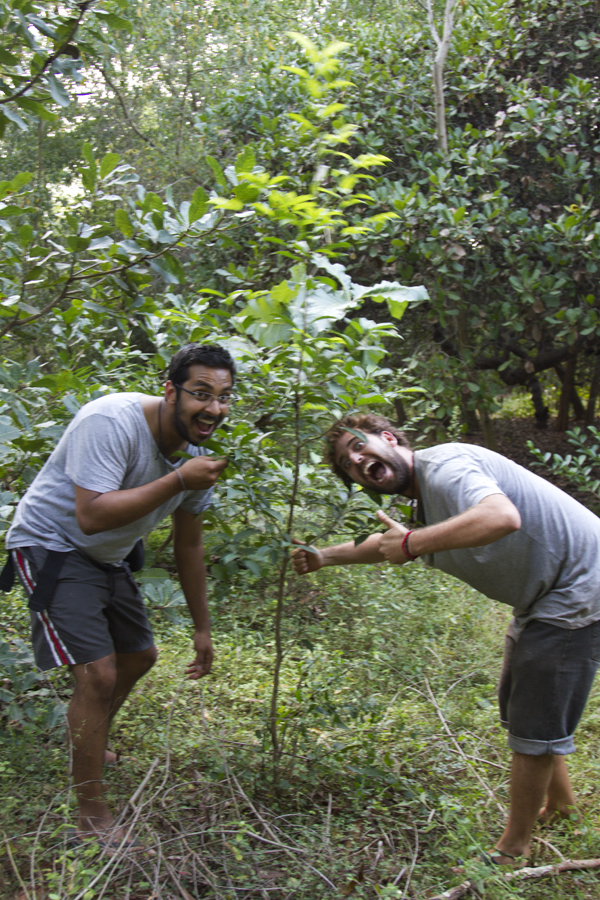
Here is a look at this year’s SDP Practicum 2011/12 tree planting:

A Sustainability Balancing Act in Auroville

by Laura Collier

Sustainability is not communism. It does not mean that everyone should have the same things, nor does it mean renouncing all of your worldly possessions and living in a hut. I have found myself struggling with this a bit during my time in Auroville. The surrounding villages and many parts of Pondicherry, especially after the recent cyclone, are impoverished, and life there can be very difficult. My experience in Auroville has been extremely pleasant, despite setbacks with power and water shortages as well as damage to trees and structures because of the storm. I’ve been well-fed, housed and taken care of. Is it inconsistent with the notion of sustainability if I eat an ice cream at the Visitor’s Center while I am working on a project to help a local NGO, which hopefully will have a positive effect on Auroville and the surrounding communities? Perhaps. But it is not inconsistent because I am eating ice cream and there are some people in the world, or even in Auroville, who cannot afford ice cream. It may be inconsistent with sustainability because I am eating too much ice cream or because of the costs, be they economic or environmental, to supply the cafe. But it is not a problem to have ice cream simply because there are people in the world who cannot have it.

The idea of living sustainably is partly to serve as a model for how others can or should live. Though I was assured by Sacha, one of our program coordinators, that “you don’t have to be Buddha,” or give up your entire life to serve others, living sustainably calls you to lead a life that can be a model for others in the world. The lifestyle should be one that generally, if adopted by others, would have a positive effect. It calls for sharing and conserving resources, being mindful of how you interact with the environment and consciously trying to give back to the world, your family, friends, neighbors and community on a local, national and/or international scale.

There must, however, be a question of how much inequality is acceptable in the concept sustainable living. Having a fortune that would be difficult to spend even in two lifetimes while people are dying from hunger in the streets, doesn’t fit into a sustainable living model. I would assert that everyone has the responsibility to give of their extra resources to ensure that the basic needs of others are met. The controversial part of this assertion comes in defining basic needs. Are they just clean water, food, and a place to live? How much water, food, living space? What type? Do we just cover the basics of human rights? There is a lot to interpret.

It is in search of this balance that Auroville’s experiment is interesting and important. One can dive into contemplating these issues and then go beyond and try to live them, not just on a personal scale, but in a community. I can say personally that I don’t think I’ve found my balance, but my eyes are opening to new ways to try. I may need to start by having less ice cream…or at least sharing more of it.

A Different Type of Learning

by Sorana Ionascu

People often say there is a huge dissonance between expectations and reality. Personally, I always thought of this as one of those clichés that make you cringe and you end up agreeing with only out of courtesy. India proved me wrong. About half-year ago, as I was drafting my application essay for the Practicum, I vividly remember including some thoughts along the lines of how this trip is going to change me forever. At the time, I was fully confident of the persuasive power my declaration would have on those who read it, but I only half-heartedly believed in the statement itself. In my case, I tried to limit pre-departure research because I wanted to live this experience on my own, unmediated by other people’s interpretations. India and especially Auroville was surrounded by an aura of mystery, best defined by “well it’s going to be different”. Still, I was not convinced that I would go through any life-changing process. Coming from Eastern Europe, pretty much anywhere I go in the world is an encounter with a different culture, so up until I arrived on Indian soil I was not expecting much more than an intense culture-shock.

I could not have been further away from the truth. In the past weeks, I was overwhelmed by the learning process that grabbed me and has not yet let go. India, especially Auroville, truly teaches me something new every day. And it is not only theoretical information; it is mostly valuable knowledge about how to live in harmony with nature and build a relationship based on respect. As the Earth’s resources are depleting, people here are trying to find tangible solutions to the problem and incorporate them into their everyday lives. Be it solar panels, composting toilets, recycling or planting trees, Aurovillians are constantly fighting to diminish their negative impact on the land. The first few days in India were an exercise in learning how to reconnect with nature. But it was not as easy as it sounds, as there was a lot of adapting involved. You are put in a situation where you have to forget the lifestyle you had back home. But it is not just slightly altering your behavior. You have to be willing to learn how to put the interest of the community before your own concepts of comfort. And trust me, it is not easy at first, but it sort of grows on you.

While I was barely getting used to this new approach to life, Cyclone Thane came by and left us with complete devastation. Looking at the bigger picture, this catastrophe taught us an important lesson in modesty. The lack of water and electricity combined with the witnessing of the destruction in the region is almost too much to explain in words. The first thing that comes to mind is gratitude that we are still alive and unharmed. The emotion that follows the appreciation is a sense of guilt, which leads to an encouragement of giving as much as we can to the community through our work on projects.

Every day I wake up with the impression that I am still dreaming. Half of the time I am overwhelmed by everything that is going on around me. Auroville is a constant learning experience that I will never forget. The culture-shock is indeed present, but it slowly becomes a minor element in the background of a lesson on adaptation and an attempt at understanding. While trying to arrange the confusion currently going on in my head, I stumbled upon a quote from Sri Aurobindo, Auroville’s main spiritual figure: “what the soul sees and has experienced, that it knows; the rest is appearance, prejudice and opinion”. With that in mind, I leave you dear reader to draw your own conclusions.

NGOs Galore!

By Madeline Boughton

The aim of this NGO Practicum is for students to act as interns or consultants to various organizations, assisting with their communication needs. Since day 2 we’ve been touring and visiting non-governmental organizations (NGOs). In only six days we visited about 19 different organizations out of 23. Each day is packed with multiple units where they present their goals and missions to students and answer any questions we might have.

The overarching themes of the NGOs we will work with are health and human rights, environmental sustainability, alternative energy, and sustainable fashion. These broad terms include causes such as women’s empowerment, Dalit rights (formerly known as Untouchables), children, sustainable and ethical fashion, sustainable living, radio, solar energy, waste management, and more! This NGO practicum truly offers something for everyone’s interest or passion.

With so many “good causes” it is difficult to choose just one. I could easily choose about 3 places I’d be interested in working for. The other factor that could make choosing an organization difficult is matching an organization with student’s skill sets. Some organizations need assistance with website building, creating pamphlets and flyers or creating short videos to display on existing sites. Fortunately, there is a wide range of skills within the group and we also have “media mentors” that will assist us with technical questions and projects.

After a few days of visiting 5 organizations per day, most of us had an idea of where we want to work. The remaining organizations and speakers were essentially lectures and informative sessions on the functioning and practices in Auroville. Even though we will wind up doing a major project at only one organization, we are now well informed on almost all that Auroville has to offer in terms of advocacy and will use that information when completing our projects and final papers. Some of us are quite anxious to begin work right away. I have chosen to work at the ADECOM Network. This agency advocates for the rights of the Dalit community. I am happy to assist this agency in any way in helping shed light on discrimination against a vulnerable people. We will keep you updated on how our progress and projects turn out.

Thanks for reading!

Image

The Other Side of Sustainability

By Shannon Warren

This morning Auroville was abuzz with the whirring of chainsaws slicing into fallen trees, the frantic beeping of the suddenly plentiful rickshaws, and the general chaos of people trying to make sense of the destruction around them.  It has been three days since cyclone Thane hit Auroville and the devastation is still astounding.  The heat and humidity bring into sharp relief the lack of drinking water and electricity as people venture out in the glaring sun to procure necessities and try to clear debris from the roads.  Some of our group has experienced natural disasters and many of us haven’t (I am included in the latter group).  Certainly none of us expected anything like this when we came to India for a practicum in communications and sustainable development.  I suppose the thing about learning, about self-improvement, is that you must be confronted with the unexpected and unknown to progress.

The night of the storm, while I curled up afraid but safe in my sheets and behind sturdy brick walls, I listened to the howling winds, shattering glass, and falling trees as peoples’ homes and livelihoods were destroyed in a matter of hours.  The next morning I woke up in disbelief.  Just one day earlier we were carefree, hiking up to a temple on top of a hill and swimming in a beautiful freshwater lake.  That morning we were not only in an unfamiliar landscape and culture, but had just been through the worst cyclone that had ever hit Auroville, according to local sources.

Although the situation could have escalated to the point of hysteria very quickly, we chose instead to play cards by flashlight and sit together singing familiar songs, letting our apprehension out through laughter rather than tears.  Some of us ventured out on the roads, clad in our raincoats and ponchos, to see how the villages had been affected and to search for food and water.  After climbing through the fallen giants blocking the roads and seeing that being in a mud hut during a cyclone as opposed to a sturdy brick building made a world of difference, we knew that we had our work cut out for us the next couple days.

The next day, New Year’s Eve, we donned our work clothes, picked up machetes, and started chopping and clearing up the trees and debris around our pavilions.  Suddenly it seemed as if we were no longer a group of semi-strangers brought together by wanderlust and a course requirement, we were all kindred spirits, working together to realize a common goal.

While traipsing through the grass behind my classmates with my arms full of branches and my heart full of determination, it became clear to me that there are two sides to sustainability: the physical side that involves composting toilets and cold showers as well as the emotional support that comes from being a member of a community which takes care of all of its members as well as the physical space that it inhabits.

So, while it may not have been the lesson we set out to learn, we have all discovered the emotional side of sustainability over the past few days.  Although the people who live here may not have many of the comforts we enjoy back home, they do have one thing that many of us don’t: the sense of security and assurance that comes from living in a community where people are connected and take care of one another.   I think I’d take that over an iPad any day of the week.

A New Year

By Lindsay Hebert

Seventeen years ago, Kalsang planted a service tree in preparation for a road that was to run through Auroville by way of her yard. The tree was a service tree, named for the cover it provides from the hot Indian sun. The road never came, but the tree grew to shade the pavilion where her daughter was born nine years later and where we have lived since we arrived in India. Someday, Kalsang wanted to build a house beneath that tree. But yesterday, in service to her, we used machetes to cut it into pieces.

Continue reading