Britain came to India in the 17th century. For over 300 years the British ruled India, exerting enormous influence over the economy, the laws, and the ways of thinking of one of the world’s oldest civilizations. Then they just up and left (more or less).
Now India has had to live with that colonial influence and Western way of life while still trying to hold on to their own culture, which has played out quite interestingly in the rights of the Indian population to be homosexual or transgender.
It is legal to be transgender, but illegal to be homosexual.
The legal acceptance of transgender stems from that fact that it is not viewed as sexuality, but simply a matter of gender: male or female. However, just because the law has made it so (even going so far as to declare transgenders to be a third gender) does not mean that society has accepted transgenders with open arms.
Homosexuality is an entirely different matter. It is a subject that is quite sexual in nature and simply a question of being either of the male or female gender. Intercourse between two men is considered to “against nature;” a violent act; and therefore even a consenting adult can be put in jail for up to 10 years simply for having sex with someone of the same gender.
In the Indian Penal Code, the 377 law, established during the British colonial era in 1860, criminalizes homosexuality as “carnal acts against the order of nature.” The LGBT community in India saw a hope for their rights though in 2009 when the Delhi High Court ruled that this law was a violation of fundamental rights. The victory was unfortunately short lived though as four years later the Supreme Court reversed the lower court’s decision, citing that it was a matter for Parliament to decide and not the justice system.
So besides being a taboo subject, since being homosexual is illegal it is therefore very hard for organizations to even form to help those in need. To provide information on safe sex practices, a safe space to simply discuss, or even just a place to be where someone doesn’t have to hide who they are. An organization we visited here in India, Sahodaran Community Oriented Health Development Society (SCHOD), is trying to do just that though.
At the moment SCHOD focus is to educate the LGBT community in regards to safe sex practices to lessen the cases of sexually transmitted infections and HIV/AIDS. However, the ultimate goal is the rights of the minority community they belong to. Our presenter, Sheetal, formally Rajesh, provided us with an eye-opening story of her life and her freedom of being able to transform from the male body she was born into to the female she was meant to be. However Sheetal and her organization have a long fight ahead of them.
So, in a nation determined to be still developing, though it claims to have the world’s largest democracy, where is the line drawn on what the government can and cannot tell its citizens they are allowed or not allowed to do? Should individuals of a country stand by and allow a government to tell us who we are and are not allowed to love?
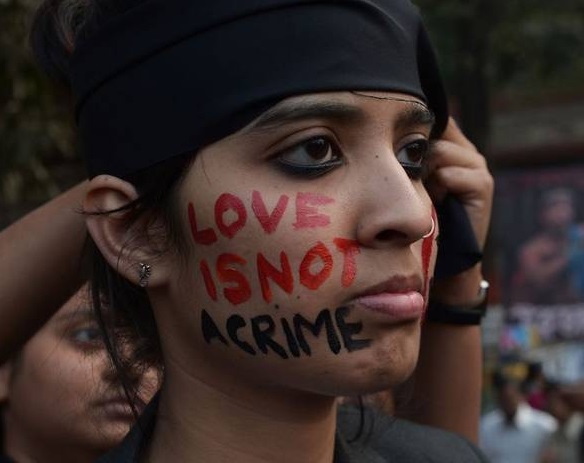
This subject though is really an issue of fundamental human rights. I cannot imagine how frustrating it must be for people of one country to look at those of another and be envious of the rights afforded to them (I am specifically thinking of India and the United States, though the US is by no means perfect). It is a complex problem of allowing each country to uphold its own traditions, customs, culture, etc. However, there are certain fundamental human rights that should globally be the same.
If you would like to read more on the subject, check out these articles.
– JLH

 AUP Sustainable Development Practicum in Auroville, India