Creche Visits and Microfinance Insights – Welcome to My Days at PSDF!

Indra Muthu – Creche Teacher and Self-Help Group Leader

Indra Muthu – Creche Teacher and Self-Help Group Leader

I am nearing the end of my internship with The People’s Social Development Foundation (PSDF) and have had an incredible experience. PSDF works to improve the socio-economic welfare of the Dalit community and women in the rural and slum villages surrounding the city of Pondicherry through awareness programs, childcare support services, disaster relief, family counseling, micro-credit entrepreneurship programs, and vocational training.

My favorite day of my internship thus far included site visits to 3 of the crèches (daycare/ pre-primary education centers) that PSDF runs in coordination with the Government of India’s Rajiv Gandhi National Crèche Scheme. The Rajiv Ghandi National Crèche Scheme For the Children of Working Mothers was started by the Government of India (GOI) in recognition of the “failure  to meet the needs of working mothers” in need of “quality substitute care for their young children while they are at work.” As free, public education is not provided for Indian children until they reach 4 years of age, families unable to afford private daycare fees must care for their young children on their own until they can begin school. Most of the children’s parents work as day laborers in factories, and while this provides generally consistent work, wages are very low, between 80-100 rupees day (approx. $1.30-1.62), and no benefits are provided. If both parents are able to bring in these wages consistently, the family can cover its basic shelter, food and clothing costs, but face difficulty any time a large or unexpected expense comes up, such as school tuition or sickness. Mothers who have to take care of children are unable to work at the factories as they provide no childcare services, thus imposing a great amount of financial stress on these families. Even if the child remains at home with their mother or another relative, it is rare for them to receive the kind of educational attention provided at the crèches, as many families are illiterate and/or do not speak English. Children thus enter school with little prior experience in reading or educational activity, making it easy for them to fall behind quickly.

I headed out to the crèches in the hopes of gathering lots of information and individual stories about the children in the crèches in order to assist my grant-writing and fundraising for PSDF and was able to gather quite a bit of good material even if it wasn’t what I was expecting!_MG_3322
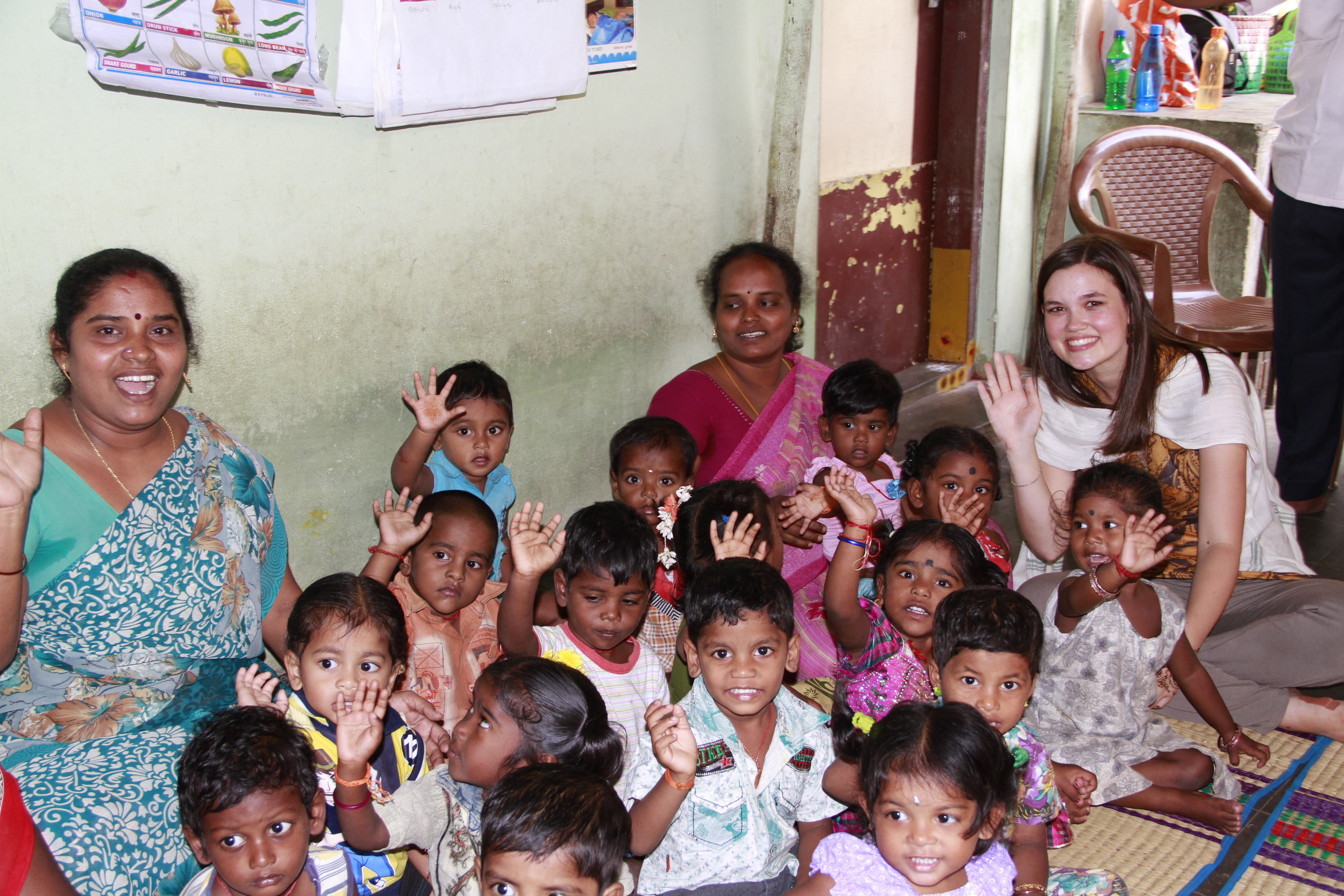
I did not anticipate that so many of the crèche teachers would be involved in or lead PSDF Micro-Credit Self Help Groups (SHGs) as well as teach in the crèches. I was struck by how both of the women that I interviewed more intensively really focused in on the social/non-economic impact of the SHGs and microfinance plans. I kept pushing questions about how/if microfinance had raised their living standards and what kind of income micro businesses generated in relation to other jobs – but after awhile my translator Segar laughingly told me that this topic didn’t seem to be what they were most interested in. Instead, the women kept telling him about the support system that the SHG had created for them.

Standing with Creche Teachers who are also SHG Members

Standing with Creche Teachers who are also SHG Members

Instead of simply grouping together in order to be able to have access to loans, PSDF requires its SHGs to save on their own through monthly contributions (usually 50-100 rupees) by each member. The women talked about how having this pool of savings took away their fear that even a small misfortune, such as a family member falling ill, could wreak havoc on their family financially. All of the women understand that misfortune could hit anyone of them, and thus know that even if their savings are going to help someone else in the immediate term, in the long term it is also providing security for them. Furthermore, the women told me about the strong bond that the SHG creates. For example, one told how in her group they are “each other’s biggest cheerleaders” and that if one woman opens a microbusiness, the group all comes on the first day to be her first customers. They then make sure to wear/show the products they bought around the village and surrounding villages, as a form of free advertising by word of mouth. The sari she was wearing that day was made by a member of her SHG, and she said that she drops that fact into conversation as much as possible to get the word out. Furthermore, through the education and awareness programs that PSDF conducts each month with the SHGs, the women bond even more by talking about issues that are often taboo, such as menstruation, domestic violence, dowry issues, and child abuse. The women see that they are not alone in their problems and can brainstorm ways to help each other or encourage each other to bring large issues to the Family Counseling Center at PSDF.
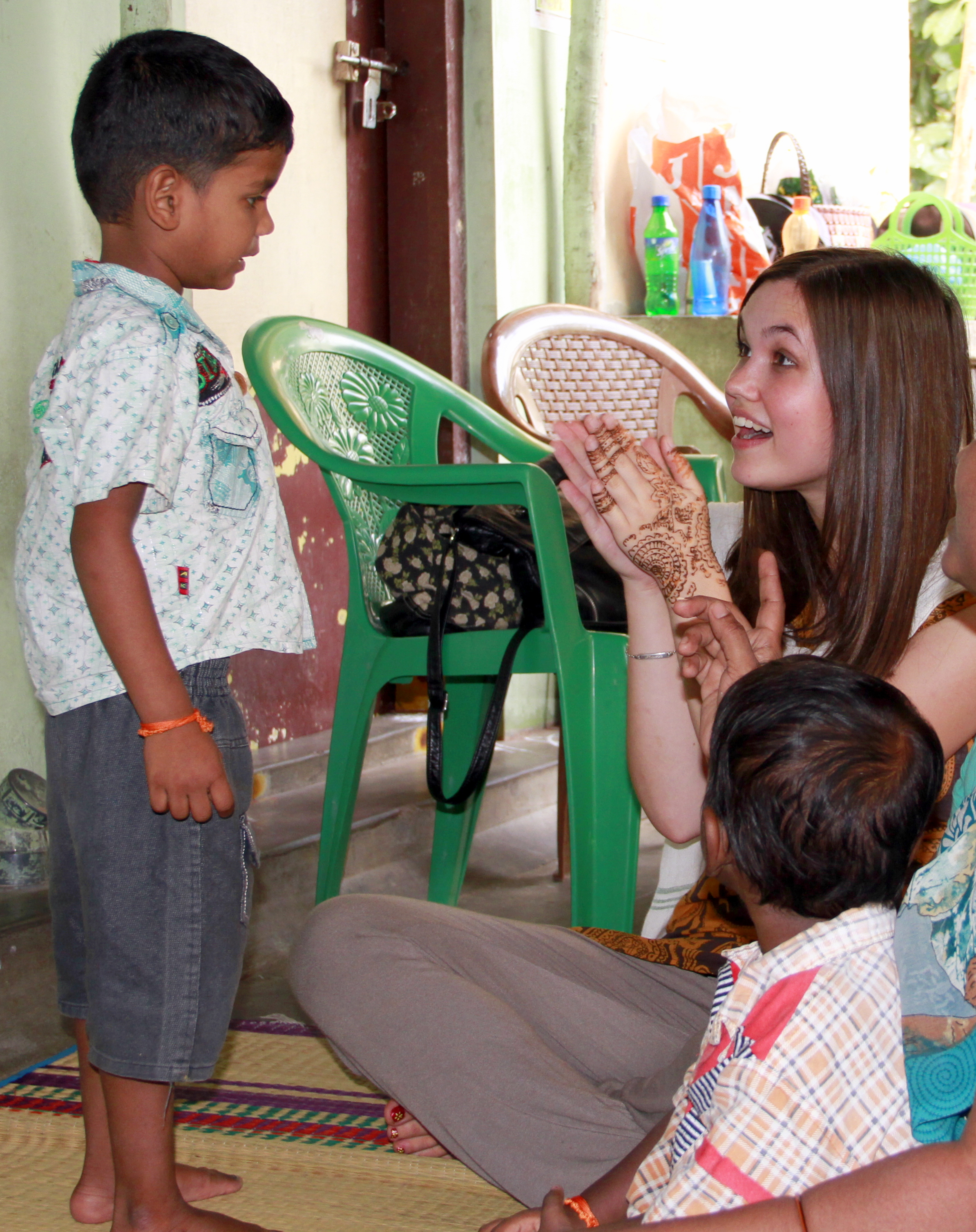
Listening to the children sing and recite in English - very impressive for only 1-3 years old!

Listening to the children sing and recite in English – very impressive for only 1-3 years old!

I did not expect that my main takeaway from these visits would be learning so much about how microfinance participants view the value of the assistance that microfinance provides them! It is a good lesson for me that while economic empowerment and a raising of one’s monetary standard is important in the context of impoverished peoples, “non-economic” empowerment is also extremely important and perhaps even more important to some, as these women indicated. This provides an important counter to the connotation that often comes with the term “non-economic empowerment” in the development community that denotes that this is somehow a lesser achievement than economic empowerment. I’m thankful that the women resisted the way my line of questioning/interviewing was going and instead shared what they really cared about – it’s difficult to be sensitive to that on my own when going through a translator, so I feel lucky to have gained this insight despite my preconceived notions about how microfinance worked. In the words of Radna Gandhi Madhi, a PSDF Self-Help Group Leader and Crèche Volunteer Helper, “Microfinance goes beyond improving one’s economic position, for me it is even more about the social effect of coming together.”

If you are interested in learning more about PSDF’s Crèche Program and how you can help them, please click here to be taken to their website. PSDF is currently conducting a 1 month “Crèche for Success” fundraiser to raise money to reopen 5 crèches that have been closed in the past 2 years due to lack of funds, leaving 125 children without free care and education during the day. $14 and 5 minutes of your time is all it takes to cover 2 children’s basic educational costs for an entire year! Thanks in advance for your interest and generosity!!

Anna Wiersma – American University of Paris

Investigating the Impact of Microfinance and Social Enterprises in Auroville

As a student whose primary interests lie in economic and social policy in the developing world, it isn’t too surprising that microfinance has captured my interest, just as it captured the interest of the development community worldwide. Yet, an increasing body of research finds little evidence that microfinance actually helps to lift its recipients out of poverty. Aneel Karnani’s article “Microfinance Misses Its Mark” provides a helpful example to help explain where scholars see microfinance falling short:

“Consider these two alternative scenarios: (1) A microfinancier lends $200 to each of 500 women so that each can buy a sewing machine and set up her own sewing microenterprise, or (2) a traditional financier lends $100,000 to one savvy entrepreneur and helps her set up a garment manufacturing business that employs 500 people. In the first case, the women must make enough money to pay off their usually high-interest loans while competing with each other in exactly the same market niche. Meanwhile the garment manufacturing business can exploit economies of scale and use modern manufacturing processes and organizational techniques to enrich not only its owners, but also its workers.”

Thus, this type of critique leads scholars to see microfinance as a tool that elevates the standard of living of those in poverty, without necessarily drawing them out of poverty, by giving them access to credit that they would not be able to obtain otherwise, due to their lack of collateral and the small loan amounts. Yet, the very small scale of these micro-funded activities is not conducive to actual poverty alleviation; instead, creation of stable jobs is necessary.

Therefore, I was particularly interested in seeing microfinance in action in Auroville, and have been presented with multiple opportunities to do so over the past 10 days. In our visits to different microfinance and social enterprise organizations in and around Auroville, I was fascinated to see this critique being embraced in innovative ways.

WellPaper doesn’t simply form groups of women to receive loans, it provides a structured training in the making of high quality products from recycled materials. Instead of sending the women out to create their own individual crafting enterprises, WellPaper acts as a collective buyer for the women, who can work individually or in teams to fill the orders that WellPaper receives. This provides reasonably steady employment for the women, though there are busy and slow order periods, and allows WellPaper to sell and market its products all over India and abroad.

The Auroville Village Action Group (AVAG) has touched the lives of over 4000 women through microloans and women’s groups and, while continuing to expand their microcredit programs, is investing more and more efforts in opening business lines that provide stable jobs that build on the skills that their loan recipients have acquired. They now have lines selling environmentally friendly feminine protection, clothing and jewelry all over India. Thus enterprise development is building upon initial microfinance and education efforts.

Naturellement goes even farther than providing stable jobs; indeed, its founder argues that this is not enough, and that educating her employees on personal finance and providing a community in which the women can discuss issues such as domestic violence is also necessary.

The People’s Social Development Foundation (PSDF) does focus on self-employment micro-enterprises, and the effects of this do indeed seem to tend more towards “softening the blow” of poverty rather than alleviating it. However, this is not to say that this is not useful. PSDF’s microfinance efforts have made great gains in freeing families from crippling debt to local moneylenders and empowering women in non-economic ways, through providing counseling and social forums to discuss domestic violence and women’s political and communal leadership.

PSDF conducts awareness programs and group counseling in the 47 villages that it works in, as well as providing microloans.

PSDF conducts awareness programs and group counseling in the 47 villages that it works in, as well as providing microloans.

Thus, while it is important to take critiques of microfinance into account, criticizing microfinance’s ability to alleviate poverty does not mean that microfinance is a completely ineffective tool. Opening large enterprises that provide stable jobs is not always feasible in the short-term, especially in rural areas that are not attractive to investors due to a lack of skilled workers.
Indeed, both AVAG and PSDF note that, while the microfinance approach may not pull its recipients out of poverty, when coupled with education initiatives, it provides a basis for further quality of life improvement in future generations and a stronger foundation for present and future skills acquisition, thus creating a more attractive environment for larger, traditional investors in the future. These organizations see less children being taken out of school to work and less interest and trust in financing from moneylenders.

Auroville has thus demonstrated to me how both microfinance and enterprise building can be used as a package to empower and alleviate the poverty of developing communities. There is rarely a true “silver bullet” in development; rather, development practitioners need to draw from a toolkit of multiple tools, depending on the specific situation at hand. While the Auroville context, from my observations, provides further evidence that microfinance is not necessarily the best tool for rapid poverty alleviation, and the power of enterprise building and job creation to do so instead, it also demonstrates the power of microfinance coupled with social and economic education to lay a foundation for skills acquisition and women’s non-economic empowerment, which may ultimately create a more conducive environment for larger scale job creation in the future.

Stay tuned as I begin my work with the People’s Social Development Foundation for these next two weeks and explore this topic and the power and shortfalls of microfinance in more detail!

– Anna Wiersma, American University of Paris – MPPA (Master of Public Policy and International Affairs)

Sources for further information on the “Microfinance Critique”:

Banerjee, A. V., & Duflo, E. (2006, October). The Economic Lives of the Poor. .

Karnani, A. (2007, Summer). Microfinance Misses Its Mark. Standord Social Innovation Review. Retrieved December 29, 2013, from http://www.ssireview.org/articles/entry/microfinance_misses_its_mark/

Panagariya, A. (2010, December 17). Does Microfinance Reduce Poverty? An Analysis of India’s Crisis. Brookings. Retrieved from http://www.brookings.edu/research/opinions/2010/12/17-india-panagariya#

Participant Observation

We have been in Auroville for almost two weeks, have chosen our organizations, and are preparing to begin work after the New Year. Through our readings (Participant Observation by Danny L Jorgensen and Participant-observation by Eric Laurier) and discussions we have learned about Participant Observation as a method in becoming involved in the community around us. The interaction with the local community is what has drawn most of us here. Observation and participation is something that it comes naturally to everyone since, at a simplified level, it means watching and mimicking. The challenge is to notice the nuances that happen in everyday interactions and be able to take a step back at the end and look at the big picture.

I was first attracted to India more than ten years ago through a book that many students in our AUP-Linnaeus group have read, Shantaram by Gregory David Roberts. I was excited to arrive in India and I have to admit when we first arrived I tried to take pictures of everything. It is easy to get sensory overload in India with all the noise, the fast pace, and the chatter in a language you do not understand. According to our readings this is being a “tourist.” So how do you take regular tourist or researcher observation and turn it into participant observation? Daily, I found myself taking less pictures, taking more notes, and keeping my head on a swivel to try to pick up some cultural specifics of our Tamil counterparts. I began by learning some Tamil: Vanakkam! (“welcome” or “hello”); Nandri! (“thank you”); Iillai (“no”). Then I picked up some gestures—saying yes with a head bob. These simple things seem to open the door a little bit for us into the Tamil culture.

I am looking forward to begin work. Our group of students will participate in a number of different organizations that work with Tamil people and Aurovillians. The first step has been to introduce ourselves to our organization managers and listen to their specific needs. We have a lot of work ahead of us to produce photos, write content for websites, create logos, grant writing, interviews to conduct, and videos to edit. Over the next two weeks our experience of India will change through our hands-on work.

In the article “Sustainable Development” by Edward Carr (Encyclopedia of Environment and Society, 2007) it is said that sustainable development is the linkage between issues in environmental, social, economic, and political concerns. We have observed firsthand how these issues often inter-work in this community and in our work we hope to participate in the steps towards developing sustainable solutions.

By Karin Johnson

Repair Culture

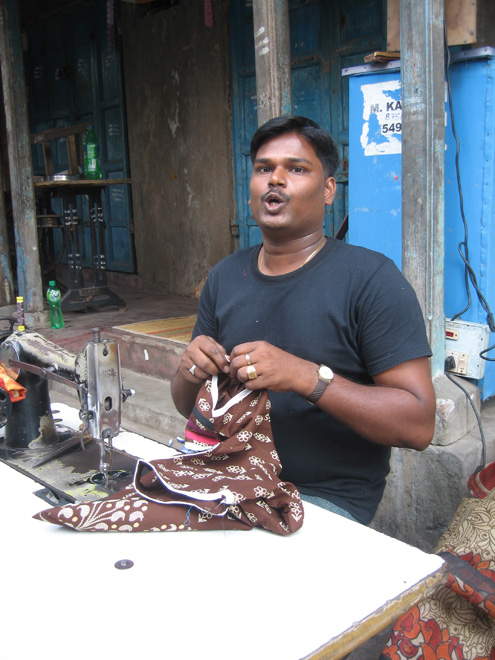
Street tailor in Pondicherry

Street tailor in Pondicherry

I picked up my laptop back from the repair shop today. It died two days after the cyclone hit, resting in a padded case with a full battery. I found it in the morning when I tried to turn it on and there was no response. No lights. No sounds. Nothing.

The only luck in my unhappy situation was that it happened in India, a country where you can get almost anything repaired. Almost anything.

A few days ago in Pondicherry, my friend ripped one of his two-dollar flip-flops. The shoes were almost disposable, so his first reaction was to toss them and buy a new pair. But when he asked for the nearest shoe store, he was pointed to a repairman lounging on the side of the road. A few cents and seconds later, his shoes were as good as new. He saved money and another pair of potential trash was saved from the landfill.

On a similar shopping trip, I bought a shirt that was a size too big for me. At home, it would have ended up sitting in the back of my closet, but not in India. Here, I simply handed it to a man sitting on the street with a small table and an old Singer sewing machine. Half an hour later I had a custom-fitted shirt.

As for my computer, it now has two more gigabytes of internal memory and is working better than new. Not only did I save myself from buying a new computer, I saved a pile of electronics from ending up in the Pondicherry dump (link to dump post).

The abundance of convenient and affordable repair services exist here because they save money, not because they save the environment. But the practice of repairing rather than re-purchasing keeps reusable resources from rotting in a landfill. It is a practice that contributes to a sustainable lifestyle and one that I wish was more common in the United States, where I’m from. When I get back, I plan to pay more frequent visits to my local repair shops, to promote my own repair culture at home.

From the Edge of the Sphere: Progress as development of modernity.

by Andrés Del Castillo 

El Progreso

“There is no Route to Peace, Peace is the Route” M. Gandhi: As I reread this introductory quote, an ant climbed on to the screen of my laptop; I squish it with my finger. Now there is one fewer ant to kill, or a battle has begun.

2012 began for us without electricity, which means without technology: low battery in the camera, no internet, and no social networks.  Little by little, I realized how dependant we are on technology and the automatic link between development and progress.

Indeed, progress means to go forward, but it is not a synonym for technology or modernity. Modernity is a hand that uses the lantern, which is technology, to show us the way to follow, but leaves the context in darkness. (Baudelaire?)

On the other hand, development is not a goal; it is a process toward progress, not toward modernity. In Kant´s words, progress involves “chronological unfairness.”

Progress takes many resources, which leaves fewer for those in the future, who will actually reap the benefits.  It also demands labor and innovation from those in the past, who do not get to enjoy the fruits of their works. It is unfair to the past and future generations. In an attempt to compensate for future generations, sustainable development is one of the ways to mitigate the chronological injustice.

Kant argued that progress is not a measure of prosperity or knowledge, but rather a necessary step toward enlightened culture and the abolition of the war, which in others words means a culture of peace.

I squish another ant with my finger.

Sustainable development is just one side of the coin. On the other side, there is the culture of peace. As human-centred approach to address current global challenges, the concepts of culture of peace and sustainable development are intrinsically linked. Peace must not be considered as the mere absence of war, but as an environment where human rights are observed and where every person has the possibility to realize his or her potential.

The core elements of peace and sustainable development are the respect of life, human rights, dignity, freedom, stability, social harmony, duty of forgiveness, justice, tolerance, mutual respect, solidarity, gender equality, and a lasting and sincere dialogue.

In my reflection, I have done my best to try to explain (or confuse) the difference between modernity, progress, technology and development. This practicum is our time to act, stopping occasionally to think about the meaning of the words that we wish implement.

The unfortunate ants were stuck between a rock and a hard place, or between the screen – technology and my finger – humanity.

MacBook, MacBook Everywhere, nor Any Plug in Sight

Jeomar Montelon

For those of us from developed nations, it’s unusual to think about our world without the “basic amenities” in life. By “basic amenities” I mean technology and Web 2.0. They have undeniably become our source of information, formed our social cohesions, and kept us engaged with the onslaught of our friends’ Facebook status updates. As Global Communication students, access to technology is at the very heart of our academic and professional existence.

But what happens when you’re living in a developing country far away, and you happen to be in the midst of a natural disaster? How do you remain informed and able to carry out tasks when needed? That’s what happened to us last week. On the night of December 29th, Auroville and the surrounding area witnessed one of the worst storms in decades that leveled villages, destroyed 70% of the natural vegetation, and left us completely off the grid.

There we were, a group of communications students incapable of beginning our projects because we lacked the necessities needed to see us through our work. Without electricity we can’t charge our computers. Without computers, we can’t work on our projects and utilize the Internet. Without the Internet…well, we might as well be drawing paintings on a cave wall.  As the days dragged on, some of us began to develop a type of “island fever.” With trees knocked-down, blocking access to the outside, we were in a sense, trapped. “Why are we even here?” some of us began to ask ourselves. We found ourselves questioning whether or not our projects would even commence, and a feeling of uncertainty began to linger in the air. What about food; would we eat that day? –Not a concern. Was there enough water to shower, let alone drink? –It didn’t matter. Our main priority was getting ourselves back on the grid.

In retrospect, it’s weird – almost embarrassing to be so preoccupied with feeling inadequate due to lack of technology when there are villages less than 3km away lacking food, water and even shelter. But should we feel bad? We were here for a specific purpose, so what do our needs have to do with the needs of others? Is it my fault I was born an American, automatically making my values different from others in this situation? These are questions I asked myself with nothing to be done but stare at the flame of a burning candle.

Unfortunately, this story ends well only for the Practicum students. While our technological amenities were eventually restored, we don’t know if those most in need received their real amenities. And you know what – we probably never will.