Building a village cultural learning centre from scratch

BY SIMON MUSASIZI

Written on January 4, 2018

When Ponnusamy Balasundaram, first came to Auroville, a lot of things captured his eye. The village was dotted with foreign faces living in nice houses with an enthusiasm about Indian culture, which many youths in the other villages were abandoning.

Balu, as he’s commonly known, had been sent to bring food to his grandfather, who made a living working as a casual laborer at the construction site of Matrimandir where he supervised a team of 60-70 workers. The then 12-year-old, Balu recalls that Auroville was a beehive of activities, with construction work going on everywhere. The above environment in Auroville inspired Balu; he knew this was the place he wanted to live. That explains why every day after school, the seventh-grade student would gladly avail himself to take food to his grandfather, uncles, and cousins at the construction site and would use this chance to link up with classmates to chat. Following the death of his father at young age, Balu grew up with his grandfather in Sanjeevinagar, a village surrounding Auroville.

The dramatic loss had an impact on his upbringing and resulted in him being always among the last people in class. Yet, he always had a dream of working together with friends to have a positive contribution to his society. His teacher noticed this attribute and always encouraged him: “Education isn’t working, but you have the energy and passion for doing something.” This encouraged him to pursue his vision. He came up with an idea to start cleaning up Auroville, which at the time had bushy roads, with poor drainage. When he proposed it to his friends, some liked it, others ridiculed it –because as young and ambitious teenagers, they would not imagine lowering themselves to being street cleaners. But Balu, who dropped out of school while doing a diploma in electrical engineering, had the backing of two Aurovilians: Bavana of Auroville Village Action Trust, and Aurelio with whom he later started Svaram Music Centre. These two believed in his idea and he would always run to them for advice.

In 2001, what started as street talk began to materialize when Balu and his friends secured a house for rent in Sanjeevinagar.

“We needed a place where we can conveniently meet because we always met at the bus stop where we would talk casually,” he recalls.

They went house-to-house to try and raise money for rent. With Bavana and Aurelio’s support, they were able to have the house, hence, Mohanam Village Heritage Centre was born in one of the last traditional houses of Sanjeevinagar.

The vision now expanded to create a heritage centre that would act as a bridge between the traditional and modern, the old and the young, and between what is happening in Auroville and its surrounding villages. This is because when Balu arrived in Auroville, there were many curious minds that wanted to know more about his culture. They would bombard him with so many questions, which inspired him to share the knowledge. Many young people who had settled in Auroville with their parents would tell him, ‘We want the real Indian experience; where do we get it?’ And he would reply to them, “But you’re in India’. They would then say, “In Auroville, we meet the same people we left in Paris, Germany, Holland. We want to meet Indian people.” This curiosity of the Aurovilians inspired him to think bigger to create a centre that would bridge the gap between Auroville and its surrounding villages.

The cultural centre therefore started tours that provided opportunity for the visitors to interact with the locals and get a taste of their culture. That way, it also began to reenergize the locals to believe more in their culture. Mohanam thereafter spread its wings into livelihood programs. In 2006, Mohanam Women’s Group was founded as a way of empowering women and making them less dependent on men. Based at Mohanam Malargal House, the women are trained in skills such as tailoring, embroidery and fabric painting. For children, there are various projects, one being the Mohanam Kindergarten with strong emphasis on creative and child-centered approach, with the foundational experience of modern child psychology and new pedagogical methods.

For local youth, Mohanam offers classes in folk dance, Carnatic singing, arts and crafts, yoga, martial arts, and theatre.  The organization keeps the youth active and stimulated as well as ensuring they have a good knowledge of cultural practice, helping them to find identity and connection to their own original culture.

There is ongoing and collaborative work regarding community welfare and development in Sanjeevinagar and Alankuppam villages, where the Mohanam team, the village elders and the youths join hands to work towards a sustainable environment.

Today, Mohanam has become the Auroville bioregion arts and cultural historical knowledge hub. “We want to be more dynamic. It is a place where people can explore the local cultural values. The dream is that every village should have a cultural centre; it is critical for future generations, to have a place where they can get in touch with their tradition and local knowledge. This is what I feel is missing. We need to create space for the next generation to understand the value of nature, to bring harmony, and peace for community building,” says Balu.

“You can be modern, but you do not have to forget where you are coming from. It is very important that we keep the connection from where we came from and find our roots. This brings community together and fosters unity.”

Currently, Mohanam is building its future campus, having received support from the Pondicherry government department of tourism and the French government. The new campus spans about five acres with a lake, which will be developed as an ecological project for the community.

Yet not everything has been achieved on a silver plate. The hardest year for the organization was 2008 when there was no funding at all. This demoralized workers and some of Balu’s friends, who quit for profit-making ventures.

Fortunately, in 2009 came support from the Lion’s Club of Holland. There was also funding from the Rose Foundation, a women’s organisation in Japan, and many other organizations have since then supported Mohanam.


Humans of Auroville

By Stephanie Alex
Written on Jan. 8

DSC00993

“My name is Madhu. I’m 27 years old.  I am from Tamil Nadu, India. I work doing graphic design and social media at Village Action Group. I create music, I do theater and I’m a dancer. I am also working with kids, teaching them what I’ve learned.  What I like the most is to be on stage, do different dances and performances with my friends. Every-time I am on stage it reminds me that I can do anything. When I was growing up I was way too shy to even dance, I remember the first time I went on stage and I did a performance, I was so happy by the end of it. I really believed that dancing and music were not for me, that I could never do that. But once I did start practicing and continued preforming, it gave me the confidence to believe that I could do anything. From all the people that I’ve learned to all the challenges that I faced, I know growing up in Auroville had a big influence in becoming who I am today.”

“I’ve noticed how every-time I go to my own village I feel like an outsider, I feel that in there everyone is the same. Every-time I visit my mum in the village, she tells me Madhu you cannot do this, you need to cut your long hair, you can’t wear earnings, you should do this and you should do that. But the main thing that I’ve learned in Auroville is that I can do what I love to do and be who I want to be.”

“I remember growing up being six or seven years old, when my father was a construction worker. I remember being on my school holiday and my father took me to work with him that day. I was playing with the sand while he was building houses in Auroville, when I saw for the first time a family of white people (jiggles) can I say that? I remember the voices in my head asking why are they white? what are they doing in here? The father of a family that was there that day invited me to play with his kids. I couldn’t understand them and they couldn’t understand me, but we played the whole day. That day Auroville started for me.”


GNO

This moment is so unreal I’m not even sure how to perceive it. I’m lying on a thin cloth blanket draped over the hard tile floor. A small pillow rest behind my head and this pen on paper is the only thing I can think to do, as I’m not sure sleeping is an option.

There is a transgender woman lying beside me. The room is filled with smoke from the prayer ritual she performed earlier this evening. The fan is on full blast, so strong that I’m really not sure I can sleep through the noise. Her daughter is asleep on the cold floor in the next room, but the lights are still on as I, their guest, is not yet ready for bed. I’m on the far-left corner of the room and she is on the far right. A pillow lays vacant it between us until dawn when the third woman returns from a night of prostitution.

I have been invited into the home of three transgender women. The youngest is a mere 17 years and spends her days begging on the streets. She is young and juvenile. She plays the role of the daughter entirely, cleaning up after her parents, making coffee and tea, fetching a drink or cigarette at their beck and call. Her guardians are not much older; one is 21 and the other 28. Together they live in an apartment smaller than my bedroom. They have their own unique family dynamic that is no different than any other. They support each other financially and emotionally as best they can.

In my quick glimpse into the lives of seven transgender women, I learn the ins and outs of their lifestyle. It was a party they told me, just for me. All the women get together and we enjoy an evening of food and laughter until it is time to go to work. Each of the girls took out their makeup bags, showing me all the products they use as they proudly put on their face. Each woman one by one applies her makeup and changes her clothes for the night to come. I joined them in the ritual and apply some of my own, as I realize they stopped what they were doing to watch and learn from me. They begin to comment on my complexion, hair color, and eyes in a way that I had never experienced before. They kept asking me if I wear lenses and of course my answer was yes because I can’t see without them, but by the time the night rolled around and I lay here writing about the days experience I realized they weren’t asking me if I wore lenses to see, but they didn’t believe that my blue eyes were real. One of the women asked me how I get my complexion so fair. Do you use cream she asked? What can I do to look like you? I’m not sure how to respond, so I returned the quasi complement by telling her how beautiful she looked and that she shouldn’t change a thing. Although in my head, I knew she honestly wanted an answer of how to whiten her skin and get blue contact lenses to look more beautiful.

I stop what I’m doing as I’ve have enough in the spotlight and each of them go back to their own process. Through a strong language barrier, I learn that four of the seven girls around me have graduated from University with degrees in engineering. They explain to me their studies and how some of their hobbies are computer programming and design. I listen to their stories and realize the complexity of what they are telling me versus what I am seeing. These women are educated, they have the ability to live successful lives and be financially stable—only if they were men. The reality of it is that they can brag about their college degrees to me only as they are preparing for a night of prostitution because it is their only possibility of bringing income to their families. They shift from the subject of university to prostitution as if it’s no big deal. They act as if they have accepted their line of work, as there are very few other ways to live their lives openly as trans women. The only woman who doesn’t do sex work anymore lives upstairs and was able get out of it once she married. Her husband, a transgender man, is the moneymaker. She told me a little bit about her active sex life and the other girls giggled to themselves exclaiming, “They have sex every day!”. Their intention was to say that this wasn’t so normal and I’m still not sure why they feel this way. Is her active sex life strange because the rest of them are paid for sex? Is a love relationship so foreign within Indian culture?

Once the girls are dressed and ready for the night we say our goodbyes as I won’t see them until I wake the next morning. The woman laying beside me playing on her phone as I write in my notebook is missing a night’s worth of income just stay behind and chaperone me. As I pause to stare up at the turquoise walls chipping and fading away, I wonder how many others have looked up at the same four walls. The women who live in the apartment told me earlier that they had only lived there for three months. She explained that they have to move often because neighbors have problems living with transgender’s.

I finally get tired, as I think the exhaustion from the overwhelming day finally sinks in…

A call for action

By Dorothea Mursch-Edlmayr, written on 03.01.2018

The sustainable fashion brand Upasana stands for “design for change” with a socially responsible approach that goes beyond the product. It stands for the farmers, the weavers, the dyers and the whole production chain, with the mission to bring out India’s identity through textiles. Fashion Designer and founder of Upasana, Uma Prajapati set her principles on ethics and integrity. Over the last 20 years, Upasana has started many projects to support various local communities and to raise awareness for different social issues circling around fashion. In 2017 Upasana launched a new project “The Conscious Fashion Hub”. “Looking at our journey with all the social projects and actions and processes, we’ve realized it’s time to share that, to give a collective space to share and exchange. And since there was none we’ve decided to create one,” explains Uma Prajapati.

The conscious fashion hub logo-01

“The Conscious Fashion Hub” is a platform to share knowledge and start discussions about social issues such as farmer suicides in India, plastic pollution, fashion waste production, women empowerment and employment, craft empowerment and many more. The platform is initiated by Upasana and is based on principles of ethical business, slow fashion, fashion revolution, fair-trade and community empowerment. Karthik Subramanian is part of the communications team of Upasana and explains the intention of the project as the next step for the brand following its actions and ideologies. He says “the idea is to be louder, to make noise and to make people curious about the noise through sharing knowledge and information about an issue they interact with everyday in their life.” The project aims to bring together textile and fashion enthusiasts, students, artists, designers, social workers, farmers, businessmen, environmentalists and everyone with an interest in the country’s future to discuss, brainstorm and practice sustainability in fashion towards more consciousness. The first event was “The Desi cotton workshop” that took place in June 2017. Speakers and workshops gave the audience the chance to gain knowledge about the history of cotton in India, the lives of the people working with cotton, the dramatic consequences of a non-conscious interaction with our garments. The workshop allowed for a space to ponder, learn and encourage the participants to get involved in the processes of upcycling, natural dyeing and conscious styling.

The first event was dedicated to the topic of cotton because farmer’s suicide in India is the most sensitive issue. It is connected with one of the greatest resources in South India that lost its relation with the tradition and heritage of the country because of exploitation of people and the environment.

Priyadarshini Ravichandran, the photographer for Upasana was very touched by the Desi cotton workshop; “People need to know that there is a history behind textiles especially in India where it’s so closely connected to every region. It’s intertwined with the geography of the region, the arts, the aesthetics – we need to respect the history and art of this beautiful medium called fashion.”

Uma Prajapati’s entry point of conscious fashion is the farmer’s community since day one, to make a change for the people who contribute the base for almost every garment we are wearing. “Conscious fashion is about the story of what you wear and about the garment itself,” explains head of communications Madhumita Chandra. So we need to start to value the whole supply chain and the work and effort of every single person involved in order to understand the long way from the seed to the garment. Conscious fashion means responsible fashion and the understanding that every action has a reaction and each one of us can choose who and what we support with every single purchase. In order to start a conscious way of thinking towards fashion, people need to gain knowledge, people need to ask questions and people need to make the effort of getting involved.

“The Conscious Fashion Hub” is the platform for exchange and reforming perspectives towards a more conscious approach to fashion and it’s real price and value giving the people who plant the seeds, who weave and dye the fabric, who cut, stitch, sew and embroider the textiles a space to tell their stories and be heard. “The platform is a space of collaboration to endorse and acknowledge each other”, states Upasana’s founder Uma Prajapati. We all are involved in fashion in our daily life contributing and supporting consciously or non-consciously – exploitation, unethical treatment, overuse and waste of resources and overall violation of human rights because of a lack of knowledge and awareness. But this excuse of not knowing is not acceptable. Consciousness means making an effort that can result in a change in the bigger picture trying to make the world a better place. And in order to achieve this goal, we need to start a movement of conscious fashion that leads into a conscious lifestyle. Upasana and “The Conscious Fashion Hub” will continue to raise awareness for the issues to help people reconnect with their garments and India’s heritage and tradition with textiles. We need an ethical, sustainable and conscious way with a socially responsible interaction with the whole fashion community.

Read the article on Upasana’s blog as well and don’t forget to follow the Social Media Channels of The Conscious Fashion Hub. Join the movement for more consciousness.

http://www.upasana.in/2018/01/03/call-action-conscious-fashion-hub/

https://www.facebook.com/theconsciousfashionhub/

https://www.instagram.com/theconsciousfashionhub/


I’m Wiped Out: An Auroville Experience

By Katie McGarr
Written on Jan. 6

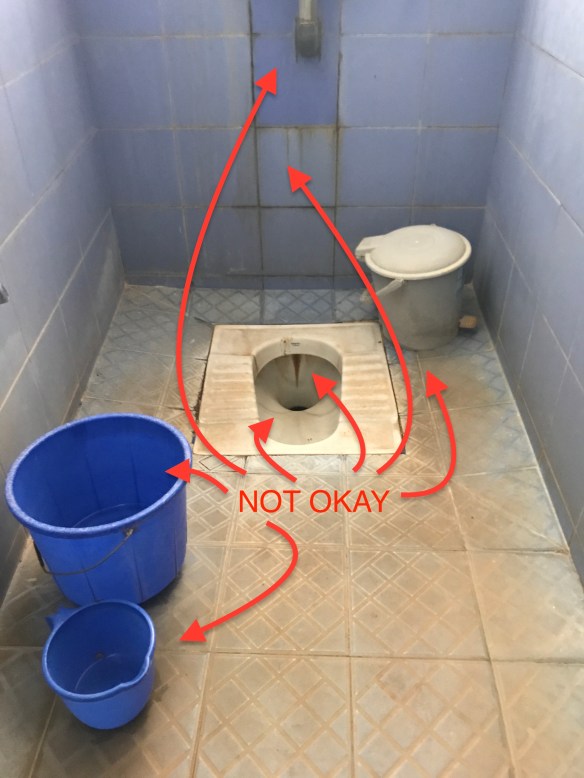
I have been in India for twenty-five days. Twenty-five days, and going to the bathroom is still a trivial matter, and I would even go as far as to say my biggest challenge.  Most toilets in India are very different from the ones in Western culture — I like to call them squatty potties.  They are exactly as they sound, you go into a stall and squat over a hole.  Admittedly, this is not the most difficult part.  It is the post-excretion ritual that gives me the struggle. But wouldn’t someone of Indian culture find themselves struggling to adapt to the Western bathroom ritual?

Did you know that Indians generally find the Western wipe to be unsanitary? Westerners wipe, using paper, usually with their dominant hand.  That toilet paper either ends up in the septic system, which makes it harder for bacteria to break down the matter, or it ends up in the garbage where it becomes part of a land fill or ends up in the dump thus adding to the already unsanitary conditions.  In Indian culture there is no paper waste, allowing for the bacteria to properly break down waste and thus makes Indian toilets more environmentally friendly and sustainable.  In Southern India, one uses a bucket of water, or a hose in rare cases, and they use their left hand to clean themselves. As a result, the left hand is considered “impure” and you will never see an Indian eating their food with that hand as a result.  Indians cannot fathom why someone would the same hand they eat with, to wipe themselves after going to the bathroom. This leaves the major question—which method is actually more sanitary?

NOTOKAY

Sanitary is relative, and the answer may surprise you, as it did me.  During our week of NGO visits, we had a special lecture from Dr. Lucas, a man who has devoted his life to poop.  He would argue that the Indian toilet culture is more sustainable and better for the environment.  You may ask, but using paper creates a buffer between your and the waste, decreasing the chances of fecal matter getting on your hands and spreading illness. Most fecal –oral infections do not come from mishandled food but rather, eutrophic bodies of water, hypoxic seashores and nutrient-poor soil— a problem that conventional methods of sanitation causes.  Septic systems in India are more sustainable, as mentioned before, and in less time than conventional septic systems, the waste turns into highly nutritious soil that can be used as fertilizer.

It is uncommon for Indians to have a bathroom located inside of their house.  This is not a totally foreign concept, but in today’s Western society it is seen as outdated.  The mindset is, why would one go to the bathroom in close space and proximity to the kitchen? Many Western living quarters admittedly do have bathroom and kitchens located right next to each other.  This is related to the Indian concept of “in” and “out”. Indian’s believe that the “in” which is your space–be it your body, living quarters, etc—should be pure and clean. Anything that is dirty, is placed “out”, which is why anything associated with waste is usually placed outside (garbage, toilets, etc.).

So while convinced the Indian ways of going to the bathroom are hygienic and more sustainable for the environment, having toilet paper is still a necessity. Can a middle ground exist, where all cultures meet in harmony, in one single gesture? My trip to India made me think very hard about the idea of poop. Maybe Dr. Lucas found the solution that not only provides harmonious, sustainable comfort in the bathroom, maybe that solution still remains to be invented. In any case, I stick to my toilet paper, thank you very much.

A Letter To No-one

Never to be Sent

My Dearest Family,

Who I love more than anything.

I’ve thought a lot about what I would tell you, the things I knew you wanted to hear, the things I know you don’t. I’ve realized there is no point in having secrets from the people I love the most, but I also know there are some things that are too painful to hear.

I’ll start with an analogy.

In dive training we were taught that a drowning man will always cling to the highest point— unfortunately for his savior, it is the head. He will dunk you under in a chest seizing game of chicken; so you train to remain calm, to hold your breath until the drowning man can get his own. Working in development is like going out into a riptide. At one point you lose your footing, then your buoy, without such things you start to question if you can float yourself. You are engulfed by waves, frantic energy tries to drag you under before you can even reach the man you are trying to save. When you get to him you’ve lost all your tools, and you are there, naked, hoping that you can hold your breath long enough.  Long enough to save him, to give him respite from the salt water gushing into his lungs: long enough to survive the pressure building in your chest: long enough for yourself, to keep yourself free from the salty flooding.

I feel like the drowning man myself sometimes, praying for respite as I am dragged farther from the shore, farther from familiarity.

Please don’t fret over my explanation, it is myself at my lowest point. Sometimes I ride the waves, I float for hours on calmer waters; knowing that if I don’t, if I keep kicking— I too will drown. To save something for yourself, I think that is the hardest part of development, that and the feeling of being naked in front of a drowning man.

Even as I sit here, I accidentally make eye contact with a man on the side of the road— he braiding elastic rope as I look over my lunch. He’s there every day, his place set in the stone of his life and I’ve never seen him make a sale. Sitting by the side of the road, braiding this rope is all he has, so he does it each day.

The only thing I recognize in this uncomfortable place is the sweet eyes of a dog, who visits me for food I no longer have, stays for a good rub and then meanders away to stare sweetly at somebody else.

All dogs seem familiar to me—even those that stare with guarded, alert eyes; ready to snap for some reason or another.

If dogs are the same everywhere, if cows have the same kind eyes, are humans not too?

Are we just the same? The best and the worst of us? Am I not the same as the man who braids rope on the side of the street? Who braids everyday but never makes a sale?

The best and the worst of humanity is in each of us, so how can I not feel fraternity for this man? For the drowning man?

Is it the ego that jumps in the way? That screams ‘I am not like anyone else!’ Is it the ego that separates us from the worst of human kind— murders and manipulators, those that knowingly feed off of others’ ignorance? The thieves who comprehend the harm they are doing? Should we not celebrate the ego then— the thing inside of us that separates us from knowing depravity? The thing that screams “I am not like him!”

But is it not also the ego that separates us from the man on the street? That whispers ‘I am not like him’ comfortingly in our ears?

In these moments I’ve turned to the words of the Mother, while alien, she provides a semblance of comfort:

… you are made up entirely of something which is the forces of Nature expressing a higher Will of which you are unconscious.

    ‘Only, one doesn’t understand this except when one can come out of one’s ego, though it be only for a moment; for the ego – and this is its strength – is convinced that it alone decides. But if one looks attentively, one notices that it is moved by all sorts of things which are not itself. . . .

    ‘From the minute you become unconscious of the Unity – unity of Force, unity of Consciousness and unity of Will – well you no longer have the perception which makes you quite separate from others, so that you do not know what goes on in them, they are strangers to you, you are shut up as it were in your own skin, and have no contact with others except quite externally and superficially. But this happens precisely because you have not realised in yourself the perception of this oneness of Consciousness, Force and Will – even of material vibrations’” 

So do we celebrate or lament our ego?

Is it our greatest strength or our most crippling weakness?

My dearest family,

These are the thoughts I cannot share, for if I did they would break your heart. So they shall remain a secret, familiar only to myself.

-Your loving daughter

Second in Line: Women’s Rights

Imagine you have prepared a delicious meal for your family.

The aroma of the freshly prepared dinner fills the room, your mouth waters with anticipation. You have not eaten since breakfast and you have spent the last two hours preparing your favorite dish for your family. You begin serving the meal, first to your sons, then to your husband, and lastly to yourself. To your dismay, you watch as the food disappears before your eyes. By the time you are finally able to serve yourself, the best food has been served to the men of the family and all that is left for you to eat is meager handful of rice.

For many women in India, this scenario is a common experience that stems from deeply held cultural beliefs that perpetuate discrimination against women. Viewed as the future of the family, sons are believed to be the most hardworking and deserving, and it is believed that they should be fed first with the best food available. It is considered a wife’s duty to her family to serve herself last, eating only what is remaining after the men and the others have eaten. Often this amounts to very little or no food at all. Ironically, while women are expected to be the primary providers of health and nutrition for their families, it is the same women who suffer the greater extent from hunger and poverty.

These deeply held beliefs rooted in religious doctrine, practices, legal systems, and cultural traditions require that women across India give up their individual rights and sacrifice their personal well-being for the benefit of their husbands, families, and community. Generally, it seems that these issues are deeply related to a lack of education and understanding. Many women are prohibited from gaining a proper education and are denied a voice in society. We have visited several NGOs working in Auroville to minimize gender discrimination, one of which being the Life Education Center (LEC). The LEC is an NGO that seeks to combat gender discrimination by empowering girls through education in order to build their self-confidence, self-worth, and to give them a voice in their families and within their community. While this NGO seeks to empower women during their time spent at the LEC, their programs are aimed to help these women develop skills and confidence that are sustainable and continuously developed beyond their time spent at the LEC.

The LEC was established in 1991 and has since provided a safe learning environment for women from Auroville and the surrounding villages. The LEC’s mission is to support women’s empowerment through education, seeking to “bring social change through a change in consciousness.” At the LEC, young women are provided a safe educational space where they learn skills and tools that enable them to continue their personal growth even after their time spent in the LEC. The LEC currently offers vocational training programs as a means to provide an opportunity to earn a livelihood and to help support their families. This vocational training program is a means to bring identity and dignity to women who are often oppressed and considered inferior by society. At the LEC, women are encouraged to connect to their inner creativity and consciousness, and to use their work as a way to reflect, build confidence, and express themselves through their craft. Not only do they offer a means for women to learn technical skills, they also offer entrepreneurial skill development programs, collective quilting classes, health and nutrition workshops, cooking classes with a focus on sustainability, and a career development program that helps young women in the college application process.


Indian Nature

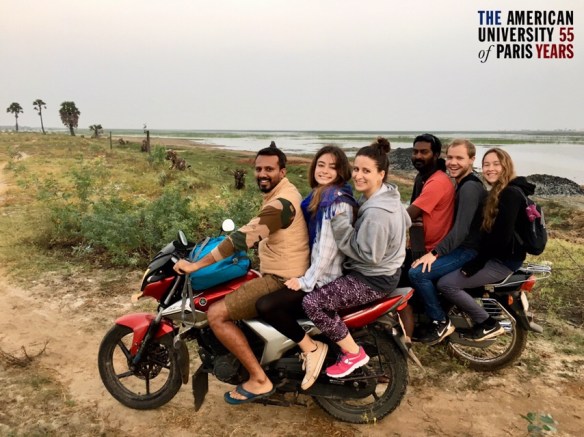
5:45am. En route for a visit of the spectacular Kaliveli Lake. We encountered a roadblock and had to resort to a tight ride-share with Boomi and naturalist guide Shankar to access the wetlands. Flocks of Dalmatian Pelicans, egrets, heron, cormorants, painted ducks, flamingoes, along with dozens of other species make the critical watershed of Kaliveli Lake their winter sanctuary.

The Possibility of Auroville

It has been three weeks since our arrival in Auroville. To some extent, we were expecting to enter a highly conceptual space, with a meaning that transcends our understanding. It turns out that our lives back home themselves have become more conceptual than ever before. Each in our own way, we have already made up our minds about what Auroville means. Either we hate it or love it, or generally struggle to understand how to evolve in such a system. To me, Auroville has been a complete experience, with many lessons to bring back home, in the hope of making it a better place.

Among the lessons I already wish to bring back with me, the fact that Aurovillians share such a profound mutual respect for each other is the one that struck me the most. As a born-and-raised Parisian, this is more than enough to surprise me, even make me uncomfortable. Quickly though, I realized that this mindset, deeply inspired by The Mother, was the difference that made Auroville so powerfully positive. At this point, never mind the utopia: a place where people truly live in harmony and in peace with each other, without the fear of confrontation or aggressiveness is possible. It may be due to our short time here — maybe after a while Auroville would not seem like such a peaceful, harmonious place after all — but in my case, feeling the positive energy around me incited me to do the same with others. Much more than in Paris, I consider other people with more care. Auroville enhanced my sense of sonder — the sudden realization that people around us have the same vibrant, complex lives as ourselves. Suddenly, I realize that I greet people in a different way, with a positivity and genuine concern for their well-being that I have only rarely experienced before. The lesson here is that my interaction with others has a deep correlation with how people interact around me. Seeing the negativity around Paris takes a toll on my ability to emphasize with others, makes me numb to their feelings or struggles. Auroville, at least in this aspect, shows the true example that human beings should follow. My wish is to bring back this sense of sonder to Paris with me, and make it last as long as possible. Hopefully this change makes me a better person. Someone whose empathy is not driven by self-interest, like the majority of the people I met in France’s capital. If Auroville is considered an open-field experiment, I say it can be considered an experiment of the self as well. The ultimate question that Auroville asks, however, is if such a space can — and should — be allocated solely for the purpose of enlightenment in a third world country. I believe that my classmates have many opinions on that matter, as we discussed this problem at length. In the end, the possibilities that Auroville offers for the rest of the world remain endless, only if this mindset or respecting each-other was transferable literally anywhere else. I still do not think that even Auroville has what it takes, despite the strongest willingness to come together — which shows that determination alone does not make an alternative township. But if I, at least, tried to replicate this model within my own community in Paris, this would be a victory for a slightly better world. Like a tree growing in the middle of a barren land, it would be nothing short of a miracle.

Burning those masala dosas!

By Patricia Molinos


On the second day of this new year at 6:30am two buses were already at the parking lot waiting for those who had signed up for the early morning Gingee trip. Our first stop was for breakfast at Sristi Village, and since the driver did not know the way and I have been going there the past weeks (it is the organization I am working for), our trip coordinator Sacha Elder asked me to sit in the front and give the chauffeur directions. I was one of the few who did not sleep on the way. “What if we miss the left we must take because I’m not paying attention!!”, I kept repeating to myself, so phone in my hands with Google Maps opened (just in case :-p), I stayed focused on the road. We finally made it to Sristi Village and our sleepy faces vanished away as we were served some South Indian traditional breakfast prepared by the residents and staff of the village. It was delicious! Karthik created this inclusive village for intellectually disabled people in 2013, where he aims to train them in farming so that in the future they can have an independent and dignified life generating their own income. His goal is to give an opportunity to the 355 kids in need of special education living in the surrounding villages near Kunamangalam (between Pondicherry and Mailam). We ended our visit planting a tree together with some members of the community and we headed back to the buses.

After almost another hour and a half on the road, we reached Gingee, in Villupuram District (Tamil Nadu). “Ah! It’s not that high!”, we all said as we were taking water bottles and some snacks and sandwiches Sacha had bought for us. Only a few minutes later we realized we were wrong…What a climb! The stairs were the steepest I had ever witnessed, some of them being more than half a meter tall! The more we climbed the more monkeys we found. Some of them did not notice our presence and continued playing, while others kept their eyes on us following all our moves. We were told not to take the snacks out of our bags while climbing, since it would not be the first time monkeys steal food from the hikers’ hands. After taking several breaks under some shadows we found on the way, we finally made it to the top of the Gingee Fort Hill with our now sweaty t-shirts. From there we could have a 360-degree beautiful vision and many angles we could take good pictures from. The views were awesome!

The fort was originally built by the Chola dynasty during the 9th century and modified during the 13th century. It was under the control of different regional powers like the Kurumbar, the Nayaks, the Marathas, Bijapur sultans, the Moghuls, Carnatic Nawabs, the French and the finally the British in 1761. As Sacha explained, the fort is closely associated with Raja Tej Singh, who lost his life there when trying to revolt against the Nawabs of the Carnatic who ruled this region of South India between 1690 and 1801.

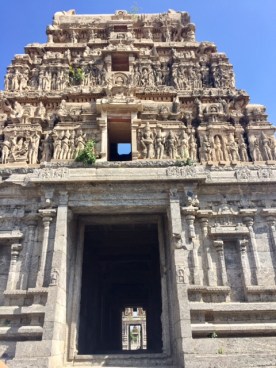
fullsizerender-7We met in front of the buses again around 1pm and headed to an ancient temple that is only five minutes away from the Gingee Fort. The group made it to the heart of the sacred building, where we received the blessing of two temple men with some kinds of crystal-sugar cubs, an azafrin rounded mark on hour foreheads, incense and some words they pronounced.

It was a really awesome day that combined both culture related learning, amusement, and also some intense exercise, very convenient to try to make up for all the masala dosas, dals, lassis, and Gobi Manchurians that we all are eating quite regularly here 😉