Talking Trash

By Tara Jamali

What intrigues me about Auroville is its commitment to natural, waste-free living. While I have made attempts in the past to live a more sustainable lifestyle, I was not always sure I was doing it the right way or making a real difference. But Ribhu’s “trash talk” earlier this week opened my eyes to a completely new dimension in sustainability.

After graduating in European Hospitality Management in the Hague, Ribhu Vohra had worked in human resources at an oil company for a few years before he realized the longer he stayed there, the more he wanted to work for an organization he believed in and do something he felt good about. So he convinced his wife Natasha to move back to his native Auroville. Upon landing here, his sister asked him to join her in a litter cleanup activity which included a “trashion show” for youth. Their activities eventually merged into a large campaign. “It taught us the power of children and how they can bring positive change to our small village”, he says. “From there we decided we had to educate every young mind in the world.”

Observing firsthand how children were powerful change agents in sustainability, Ribhu decided to dedicate his life to educating them and seeing that they establish positive habits early in life. He tries to get them to inspire their parents and family members to take positive steps and change habits as well. The children Ribhu works with are usually 6 to 15 years old, and he tries to make learning fun by creating games and activities that engage them, while teaching them how they can be part of the solution and not the pollution.

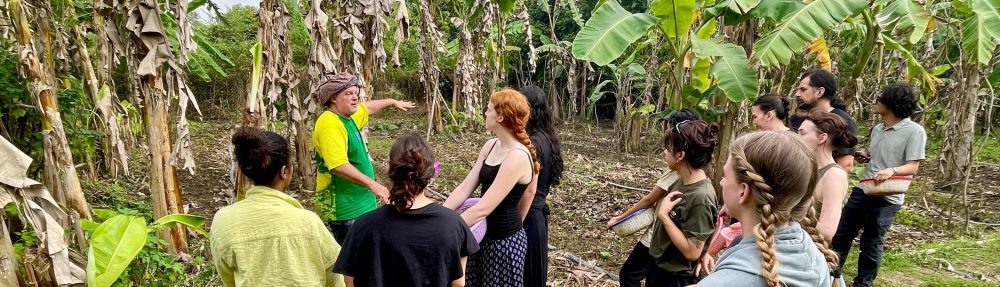
“We have to bring sustainability to the way we deal with our consumption, in how we dump things away when we’re done consuming them,” Ribhu said during his “trash talk” at Auroville’s Unity Pavilion on Dec.19. It was more like a Ted Talk than a typical lecture or presentation. Many fellow students later commented on how Ribhu’s style of communicating and educating on the topic inspired them to make sustainability a more significant part of their lifestyle.

Ribhu dedicated a significant portion of his talk on plastic waste, explaining how plastic usually makes its way into the oceans, eventually suffocating marine life. In a research study on a community living near a local dump in Pondicherry, the amount of plastic in the inhabitant’s blood was found to be 15 times higher than in any other community in the world. Much plastic waste is dumped on roadsides, where cows usually roam around. In one case, 54 kilos of plastic was found in a cow’s stomach.

Reducing plastic consumption is not at all difficult. We can start using stainless steel beverage containers and glass bottles instead of plastic bottles. We can start using reusable bags instead of plastic bags, and be careful not to mix plastic waste with compostable waste.

When you make the conscious effort to be sincere, things happen. When you recognize everything is sacred, you automatically become ecological. Sustainability as a hallmark of spirituality is a way of life in Auroville, where the emphasis is on creating a conscious future. Ribhu’s desire to create a waste free and sustainable earth for his two young children led him to sacrifice lucrative career paths in order to dedicate his whole life to educating on sustainability. His passion is in “talking trash” to students like ourselves, who then find his passion for preserving resources contagious and start doing the same, especially after realizing how current waste patterns tremendously affect future generations. From now on, I proudly pledge to be a trash talker. Will you do the same?
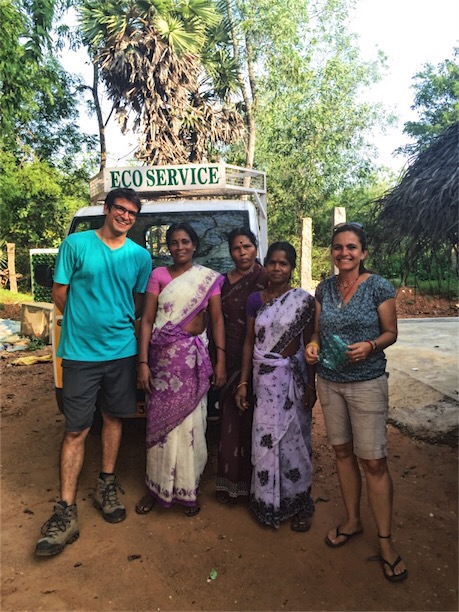
vsco-photo-115                                              Ribhu (far left) and colleagues at a local recycling plant


Is India doomed to become a specialized manufacturing country?

There is a very young population in need of education. In 2011, a census revealed that there were 264 million people between 15 and 34 years old (productive age) in India, whereas 67.6% belong to the rural sector and the rest to the urban.

However, since 2010 the level of education has plateaued, which implies a huge problem because individuals are entering directly into the work force. This creates a time bomb for India because it dooms it to become a specialized manufacturing country. The solution relies on educating this young generation.

Auroville Institute of Applied Technology (AIAT) is a private organization that seeks to contribute into poverty eradication through vocational education and self-empowerment of students. They primarily focus on attracting students from rural areas. These students tend to share similar backgrounds such as disadvantaged family (below the poverty line), academically weak, socially challenging background (caste system) and lack of motivation/enthusiasm.

The Institute has to deal with the families and government (needs to adapt to constant regulations) and institutions to demonstrate the importance of vocational training. AIAT trains their students through Project Oriented Learning in order to increase their abilities in problem solving, seeks to motivate them, invites them to engage with their culture and make them aware of the social issues such as health, environment and society.

The anticipated outcome? Qualified workers and responsible citizens. The results are indeed very positive; 80 percent of those who completed the program get a job and another percent choose further education.

However, it is not easy. AIAT is in need of strategies for extra fund raising in order to manage to train more students. Those below the poverty line live with less than a dollar per day (68.08 Rupees). The Institute fees are 20,000 rupees per year. If this is broken down, an individual below the poverty line lives with 24,849.2 rupees per year. It is evident that it is impossible for the students to enroll by their own means. AIAT is not willing to give up, however they are constantly at the end of a cliff because they do not receive any financial support from the government and they depend on donations. The institution has a capacity of 400 students, yet there are only 100 enrolled currently.

Marcos Lopez Manrique

Our Eventful Arrival in India

After an 8 hour flight from Paris, we landed in Mumbai and we were all rushing to make our next flight to Chennai. We arrived in Chennai at 4:30 am and all got onto two buses. Our first stop was to enjoy an authentic Indian breakfast. Though the taste was unfamiliar to most of us, we thoroughly enjoyed every bite. Certain students found the dish too spicy, while others were prepared to eat spicier dishes! We returned to the buses and traveled another couple of hours to a beach. There, we saw horses, sacred statues, and a beautiful ancient temple. Many of us climbed up some rocks for an even better view. There were men cutting fresh coconuts nearby with machetes, and each of us were eager to stick a straw in a coconut! Then, we walked up to a gorgeous relief sculpture which lead to a lighthouse, more ancient statues, and temples behind it. Where we are, in Tamil Nadu, is actually one of the most ancient regions in India. When we finally arrived in Auroville (the township we will be working within the next four weeks) we ate at Tanto’s, an Italian restaurant wherin we all enjoyed pizzas to share. At this point, it was only 3 pm, but everyone was exhausted and falling asleep. We eventually made it to the Mitra Guest house where we are staying. We were assigned roommates, received our room keys, and had free time until 5:30pm. While most students decided to nap, I decided to venture out with three other students to discover the area. We forgot that the roads were reversed à la UK style, and wandered straight into oncoming traffic–which was both scary and funny. We got to the Vistor’s Center (built out of sustainable brick materials) and were pleased to find delicious iced coffees and good wifi connection, for the Mitra’s wifi is not very strong. Finally, we all gathered for dinner next door at the Town Hall around 7pm. Needless to say, the day was filled with plenty of food and travel–and even I could not wait to get to bed by then.

We all called it an early night, and many of us woke up for a 7am yoga session with our instructor-to-be Natascha. It was amazing and much needed!


-Serene Obagi

Cultural Identity Formation

Identity is not a role and is often confused as one. As Kakar clearly states identity is not a garment that can be put on and taken off accordingly; a man’s identity is a vital part of his culture, it makes him recognize himself and be recognized by others. He goes on to argue the difference between those born into a particular culture, average age 20. They will never acquire a full understanding of other cultures. The possibility of fluidity and changing identities in adulthood are limited. Our identity is stabilized before we even have the choice to identify it as an essential part of our identity. As for Indian-ness, it is produced by similarities created by Hindu civilization that contribute to a cultural gene pools of India’s people. The ideology of family, view of social relations influenced by the caste system, image of human body and the bodily process based on medical process Ayurveda, and a cultural imagination shared with myths and legends are also major influences in the procedure of shaping one’s Indian identity.

India has curated several branches of beliefs that deeply internalized subjectivity of identity formation. The web of family life is the base of formation. Bollywood movies have shown Indian families to be large and noisy; with aunts, uncles, and grandparents and parents all living under one roof. Researchers have proven this to be unlikely. The ‘joint’ family feature that is so intertwined in the Indian culture has to do with ideals of fraternal loyalty, obedience and common social and ritual activities. Family occupies a much greater space among Indians unlike European and Americans where there is only parental influence subjecting their inner lives.

I relate with the Indian identity because I have many similarities among my own cultural background. Having influence of American culture where much emphasis is placed on the single partnership of the parents guiding the way for their child, as well as Spaniard influence where family is the major factor in the shaping the child’s life. Although there may be a disconnect in the child’s life where he may have to move away because he has reached adulthood and must study – there is never full detachment from the family. In the Spanish culture that child’s home will always be there, his family will always be there for support and vice versa. The child is to return home to his parents, and under that umbrella are his aunts’, uncles and grandparents patiently waiting with open arms to congratulate him on his highest achievements.

Christa Rodriguez

We need to challenge the system we live in

While I was in Pondicherry, India, doing NGO work for the Gypsy community, I noticed that as soon as girls had their periods they had to be sent back to the village. As far as I recall, there was a 16 year old with a baby in the village who had been to Samugam, Bruno Savio’s orphanage, created for the Gypsy Community. After hearing and witnessing this. What can be done about this? Why is it that even when one had created the proper infrastructures and help, some of the children would go back to the village? Tradition was among other factors. How can values and traditions be changed? Should they be changed for the sake of development?
These issues do not just concern India; as human beings, we need to change our habits as active members of the world community for a better future. How do you make people change their habits? How do you make them realize that they need to change them?
Since I came back from India, I see things differently, I had a violent epiphany about the problems linked to how we live in the West. What can we do to change how things are done? I can no longer stand on the side and look at the world crumbling because of us. I need to start acting; we all share responsibility! Since I came back, I have paid attention to how much waste I consume, I constantly think about all the NGOs we visited and try to apply the solutions these people came up with. I think about these discussions regarding the seen and the unseen. I always think about the hole in the O-zone layer and how because people cannot actually see it, they think there is no problem. Do we have to get to the point that we see everything in order to act? In thinking about the waste I consume and how I recycle. I have now created one trash for compost, one trash for plastic, cardboard, paper, glass, and one trash for garbage and other non- recyclables. Ever since I got back, I have furthered my knowledge and understanding of what steps can be taken in the right direction, by learning from people who try to live with Zero Waste and off the grid by challenging the system. We all need to challenge the system we live in; we all need to challenge ourselves.
The lack of sufficient infrastructure for recycling, disposable waste and compost creates a problem in cities, as does the lack of second hand, damaged or unpacked goods in retail stores. Cloth bags should also be used in lieu of plastic ones.
I am fully aware that taking the organic route might cost more in the long run, and that it isn’t the top priority for families and people who have trouble to make ends meet. Living sustainably needs to become more affordable because we are going on a slippery slope. My dream is that we get together as a community and act! Actually, when you think about it, are alternative ways to living better that expensive? The answer is NO! On the contrary, living sustainably is affordable and actually costs less; making your own toothpaste, shampoo, and laundry detergent are a few things you could do, for a fraction of the price you buy them at! Little by little, I would like to get to the point where I too only have a little jar of trash in a year. How can we communicate these things effectively to the global community?

-Chelsea Carter

They are the champions!

Last semester in my Development Communications course we had to read a book called Communication For Another Development. It gave candid accounts and insight into the world of working in the field of development communications. It did not hold back in describing the ways in which working in development communications can be challenging.

It conveyed the sense that there are many external factors (social, political and economic) that prevent progress in development. Whether there is a need for development and whether it is just creating a binary between the underdeveloped and developed based on the model of the Global North as the benchmark for development is another topic all on its own. The reality is (according to the book) – working in Development communications can be incredibly tough.

The book posited that even though many hurdles await development communicators to jump through, there have been many “champions” in the field. These are the individuals who perservere despite unfavourable circumstances which emerge during development practice. Our month in Auroville certainly exposed us to such champions. Anbu is the Director from the Non Governmental Organization I worked with – Auroville Village Action Group (AVAG). She is a real champion for creating an NGO that aims to emancipate the community and integrate the lowest caste through AVAG’s activities. Ribhu’s Wasteless team is contributing significantly to recycling education through imparting information about sustainability to more than 1000 schools in India through their Garbology 101 curriculum. Bruno’s Samugam orphanage that he started after he felt compelled to change the lives of Dalits in India is indicative of why he is a champion. Karthikeyan from Sristi village created a village for those with psychiatric disorders who were marginalized and neglected by society. Sristi Village is a place that offers this community employment and wellbeing support. The team from the Sahodaran Community Health Oriented Development Society (SCHOD) is bringing the LGBTQIA community in Pondicherry closer to true liberation.

I produced a video for UNESCO’s World Radio Day that reflected John Nelson’s story concerning the Cuddalore emergency radio station that he established in response to the devastating floods that occurred in the area in November.

DSC00111

An image of John and his team of fellow champions from  Cuddalore.

The Adecom team’s dedication to protecting marginalized caste members speaks to their champion work for this community. These are only a few of the plethora of organizations that we were exposed to, that persisted despite hard conditions they continue to try and overcome.

Change takes a long time, apartheid in my home country South Africa spanned over three generations in time, Nelson Mandela was in prison for 27 years before he was eventually released to become the president of the country. It took lifetime upon lifetime for slavery to be abolished, for the civil rights movement to change its society. These examples reflect that change can eventually happen. It takes champions: Martin Luther King, Nelson Mandela, Ribhu, Anbu, John and others like them to lead to triumph!

Nolwazi Mjwara


I am fine

by Mia Windisch-Graetz

And you?
Do you live in one of the world’s most livable countries? Do you live in an apartment in ‘The City of Light’? Are you going to sleep in a bed tonight? Or are you going out with your friends? Is there someone out there who loves you? Did someone ever tell you that he or she loves you? Can you think of someone who made love to you instead of just having had sex with you? Have you ever been drunk and happy? Do you have people around you that you can rely on? Do you have a phone? Do you have someone in mind you could just call right now? Can you express yourself freely without being afraid of getting punished afterwards? Are you living in a country that promotes the freedom of speech and expression? Are you just connected to your home Wi-Fi right now? Or the Wi-Fi of your university, a coffee shop or a restaurant? Did you eat something you liked today? Can you drink water whenever you are thirsty? Can you read this? Did you ever go to school? Is your degree even higher than a Bachelor’s Degree? Can you think of a life event that makes you laugh? Have you ever been on a holiday? Have you already been to the beach? Can you treat yourself by going to a spa? Have you ever been to a hairdresser? Do you like to make yourself pretty? Do you think you are pretty? Do you have several dresses and other pieces of clothing in your wardrobe? Do you have a family? Is your Mum still alive? What about your Dad and your siblings? Are you living in a  peaceful country? Can you leave your house without being scared? Did you already have a job? Do you believe in yourself? Did someone encourage you today? Did someone ever give you a hug? Did someone ever cheered you up? Did someone ever say you were right although you actually weren’t? Did you ever receive a present by a person you like? Did someone smile at you today? If yes, smile back. If not, be the first one to smile. Because if you could answer three questions with yes, you are better off than most people in the world.

What a wonderful life I’ve had! I only wish I’d realized it sooner. ~Colette

If you want to be happy, be. ~Leo Tolstoy

Happiness is never stopping to think if you are. ~Palmer Sondreal

Even if happiness forgets you a little bit, never completely forget about it. ~Jacques Prévert

Don’t put the key to happiness in someone else’s pocket. ~Author Unknown

There is no cosmetic for beauty like happiness. ~Lady Blessington

DSC_0428

Laughing Women in the Dump of Pondicherry, India 2016

Just remind yourself what you have and not what you don’t have. You will see, that will make you happy. Sustainably happy.

“Oh my God, I have to take a picture of that.”

by Mia Windisch-Graetz

But what does that mean anyway? It is the otherness, things we have never seen before or things we cannot relate to ourselves. Things like an entire family (including parents, their three kids and a dog) riding on one motorcycle. Things like colour-faded billboards that look like they have been out for the past five years. Things like people eating from the garbage. Things like people working under bad conditions in the dump but still find a reason to smile. Things like orphanages enjoying nothing more than to play with you. You, the girl or the boy who came all the way from Paris. You, the person that is not used to all of this.

You may be surprised. You may be disillusioned. You may be happy or sad. However, one thing is for sure: one can tell that you are not from Tamil Nadu. Not only because you look different. But also because you behave differently. You are dressed differently. You eat differently. You have different gestures. Why do you shake your head? What does that mean? And why do you always take tissues or a toilet paper roll with you when going to the bathroom?

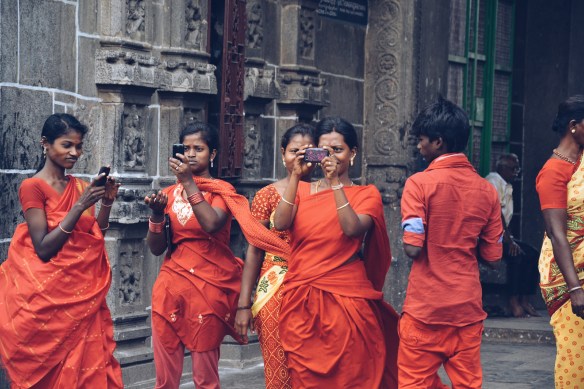
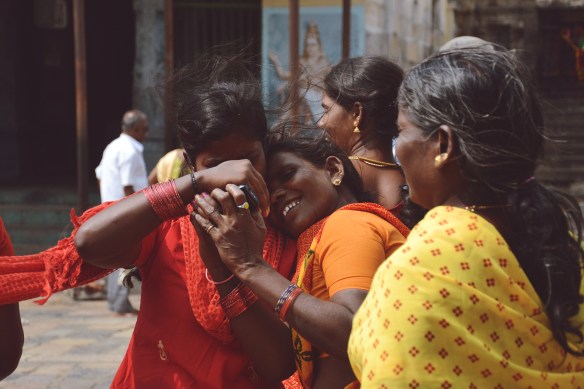
While being in India, the intention of most of us was capturing every single moment that proved the unfamiliar, the otherness. However, as all of us realized, most people we encountered in India just felt the same way about us. One of the students even said “I feel like in a zoo”  because guess what: it was not only us, the let’s say strangers, the tourists, the volunteers or whatever we call ourselves taking pictures of them, but also them taking pictures of us. Sometimes if felt like they were even more fascinated by us than we were by them. As if we were some sort of celebrities. Their fascination, however, was almost contagious! At the Chidambaram temple it eventually reached a point that we took pictures of them taking pictures of us. Without having made these interesting encounters outside of Auroville, we would have experienced India in a different way. Thank you.

Processed with VSCO with a5 preset

Processed with VSCO with s1 preset

Fascination at the Chidambaram temple. Image Credit: Mia Windisch-Graetz

Half of the population is bleeding


“Half of the population is bleeding,” the Director of Eco Femme reminded us. Some form of sanitary napkin is essential for all women between fifteen and fifty.
The modern sanitary napkin is made out of gel and plastic, and takes 800 years to biodegrade. When I heard this, I was in shock…Why is it that we are not better informed about these problems around the world? Why are most of the educated women on the planet using disposable pads instead of more ecological and environmentally friendly methods?
Once I switched into the ‘unconscious right’ by using Eco Femme’s washable pads and diva cup (a silicon blood collector worn internally) I felt better about not polluting the landfills monthly with dozens of pads that would each take 800 years to disintegrate. I can definitely attest that the Eco Femme pads and the diva cup are comfortable! Any women reading this should definitely try them, and any men reading this should recommend these alternative solutions to wives, daughters, cousins, aunts, and female friends.
After learning about Eco Femme, as soon as I got my next period I thought that I should try this new solution and see how it went… I began by cleaning my new diva cup with the little soap sheets inside the packet. I put the diva cup to boil for 20 minutes, and rinsed it with cold water. Then I followed the instructions that come with the cup: fold the cup in half, push it in while holding it. Once the cup is inside, you are not aware of it. I had to check if it was still there at one point because I thought, wow, it feels like nothing at all. You wear the cup all day and pull it out at night. I like to switch to pads sometimes during the day and especially at night. The pads are very comfortable; more comfortable than plastic pads from the supermarket. I switched pads three to four times a day, and would simply let the pads set in water after having rubbed them with soap. They dried on my towel dryers.
If you switch to Eco Femme you will make a difference to the environment. Imagine how many pads or tampons one woman goes through in a day, a week, a month, a year. The diva cup lasts six years, it’s comfortable and it’s cheap–far cheaper than the plastic pads and tampons you buy at the supermarket. Trust me, Eco Femme pads and the diva cup are the best way to go because you will also feel relieved that your cycle is not hurting the environment anymore.
The Eco Femme washable pads are currently sold in 17 different countries. You can order them online on the Eco Femme website. Some cups are also available in pharmacies.
The Director of Eco Femme talked to us at length about health education. Eco femme teaches low-income Indian woman to make its washable cloth pads. The Director told us that she was curious to find out what sanitary methods Indian women now use: to find out how many women have switched to disposable pads, and how much are they paying for these plastic pads? What are the social constructs involved? The Eco Femme study discovered that 50 % of Indian women use disposable pads.
Menstruation is culturally very complex. Women in Indian cultures relate to menstruation in a different manner from how we deal with menstruation in Western countries. For example, when Indian women have their periods, they are not allowed to go to the temple or prepare food, because they are considered dirty. Regarding tampons: Indian women are actively discouraged from the insertion of any products inside their bodies. It is considered part of the shame of touching one’s self and provokes accusations of damaged virginity. The majority of Indian girls know nothing about menstruation before they have their periods. Consequently, better communication and education about menstrual hygiene is critical and needs to take place around the world, not just in India.


– Chelsea Carter

Organization: Eco Femme

Contact: Kathy

E-mail: kathy@ecofemme.org

Website: wwww.ecofemme.org

You asked me why I am so enthusiastic

You asked me why I am so enthusiastic. Well, that’s because I count what I have rather than what I don’t. I have a family, friends, a school, a roof, food, clean water, freedom to express myself and to do what I want to. I think about all the people who have nothing. People who no longer have a family because their country is torn apart by war, people who no longer have a house because it exploded, people who must travel many miles to find—maybe—a better life. I think about small kids who walk miles to school if they even have one, people who walk miles to find water, people who wait in line hours for bread, people who do not have the ‘right’ to express themselves because if they protest they are killed. I think about people who have many more problems than we do and who are still positive, smiling even as they try to keep the tears from coming, and who keep moving. I think about all these people and decide that I too will keep moving.

-Chelsea Carter