Planting the Future

By: Kathleen Buchholz, AUP Image

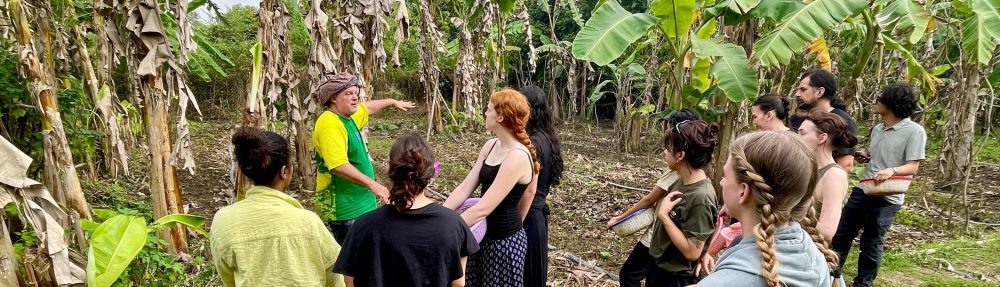
Every day in India we face new experiences and difficult cultural challenges.  We expect these and try to prepare ourselves as best as possible. Today brought a different kind of challenge though. Today, we planted trees. The cyclone last year destroyed sections of the forest, and while our group only planted four trees today, I would like to think we made an albeit small dent in reforestation, in capturing some of our carbon footprint and maybe even changing our own thinking on global climate change. We visited Evergreen Forest this morning, where along with getting our hands dirty, and tasting some homemade chai tea on a work break, we learned about the trade-offs between biodiversity conservation and the carbon crediting system.

In a nutshell, biodiversity conservation creates a sustainable environment by re-introducing different species of trees that are native and can therefore thrive best in a given region while carbon crediting is a system of buying the right to emit carbon dioxide by paying someone else to plant trees.  If you want to optimize the biodiversity of the forest then you don’t necessarily cram as many trees as possible into the space as you would if you used the carbon crediting system.   Carbon credits are part of the Kyoto Protocols ‘flexible mechanisms’. The Kyoto Protocol to the United Nations Framework Convention on Climate Change sets binding obligations on industrialized countries to reduce emissions of greenhouse gases.  It has been largely unsuccessful but at the very least it demonstrates hope that conversations about climate change are happening worldwide. But even if biodiversity conservation is the goal, carbon crediting pays for the forest.  As with many elements of development, there is catch-22 built into the system. Do we do what pays or what is ultimately better?

For India the change in temperature means rising sea levels, increased cyclonic activity and precipitation patterns and while the jury is still out, one can’t help but connect last year’s cyclone with the climate change. The effect of our trees today is minimal. The one act we did today may not change the world but if that tree can offset even a little of the carbon dioxide released into the atmosphere every day then maybe we are moving in a more sustainable direction.

As we move into the final week of our communications projects in India, we can begin to see how everything in development must be connected in order to be sustainable. The tree we plant for fun on a Saturday morning is actually going to grow into a tool to help the environment, pollution, and creating a scene that would not have existed otherwise. It may be small but maybe with a few more trees we can grow a sustainable future.


The Auroville Forest and the greenbelt


“A nation that destroys its soils destroys itself. Forests are the lungs of our land, purifying the air and giving fresh strength to our people. ”

– Franklin D. Roosevelt

It is commonly known that trees are good for the environment. Carbon dioxide is not good for the health of the planet, neither for humans and animals nor for nature. Trees help the levels of carbon dioxide to not rise as much as it would without them. Also, without forests the deserts would grow and farming would face some serious problems due to water scarcity in the soil. Furthermore, humans and animals need to drink to survive. These are just some of the benefits of forests, plants and trees.

The place where Auroville is situated was a desert and the Indians that lived in this area (Tamil Nadu) did not see a potential in the land or were too poor to make the necessary changes. The founder of Auroville, the Mother, wanted a place close to Pondicherry and since the land was not used by the villagers in the surrounding area and the owners were willing to sell the land, the location was chosen for the community that goes by the name Auroville. For people to be able to live there they needed water and shelter. So a forest was planted to facilitate the needs of the people. According to Auroville Green Practices there is a legend called the tale of Kaluvelli Siddha that predicted that “in a distant future people from far away would come to transform the cursed wasteland into a beautiful green area.” Whether this is a tale of Auroville is impossible to know.

According to Auroville Green Practices the first Aurovillians wanted to plant a forest that could withstand wind and weather and build the foundation of a long-lasting forest. It was morally supported by UNESCO and in the end it was one of the earliest large-scale forest restoration works in the world. The focus was to provide a bio-diversity but at first the indigenous species (TDEF) was not suited for the area so the Aurovillians had to plant species that could provide cover, build up the soil and improve the climate (for example, the area suffered from dust storms) so all the species that were chosen in the beginning were trees and vegetation that could stand hard conditions. When the conditions improved, the Aurovillians planted indigenous trees and plants.

Today, more than 3 million trees have been planted and as many as 185 of these species are indigenous. Auroville has the largest archive of TDEF in the bio-region and more indigenous species are added every year.

Today, the forest or the green belt are used as a shelter and a shade but the trees and the plants are also used to make medicine and old traditions are re-born. Other places, besides Auroville, has taken advantage of the supply the Aurovillians has built up. For example, Chennai has had help from organizations in Auroville to plant trees in the city.

Last year there was a cyclone that hit the south of India. Many trees fell down, forests were damaged, many buildings were destroyed, and the roads were blocked. The amazing part was that the trees still standing were the indigenous species, while the trees that were not originally in the Tamil Nadu area were the ones that fell. This only proves that you should not tamper with nature since nature knows best.

By Martina Mattsson, Linnaeus University

Shanti’s Work for Sustainability


Newly arrived to India we had just gotten adjusted to the hot weather, the special toilets and the bugs and spiders invading our rooms at night when our teachers and coordinators told us that we would spend a day at the garbage dump. We were told to bring a scarf to wrap around nose and mouth to avoid the smell, and to bring comfortable shoes. The rest of the preparation, the mental part, we had to do on our own.

In India, garbage handling does not work the same way as it does in Sweden, France or the US. In fact, it seems not to be working at all. One of the first things I noticed during the three hour ride from the airport to Auroville was all the large heaps of garbage lying around. On the streets, on the side of the street, in front of people’s houses. Waste bins are nowhere to be seen, and people don’t seem to be searching for them either. Many just throw their waste on the street outside their house, which of course results in the heaps of muddy, stinking waste. The smell that occurs when it rains or when the heaps are burnt might be one of the most obvious signs of the massive amount of waste lying around, but it is not the only one. There are other, more long lasting and serious problems created by the enormous amount of waste produced in India every year.

The day for the dump visit came with burning hot sun and not much wind to make the heat easier to stand. We were all prepared with sunglasses and scarves, but still the smell was a shock. The dump was burning. Not heavily burning with flames and people running in panic, but with grey smoke that floated like fog above the gigantic mountains of paper, plastic, computer parts, human excrements and banana leaves. The burning sun did not make it easier to stand. In the middle of this hell we could see shadows of cows, dogs and people walking around on the mountains. We met one of the women working there. Her name is Shanti, and even though she is only 37 years old she has three children and has been working at the dump for over 20 years. Her job is to collect metal and sell it to collectors in the city.

There is quite a well developed chain of people handling the metal that Shanti collects. When she has sold it to a collector, she gets paid a certain price. The collector himself then sells it on and in his turn receives money, a little more than Shanti gets. The first and the second collector take on large amounts of any kind of waste, but the third one specializes in one area. Shanti’s metal findings will eventually end up at this third collector who will pay the second one a little higher amount of money than the first gets. Finally, the third collector sells his waste to a factory that pays him he largest sum of money in the chain and then uses the waste to produce new items. This way everyone in the chain makes a small profit.

Shanti and the other people at the dump are in their own way working for sustainability. The fact that a lot of the waste in India does not get separated is a huge problem. If compostable waste and non-compostable waste were separated they could both be used again. Compostable waste can be used in farming and growing new food, and non-compostable can be recycled into other products. But when mixed, the waste is useless. Shanti and her colleagues are working with this sorting. Some specialize on computer parts, some on metals and some on plastic, and slowly they are cleaning the dump from non-compostable waste. But the progress is too slow and the working conditions at the dump are horrible. I could not wait to get away from there and my tears started falling when the first glimpse of life in Shantis eyes emerged while talking about her children who have all gotten education. She does this for them. She does not care about sustainable development or that the waste is creating enormous problems for her country and for fellow indians’ and her health. And she should not have to. Shanti should not have to work at the dump to enable her children to get educated. She should not have to sort the waste with her bare hands. Shanti should live in a country where people sort their own waste, where the streets are clean and there is no huge burning garbage dump. Talking about, reading about and studying sustainability is great, but it is people like Shanti who do the work, make the changes, who are the real heroes.

By Ronja Ekström, Linnaeus University

Auroville – a new way of thinking

Auroville is a special place in many ways. People come here from all over the world to live together despite their different cultures, religions and beliefs. They live in unity and try to make use of all the resources in their community and to minimize their waste as much as possible. About half of the population in Auroville has put this into practice in their daily lives and created their own economic system of minimum waste and sustainable living.

It is called Pour Tous Distribution Centre and the members of the system put an amount of around 2900 rupees every month into the service coop. The amount is depending on their needs, size of family etc, so some pay more and others pay less money. There are special stores and shops organized for the people who do this. There is a grocery store where people can go and pick up the food they need and there is also a clothing store where you can pick up clothes and shoes. Prices are not shown and bills are not given. One month maybe you pick up clothes and food for a bigger amount of what you have paid, and other months you might pick up supplies for less money than the monthly amount you pay. The thought is that in the end, it will be evened out between all the members. This amount of money you pay is planned to go to many different things, for example health care. If, for example, there is a health situation where your family can’t afford the treatment, the community will pay for it. This is to create security and a way for the community to provide you with what you need.

That is the common purpose with this idea, to provide the people with what they could possibly need on a monthly basis, and also to even out the different economic divisions in society to create a more even balance. There should not be a certain value on certain things, everyone should get what they need, not more not less. This idea of a limited supply of products is to decrease the capitalistic way of thinking when it comes to purchasing and shopping. If there is a limited amount of products you will only get what you really need and that way the consumerism decreases. Also the materialistic view of thinking is changing since you don’t shop for clothes that you don’t need, or shop just because you can. You only get new clothes when you really need them, and that also decreases the materialistic needs and consumption.

Decreased shopping habits contributes to less waste and less negative effect on our planet. PTDC also takes great environmental responsibility and tries to avoid plastic and unnecessary packaging. It is important to prove to people that you don’t need as much as you might think you need. When using this system you decrease the waste to improve the environment, you work against the capitalist society of materialism and consumerism and in that way you work against the uneven division of development and the economic differences in the world.

Personally I feel that PTDC is a good thing in theory although there are some threats, for example there is always a chance that people will take advantage of the system. I also feel that this only could work in a small group. Although it is a great idea with necessary and important outcomes, this could never work in a more global context. If PTDC’s goal is to expand I don’t know, but I think that it would be hard and a great challenge. However I do believe in PTDC and their system if the goal on a more global scale is to influence people and make them more aware of their consumption and their effect on the environment. For a PTDC system to work all over the world I think is a utopia, but if it works in Auroville I think it is a great thing.

By Louise Sjöberg, Linnaeus University

Changing Times in India by Kristen McGuiness, AUP

From the window to my left I can hear the ongoing wave of an Indian rainfall, from the window to my right I hear the loud chanting from the nearby Hindu festival, which is intermittingly interrupted by the sound of firecrackers spawned by the same. This is the end of our second week in India, and I am not quite sure we know much more about this mysterious culture amongst whom we have been living.

In Sudhir and Katharina Kakar’s book The Indians, they describe the culture as one built upon “an ideology of family and other crucial relationships that derives from the institution of the joint family; a view of social relations profoundly influenced by the institution of caste; an image of the human body and bodily processes that is based on the medical system of Ayurveda; and a cultural amalgamation teeming with shared myths and legends… that underscore a ‘romantic’ vision of human life.”

On Friday we visit the local NGO Attra where many of these concepts are explored. Yatra is at once an after-school program centered in the arts, and a community awareness campaign bolstered by the Bollywood-inspired filmmaking of its founder, Srini. Srini and his colleagues have realized that one cannot educate a child without paying attention to where he or she is coming from. And that place is modern India where questions about the environment, about alcoholism, about the social fabric of the joint family are all being called into question. Working in the local villages, Srini sees what his students are facing and works to educate them and their families about how they can begin addressing the issues that both globalization and traditional practices have raised.

According to Sukant Khurana, Ph.D. on the site Mouthpiece for the Youth, “Simple economic, age, gender and professional dimensions that define alcohol consumption patterns in small homogenous western nations are insufficient in a multilayered society like India. Despite adoption of western lifestyles, middle class in urban India has yet to entirely do away with the old mores and values. For few in the big city, the old values are still the core of their identity, while for others they are suitable pretences [sic], resulting in schizophrenic environment where youngsters grow up absorbing the worst of both the eastern and the western influences.”

As India struggles with the its movement from a relatively closed economy to a rapidly open one, similar shifts have also been taking place culturally, particularly in the areas of social norms and engagement. But much like alcoholism and closed caste systems, they are still battling old ideas even as new ones emerge.

Later in the afternoon, we learn about another challenged sect of society: the gay, lesbian, and transgender communities. Not surprisingly, a society who holds such rank as the main component of their identity also has trouble accepting alternative lifestyles, which is why hearing from Ganesh, the founder of Puducheri’s LGBT organization, the Sahodaran Community Oriented Health Development (SCOHD), was so moving. A transgender him(her)self, Ganesh has been cast out from his own family because of his homosexuality. And he is not alone. As homosexuality is still illegal in India, Ganesh’s work is as subversive as it is important. SCHOD’s mission is to “minimize the prevalence of STI/HIV and AIDS among the MSM (men having sex with men)/transgender community and to provide quality services for their sexual health needs as well as ensuring their rights and dignity.”

As much as India is a romanticized place, the hard reality is they suffer from the same intolerance and inequality as the rest of the world. I wish I could say that they were any different from what I know from my own home, but as Srini shows us a video in which the elder family members argue that they do not need to change their behaviors to help the environment, I lean over to a friend and say, “That’s like my family in Texas,” and when Ganesh talks about how difficult it is for transgender peoples to find work, I think of my transgender friends in the US who have faced the same discrimination. Though the poverty might be thicker here, the problems are sadly the same. Now, we can only hope that together we might start finding some solutions.

India in comparison to Sweden and what we can learn from each other

India is a country were you can find beautiful nature, great cities and people with different culture, religion, visions and goals. Some struggle with providing food, housing and basic necessities for the family, and some struggle to find the best place to get a suntan.

I have not a lot of experience with low income countries; I have mostly been in Europe on vacation where the standards have been quite high. So coming to India is a new world to me. My first week in India has shown a country where poverty is found next to wealth, fancy and westernized stores next to a small store that is missing walls. But still there is a sense of brotherhood and an understanding between the people in India. The people I have meet in Auroville are friendly, eager to help and try to make the world a better place, both for the present but also for the future. It is called Sustainable Development.

We have been visiting many different organizations, and they are all consciously trying to focus on improving the standards of India and thinking about a sustainable future. For example, we visited a solar panel system organization called Sunlit Future and another organization called Naturellement that made jam, marmalade, and lemonade but also had a garden cafe. Their focus was on making natural products and empowering women. The fact that this organization is in rural India does not make a difference, when a problem arises the people come up with innovative solutions. According to Sunlit Future the demand for solar power has risen since the cyclone, and this is because the people of Auroville want to be “off the grid” and self-sufficient. By “off the grid” they mean when the houses/buildings are not dependent on outside systems.

So I started thinking about how Sustainable Development is functioning in Sweden. Several issues come to mind when reflecting on Sweden. I am from a little village in Sweden, and I will reflect mainly on the place were I grew up on. For example, waste management is quite easy to handle in my village since most people have compost stations in their gardens, and there are garbage stations were you can separates the household waste. I do not claim that everyone separates their household waste properly but they have the chance to be responsible and take action against pollution. The scary part is that it is only 2 percent of the waste that comes from households, the main part is from industries. How the industries handle their garbage in Sweden is a question I have no answer for.

Another problem is the heating of the houses. Sweden is a cold place. We may not have polar bears roaming the streets, but we do have a lot of snow and rain. Many use oil, wood and electricity, which is not very sustainable for the future. Many in Auroville uses solar panels, but since Sweden has few days of sun, this may not be an appropriate way of heating. But there are several other options that will not contribute to the pollution of the world, and Sweden might benefit from exploring these options further. Here the Aurovillean way of being innovative could serve Sweden well.

In conclusion, Sweden might have certain things to learn from India and especially from Auroville, such as being more sustainable and not putting convenience and comfort first; also having an innovative way to solve problems.  Likewise, India might learn other things from Sweden such as household management or women’s empowerment. Furthermore, India is an exciting place, and even though some things should be improved there are many things that I hope will remain the same, such as the sense of brotherhood you can find in Auroville.

By Martina Mattsson, Linnaeus University

Creating Shared Value

Some recurring trends have emerged throughout our visits to the many organizations within and surrounding Auroville, including sustainability (of course), environmental awareness and preservation, and the effect of happy workers on the productivity of a business.  Listening to these truly grass-roots efforts explain their motivation to find creative solutions for social and environmental challenges that they have witnessed in their communities has demonstrated that determination and ingenuity can accomplish things without a strictly profit-oriented model.  In this remote location thousands of miles from Wall Street, these social businesses seem to perfectly embody on a small scale Michael Porter and Mark Kramer’s concept of shared value. 


As articulated in the Harvard Business Review last year, shared value is the next emerging business model, which rejects traditional capitalism as both socially and economically destructive due to its short-term, encapsulated perspective.  Traditional business can create huge profit margins very quickly, but as Porter and Kramer argue, this is not sustainable in the long-term, and the evidence of its destructiveness is visible globally where we find exploited human and natural resources being pushed to the brink of extinction.  Shared value is defined as “policies and operating practices that enhance the competitiveness of a company while simultaneously advancing the economic and social conditions in the communities in which it operates.”[1]


Where NGOs were traditionally thought of as purely socially driven and businesses as purely profit-driven, here in Auroville we have witnessed a coalescence of the two that gives true clout to Porter and Kramer’s concept of shared value.  At Naturellement, a business that began with producing natural jams and juices and has now expanded to add other projects such as a lunch café, profits are extremely important because the Tamil women who work there are dependent on their salaries to support themselves and their families.  On the same token though, the owner Martina was adamant that the quality of work environment would never be compromised.  By creating a lunch program for the women who were used to eating white rice at every meal, she makes a long-term investment in strong and healthy employees.  Her philosophy is that by thinking about the business in a different way, she can have happy employees, who are able to work, to create and maintain the profit they need.


Although Naturellement is a very small-scale business, shared value is not limited to such enterprises. Porter and Kramer cite, for example, Project Shakti, an undertaking of the corporation Hindustan Unilever that creates shared value in communities across India by providing skilled employment opportunities for women and fights the spread of disease through access to hygiene.  These huge social benefits for Indians translate in profit benefits for Unilever, since Project Shakti now makes up 5% of their revenue in India.  Unilever is able to create new markets for itself while simultaneously benefitting the community, embodying a truly shared value.


As we begin to participate more actively with these organizations this week, we will have the opportunity to gain more insight into the practical operation of creating shared value and will ideally take away understanding that can be applied to any project we encounter in the future.


By Jillsa Aringdale

Whose Environment is it?

At the beginning of the day, I heard we were going to attend talks on environmental sustainability and I pictured myself walking through the boonies, and following dirt paths that led to smaller dirt paths. This was entirely accurate, though it does not begin to describe the  links that I found being built between the environmental projects and the local economy.

I knew that the benefits of having a more direct connection to environment can be found at every turn.  One expects to hear the medicinal benefits of plants and the usefulness of building with indigenous plants (bamboo.) These were the first explanations we were given today when visiting Pitchandikulam Forest, and the Bamboo Center. From a western perspective it’s hard to disagree with all the evidence that these are both worthwhile endeavors.  Yet these reasons barely scratch the surface of what environmental sustainability means for the rural villagers touched by these projects. These projects, which are all connected, bring jobs, knowledge and opportunities to villages where historically you did what your family did and your children did the same after you.  These projects offer ways for at least some villagers to stay in the village and not be forced to seek work in cities, where the only option is living in slums far away from family life.

Maintaining Pitchandikulam forest creates jobs for 200 people, who in turn support 200 families in and around Auroville.  Largely, these are not expats living off previous bank accounts; these are the true Tamil people, who have lived in the village years before Auroville was even conceived.  They plant trees that are indigenous to the region, and raise awareness about the Kaliweli Bioregion and the benefits of using local plants for preventative and curative medicine. In India alone, an estimated 8,000 species of plants are used as medicine in the folk tradition. Yet, In an age when pharmacies are cropping up in villages while the actual crops are being destroyed to make white rice, places like  the Forest, which serves as a medicinal plant conservation park connects villagers to livelihood, to knowledge, and to maintaining their historical ways of healing.

The Bamboo Center demonstrates the advantages of using local materials in building and how versatile bamboo can be. Everything from buildings to clothing and even musical instruments can be built with it. This practice follows their adage of sustainability because the materials are completely recyclable, but the Centers greatest triumph is the training and employment it offers for the community. Currently 14 women are trained for 3 to 4 month periods at the center, and after they not only have skills in working with local materials but they have the option of employment by the center.  Especially for local woman, the options of learning skills that involve working directly with manufacturing largely do not exist.

In the sense that these two places offer initial jobs for villagers and provide them with an opportunity to gain skills and buy themselves basic necessities, the programs offer a chance for a better financial situation. What isn’t clear is whether these programs will truly offer villagers a chance at sustainable development, or if these programs are merely sustaining them currently.  As the nominal rate of inflation grows, the real rate of inflation for villagers who spend almost their entire income on food is actually much higher, so even for villagers with these program jobs, their purchasing power shrinks each year.  It’s with this in mind that the question of environmental sustainability must be examined. What is the point of preserving the environment if an entire section of the population cannot afford to even survive?

-Kathleen Buchholz

Merry Sustainable Christmas

On the 24th of December – which is the most important Christmas day (at least where I come from –Germany) – was started off by a visit to Upasana and ended with a nice Christmas Eve dinner in Pondicherry.

Upasana is an organization that is mainly concerned with sustainable and ethical fashion, art and design.  When we arrived at their office in Auroville, two women that manage Upasana greeted us and gave us a presentation on the whole company, including its sub-brands. Uma, the one in charge for fashion and design, presented the latest addition to Upasana: the Tsunamika dolls. As the name already suggests, those dolls were made to help Tsunami victims. The history of the dolls, she said, goes back to a little child that wanted to put a smile on her mother’s face after the Tsunami had taken most of what she had owned and loved. The child crafted a doll out of waste material and succeeded in making her mother happy with such a simple little gift. Upasana’s role in this is that they hired women that needed help and liked the idea of the doll that was crafted out of waste material. The women working at Upasana still continue to make the unique dolls as a gift to others. They are never sold. Rather, they are gifted to those who make a donation for Tsunami victims.

Uma further explained to us that she and the manager of the company just came back from a business trip to Paris, where they presented their handmade fashion lines. One of them is Paruthi, the luxury organic cotton fashion line. She highlighted that all materials they use are 100% organic cotton or silk and are never chemically processed at any stage. Also, no artificially produced materials are used, such as Rayon or Polyester. The main reason for this is not only to save the environment and improve working conditions within Upasana, but also to improve health and economic situations of the tailors and the suppliers, such as the cotton farmers. The company keeps their own profit to a minimum so that farmers and tailors can benefit from sales. This is especially important to Upsana, as in India there is a high suicidal rate among cotton farmers. Mainly this results from health issues due to chemical processing during the production, but also due to not being able to make a living from their work. Uma told us, that it is common in India to commit suicide if you fail to make a living.

However, this is also a global issue. I worked for the corporation Monsanto, who produces only one single type of cotton GMO crop. This ruins local businesses as GMO crops are highly efficient and cheap due to economies of scale. Nevertheless, these crops do not only harm the environment, but also the health of workers on the field and customers wearing the final products. Therefore, Upasana’s work in providing help to farmers and tailors and solely using organic cotton is an invaluable step towards a more sustainable environment, society and economy. 

I found it especially interesting that Uma told us about how the Indian environment and also economy could benefit from this approach. Upasana does not only use organic material to create a sustainable environment and clothes production, but also as a unique selling point. Uma mentioned that many companies and wholesalers turn to China, as cotton and especially silks are much cheaper there. Therefore, she sees China as a main threat or as a “blocker” of changing society as most things we buy originate from there. “If this huge nation will not make an effort to improve environmental and health impacts during clothes production then change will be very difficult”, she said. Upasana is therefore trying to be a role model and to raise global awareness by producing sustainable and ethical fashion, art and design. I share Uma’s opinion, that people should be conscious buyers. I also believe that Upasana’s business model can inspire others and make impacts especially in sustainability-conscious nations, such as Germany and Sweden.

At last, Uma presented us other brands and projects such as “Small Steps”, an alternative to a plastic bag, which is reusable, and Navarasa, organic food and drinks. Afterwards, we went to the Janaki (House of Conscious Living), where most of Upasana’s brands can be bought.

In conclusion, the visit was very interesting as we learnt about how Upasana helps employees, suppliers and the outside environment with its work. I also found it impressive, that in contrast to the other organizations we’ve visited, Upasana does not rely on funding and aims to operate without it also in the future.

Later that day, we went to the closest city, Pondicherry, to have our Christmas dinner there. The place we ate at (Villa Shanti) was very nicely decorated and I felt a tiny bit like Christmas in the rather summery India.  

The day after (25th of December), we were given a day off. Some Swedish girls, Kallie, Melissa and I took that opportunity to spend a day at the Mango Hill Resort, a little hotel in Auroville with a nice swimming pool area.

Happy holidays to you from India!

Janine

One Man’s Trash is Another Man’s Treasure

Image

Shanti at work at the Auroville landfill

Today, Auroville was full of garbage.  Literally.  We kicked off the day at the dump, where we marched in our rubber boots (well, Victoria in heels!) and observed exactly how landfills operate.

We could smell the burning waste through our scarves as we conducted our own analysis of what was in the landfill and watched attentively when ­tractors dumped new loads of garbage.  Our passionate guide, Rheibu, explained how the waste in Auroville is disposed here unorganized and not separated by material.  He emphasized the importance of recycling—separating plastics, glass, and biodegradable waste—and then pointed to a woman sifting intently through the garbage. 

Rheibu introduced us to Shanti, a waste picker, who sifts through the garbage in search of re-usable items such as milk packets and metals to sell for profit in the secondary market.  As we learned, selling items in the secondary market can bring about 250-500 rupees a day.  Unfortunately, most waste pickers don’t have a long life span because of the exposure to unknown chemicals and bacteria commonly found in garbage.  At 37 years old, Shanti spoke proudly about her work and eagerly showed us the copper she had collected and the tool she uses to sift through the waste.  Also a wife and mother, Shanti works nearly everyday to provide for her sick husband and children who currently attend a local school.  It was both heartbreaking and inspiring to see such a young woman sift through the trash with the hopes of finding valuables.  In a sustainability sense, Rheibu explained that separating trash in the households can actually help waste pickers to collect material all at once and put them back into the hands of producers.  Basically, the work of waste pickers play an essential role in the sustainability cycle in Auroville.  

Next, we headed to the Town Hall for a lecture on Garbology 101 from Rheibu.  The emphasis here focused on educating our youth on the importance of recycling through a stimulating and interesting curriculum.  Through educational games, coloring books, and student input in the curriculum, this program can set the foundation for future generations, especially during a time when energy conservation is needed the most.  

Overall, aiding in the sustainability cycle comes down to one thing- YOU.  The individual needs to feel the desire to change and understand why they must do it.  Then, our actions and behavior to become environmentally conscious come naturally.  It’s critical for everyone to separate waste accordingly so they have the potential to be re-used in the sustainability cycle.  As far as Auroville is concerned, each day brings loads of new trash to the dump.  Or for Shanti and the environment, hopefully treasure.


Image

Kristen, Victoria, and Janine at the Auroville dump

By: Melissa Lerma