Talking about the weather

DSC_0393


January 3td, Auroville, India


Yesterday I was standing in the kitchen at International house talking to Tashimi, one of the women working here. We talked about the weather; I guess some subjects are topical in all languages.

In the local language Tamil sun is called sury, when speaking about mare Tashimi meant the rain. But when I asked her how you say snow in Tamil, she looked confused, did not know what I was talking about. Understandable though Auroville has 300 days of sun, and the temperature never go below 24 degrees °C. A word for snow is not particularly needed here.

In an intercultural communication perspective it is interesting to see the how the local language and how the people living here are adapted to the life in south India. The words spoken exist for a reason, they explain and communicate the place where they were found and the place where they are spoken.

Also practical things are adapted to and even built for this place. As for example how the light switch is installed on the outside of the door, instead of on the inside, as it is in Sweden. This because then you are able to see if there are any snakes inside before you put down your foot down on the toilet floor or stretch your arm after the light switch.

There is even a non-vegetarian section in most of the restaurant menus’, because here it is an exception to order meet and not vice versa, as many of us from the western world are used to.

People in Auroville are really skilled at make use of what they got. For example by upcycling already use material to beautiful and useful things and using solar energy. Because of the unreliable grid in Tamil Nadu, there are more advantages using solar energy than just for the environmental sake. To let solar energy stand for the majority of your power supply, you get a more reliable supply of electricity to your house without reappearing unexpected power cuts.

Through my experiences in Auroville I have also seen examples of how it can be when it is the other way around. What can happen when we are not paying attention to the environmentally conditions. The cyclone last year opened the eyes of people working with the Auroville forest. It reminded the people at for example the forest Putchandiculum they planted the wrong things, the trees were not suited to grow here. One the workers at the forest said a beautiful thing, that can summarize this post; “The trees suited, help you live in that area”.


Anna Kjellerstedt, Linnaues University, Sweden

The story of B

B

It was back in 1972. I was teaching a course in eastern religious disciplines at a small School in California. One day in class. a question came up about Sri Aurobindo. At that time, I didn´t know anything about him or his work. I got curious, and asked a friend if he was familiar with the subject. He said; you do not know? He is the man who did it all, you better educate yourself fast. And I did.

I started by reading a book by Robert McDermott, a summary of the work of Sri Aurobindo, published in connection with his 100 anniversaries.

(Sri is a more formal title of a spiritual leader. Sri Aurobindo, was originally from India, taken to England for education. When he came back he started taking active interest in the politics of India’s freedom struggle from British rule. He wrote all these texts, influencing the freedom movement. 

Later, spiritual experiences guided him to a life dedicated to spirituality and yoga. He withdrew from the politics and moved to Pondicherry, Tamil nadu, where he evolved a new method to spiritual practice, he it named the Integral yoga. 

You know, Yoga means connection. It is about life, all life is Yogi. Life is a continuing phenomenon, beyond words. With words, you are stuck in one language, stuck in your mind; you need to go behind the mind to understand life, the magic of life. Sri Aurobindo meant the world needs a balancing force.)

It was in this period I first heard about Auroville. I went to the culture center in Los Angeles, were I met a women who told me about the mother and about Auroville and, how the mother influenced by the ideas of Sri Aurobindo planned creating a place which would serve as a beginning of this balanced force. She said they are going to do it. I was totally impressed; I felt I had to found out more, I had to go there.

I was a filmmaker at that time and I decided to do a film about Auroville.  I contacted a new age film company in the states, who at first were interested of my idea. But in the last minute they changed their mind, asking me to go to Bali instead and screen a film there. I knew if I had gone to Bali, life had come in the way, and I had probably never gone to Auroville. So I went to Auroville anyway.

It is a sad story actually, I came to Auroville and it was nothing there. Just bare land, no water, no trees, nothing. The people where walking down to the sea, collecting water and carried it back up on their heads. There was no place to hide from the sun. The only thing we could do was to plant trees.

I´ve lived here since. I am 72 years old, I enjoy it, if I had not lived all these years, I would not be able to do what I do now. I like the feeling of walking around in Auroville and see all these things I have been a part of creating, trees I planted and houses I built.

Written by Anna Kjellerstedt, Linnaeus University, Sweden

‘There is that in your environment, that will bring you back when you get out of balance.’

What would you do if the world was all of the sudden out of medicine, pain killers for your migraine, ointment for your itch, pills for your stomach? Take a second and think about what YOU would do.

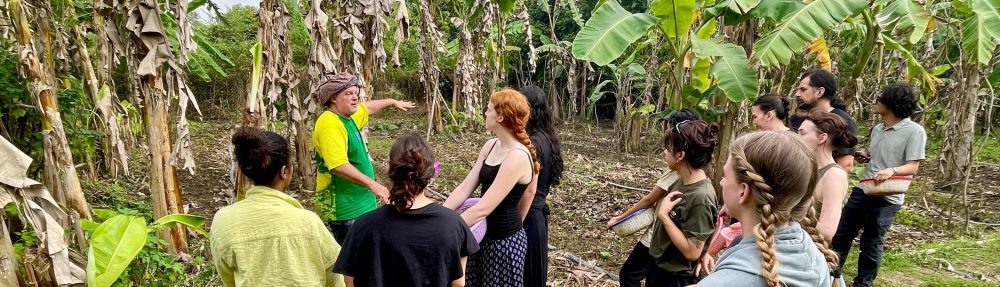
In Auroville we met with Pitchandiculam, an organization that works with the forest in many different ways, all ethical, one of the ways being promoting natural medicine.

Remember your future garden. Our nature, that once were our kitchen and our pharmacy is being exploited to an extent that will come to backfire us in the future. Much of our original and natural products are being removed, and with that also natural herbs and plants that can be used for medical purpose. Today we put much trust on mass-producers of food, drinks and medicine, much which is fabricated, polluted, packed in plastics and aluminum, produced and shipped in unethical ways. Our bodies are changing to fit the world that we live in now and the things that we put in our mouths. At Pitchandikulam we were reminded that we must not forget the nature around us, the natural products that are far more sustainable than the pharmaceutical products and that the solution to a head ache, a soar throat or an itch can be closer to us than the closest pharmacy. At Pitchandikulam they wanted us to think of the nature as our future garden, what we do to it today will impact us tomorrow. So if we hypothetically would be out of medicine or the prices would rise so that we couldn’t afford what we needed, how would you want your future garden to look like? What plants and trees would you put there?

With these question Pitchandikulam wanted to point out that much of what you buy, you can produce yourself. Use your own garden or kitchen to grow plants or food that can sustainably feed you and treat the illnesses that you come across. Important to emphasize was that they of course realizes that you cannot leave everything to the nature, there are sicknesses and complications that is better treated in the hands of a doctor, but much of what we treat today, such as headache etc, can be dealt with in a more ecological friendly way, for our bodies, the nature and our wallets, we can ourselves grow a primary pharmacy at home that could help us to the same extent as the medicine we get at the pharmacy.

When I was younger we would use a special leaf to treat the burn from a stinging nettle. Also it is known that ginger, garlic and lemon are good ingredients to treat a cold, plums are good for hard stomachs and a diet of warm beverages and soups cleans your body. Natural resources that are more sustainable than the pills we take.

Do we really need our mass-producing pharmaceutical companies to the extent that we are using them today? – the answer is no.

Nothing is perfect, everything comes with a consequence, we just have to choose which decision, which garden we would like our children to stand in a 100 years from now when the world might be out of balance.

——–

Safi Sabuni, Linnaeus University

Poverty and its different faces

In my years of travelling, I have seen poverty in different forms, not only in Africa, the US and in different countries in Europe, but also in my home country Sweden, and even though it might not look the same over the world, it’s just as eye-opening and heartbreaking each time.

The media of the western world have a way of portraying Africa as a continent filled with poverty, hunger and diseases, but what many people do not know is that India, a single country, have more poor people than the whole of Africa, the second largest continent on earth. When I first heard it, I could not believe or even begin to understand the poverty that I would meet when coming to India. However when here, I thought I would witness a much more rough reality than I have, a much more visible truth. Taken into consideration, most of the time I’ve spent in Auroville.

  •  According to Oxford Poverty and Human Development Initiative (OPHI), 8 Indian states have more poor people than 26 of the poorest African nations combined, which is a total of more than 410 million poor. India is estimated to have a third of the worlds poor. (http://www.bbc.co.uk/news/10609407)

What has struck me every time is the street children.  I have younger siblings,  an 8 year old sister and my brother who is 3 years old. The children I see walking the street are the same age as my sister, and the siblings they are caring with them, the same age as my brother. They walk through the streets with a pure confident only a child can have, playing around and filling the streets with noise and movement, however when the opportunity might strike they have to put on the role of provider and use the routine they’ve been thought to beg. It is such a contrast from where I am from, where we take so much for granted as parents, and we learn to take so much for granted as kids. Witnessing poverty in real life and not on film or on the news, in papers and in books, is another reality.

I use to work as an telecom fundraiser for NGOs that works with peace and development related issues and it is astonishing to see how we today are so overloaded with information that when we are presented with a reality that might not affect our own directly we just tend to shut the information out. Therefore I believe that the methods used is presenting extreme picture of poverty in order to make an impression with the reader, leave a mark, and with this comes the consequence of generalizing and creating a picture of poverty only when it is in its most extreme.

What I was reminded of during this journey was something that I learned when visiting Cape Town, South Africa. It is important to remember that poverty in itself does not always portray as media portrays it, being slums, beggars and homeless people, poverty exists behind closed doors and in the heart and the minds of people as well. I was explained that poverty does not always have to do with money and material in possession but rather, being poor is lacking the most important things in life that makes it worth living, such as love and happiness, an expression I hadn’t come across until then.

However if we’d stop projecting the pictures of poverty, writing about our experiences to share, the problem would surely not go away. So I wanted with this blog post to add another writing to the billions of writings about poverty. Share with you the situation I have experienced, and hope to set of a line of thoughts that will contribute to something good.

________
Safi Sabuni, Linnaeus Universtiy

Communication barriers

English has become the most important language in the world. More than 80 countries are having it as first language and several other countries have English as a second language. A lot of NGO organizations also use English to promote and express themselves for their target groups. This incredible amount of people that use English has made the language the largest and most flexible social way to integrate

When I travel in Auroville, a lot of people interact with me, start to talk, smile at me, laugh with me and are always there when I need help. One time my motorbike stopped, in 30 seconds a man stood beside me and offered petrol. One time I needed a ride, I just put my thump up and someone stopped for me every time. People are helpful and want to interact with you. No matter if they talk English or not, they always find a way to communicate with you. When I on the Pongal day looked for dinner for the evening, an 80 years old man tried to explain himself just with his hands and gestures. He couldn’t speak a word of English. But he was happy to help me and in the end, I actually got it. Funny world we are living in, where you can let your body language talk instead of your voice. The question is, if this way to live and express yourself at will live or die.

When I talk about communication barriers I don’t necessary mean that it is a problem to have it. Of course it would be easier to reach your destiny in a cab if the taxi driver speaks English. Or your volunteer time would be more effective if the board of the organization was talking English. It would be easier and more sustainable. The taxi driver would not waste petrol going the wrong direction because of communication problems with customers. The organization would have a larger area to work with and become more global. Maybe their needs for volunteers would decrease.

After having studied nearly my whole life from the age of 6-23, I never thought about the importance of a common language. Language like English in school was never my favorite subject. But at last, my ears listen; my mouth wants to form the words and my eyes will follow the one that I integrate with.

At the same time, when I understood the importance of English I understood how the future will be. The knowledge of English is the future for sustainability. But we cannot allow ourselves to forget the generation before us. People need help with language barriers. The creation of a common language is like a big company that exploded and concurrent out the smaller ones. Every decennium, languages die out. At the same time, I cannot stop thinking about organizations, identities and cultures that will be lost. English is the future, but is it the right way? English helps us create the Global world, but do we want globalization? Since 1860 the globalization has created the best living standard for people in the history of humanity. But it has also created the largest inequality between people. Is globalization sustainable? I don’t think so. Globalization is like a bottle of water, and we have filled this bottle with 7 billion drops. How much more can we fill it before the bottle starts to be overwhelmed?

Anyway back to subject, should we kill and concurrent out the small companies with English, or should we start to think on a local level again? The Globalization and the common language is a way to socialize the humanity to be more common with each other. Do we want it? Or, do we want to have our own identity and create a world that are sustainability in the way it’s just are. A local place there we can live in peace and progressive harmony, above all creeds, all politics and all nationalities, all allow of different language, places like Auroville.

/By Filip Johansson, Linneaus University      

Auroville

Auroville is meant for one thing and one thing only: humanity as a whole, which means that the community should not belong to no one in particular and be a place of material and spiritual research for a living embodiment of an actual Human Unity.

Auroville is a complex society that was founded 1968 by Mirra Alfassa also known as the Mother. She defined and explained the purpose of Auroville: “Auroville is meant to be a universal community where men and women of all countries are able to live in peace and progressive harmony, above all creeds, all politics and all nationalities. The purpose of Auroville is to realize human unity.”

Auroville is not like other communities. For the first time in my life, I see a community that is trying to be their own society- independent of governance and other actors. Of course they are not able to stand outside of the system fully, but their attempt to only use local organic foods and trying to keep things in Auroville create a value and identity for the people in the area. We are one, it doesn’t matter where you come and have done before. This makes Auroville unique, unlike any other community in our world.  

Approximately 1500 people live in Auroville, a laboratory for the development of human consensus. Their residents are not tied to any religious belief and the society should have room for alternative lifestyle and different individual life choices. It is a place which people move from far, far away to express your dreams. It’s the own journey, to find peace, concentration and release everything in your body. To not feel any anger, frustration and credence any more.

Instead of using paper and coin as a currency, people that chooses to live here gets an account card that is connected with their central account bank. Visitors are allowed to requested for a temporarily Auroville card. This is one of many attempts to change the value of currency.   They could just as well use 1000 apples instead of changing money for some numbers. Auroville wants that people do not have to consider the economic factors. Another business that Auroville have is the shop”Pour Tous” where you can get the things that you need. You buy yourself into the system with a small amount, and for example, if it’s going to rain soon and you know it, you can go the shop and borrow an umbrella. When you feel the umbrella is not needed any more, you can go back to the shop and leave it. At the same time you maybe think that you have things that you don’t use, that you can give the shop like a pair of boots. The purpose with the shop is that material things should go around people so you not over-consume.

It is impossible to explain the world of this society in one small text. People have written large books in this subject and even then you have to read between the lines if you want to understand its complexity. This was only an attempt to open your eyes for a new world that is trying to be sustainable. 

/By Filip Johansson, Linneaus University

Conscious living – a rare but important lifestyle

In today’s industrial and modern societies the majority of people walk the earth and live their lives without asking particularly many questions concerning their surroundings and especially not regarding their own impact on their surroundings. Every step we take in any direction, any device we use, wear or deplete will either affect our surroundings before we use them, while we use them or after we have used them. This consciousness about ourselves and our surroundings is a very rare but important lifestyle in need to be applied in modern societies where great changed then could be made for sustainable development.


One project here in Auroville strives to promote this idea of conscious living through selling products that enable people to have a sustainable lifestyle. This project is launched by the organization: Upasana – Integral design and is called Janaki – House of conscious living. The project is formed as a store that sells certain wares that follow the guidelines of sustainable living. They gather lots of brands in organic clothing, cosmetics, hygiene, food and drinks in one store and try to spread this idea.


Today many people could be “turned” towards a more conscious living, but the problem is that they often do not have any knowledge about how to apply such a lifestyle. They also do not know what impact their daily lives have on their surroundings. Upasana’s work in this project is therefore crucial so that this issue is brought to the forefront and on to the agenda. However there also exist a skepticism and reluctance to such ideas. There’s often a mentality that the sustainable products aren’t as good looking, smelling or efficient as the non-sustainable products. And people often don’t see or don’t want to see the dark backside of everything they consume. There is always a bigger price for a product than just the numbers on the receipt in the store. But the Janaki project aims to turn this fact around and bring forth the positive backside of every product they sell. With their products organic farmers and producers are promoted and our surroundings don’t have to pay an unnecessary and harmful price. Fairtrade products have started to spread and grow in popularity as for example in the coffee industry. Janaki works with a lot of brands and lots of products in different businesses and therefore there’s always something to suit everyone to take a small step towards change. Small steps by individuals will result in big changes and big steps for society as a whole.


There is a need to become conscious about our lifestyle and put some effort in changing our habits for the greater good. Janaki is a role model that should be embraced and followed. These issues makes me relate to some phrases of the lyrics to a song by the band Disturbed that is related to this issue: “Our future is fading. Is there any hope we’ll survive? Still we ravage the world that we love. And the millions cry out to be saved. Our endless maniacal appetite left us with another way to die. Feed and hunger led to our demise – a path I can’t believed we followed. Can we repent in time?”


And that is the big question: can we repent in time if we continue the path of our maniacal appetite and ravage the world that we love? I say: lets change ourselves and save the millions that cry to be saved throughout the world and in that way make room for hope and our future. Janaki in this case is an opening and door to such change. Let’s open the door and enter it!

 / Daniel Ahlm – Linneaus University

Entry number 3 – Conscious living – a rare but important lifestyle

In today’s industrial and modern societies the majority of people walk the earth and live their lives without asking particularly many questions concerning their surroundings and especially not regarding their own impact on their surroundings. Every step we take in any direction, any device we use, wear or deplete will either affect our surroundings before we use them, while we use them or after we have used them. This consciousness about ourselves and our surroundings is a very rare but important lifestyle in need to be applied in modern societies where great changed then could be made for sustainable development.


One project here in Auroville strives to promote this idea of conscious living through selling products that enable people to have a sustainable lifestyle. This project is launched by the organization: Upasana – Integral design and is called Janaki – House of conscious living. The project is formed as a store that sells certain wares that follow the guidelines of sustainable living. They gather lots of brands in organic clothing, cosmetics, hygiene, food and drinks in one store and try to spread this idea.


Today many people could be “turned” towards a more conscious living, but the problem is that they often do not have any knowledge about how to apply such a lifestyle. They also do not know what impact their daily lives have on their surroundings. Upasana’s work in this project is therefore crucial so that this issue is brought to the forefront and on to the agenda. However there also exist a skepticism and reluctance to such ideas. There’s often a mentality that the sustainable products aren’t as good looking, smelling or efficient as the non-sustainable products. And people often don’t see or don’t want to see the dark backside of everything they consume. There is always a bigger price for a product than just the numbers on the receipt in the store. But the Janaki project aims to turn this fact around and bring forth the positive backside of every product they sell. With their products organic farmers and producers are promoted and our surroundings don’t have to pay an unnecessary and harmful price. Fairtrade products have started to spread and grow in popularity as for example in the coffee industry. Janaki works with a lot of brands and lots of products in different businesses and therefore there’s always something to suit everyone to take a small step towards change. Small steps by individuals will result in big changes and big steps for society as a whole.


There is a need to become conscious about our lifestyle and put some effort in changing our habits for the greater good. Janaki is a role model that should be embraced and followed. These issues makes me relate to some phrases of the lyrics to a song by the band Disturbed that is related to this issue: “Our future is fading. Is there any hope we’ll survive? Still we ravage the world that we love. And the millions cry out to be saved. Our endless maniacal appetite left us with another way to die. Feed and hunger led to our demise – a path I can’t believed we followed. Can we repent in time?”


And that is the big question: can we repent in time if we continue the path of our maniacal appetite and ravage the world that we love? I say: lets change ourselves and save the millions that cry to be saved throughout the world and in that way make room for hope and our future. Janaki in this case is an opening and door to such change. Let’s open the door and enter it!

/Daniel Ahlm – Linneaus University

Help to self-help and social development

Our time here in Auroville is soon over and our communication projects have been completed and presented and now it only has to bee handed in and delivered to the different organizations. In the beginning of our visit here we went out on a lot of field trips and met inspiring people and organizations and listened to them discussing their work on sustainable development. The interesting thing was to witness so many different angles on this issue and see how it works in daily life. One organization that made an impact on me was the design studio Upasana – Integral Design. This organization also became the one I worked with during our time here in Auroville. Upasana is a big organization in the way that they work with many projects on different levels. They are an organization that mix fashion, design, social responsibility, Indian culture and business under one roof. They started of as a design studio in 1997 and aimed towards expressing the different textile cultures that exist throughout the Indian states. However, as the tsunami struck the western coast of India in 2004 and many other parts in south east Asia, Upasana ventured into the field of social development and decided to incorporate social responsibility as a value in their daily work. This made them launch their first social project named Tsunamika. This was made to be a trauma counseling effort for the victims but it also created tsunamika dolls to be given in an attempt to bring comfort to the victims of the tsunami and its relatives. The projects was a success and became known worldwide. There was also the nice thought behind it that they stressed the fact that the dolls was supposed to be given and not sold which enhanced both its emotional value as well as its spread throughout the world


After this project Upasana continued to launch different programs as the years passed. The value of self-development became stronger and stronger and Upasana keeps referring back to its focus on people and development of the supreme self. This social-sustainability is of great value in vulnerable regions such as this one. The big focus on this issue was a great reason for why I felt a strong urge to work with this organization. To enable an environment where people are given help to self-help is something that is greatly discussed in today’s development work. This issue is a core factor in keeping development sustainable and long term in regions like this. Upasana has several projects that works to enable this kind of environment both for farmers throughout the region, weavers in Varanasi and different craftsmen in the coastal town of Tranquebar. They help them to either restore their former livelihood that has been taken from them after the tsunami in 2004 or just to keep their livelihood up and running and helping them to stay in business. Help to self-help gives opportunity for social development and a greater knowledge base in the world. Without a population with these opportunities and characteristics we can not hope for any change in the world and that is why this issue can not be stressed enough and why Upasanas work is of such great value in many aspects.

/ Daniel Ahlm, Linneaus University

Educating children in order to create a sustainable future

By Johanna Lindgren, Linneaus University

In only four days we will leave Auroville, which makes me think of the strong impressions and good memories I will take with me when I go. During these four weeks we have met some wonderful people who are doing some extraordinary work for their society one way or another. These people work for a sustainable future, so that the coming generations will have a world in which they can live a happy and healthy life. One of these people is Srini at the Yatra Arts Foundation. He really made a strong impression on me and especially with the movie he made, together with others, on the subject of alcoholism.

The movie was about a young girl that lived with her two younger sisters and her alcoholic father. The mother had passed away, leaving the young girl to take care of her siblings. The girl worked every day taking care of goats, but her dream was to go to school. She watched the other children when they left for school and was sad when she had to do chores at home and go to work instead of being able to go with them. Her father was sitting on the front porch drinking and when he was not drinking he was passed out. Not only did the girl have to take care of her siblings, but also of her father. It was a really sad story. The father died in the end, leaving the three girls without a mother or a father. This had such a strong effect on me that I started crying right there amongst my fellow students and the people working at Yatra.

I highly appreciate the work that Srini and the organization are doing, trying to educate children and their parents about social issues using different forms of entertainment. Education through entertainment is called edutainment and is a widely known concept amongst development communication workers. Considering the effect it had on me, I think it has the power to have a strong effect on others.

If you look at the work of Srini and the Yatra Arts Foundation one must say that it is highly relevant in order to create a socially sustainable future, since the children are our future. If Srini is able to educate the children about alcoholism or waste management, for example, through his movies or street theater, this might create a change in the way the children think. The children might start saying no to plastic bags, to create less waste. If the children start saying no to plastic bags, then the parents might get influenced to do the same thing. If they watch a movie about alcoholism and see how badly it affects the people around the alcoholic they might not start drinking when they get older since they know about the problems it can create.

I wish that Srini and the Yatra Arts Foundation will keep up their good work, creating more edutainment around important issues. I also wish that their work will have a long lasting impression on people so that more people start taking small steps in the right direction. Lastly I wish that these small steps will turn into larger steps, in order to create a sustainable future.