India Has a Stray Dog Problem and It’s Breaking My Heart (Warning: Graphic Images)

This little guy has been spotted in several areas of Auroville, emaciated and starving.

This little guy has been spotted in several areas of Auroville, emaciated and starving.

I’m a serious dog lover and the situation I found as I arrived in India has been eating away at me. It’s breaking my heart, more and more every day. It doesn’t matter if I’m walking through Auroville, sitting at the hostel, or eating at a restaurant, stray dogs are everywhere.

We visited a recycling center outside of Pondicherry and this little guy followed me around.

We visited a recycling center outside of Pondicherry and this little guy followed me around.

I’ve visited cities where stray cats are running rampant, but never have I ever seen so many helpless dogs. From the absolutely tiniest puppies to full grown matted muts, they are emaciated, hungry and in need of a loving home. Most of the free-roaming dogs are of an ancient canine race known as the Pariah Dog, which exist all over Asia and Africa. In addition to being scavengers who live mostly on human-created garbage, they are often kept as pets by rural and urban slum households.
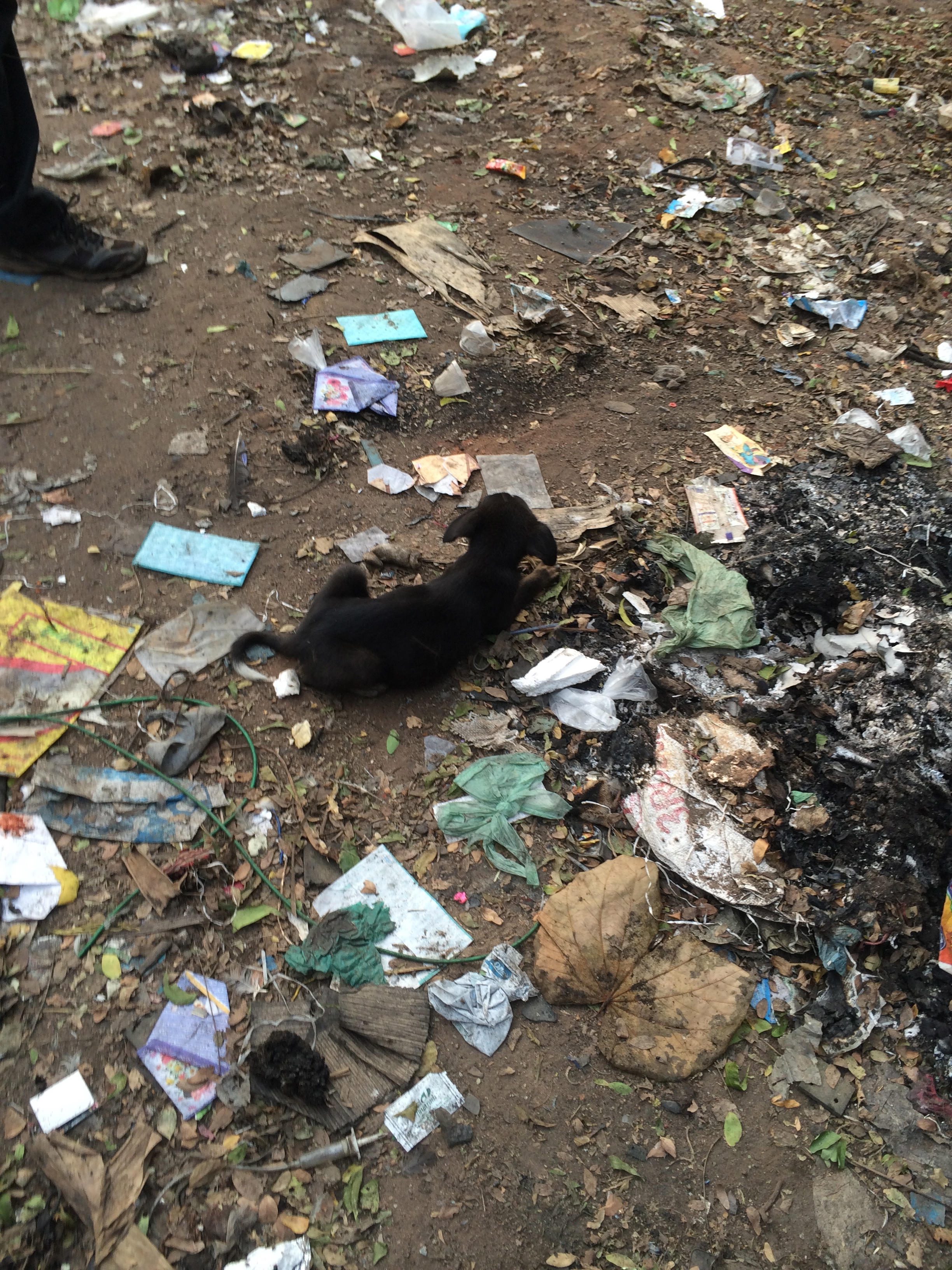
Stray dogs are often found eating garbage to stay alive. This was taken at the Pondicherry dump.

Stray dogs are often found eating garbage to stay alive. This was taken at the Pondicherry dump.

Most of the dogs I see roaming around are covered in mange, fleas and ticks with chunks of hair missing all over and dark bloody scabs. They are also typically very thin with most of their ribs popping out. Every time I see one of the dogs, my initial instinct is to run over and give them the best petting of their life, but I restrain myself. I want to feed all of them and take them home to give them all the life my dog has. Every dog deserves a warm fluffy bed, fresh food, water and basic health care.
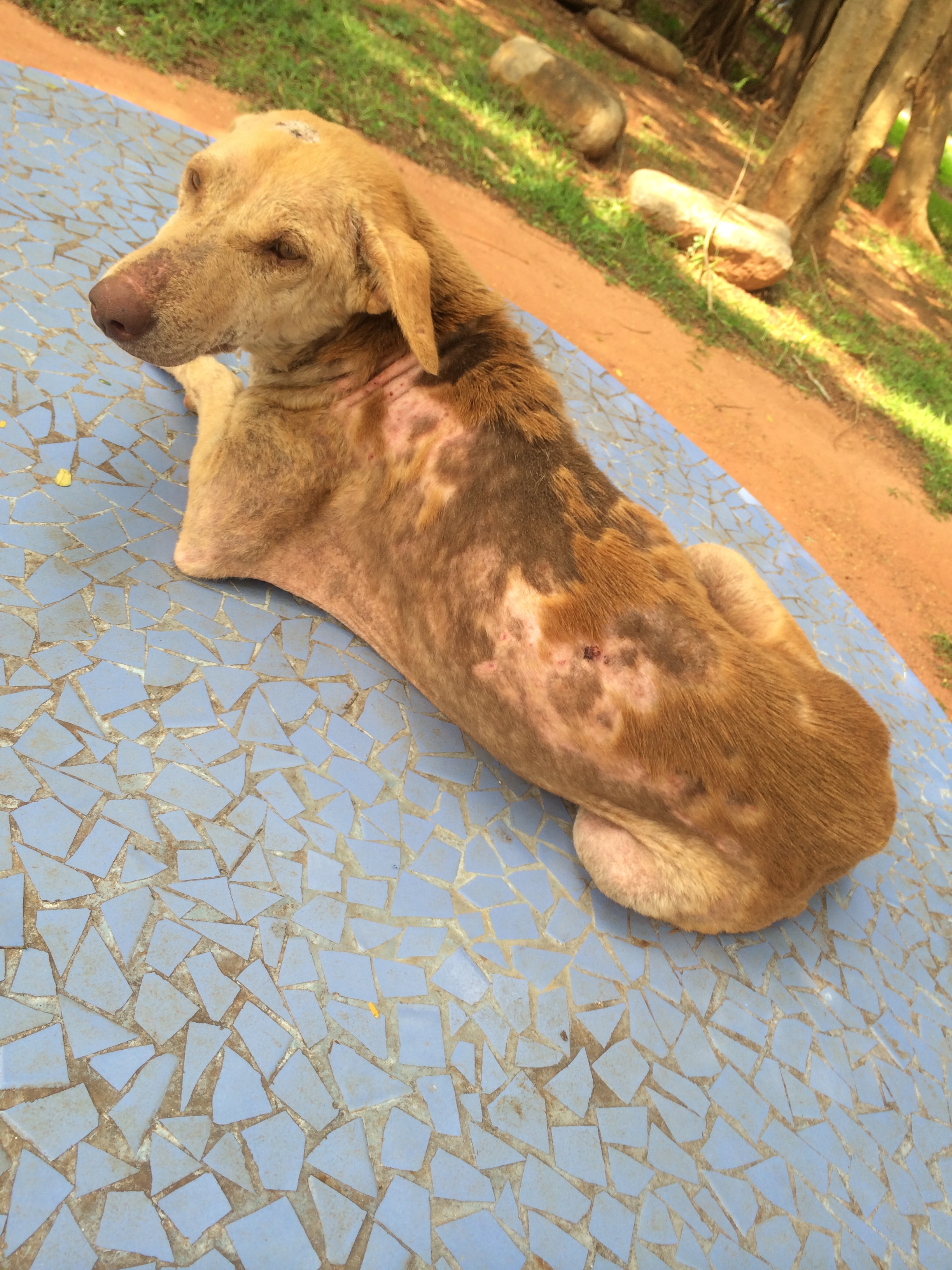
This dog hangs around our hostel and occasionally sneaks up the stairs near our rooms. The sadness in this dogs eyes is overwhelming.
This dog hangs around our hostel and occasionally sneaks up the stairs near our rooms. The sadness in this dogs eyes is overwhelming.

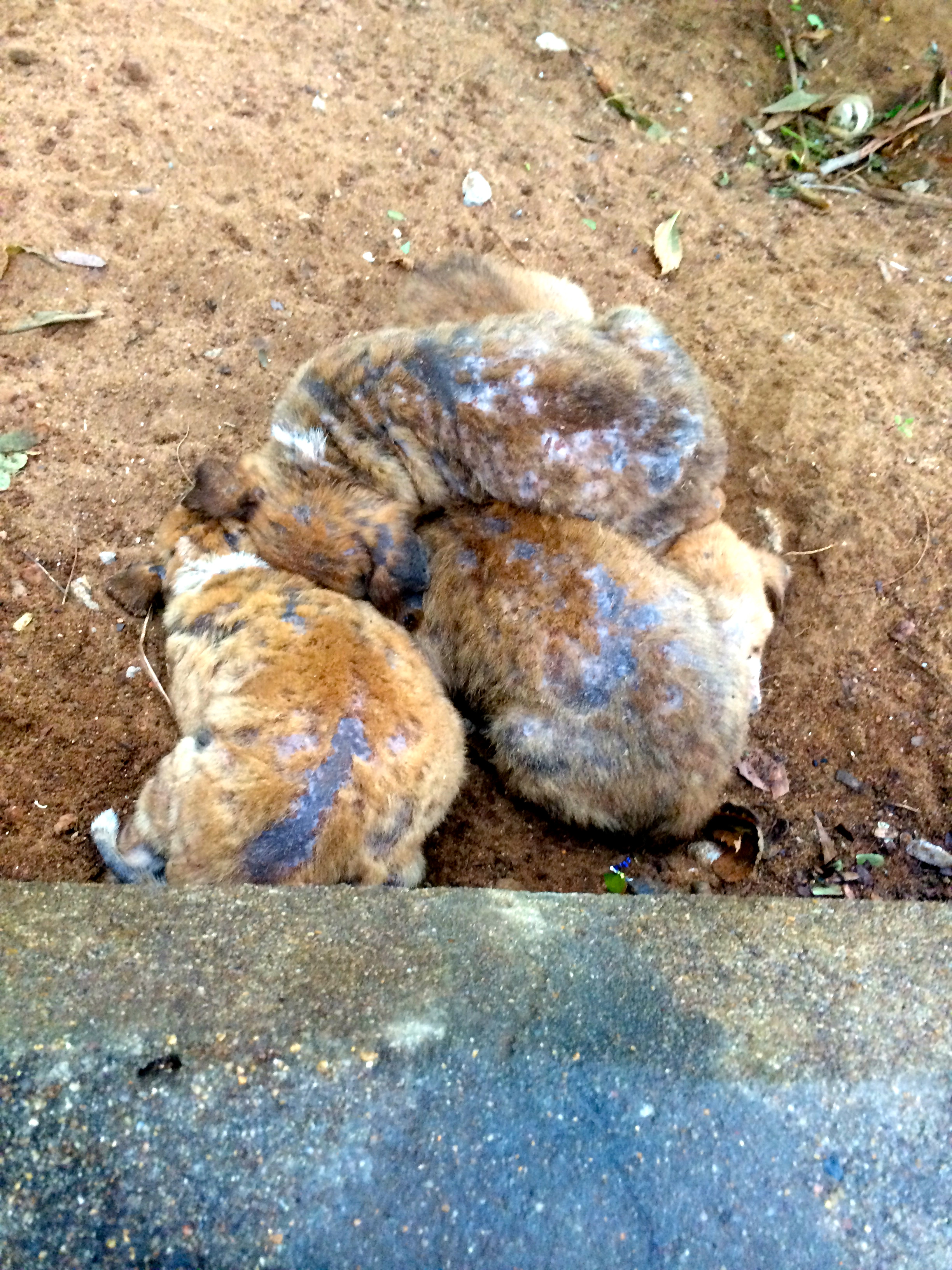
These four pups were on the side of a walk way in Malappuram, India. They were just fighting to stay warm.

These four pups were on the side of a walk way in Malappuram, India. They were just fighting to stay warm.

It’s not uncommon to see an adult dog lying with her freshly birthed puppies on the sides of the roads or near food markets. It’s so sad to see them struggling from the second they are born. The outlook for their lives are so grim.

I saw this mom and her babies lying on the side of the spice market in Pondicherry.

I saw this mom and her babies lying on the side of the spice market in Pondicherry.

India is home to nearly 30 million stray dogs and in 2012 WHO estimated that India had around 20,000 rabies cases. These numbers are not only heart breaking, but should be an alarming wake up call to the Indian government to create change. The Animal Welfare Board of India (AWBI) has been trying to implement the recently approved National Rabies Control Pilot Project, however due to lack of governmental funds and outdated policies, the program has remained stagnant. NGO’s around the country are working hard, but without needed funding, cannot fully implement the program. It’s very expensive to vaccinate and sterilize the dogs, not to mention that there are so few NGO’s in comparison to the excessive amount of dogs. It takes a lot of effort to control the disease and the overpopulation.

With a population of over two billion people, millions of which have no guaranteed food, water or shelter, it may be hard to justify spending precious time and resources on saving the dogs of India. But, all hope is not lost. In the nation’s capital of New Delhi, police officers have been dispatched to safely collect and find homes for hundreds of street dogs. The dogs will be given proper care and veterinary attention before they begin training to become service dogs. The thought is to control the street dogs, giving them purpose by engaging them with society to benefit the people.

I’m not sure if this issue will ever be fully resolved, but with the right plan of action and support, many dogs could be saved and sheltered.

-Alexa Pizzi

In a landscape of burning plastics

Pondu Landfill

Click to enlarge

In India, almost all the waste goes to landfills, since people are really bad at recycling. In fact, half of what goes to the landfills in India is organic waste that should have been composted. A consequence of the lack of waste segregation is that PET-bottles, paper packaging and other items that should be recycled are contaminated by rotting food, making the items worthless.

In the midst of all the garbage, cows and dogs and a large flock of crows are feeding. Their presence make the scene feel surreal to me. I imagine cows should be on green meadows, not on dump sites? The surrealistic feeling is enhanced by a thick, toxic smoke coming from a number of small fires at one end of the dump. People in search of recyclable metals have set piles of electronic waste on fire in order to melt away plastic components and free the metal. Tomorrow they will come here to go over the ashes with magnets.

Pondi Landfill

Click to enlarge

Just next to a big cow, I see an old woman picking up some aluminum foil and putting it into a sack. We walk over to her. Turns our she’s 70 years old. She earns her livelihood from finding recyclable items like paper, plastic and metal on the dump and selling them to a local scrap dealer. In a day she earns about 100 rupies (approximately 1 Euro or 1.6 USD). Just one step away from where she stands is a big red plastic bag. The color indicates that it contains medical waste from a hospital, in other words syringes. We ask the woman if she’s afraid to injure herself. Oh no, she replies, pointing to her flip-flops, implying that they are sufficient protection for her feet. And then she shows us how she’s using a small metal stick when digging in the garbage.

I shudder at the sight of it. She’s not even wearing gloves. Personally I’m terrified of dirty needles and the risk of being infected with HIV or Hepatitis – or for that matter catching any disease from bacteria that might thrive on a landfill. I’m only centimeters away from accidentally stepping on a dead puppy. I tighten the scarf covering my nose and mouth, but I cannot shut out neither the stink nor the pain in my heart from all that I see. In my sturdy jogging shoes I head back to the rented bus that will take me home to my neat and tidy hostel room. But the Pondicherry Landfill stays on my mind. The old woman in the orange sari has no rented bus to take her home tonight.

A short film clip from the landfill


Post written by: Åsa Ljusenius, Linnaeus University

Link

India India Aims to Keep Money for Poor Out of Others’ Pockets

Yesterday, during an outstanding talk by Dave at Evergreen (several people said it was the best of the entire experience here), we learned, among other things, about the problem of corruption in India and elsewhere, especially where locals were not receiving the money that was supposed to be coming to them from the government. Today, the New York Times talks about it in this article.

Our Last Day in India

By Madeline Boughton

January 14, 2012…
After a night of celebration with dinner, drinks, gift-giving to our mentors, and swimming in the restaurant pool, we all slept soundly that night.

Saturday arrived, our last day in India. Bright and early we made our way to the dining hall in the Tibetan Pavillion. Our hostess Kalsang (and company) prepared our breakfast of bread and jams, fresh fruit, oatmeal, and tea & coffee. Around the breakfast tables the consensus was people going shopping in Pondicherry for last minute gifts and souvenirs or to the beach for some last minute sun, sand and surf. (A few people had to go into their NGO’s to drop things off and say proper goodbyes.)

Everyone was happy with their last day spent around the beach, Kulu Payam, Pondicherry, and Auroville. The evening wore on and people ventured out for some food before we had to load up the “bus” at 9:30pm. Some went to a restaurant called Paris, some went to Tanto’s and others went to the ever faithful, Visitor’s Center. Many of us spent our last rupee on those meals. We were sure to leave a nice tip for those poor waiters at the Visitor’s Center 🙂

The pavilions had rush and adrenaline in the air. A few of us decided to create a donation bag for the Social Awareness for Liberation Trust (SALT) Children’s Home. This home is essentially an orphanage and was severely affected by the cyclone. People came by and put toiletries in the bags, a few clothing items and flip flops, first aid products, and headlamps and flashlights. It wasn’t much or very fancy, but we were positive that it would be of greater use to them than it would be to us in Paris, especially since the home was still without electricity.

True to form at the Tibetan Pavilion, we also lost power (again) when everyone needed it, while packing! Thankfully we still had some candles. People continued to pack and pray that their suitcases would not be overweight.  As we brought our suitcases down to the front of the building, everyone was saying goodbyes to Sacha, Luke and Kalsang. There were also a couple of us that were left behind (of their own volition). Kalsang said she will never forget the night of the cyclone and the night after where we shared a soup for dinner because we had virtually no food and only a stone-aged method of cooking.

We all huddled up into a big circle with our arms around one another’s shoulders and began to sway. Some started getting a little emotional. I thought to myself, “Finally!” I had been waiting the whole trip for us to bond like this and sing Kumbaya! I began singing it. We didn’t make it through the whole song but it was sort of like a gigantic, 25 person group hug and we ended on that note.

As the bus drove away we waved goodbye. Some of us waved goodbye forever, some for many years, and some will return next year. Each person took away something different from this adventure. But we can all agree that it was a “Once in a lifetime experience.” Image

NGOs Galore!

By Madeline Boughton

The aim of this NGO Practicum is for students to act as interns or consultants to various organizations, assisting with their communication needs. Since day 2 we’ve been touring and visiting non-governmental organizations (NGOs). In only six days we visited about 19 different organizations out of 23. Each day is packed with multiple units where they present their goals and missions to students and answer any questions we might have.

The overarching themes of the NGOs we will work with are health and human rights, environmental sustainability, alternative energy, and sustainable fashion. These broad terms include causes such as women’s empowerment, Dalit rights (formerly known as Untouchables), children, sustainable and ethical fashion, sustainable living, radio, solar energy, waste management, and more! This NGO practicum truly offers something for everyone’s interest or passion.

With so many “good causes” it is difficult to choose just one. I could easily choose about 3 places I’d be interested in working for. The other factor that could make choosing an organization difficult is matching an organization with student’s skill sets. Some organizations need assistance with website building, creating pamphlets and flyers or creating short videos to display on existing sites. Fortunately, there is a wide range of skills within the group and we also have “media mentors” that will assist us with technical questions and projects.

After a few days of visiting 5 organizations per day, most of us had an idea of where we want to work. The remaining organizations and speakers were essentially lectures and informative sessions on the functioning and practices in Auroville. Even though we will wind up doing a major project at only one organization, we are now well informed on almost all that Auroville has to offer in terms of advocacy and will use that information when completing our projects and final papers. Some of us are quite anxious to begin work right away. I have chosen to work at the ADECOM Network. This agency advocates for the rights of the Dalit community. I am happy to assist this agency in any way in helping shed light on discrimination against a vulnerable people. We will keep you updated on how our progress and projects turn out.

Thanks for reading!

Image

The Other Side of Sustainability

By Shannon Warren

This morning Auroville was abuzz with the whirring of chainsaws slicing into fallen trees, the frantic beeping of the suddenly plentiful rickshaws, and the general chaos of people trying to make sense of the destruction around them.  It has been three days since cyclone Thane hit Auroville and the devastation is still astounding.  The heat and humidity bring into sharp relief the lack of drinking water and electricity as people venture out in the glaring sun to procure necessities and try to clear debris from the roads.  Some of our group has experienced natural disasters and many of us haven’t (I am included in the latter group).  Certainly none of us expected anything like this when we came to India for a practicum in communications and sustainable development.  I suppose the thing about learning, about self-improvement, is that you must be confronted with the unexpected and unknown to progress.

The night of the storm, while I curled up afraid but safe in my sheets and behind sturdy brick walls, I listened to the howling winds, shattering glass, and falling trees as peoples’ homes and livelihoods were destroyed in a matter of hours.  The next morning I woke up in disbelief.  Just one day earlier we were carefree, hiking up to a temple on top of a hill and swimming in a beautiful freshwater lake.  That morning we were not only in an unfamiliar landscape and culture, but had just been through the worst cyclone that had ever hit Auroville, according to local sources.

Although the situation could have escalated to the point of hysteria very quickly, we chose instead to play cards by flashlight and sit together singing familiar songs, letting our apprehension out through laughter rather than tears.  Some of us ventured out on the roads, clad in our raincoats and ponchos, to see how the villages had been affected and to search for food and water.  After climbing through the fallen giants blocking the roads and seeing that being in a mud hut during a cyclone as opposed to a sturdy brick building made a world of difference, we knew that we had our work cut out for us the next couple days.

The next day, New Year’s Eve, we donned our work clothes, picked up machetes, and started chopping and clearing up the trees and debris around our pavilions.  Suddenly it seemed as if we were no longer a group of semi-strangers brought together by wanderlust and a course requirement, we were all kindred spirits, working together to realize a common goal.

While traipsing through the grass behind my classmates with my arms full of branches and my heart full of determination, it became clear to me that there are two sides to sustainability: the physical side that involves composting toilets and cold showers as well as the emotional support that comes from being a member of a community which takes care of all of its members as well as the physical space that it inhabits.

So, while it may not have been the lesson we set out to learn, we have all discovered the emotional side of sustainability over the past few days.  Although the people who live here may not have many of the comforts we enjoy back home, they do have one thing that many of us don’t: the sense of security and assurance that comes from living in a community where people are connected and take care of one another.   I think I’d take that over an iPad any day of the week.