Sharana: Transformative Holistic Development Beyond Conventions

By Sarah Glavan

In the midst of the colorful tapestry of Pondicherry, the Sharana Social and Development Organization stands as a hub of holistic development, breaking away from traditional models to shape a narrative that spans across various facets of community life. A warm breeze is blowing through the entrance lobby of the foundation‘s building in which 17 AUP students stand shoulder to shoulder, listening to the charismatic and passionate founder Rajkala Partha. Sharana (शरण) means shelter in Sanskrit, she explains to us, and that the organization was founded in the year 2000 to address critical educational needs of socio-economically disadvantaged children and communities in urban Pondicherry and its surrounding villages. 

We are told that the organization has multiple programs spanning from children‘s empowerment over women‘s empowerment to rural development. Sharana’s various projects collectively aim to provide access to education, access to employment through micro-credit lending and vocational training schemes and access to healthcare. A key focus is on supporting children to pursue their education, breaking barriers that might hinder their path to knowledge. Sharana goes beyond the classroom, offering counseling and skill development programs, recognizing the importance of emotional and practical tools in a child’s journey. We are allowed to look at one of the classrooms which has a variety of art pieces in the back of the room. Small statues made out of paper-mache and vivid watercolor paintings reveal the creativity, learning and healing that is fostered at Sharana. Manuel, Sharana’s empathic expressive arts therapist, explains that he recently established a therapy program specifically for fathers who are struggling. Employing expressive arts for therapeutic purposes further demonstrate Sharana’s innovative and holistic approach, integrating diverse elements to create a harmonious symphony of development.

According to Rajkala, a defining moment in Sharana’s trajectory was their departure from conventional sponsorship models. Rejecting the notion of children being tourist attractions in “sponsor a child” funding schemes, the organization shifted to a collective sponsorship system in 2015. The new model allows Sharana to operate autonomously and to address the needs of each child more precisely. Sharana‘s deep commitment to transparency further allows them to operate freely and to build relationships of trust with donors.  Today, Sharana is able to support 2000 children, showcasing not only organizational success but also the effectiveness of a local, grassroots approach. Collaborating closely with the local government, Sharana emphasizes a synergistic relationship for more impactful, community-driven development in Pondicherry. In the realm of development, Sharana serves as a model, demonstrating the efficacy of innovation, transparency, and collaborative efforts in fostering lasting change.

We felt grateful for the opportunity to learn about the insights that Rajkala, Manuel and their colleagues gained throughout the years of working on the improvement of livelihoods in Pondicherry. The foundation shines bright as an example of an impactful grassroots development organization established by the community for the community. Sharana and its lasting impact remind us all that the process of development is just as important as the results.

More about Sharana on their Website: https://sharana.org/

From left to right: (1) Artwork in a classroom at the Sharana Social Centre. PC: Sarah Glavan
(2) Sharana Social Centre in Pondicherry. PC: Grant Weekes
Pondicherry

By Donatella Jackson

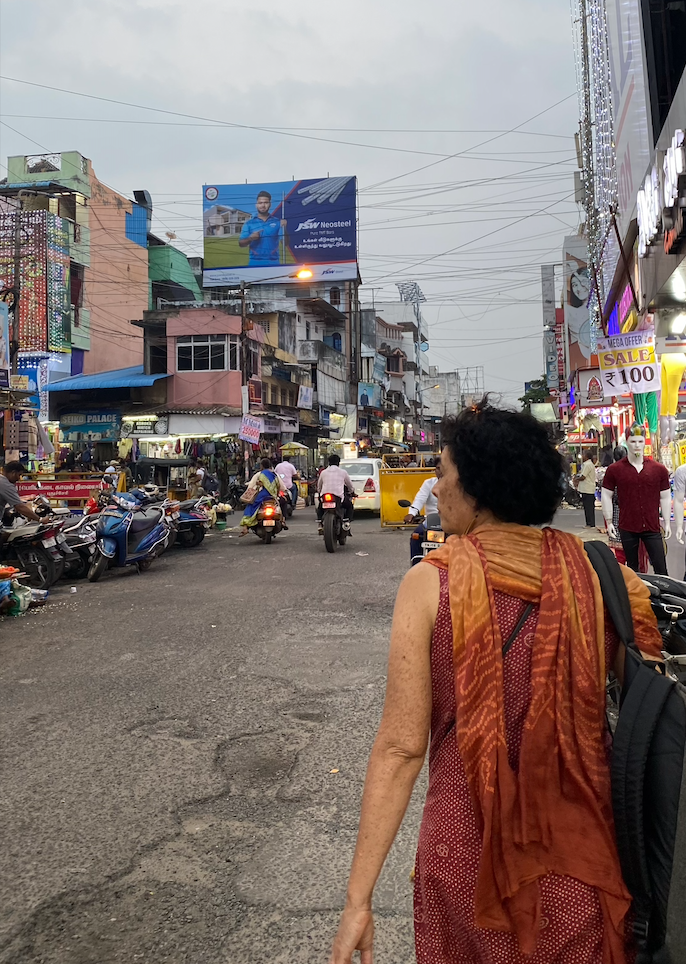
Pondicherry is a city beaming with life, as vibrant as its architecture. Houses dressed in bright blues, bubblegum pinks, and lemon yellows provide a stark contrast to the dull grays and beiges of Paris, France. Pondy, a city of 877,00 people is located in the southeast coast of India, 3 hours from Chennai and 30 minutes from the city of dawn, Auroville. First occupied by the Portuguese in 1523 and then later by the French and the French East India Company, Pondy got its name from the French interpretation of “Puducherry”, pondi meaning new and chery meaning settlement. Replete with history and culture, Pondy’s main language is Tamil, one of the living classical languages with over 74 million speakers worldwide and with writings that can be traced back to as early as 3 BCE. 

Despite its eclectic beauty and rich history, the city is marred by the pungent smell of slow-melting plastic waste left In untreated standing water. Waste management in Pondy is poor and as the Yatra Foundation demonstrated it is not solely an issue of lack of access to proper facilities, but it is also a lack of education and a distancing from historical cultural practices after colonization. 6% of India’s total population lacks access to safe water and 15% continues to practice open defecation. Additionally, there are more cell phones per household than there are toilets. In a society, where wastewater, sewage, fertilizer, pesticides, and industrial waste are some of the most common sources of water pollution, it also contributes to waterborne illnesses and death. 

Since our arrival in Pondy, I’ve been fascinated with waste management and the apparent neglect of safe water practices. What I had thought was an over-exaggeration made by the Yatra foundation video was almost an underrepresentation of the sad reality of day-to-day life. After later visiting the Mohanam cultural center, I was almost surprised to learn that water was considered sanctimonious in Indian culture. Holding not only spiritual significance, but an intrinsic connection to Indian society and culture as notions of purity and pollution determine much of the caste-based social hierarchy, as well as who has access to clean water and who doesn’t. 

Water, since the Vedic period, has been recognized as a spiritual symbol and a reflection of self through its connection to our physical and cosmic being. What then do polluted water sources say about how we view ourselves? 

In visiting Sahodoran, I carefully stepped over mounds of plastic mixed with animal waste, observed chickens and their chicks scavenge for food amongst the rubbish, and stared in awe at plates of food that sat idly alongside standing water. In the context of this, I was taken with the concepts of liberation, access, representation, and what it means not just to be seen but to be acknowledged and then in time, hopefully, understood. We engaged in these conversations about transgender life in Pondy and the reality of the community turning a blind eye to your truth for years… seeing you but refusing to understand. I sat with that in the context of our current physical environment, surrounded by mounds of rubbish, behind a mote of polluted water, sitting inside a building that could be repossessed at any moment on the basis of intolerance and I questioned permanence and longevity as it corresponds to our identity and our surroundings. 

I wondered then if it was even possible to conceptualize liberation and accessibility if the foundation that we use to construct our plans is unstable, inequitable, inaccessible, and ultimately dangerous to our health. What would it take for something to move beyond being seen and stand in acknowledgment? 

There is so much beauty to behold here. So much life to fill your cup with and enough warmth to ensure that It overflows. There is enough art at every corner with the attention to detail of mathematicians, depicting the story of a culture that has lasted through the ages…

 If that same attention to detail and warmth could only be applied to environmental education and reunification of the spirituality of water with a love for community and ourselves, it would not only ensure Pondy’s permanence and longevity but that of the people which make its colors so vibrant in the first place.

In a landscape of burning plastics

Pondu Landfill

Click to enlarge

In India, almost all the waste goes to landfills, since people are really bad at recycling. In fact, half of what goes to the landfills in India is organic waste that should have been composted. A consequence of the lack of waste segregation is that PET-bottles, paper packaging and other items that should be recycled are contaminated by rotting food, making the items worthless.

In the midst of all the garbage, cows and dogs and a large flock of crows are feeding. Their presence make the scene feel surreal to me. I imagine cows should be on green meadows, not on dump sites? The surrealistic feeling is enhanced by a thick, toxic smoke coming from a number of small fires at one end of the dump. People in search of recyclable metals have set piles of electronic waste on fire in order to melt away plastic components and free the metal. Tomorrow they will come here to go over the ashes with magnets.

Pondi Landfill

Click to enlarge

Just next to a big cow, I see an old woman picking up some aluminum foil and putting it into a sack. We walk over to her. Turns our she’s 70 years old. She earns her livelihood from finding recyclable items like paper, plastic and metal on the dump and selling them to a local scrap dealer. In a day she earns about 100 rupies (approximately 1 Euro or 1.6 USD). Just one step away from where she stands is a big red plastic bag. The color indicates that it contains medical waste from a hospital, in other words syringes. We ask the woman if she’s afraid to injure herself. Oh no, she replies, pointing to her flip-flops, implying that they are sufficient protection for her feet. And then she shows us how she’s using a small metal stick when digging in the garbage.

I shudder at the sight of it. She’s not even wearing gloves. Personally I’m terrified of dirty needles and the risk of being infected with HIV or Hepatitis – or for that matter catching any disease from bacteria that might thrive on a landfill. I’m only centimeters away from accidentally stepping on a dead puppy. I tighten the scarf covering my nose and mouth, but I cannot shut out neither the stink nor the pain in my heart from all that I see. In my sturdy jogging shoes I head back to the rented bus that will take me home to my neat and tidy hostel room. But the Pondicherry Landfill stays on my mind. The old woman in the orange sari has no rented bus to take her home tonight.

A short film clip from the landfill


Post written by: Åsa Ljusenius, Linnaeus University