The Colours of Nature: Raising the Bar of Conscious Fashion

By Naydeline Mejia

Located at the edge of Auroville sits an epicenter for conscious fashion. The Colours of Nature, founded by Spanish-born Aurovilian Jesús Ciriza Larraona in 1993, is reviving indigenous dyeing practices one garment at a time. The environmentally-friendly clothing brand is a true changemaker in natural dyeing production, providing sustainable solutions to a largely unsustainable textile industry. (For your information, the fashion industry is the second largest consumer of water resources and is responsible for up to 8-percent of global carbon emissions, per Geneva Environment Network.) Marigold, pomegranate, upcycled jackfruit tree sawdust, acacia, and madder are just a few plants the organization works with to deliver their high-quality, vibrantly-hued garments. Nevertheless, no technique is as striking as their 100-percent natural indigo dyeing process. 

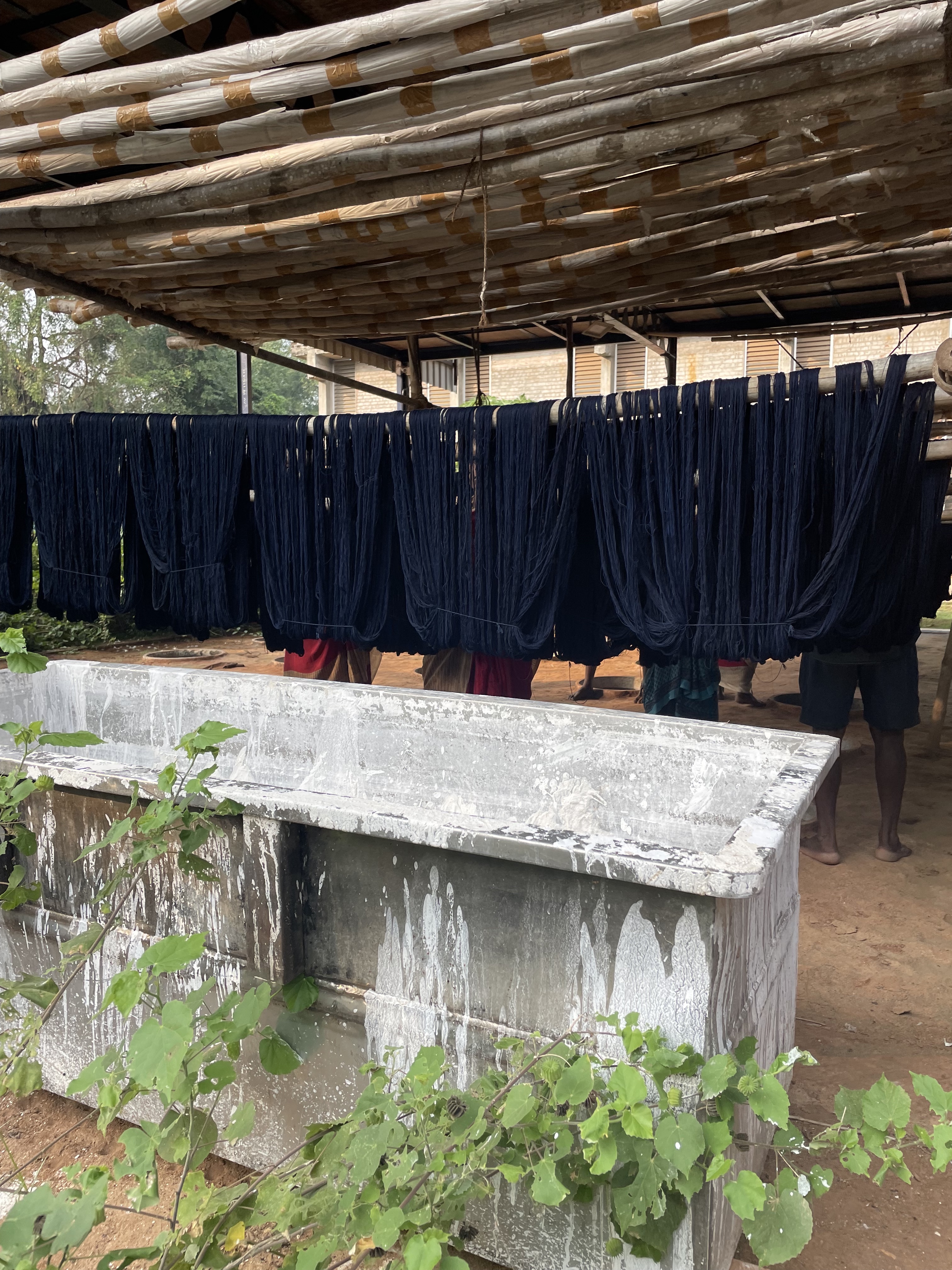
Indigo dyed threads hanging to dry at The Colours of Nature.

Atop a powdery, smooth hazel-colored floor composed of cow dung sits an array of 62 vats, each with a capacity of 1,000 liters, where the fully natural indigo fermentation process takes place. Traditionally, indigo for dyeing requires a fermentation process—either through “staled” urine or by introducing naturally-occurring microbial communities. At The Colours of Nature they utilize bacteria to initiate and maintain the fermenting process. Looking into the full vats, one notices tiny, metallic blue bubbles, which signifies the final stages of the fermentation process. If left for too long, the liquid will overferment—changing hues from a neon blue to army green (Kabish et al.). After fermenting in the vat and being properly mixed with warm water, an employee who has been with the brand for over 29 years smells the final indigo solution to ensure the pH is correct before the dyeing process can begin. Smelling the indigo, one is taken on an olfactory trip to a farm pasture, bringing the mind and body back to the cow manure under one’s feet. The experience mirrors the closed-loop system The Colours of Nature is aiming to achieve—and they’re nearly there. 

Employees mixing the indigo dye inside the fermentation vats.

Earlier this year the organization set new benchmarks in sustainable water management with the installation of an upgraded wastewater treatment system. The canonical tank filters are able to manage gray water from dye operations—extracting solid pigments from liquids—and sanitation to significantly reduce overall water usage and prevent environmental pollution. The goal is to reduce dependency on external freshwater sources by using recycled water that meets the brand’s needs. The entire project is expected to decrease the organization’s freshwater consumption by 30 to 40 percent, and reduce overall costs. Speaking about how the water filtration system works, one notices a sparkle in Jesús’s eyes. The Colours of Nature was born out of wanting to improve clean water management in the textile industry, says Petra, one of the brand’s employees, making this initiative a giant victory for them. 

The Colours of Nature’s new wastewater filtration system separates solid pigments from liquids.

Not only is the organization one step closer to a closed-loop system within their brand, but they’re also helping to reverse the misuse and overconsumption of fresh water within fashion itself—setting an industry standard that’s worth taking notice of.

Learn more about The Colours of Nature and shop their items here: https://thecoloursofnature.com/

The Alchemy of Nature: Philosophical and Technical Explorations at The Colors of Nature, Auroville

By Syed Zaman

Nestled within the center of Auroville—where the ethos of unity and environmental awareness converge—The Colors of Nature stands out as an innovative initiative seamlessly merging philosophy and technology. Established by Jesus Ciriza Larraona, a Spanish-born Aurovillian, this organization embodies the alchemical transformation of raw materials into a dynamic, sustainable, and harmonious workspace.

At its philosophical core, The Colors of Nature draws inspiration from the symbiotic relationship between humans and nature. The organization operates on the premise that textile should not impose on the environment but rather integrate with it—creating a dialogue between the hand-crafted and the natural—and this philosophical foundation shapes every aspect of their innovative approach to sustainable fashion.

Sustainable Threads: Weaving Collective Principles at The Colors of Nature

Within the landscape of ethical fashion—the universal inevitability of the fabric dyeing process echoes a shared human experience. The manner in which we navigate this transformative journey and the ethical values we champion throughout this profound passage serve as poignant reflections of our existential essence. At The Colors of Nature—the dyeing process transcends individual narratives—evolving into a collective exploration imbued with the core principles of integrity, collaboration, empathy, and a myriad of other ethical tenets. In this collaborative venture, each thread of fabric woven reflects not just a personal journey but a communal dedication to sustainable, harmonious, and ethical ‘Fashion’ and ‘fashion’ practices.

Authenticity in Sustainable Hues:

In the laborious yet rewarding sustainable coloring process at The Colors of Nature—integrity takes center stage as a commitment to authenticity and honoring individual narratives. The organization adopts a philosophy that encourages participants to engage in fabric dyeing with unwavering honesty and openness—incorporating both scientific principles and sustainable practices. This commitment extends to mindful choices made during this scientific and creative phase—encompassing considerations such as eco-friendly dyes, responsible water usage, and the celebration of diverse cultural influences.

Synergy in Sustainable Evolution:

At The Colors of Nature, the dyeing process transcends mere solitary work; it unfolds as a collaborative journey engaging individuals, artisans, and the wider community. The organization cultivates an environment where open communication and collective decision-making take precedence. In crafting collaborative dyeing plans, skilled craftsmen, sustainability experts, and community networks unite to ensure that the transformation of fabrics unfolds with a shared sense of responsibility. This holistic approach extends far beyond immediate circles—weaving a network of support that transcends individual boundaries—contributing collectively to sustainable and ethical fashion practices.

Compassion in Sustainable Coloration:

At The Colors of Nature, empathy forms the bedrock of fabric dyeing practices. The organization acknowledges the profound emotional, artistic, and scientific dimensions inherent in this transformative journey—prioritizing compassion and understanding. Artisans, volunteers, and community members undergo training to offer empathetic support, recognizing the unique needs and emotions intertwined with the dyeing process. The outcome is an environment where fabrics undergo meticulous transformation—integrating scientific principles. In this deeply innovative and creative journey within textile sustainability—individuals feel not only seen, heard, and understood—but are actively guided through a compassionate and thoughtful process.

Celebrating Heritage and Insight in Sustainable Fashion:

The journey of fabric transformation is not perceived as an endpoint but rather as a transition that provides a platform to commemorate the accumulated legacy and wisdom of a lifetime. At The Colors of Nature, individuals are encouraged to introspect on their experiences, share stories, and impart valuable lessons to the community. Legacy-building activities, such as immersive storytelling through group visits and interactive sessions—seamlessly intertwine with the fabric dyeing process—fostering a profound sense of continuity and interconnectedness. In Auroville, The Colors of Nature redefines the fabric transformation process by infusing it with values that transcend individual boundaries—embracing the collective human experience. Integrity, collaboration, empathy, and the celebration of legacy become foundational principles—reshaping the journey from raw materials to sustainable fabrics into a meaningful and shared odyssey. Through this, the organization invites us all to reflect not merely on the end product but also on the profound beauty inherent in the entire transformative journey and the influential role of conscious fashion.

Conscious Fashion: a hope for India’s young generation

For the past two weeks, I have been working at Upasana on our new Conscious Fashion Team. Upasana is a fashion company which takes a holistic approach in everything it does. Instead of focusing on maximizing profits, they take into account people, planet, and profit into everything they do. My fellow team member and intern Shraddha Mahajan has been working on Upasana’s 2017 launch of our conscious fashion hub. Shradda is a student at the National Institute of Fashion Technology (NIFT) in Mumbai. As an up and comer in the fashion industry, I wanted to get a feel of what the sustainable and ethical fashion scene is like in India amongst the younger generation.

shraddha photo.jpg

Shraddha Mahajan

Shraddha’s passion is creative writing. At Upasana, she has already begun writing for our new blog which is scheduled to go live this week on www.upasana.in

“Though at our school, we have been taught to communicate through various design means (that include visual merchandising, graphic design, styling, photography, strategy management, marketing, fashion journalism, exhibition design, etc.), I feel myself more inclined towards creative writing as I love the art of language and expressing through words.”

As much as she loves fashion, Shraddha also acknowledges the negative impacts this industry has on the world. At Upasana, she has been doing extensive research on its effects with a focus on India. Through her work on the upcoming blog she will cover topics such as building a more ethical closet, consumption and consumerism, and slow fashion* in order to educate and increase awareness among the fashion community.

“Fashion has been a vital part of our curriculum at school and we as a fashion student must not only be specialized in contributing our skills to the industry in the field of design but must also try to look at the negative impacts caused to the environment and humankind in order to develop solutions for awareness and encourage the idea of sustainability. I think embracing an ethical lifestyle is everyone’s responsibility.”

UKPFB (65).JPG

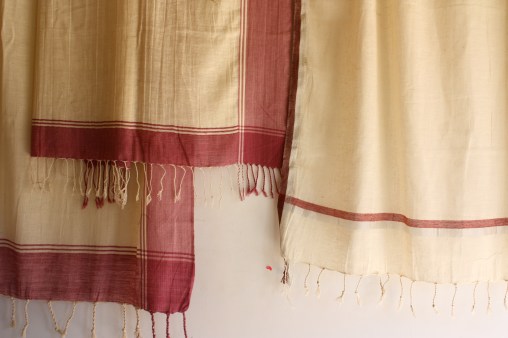
Scarves made from Paruthi brand organic Indian cotton. Source: Upasana

Although most of her research has been about the dark side of fashion, Shraddha still has hope for the future because of her generation’s potential to educate itself and challenge the status quo.

“Being a fast fashion market and majority of the population being a middle class economy, people are less aware of the idea of sustainable and ethical fashion. But since a large group of population (nearly 70%) now includes youngsters, there is a strong hope and scope for education regarding sustainability and adoption of ethical lifestyle.”

Grid1.jpg

Upasana’s Japanese collection. Source: Upasana

Shraddha’s positive outlook has also been inspired by Auroville, the universal township where Upasana is located. Auroville’s goal is to realize human unity and the transformation of consciousness, but is also concerned with sustainable living and the future cultural, environmental, social and spiritual needs of mankind.

“I already knew about Auroville before coming here and the lifestyle always fascinated me which tempted me to experience it. The life at Auroville is much better than I had expected. People are conscious and behave ethically in whatever way they can. For example, waste management, disposing of plastic, paper and vegetable waste separately. In other parts of India, you may not find this.”

It is clear that positive messages about sustainability are already creating positive change in India so that students across India such as Shraddha are drawn to work in Auroville with socially responsible companies such as Upasana. As someone who has seen her passion about conscious fashion, I wish her the best in her journey here and can’t wait to see her work in this space continue.

“I look forward to extend my skills in communication and design. I would also like to empower and please people with what I write.”

Best of luck, Shraddha

*Slow fashion: High quality, timeless, long lasting clothing that is produced ethically.

Connie MORELAND

A Visual Insight Into a Sustainable Fashion Business

By Mia Windisch-Graetz

Check out some pictures I took during my time working for Uma Prajapati, ethical fashion designer and founder of Upasana based in Auroville, India.


Clothes Aren’t Going To Change The World: Uma Prajapati Is

IMG_7899

Uma Prajapati, the founder of Upasana, embodies this quotation to the fullest. Based in Auroville, India, Upasana is the overarching company comprised of multiple different brands of sustainability from organic clothing, tsunami relief, waste management, social responsibility, empowerment and growth. Since working with the brand to increase consumer literacy about organic cotton, I’ve been completely inspired.

Uma Prajapati. Image courtesy of aurovilleradio.org.

Uma Prajapati. Image courtesy of aurovilleradio.org.

I spent some time talking with Uma today and what she had to tell me absolutely overwhelmed me. I wasn’t overwhelmed in the sense that I felt panic or loss of control, but in a sense that I was utterly affected by her story.

Uma came to Auroville in 1996 and after a year founded Upasana. Her aim was to bring India’s textiles to Auroville, so after sourcing from around 16 different states, the company began to develop traditional textile and fashions. It wasn’t until the devastating tsunami hit India in 2004 that Upasana started to transform. This devastating natural disaster killed nearly 230,000 people and affected the lives of 1.7 million in 14 different countries. The company was working to help pick up the pieces through various social projects. Uma ended up working with organic cotton farmers and became profoundly changed with what she learned.

“When I began to work with cotton farmers, I began to know our big brother, Monsanto. I had no idea. I didn’t know there was a seed mafia. I didn’t know that there was a chemical mafia. I didn’t know farmers were committing suicides due to the way the whole economy is structured. They feel so vulnerable. The whole thing hit me so hard,” she said.

Because of this, in 2010 Upasana declared that it was consciously taking the step into becoming organic to support the farming community. She told me that it just blew her mind when she found out that 25% of the world’s insecticides and pesticides get used in one single crop of cotton. She continued to reveal that fashion is corrupt at the very base level, that it can’t even support the people working to produce the crops necessary to create clothing.

Uma questioned her role in all of the mess. “And in that process I chose to align my action and my thought process to the future and the light of the future, not so much thinking about who has to change right now. It’s me who will change and it’s my organization who will change and I will align myself to the future. This is where the sustainable fashion as an option came to me, that if I had to continue doing fashion, it will be only this or I’m done.”

It was this point in the conversation that really made me sit back and examine the world and the people who comprise it. What are we doing to our planet, to our people? If all fashion companies and all of the segments that make it up changed to operate in an ethical and sustainable way the total global carbon footprint could be drastically reduced and countless lives could be saved. If more leaders of companies had Uma’s mindset, the world would be in a much better state.

The future of Upasana lies in international expansion. “It’s time to tell the story to the larger community.” Uma had purposely avoided that route because she wanted to serve her own country and domestic market within India, first. She continued, “now, I’m ready to take this story of a small brand venturing into a fashion and trying to bridge from the farmers to the wearer to the whole line of organic.”

I asked her where she thinks the future of sustainable fashion is headed and without any hesitation asserted “sustainable fashion, it’s the only way!” If we want to we can choose to continue to do what we are doing and destroy the planet, but eventually we have to think about the future. The future lies in sustainability and a conscious lifestyle. It’s not just the fashion industry; many things need to change.

Uma’s passion and dedication to making a difference is exactly the inspiration that the world needs to achieve the larger goal. In a world filled with people and companies whose only concern is to make money over everything else, Uma is so refreshing. But, in addition to her commitment to make this world a better a place, her positivity and optimism for the future makes me hopeful that change can actually happen. I hope my contribution to the effort has even a minor impact upon perceptions of sustainability as a whole. I hope people make the change.

By Alexa Pizzi