Decision Day

Today, most of us woke up with a mixture or nerves and excitement.  No longer would we spend the day completely together visiting different organizations-this early morning, we were going to pick which organization we would spend the rest of our time in India working with.

We sat down on the floor of our meeting room- where in the middle of the room Professor Talcott, in addition to the other organizers Sacha and Tanya, had fanned out pieces of paper each containing one of the NGOs we had visited.  There was over twenty-five in all.  We then had to go around putting our names on our top two organizations.

What is interesting about our group is that we are all coming in with different levels of experience and educational backgrounds.  Therefore, as we sat in the room ready to pick one of the amazing organizations to work with, there was some apprehension that went along with the excitement because of the responsibility we were about to partake in, especially among some of us who haven’t had this type of experience before.

At the end of our meeting, most of us were able to pick our first or second choice and it was time for our initial meeting with our NGO to go over their needs and come up with a specific project that we would be able to complete within our alloted time.  I think that this meeting revved most of us up to hurry to get to work and simply do the best we can.

For me personally, one of the most important things to keep in mind is that we are working within a Self-Help Group (SHG) framework.  The key is to listen first, act second in ways that our NGOs can later carry on themselves.  What we are doing is giving our skills to incredibly motivated, passionate and hard-working people who have so many odds against them, but are still able to make a powerful impact.  We are helping them with their vision-not forcefully imposing our own.

A few days back when we were visiting Mohanam Cultural Center, the owner Balu informed us before we entered the building that the door-frames were made low purposefully so that in bowing our heads in order to enter, we would humble our spirits.  I believe that this is one of the most important aspects while we’re with our NGO-to work humbly.

Mimi

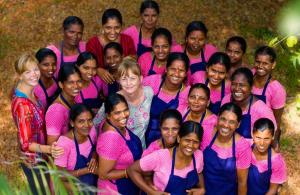
December 24, 2014 we visited Martina at Naturellement. Naturellement is a social enterprise, which Martina originally did not attend to open, as she is a teacher by trade. Martina started out by selling jams when she was not teaching, but eventually her success lead her to open a café. Martina continues to be inspired by the ladies who make their livelihoods through the café. (Check out Martina’s full story and food products at http://www.naturellement.in/)

Martina explained to us her strategy for a happy work place for all the women involved. Martina welcomes women to work at her restaurant from any background. In India, there is a very prominent caste system and often people from different castes will refuse to interact with each other. Martina has created a workplace environment that fosters positive interactions between these women despite their differences. Martina promotes group interactions through movie nights, team meetings and other fun activities. Martina also fosters healthy habits in her employees through jump rope workouts during breaks and by teaching about alternatives, such as swapping brown rice for white rice.

Martina also talked about the some challenges she faces working with so many women from different backgrounds. She shared with us that just recently several of her employees had been making fun of another employee and despite many conversations about bullying it did not stop. In order to maintain the ideals of a positive working environment, Martina was forced to talk about firing employees until the bullying stopped. Although it might seem harsh, so many women in the local villages are trying to find employment who would be willing to maintain delicate balance of a positive working environment. Martina, being the kind-hearted women she is, informed us that before firing anybody, she would first find them another job with a local business. I was inspired by Martina and her dedication to helping the women of India, while also demanding positive attitudes and respect from her employees. I have worked for several companies in the past and always appreciate a boss who demands respect and unity between all employees in order to make work a positive experience.

In addition to learning about the great job Martina is doing with her employees by facilitating a healthy and positive working environment, we also experienced the delicious food at Naturellement. The cheesy vegetable lasagna and salad was ranked by many of the AUP students as one of the best meals we have had so far in India!

Photo courtesy of Paige Nelson

Photo courtesy of Paige Nelson

R.K.H.

Tamil Culture: A Talk by Meenakshi

Om or "aum" (Image c/o Daniella Capote)

Om or “aum” (Image c/o Daniella Capote)

We sat inside the dim auditorium at the Auroville Town Hall, where we had been fighting our eyelids all morning to stay awake, and prepared ourselves for our next talk. It was about Tamil culture. Actually, we had been anxiously awaiting to attend this particular lecture—to learn about the people whose language we can’t understand, whose culture is so foreign to us, and whose home we are inhabiting for four weeks.

We were greeted by Meenakshi, a well-known Tamilian poetess and educator. She stood in front of us, in an earth green Sari (which we later learned is 6 meters long!). Her demeanor is strong yet quiet, and wisdom radiates from within her.  In her quiet she commanded attention.  At the same time she is humble with kind, thoughtful eyes.

Her male colleague was seated cross-legged on a long bamboo mat in the background. Next to him there were two tables, one with some medicinal plants from the Tamil Nadu region, and on the other table, a statue of a dancing god. Beneath the table was a burning oil candle. The light symbolizes compassion. Meenakshi says that,

“Once there is compassion, problems can be seen in a different light”.

As dutiful students, we came equipped with questions: What does the head bobble mean? How do Tamilians deal with conflict? How do they interact with Auroville? Do Tamilians like Auroville? As we asked our questions she turned back to her colleague, who then scribbled something on the palm of his hand.

She giggled a little, then digressed. Meenashki spoke to us about the ancient Tamil culture, and the root of its rich traditions.  Tamil culture is inherently spiritual, even in the formation of the language.

Tamil is not only spoken in India, but it is also spoken in Malaysia, Sri Lanka, and Singapore. The whole language is built from the sound “a” or . The vowels are linked with the soul, and the consonants are linked with the body.  All Tamil sounds are linked to the energy centers of the body, and like this, they are like living letters. Meenakshi’s friend is chanting the different sounds as she explains the meaning of “sum” (oneness and unity), and I can literally feel the sounds’ vibrations even though he was a generous distance away.

Meenashki says, “Nature is our God”, and the giant Banyan tree, which grows from the tiniest seed gives Tamilians faith in God. Like the Banyan tree, whose branches eventually become its roots, we are constantly growing. Meenakshi showed us beads and stone tools, dating back thousands of years to illustrate the antiquity of her culture. The growth of Tamil culture was temporarily stunted by Europeans who colonized their land. Now they work to bridge this gap. Along with a group of Tamilians, Meenakshi realized the Tamil Heritage Centre (THC) in Auroville to help bridge this gap. She says they feel a connection with the Aurovillians, who in a sense worship a “mother goddess” at the Matrimandir, like Tamils do at temples.

-Daniella Capote

Educating Through the Arts

Back on December 22, our visit to the Yatra Arts Foundation began with beautiful kolams as we entered.

Beautiful kolam at Yatra.

Beautiful kolam at Yatra.

We watched Yatra Srinivassan’s short film “Maattram” about the dangers of illness and environmental damage from garbage, and heard about other programs that Yatra runs including after school tuition for children to get help with homework. On weekends, children can learn in many arts programs including painting, classical or folk dance, and the Saraswati veena. Four girls gave us a fantastic demonstration of both classical and folk dance. One girl was professional enough to dive off stage to have her skirt fixed and then jumped right back into the dance!

Yatra Arts dance students

Yatra Arts dance students.

After finishing our scheduled visits for the day, we were invited to visit a village that night to see a street theater performance by Yatra’s company of very talented actors.

Finding the village was a challenge in itself, and our taxi had to stop briefly for directions. But once we were off the main road you could hear the theater. In a quiet countryside, the loudspeakers carried the Yatra Theatre Team’s amplified performance further than I would have expected. But once we turned the last 

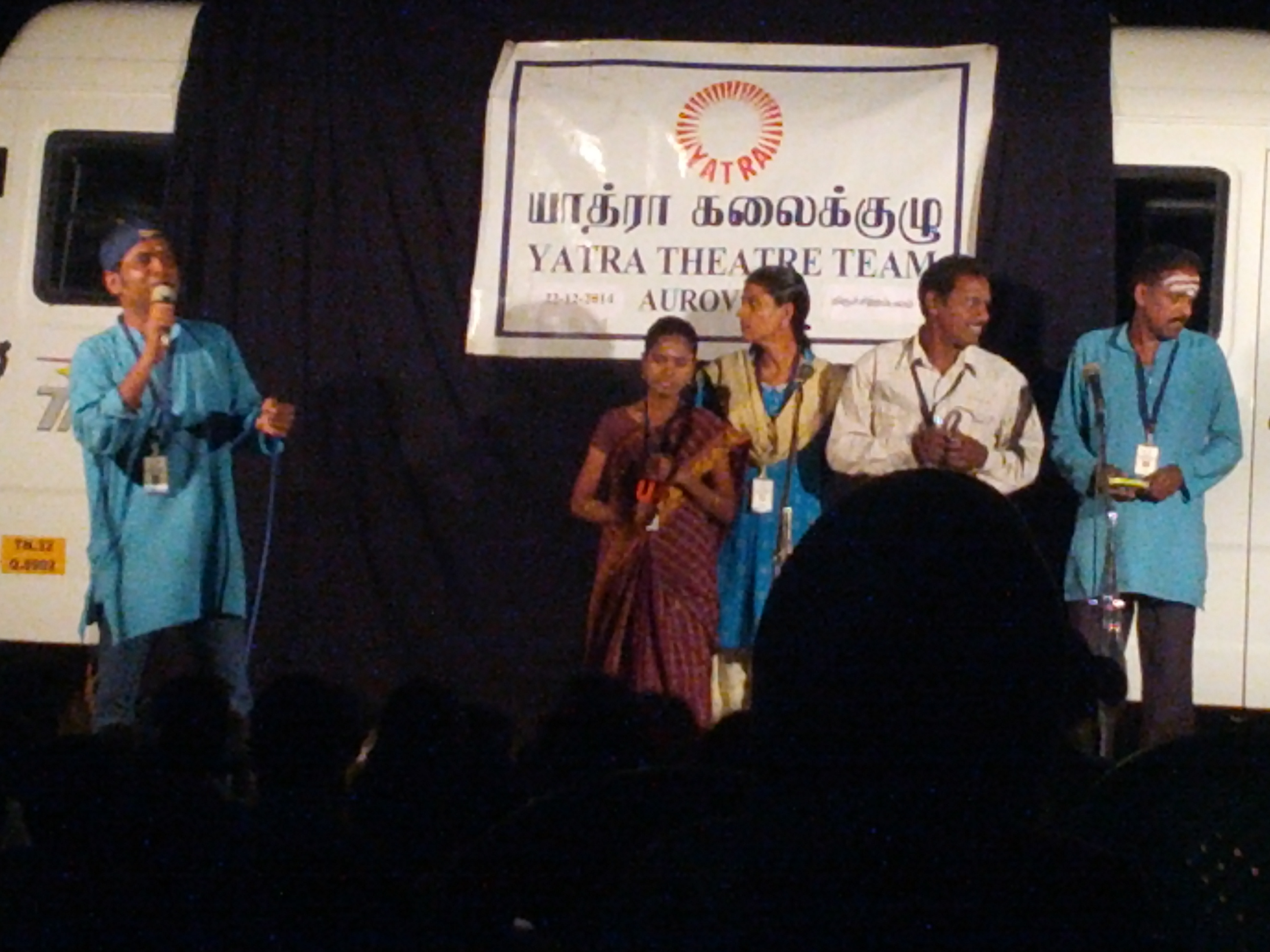
The Yatra Theatre Team

The Yatra Theatre Team

corner, we found them right away. The lights lighting their stage were simple shop lights. The sound system was an electric drum and effects set, three wired microphones, two speakers, and an amplifier. Their backdrop and backstage was the van they had arrived in, draped with their theatre’s name. It was a simple set up, but very effective – especially if the cheers and responses from the village children were anything to go by.

There were musical performances, including dances by some village children, and Yatra helped them discover some dance moves if they were struggling. Some of the women standing with me saw me kind of bobbing along with the children dancing and tried to get me to dance a little more. I did for a little bit, and they laughed. It was interesting to see the women laugh so freely when they had been so reserved when we first arrived. There was an adorable baby girl who played peek-a-boo with me and my pashmina while her mother watched the show.

Then came the all Tamil, no subtitled, live version of Maatram. This time, instead of garbage being the culprit it was dirty water. Once the cricketer son appeared on stage and said, “Hi daddy!” and “I have strong body,” the english ended. The kids were laughing and hopefully learning along with their parents and other villagers who wandered into the performance.

This short clip, in Tamil with some muttered english translation that is not really necessary to understand, shows the good bacteria in the water and the bad bacteria. Listen for how the children react. 

As we were leaving, the taxi driver told us we had just left a Dalit village. As I spend the next few weeks here, I am looking forward to learning more about this caste divide and to see how what I saw in that village compares with what I learn.

See Yatra’s short films here : http://www.yatramultimedia.org/videos/

Learn more about Yatra Arts here : http://yatraarts.org/

Yatra’s blog of this event : http://www.yatraarts.org/yatra-theatre-team-presents-giramathuvassam-a-street-theatre-performance-on-water-and-sanitation-in-saanimedu-village/ 

By Felicity Foster

Opportunities for a Creative Education

22 December 2014

On Tuesday, we visited several NGOs that had foundations in education – whether vocational, elementary, or health-wise.  I think it was interesting to examine the Indian system, and particularly how these NGOs worked to satisfy the needs that are not met through government schools.  In Indian government schools, children are taught “fundamental” subjects – math, science, etc. that will maximize employability.  An education in art or music or other creative outlets isn’t offered, and children have to go to other after-school “tuitions” or weekend institutions for these expressions.  This sheds some light on the nature of their culture, in other words, many parents are purely interested in measuring a subjective “success” of their children, whom many want to study to become doctors or other highly-specialized professions.  At the Aikiyam School, our speaker (the school’s principal) told us that most parents just want to know their child’s grade, not necessarily how they are developing otherwise.  There is a clear emphasis on the academic performance of the children, since many parents want their children to have promising, respectful careers that will both be a mark of pride and support for the family.  While this notion is understandable, children – around the globe – benefit from creative outlets where they can grow and express themselves creatively.  Children, and adults, also effectively learn from “play.”  In the Tamil villages, this idea is also two-fold, since there is a need to preserve the Tamil culture in a context of increasing globalization.  In my communication courses, there were many discussions relating to Western cultural imperialism, so I understand there is great importance on smaller states to preserve and promote their unique cultures and traditions, which is so often expressed through dance, music, and art.  Instead of letting Western, especially American, influences dominate the society, local customs should be celebrated, embraced, and communicated so that the culture can be sustained.  Since the government schools don’t provide for this (and since many families cannot afford to choose otherwise), the work and efforts of these NGOs is admirable.  When there are other rapid social and health issues, like water scarcity, sanitation, etc., the creative needs of children could easily be neglected.  However, we encountered a variety of truly passionate individuals who are working hard to empower children, specifically those whom are disadvantaged, but even more globally, to empower a collective group of individuals whose culture is under threat, which is very inspiring.

//CH

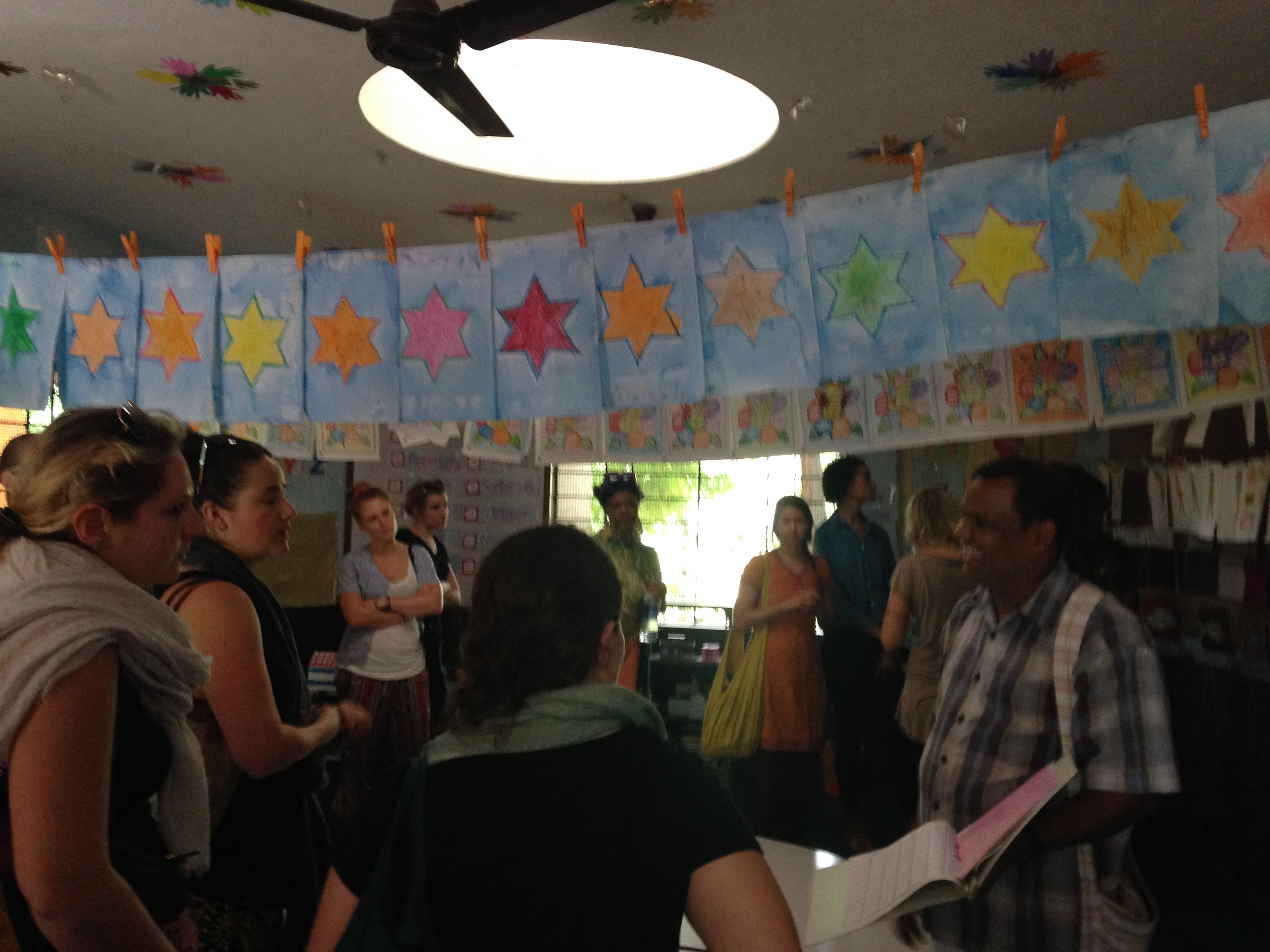
Aikiyam School tour & lecture

Aikiyam School tour & lecture

Eco Femme: Eco-Positive Menstrual Hygiene Management and Education in Auroville

f55eaed8ff1dd1f016bd8f45bc42560becofemme-2

Yesterday, we visited the Auroville Village Action Group (AVAG) right outside of Auroville in the neighboring village of Irumbai to hear a talk from Jessamijn Miedema, the co-founder of Eco Femme. Eco Femme is a social enterprise focused in the area of hygiene management, working to spread awareness about eco-positive menstrual practices. The company has created a product line of premium washable cloth pads as an alternative to disposable sanitary napkins.

Eco Femme works with women and girls in rural Tamil Nadu in Southern India to provide education on how to manage their menstruation in a healthy and dignified way. Miedema discussed how they were looking to increase the livelihood of self-help groups for women and did so by having a team of 28 women from the village, 10 of which are full time jobs, produce the pads on site.

deval--621x414 ecofemme

In order to produce eco-friendly sanitary napkins, Eco Femme had to do a lot of research. They started by conducting a focus group of about 300 women to figure out how women were actually experiencing menstruation. In India there is a strong taboo around menstruation. For example, there is an association with uncleanliness; women are not able to go to temple or walk the dog while menstruating. This was very interesting to me coming from a Western culture where menstruation is very much a part of growing up. Unlike India, where I grew up in the US, pads and tampons were readily available for young girls, as well as medication for associated illnesses and education on how it all works.

In India, girls and women have limited body literacy and often do not have the proper materials to take care of them during that time of the month. Without the necessary products and information, I can only imagine that life for young Indian women comes to a complete halt during the few days a month when she is menstruating.

Half of women are using disposable pads and the other half are using old folded cloth. The government was providing girls in school with disposable sanitary napkins, but with no place to dispose of them. This along with many other aspects has caused a massive waste issue. This is why Eco Femme started producing washable pads. The pads are sold in India, as well as internationally. They started a program, Pad for Pad, where any time a pad was purchased internationally, a donation of 80 rupees would be donated to purchase a washable pad for an adolescent girl.

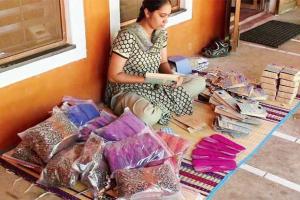
The washable pads seem like an adequate solution to the disposable method. The pads, which come in varying sizes, cost around 220 rupees, which is around three Euros and last for about 75 washes. The most interesting part of the discussion was when Miedema showed us the pad that was created to resemble the old cloths that women were using, however more efficient and leak proof. When these particular pads are unfolded they just look like a square of material, so when hung on a clothesline to dry, would not attract unwanted attention or cause any embarrassment. I thought this was very perceptive of the girls’ and women’s’ needs, while remaining culturally sensitive.

foldable

Eco Femme is continuing to encourage females to take better care of their bodies and the Earth and creating a safe space for girls to talk and share personal stories about menstruation. This is a huge issue facing young women in rural India and I’m excited to see the lasting effects of this company and its campaigns.

By Alexa Pizzi

Our large group of 27 students waited for the buses to Pondicherry. In our group huddle, our logistics coordinator and local Aurovillian informed us of an incident that occurred in the Aurobindo Ashram located in Pondicherry. Our logistics coordinator told us the passed down version of the story, stating five women were kicked out of the Ashram due to tension between these sisters and the ashrams. It was rumored they all attempted collective suicide where three were “successful” and the others were rescued. There was reported concern about some immediate uprising against the Ashram with people throwing rocks through their windows.

With caution, we ventured into Pondicherry and received more second hand information from an NGO owner who said she had heard the story over the radio. Apparently, a case was taken to court regarding misconduct of one of the five sisters living in the Ashram and after years of cases and appeals, it was ruled in favor of the ashram that the sisters should be evicted. The sisters threatened to commit suicide if they were to be evicted. According to court orders, the police came to evict the sisters and one sister climbed to the roof and threatened to jump to her death. She was talked down and the sisters left the ashram. Following, the sisters and their parents, who lived nearby, collectively walked into the ocean to end their lives. The father and three of the sisters were rescued by fishermen and were sent to the hospital, while the mother and two other sisters died. Through word of mouth and media reports, we gleaned the details of situation.

When visiting a shop later in the day, we spoke with the owner about what had happened and spoke about the bandh where all shops will be closed in Pondicherry the next day, normally a regular day of business. The owner explained that out of respect for the family, the community in Pondicherry would be closing down most businesses for the day. Later, we discussed as a group the situation in Pondicherry and the unrest of the community. The community was upset at the police for evicting the sisters without offering them an alternative living situation. Coming from different regions of the world, our group spoke about the perceived responsibility of the police in such a situation with no easy solution. In the days to come, we hope to hear the remaining family members will be able to find housing and solace in their community of supporters.

R.K.H.

For more information, check out:

http://www.ndtv.com/article/india/family-evicted-from-aurobindo-ashram-in-puducherry-attempts-suicide-3-dead-636446

http://timesofindia.indiatimes.com/india/Three-sisters-commit-suicide-after-being-evicted-from-Aurobindo-Ashram-in-Puducherry/articleshow/45557401.cms

http://timesofindia.indiatimes.com/city/puducherry/Thrown-out-of-Aurobindo-ashram-3-commit-suicide/articleshow/45569252.cms

http://www.thehindu.com/news/cities/puducherry/aurobindo-ashram-sisters-death-bandh-affects-normal-life-in-puducherry/article6710903.ece

The Beauty in the Unexpected

Tragic news upset our plans yesterday. From what could be determined by our local liaisons, Sacha and Tanya Elder and their local contacts, a mass suicide was committed in Pondicherry yesterday by a family that was evicted from the local ashram after a legal battle over sexual assault that lasted a dozen years. The Indian Supreme Court finally denounced the case, and required the family’s eviction. As a result, a transport strike was conducted in Pondicherry to protest the ashram and police for conducting the eviction. We could not visit Pondicherry out of concern that rioters would attack transport vehicles that were working in the area. In a brilliant piece of improvisation, our professors Charles Talcott and Tanya managed to reorganize the schedule for a productive day, and it happened to contain the most beautiful settings we’ve visited so far. First was the Auroville Botanical Gardens, a sprawling piece of land hosting a variety of local and foreign plants. We were guided around the areas of the gardens and explained some of the activities of the maintainers of the gardens. Income for the IMG_2006 (1024x683)gardens is partially generated by providing consulting and planning to other centers, such as hotels, on their landscape design and how to make resource use in their landscapes more efficient. Seeds of native vegetables are sold for some income, but also to provide Indian farmers with access to non-copyright seeds.Groups from local schools also visit the garden, and the experience is made as fun and memorable as possible to give the children positive connotations with the environment. A devastating cyclone that hit a few years ago wiped out the tall non-native trees, and caused damage that has only just been overcome after years of work. The wiping out of old trees did provide the landscape with space for much needed growth. Next, we visited the Mohanam Community Center for Culture and Education. It is centered in one of the oldest houses in the village of Sanjeevi Nagar.IMG_2069 (1024x683)Children were doing extracurricular activities in the back yard. Girls were learning a dance, and the boys too, but a dance that seemed combative nature in which they beat sticks together. Some AUP students tried to learn the girls dance with them.IMG_2066 (1024x683)The patient women of the center taught us how to draw mandalas on the ground. Inside, the founder explained the efforts of the center to keep alive local culture by conducting classes in traditional practices, such as cooking, dancing, and other arts. It has taken a year to build the trust of the community before members finally spoke up and offered to teach whatever they could. Now, the center provides a space where all ages can expand their cultural appreciation, and where children can escape the rigid structure of learning in Indian schools and explore their creative capacities and have fun learning their heritage. We watched the children present different dances and chants, before being served a beautiful luxurious Tamil meal. Afterwards we were given a tour of the neighborhood and explained some of the cultural significance of what we saw, such as demon heads on door corners, and the origin of the name of the village. Finally, we visited the Auroville Bamboo Center, where a quirky odd couple named Matt and Walter explained the ecological and structural benefits of bamboo and the centers activities. Matt is a hyper-enthusiastic 10-month volunteer and Walter is one of the founders of the center, who gleefully interrupted Matt from time to time to remind him of what he had to mention to us. The center sells products made of bamboo, but gains most of its income from the workshops it conducts with foreigners in how to build and create goods with bamboo. Local women are employed making decorations and jewelry and men often make furniture. The free workshops also give local youth a chance to learn real practical trade skills that can earn them a wage to provide a decent living. It was a day of spirit and color, and nothing could have compared to the conclusion. Auroville hosted a Christmas market at its youth center. Various caravans, tents and huts of straw and wood were set up, with Christmas lights stringed between them over our heads not to be outdone by the zip line gliding kids through the forest canopy.IMG_2103 (1024x683)This was the more adventurous alternative to being hoisted up on the enormous teeter totter and spun on the merry-go-round. There were local and traveling vendors of soaps, jewelry and clothes, in between a few food stands. Underneath one tent was a singer on a guitar, competing with the reggae and 70s music playing over by the crepe vendor, all of this surrounded by jungle. It was a market to rival a bohemian state fair. Just another day of extraordinary visions in a surreal montage of moments unique from the last.

-Anya VerKamp