
Her Story
Margarita, founder of MGEcoduties, a.k.a. Probiotics House, started her presentation off with one of the most profound stories of all of the NGO introductions.
She made a made powerful introductory statement that “women are weapons in war”. She was referring to the mistreatment, rape, and abuse of women during wartime and highlighted that this plight and destruction is not ever addressed in the aftermath of war when considering casualties. I wondered what this had to do with probiotics.
She shared further that she herself had been a victim of rape and torture, and a prisoner of war for over 4 weeks. This experience resulted in extensive psychological and physical damage, that could not be healed with time or with treatment offered by professionals.
Despite the tragedies that Margarita experienced, she moved on to earn two graduate degrees, became the COO of Coca Cola South America, and was successful in the corporate world. How she came about founding MGEcoduties was somewhat accidental and resulted primarily from spiritual intervention.
She had already been to 66 countries and needed a vacation, a travel agency suggested that she visit India, starting in the South and then up to the North, unexcited, she agreed. She ended up in Auroville, a culture shock, as she was unfamiliar with the living conditions and closeness to nature and wildlife as she had been a corporate executive, use to luxury travel.
Margarita had been in Aurovillve for a few weeks, and would fall asleep in public places to be awoken by a presence and a tap on the shoulder, only to find that no one was actually there. She saw this as a spiritual sign, a sign that she should stay in Auroville. Her weeklong vacation turned into a 21 year long journey, and she has yet to make it to North India to visit the Taj Mahal.

Probiotics
Probiotics are simply as live bacteria and yeast introduced into the body for the stimulation of growth of microorganisms with beneficial qualities.
According to Margarita, the top foods from which to obtain probiotics naturally are chickory, asparagus, onion, and beetroot.
Margarita stated that the human body is 90% bacteria, however, the human body is actually only made up of 3% bacteria by body mass. Human DNA however is 90% synonymous with bacteria and about 10% non-similar DNA, every organism on the planet is +/- 90% the same in genetic code. Most of the genetic code is made up of regulatory regions for basic cellular metabolic functions, so this isn’t surprising. Though not directly stated, I think that she used this similarity as a defense for why microorganisms are one of the best ways to provide healing properties to the body.
She started working with probiotics in Auroville when she realized two major South Indian issues: a polluted septic system and too much plastic waste. She then began to produce household cleaning products that would clear the drains by getting “good” bacteria into the plumbing systems to help solve the water problem. Then, she moved on to soaps for the body, they smelled good and the soap would go down the drain when people washed themselves, therefore users would unintentionally and consistently contribute to solving septic system issues. However, these products were not enough. Margarita did not just want to solve systematic issues in plumbing, she wanted to use probiotics to solve issues in the system of the human body. After all, she herself had been suffering of physical pain from her past traumas. The development of the probiotic bracelet would follow this realization.
Margarita learned about probiotic technology through a Japanese physics professor, Dr. Higa, who worked with microorganisms and figured out how bacteria could survive in clay heated to 1000 degrees Celsius. This ability is astonishing considering bacteria stop reproducing at about 39 degrees celsius and start to die around 52 degrees celsius. Naturally, most of the proteins that make up DNA and bacteria denature at a similar point. She shared that due to this temperature dependent life cycle, powder probiotic pills which go through an extensive heating process are less effective and are generally placebos; liquid probiotics kept in cool environments are more effective. Dr. Higa’s inspiration to achieve his goal of harvesting and encapsulating bacteria came from top secret news from NASA that bacteria from the human mouth survived for years on the moon in a camera lens.
Margarita and Dr. Higa were able to capture and harvest probiotic bacteria, put it into clay beads through much processing, and then make the beads into bracelets to be worn by people to promote overall health. The clay material surrounding the beads protects the bacteria from UV radiation, which would kill the bacteria. The bacteria is collected only at the event of the Major Moon in the ocean between India and Sri Lanka, making the bacteria difficult and dangerous to collect. Why this particular bacteria is collected was not very clear. Once the bacteria is inside of the clay pods and made into bracelet form, they can be used for eternity, Margarita even suggested passing probiotic bracelets down through generations. Maintenance of the bracelet is simple; the beads should be washed with water and then placed in the sun to dry, the UV radiation does not get in, but infrared rays do and they allow the bacteria to “recharge”.
Her Message
Maragrita has experienced personal healing from wearing her probiotic bracelet and using other probiotic products. While Margarita’s message is promote overall health through probiotics, she wants MGEcoduties to be recognized for its role as the organization responsible for clearing the septic systems in Auroville and for initiating a movement that caused Auroville to become 0% reliant on plastics and maintain a refillable and reusable system. She also wishes to share a message of human unity and equality, this can be seen in the organizational structure at Probiotics House, where everyone works on the same level and receives equal pay. While Margarita has been receiving partnership opportunities from large profitable corporations like Tata and Badger, she places her ethical and sustainable values over the potential for profit.
Overall, I think that the probiotic products provided by Margarita and her team are revolutionary and spiritually meaningful. However, the the science behind the product and how it works to effectively promote health is not clear. I do not understand how wearing probiotics inside of clay beads can have an effect on overall wellness. Also, Margarita did not explain the role of her partner Guidelma in the story, and it would be interesting to know more about their partnership. Her life story and ability to stay true to herself was very empowering. And so, for anyone looking to be the next head of Probiotics House, Margarita is in search of a worthy successor!
By: Shannon K. Henry





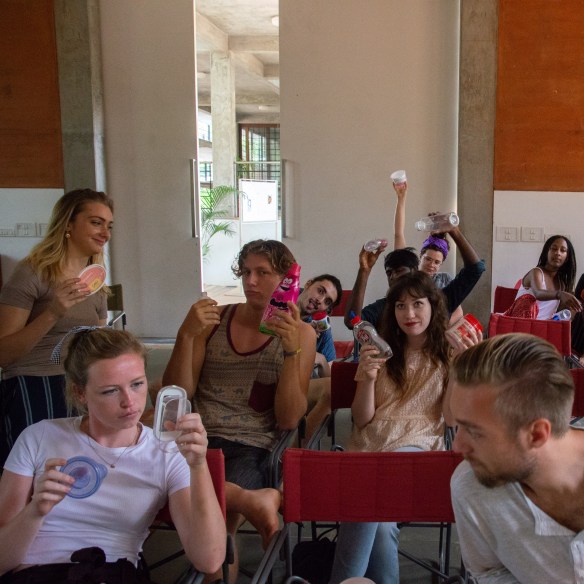 “If you walked into a room flooded with water, would you first start mopping the water, or would you turn the tap off.” This was the question that Wasteless posed to us at the beginning of their talk to us on December 28th. Wasteless seeks to educate young students about their plastic use habits through fun, interactive activities. One of these methods is Garbology 101, which includes a number of illustrated games and activities. They provide this game for free for low-income schools in exchange for their feedback to improve the game. In this way their communication model is somewhat participatory and involves a dialogue between Wasteless and the communities they are trying to educate. They utilize a dialogic communications process—a process where the aims of a communication aren’t completely decided beforehand—to help shape their communications process. They also rely heavily on edutainment to keep children involved in lessons on waste management, using memory games and relay races to teach sustainable practices. Their communications outreach, at least as it was shown in their presentation, seemed to focus on Window 2 of the Jahari window: Wasteless’s hidden knowledge. This knowledge includes information about recycling practices and plastic use, as well as the harmful effects of some plastics on human health and the environment.
 Dr. Jacques Verre, who founded Auroville Dental Centre in 1982, introduced us to two main projects that he is using to transform not only the lives of children in the villages surrounding Auroville but the dentists as well. They both center around “0 Concept”.
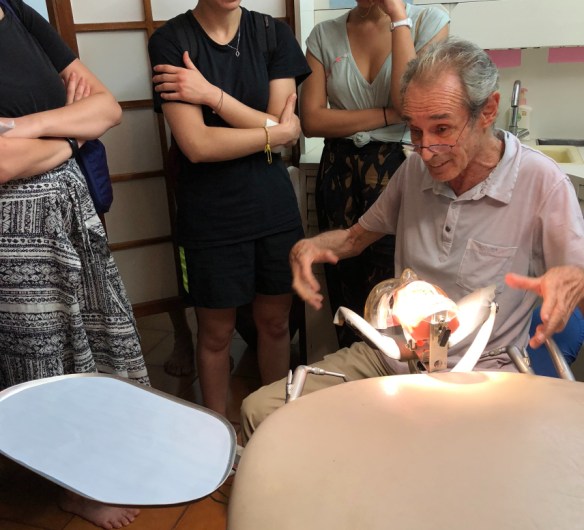 While Dr. Verre was changing the way he worked in Auroville, he was also noticing that the villages around it lacked dental care. Discovering that 95% of Indians have oral problems he knew he had a social responsibility to those around him who were unable to have proper access to dental care. There was a very small amount of dental education and a huge need for cheap care for all. He wanted to reach out to the rural population, especially the children, to help promote oral health.

