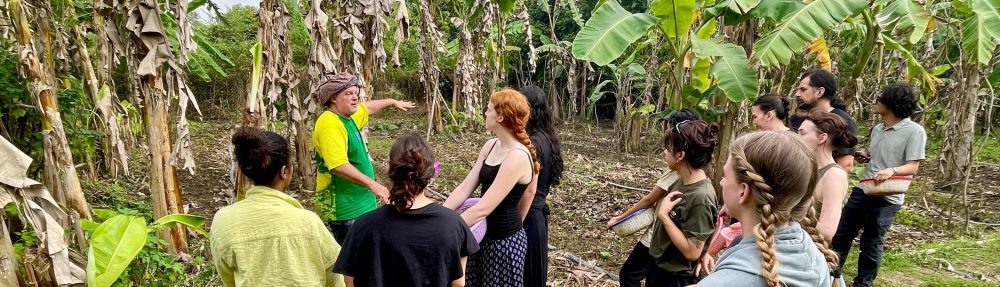
Auroville, India: Building a Conscious & Sustainable Land

Screen Shot 2016-01-07 at 12.13.21 PM

I remember it like it was yesterday.
After extensive research, countless hours of writing essays and sorting out my finances, the time had come to make a decision about Grad-School. It pretty much came down to one distinguishable course none of the other universities could offer than The American University of Paris: a one-month Sustainable Development Practicum in India.

I have always believed that the future of our planet relies on people who understand the importance of nature, our environment, and those who have a true sense of compassion towards others.

As an activist, I believe that in order to make a difference, we need to educate people and educate ourselves. I have always known that knowledge is power; so learning the fundamentals of communications and understanding the development, transformations and challenges on today’s globalization is fundamental to me as a professional and as an individual.

It has been over two weeks since I first arrived to India and I have learned so much already from this wonderful country. Visiting over 28 organizations in Auroville the first ten days was not as easy as I had imagined. Between the jet lag, the extensive days and witnessing so much poverty and misery was physically and emotionally draining.

FullSizeRender

I have always felt very alone on my journey to a conscious and responsible way of living. In India, I don’t feel this way. The city of Auroville is one of the first conscious communities in the world and I get to live here for one month. Auroville is also known for its high spiritual vibration and the creation of eco-friendly, ethical and sustainable projects. People here truly care about making a better and more sustainable world for themselves and future generations. Their passion is fascinating and contagious.

During my time in India I’ve learned about the astounding variety in virtually every aspect of social life. Diversities of ethnic, linguistic, regional, economic, and religious groups make India a mystical and captivating country. Indian society also has an immense urban-rural differences and gender distinctions, and as a result from this, most of the projects that were presented to us were projects that had been developed in the past 30 years as response to social, environmental and structural issues in Pondicherry and Auroville.

I have always been involved with animal rights organizations, but I must acknowledge that becoming familiar with projects in the areas of education, women empowerment, sustainable and ethical fashion, waste management and sustainable economics was fascinating as well as awe-inspiring.

FullSizeRender
The perception of life after meeting people less fortunate than us can only make us more humble and appreciative for what we have in life. These people despite their economic situation strive to give back, to truly create change and impact people’s lives in a constructive manner. Getting to know them and work with them to communicate their mission is a real privilege.

FullSizeRender

– Daniela Moreno

While we complain…

People are picking through the trash for something to eat, their houses are periodically flooded, their children run around naked instead of being able to go to school, hygiene and health are unattainable, and yet they still smile. The true question here is not what we middle- class Westerners can teach these people, but what can we learn from them? While we complain about our meal not coming fast enough at a restaurant, a woman is unable to feed her children that night. The waiter should come ask us; would you like a side order of trash? While we complain about having a cold, there is a man outside lying on the hard ground with a fever. While we complain about not having access to a washing machine, a gypsy family will be wearing the same dirty clothes they have been wearing all year.While we complain about cold showers,the gypsy people have nothing but a hose spewing untreated water. While we complain about our hostel,there are people nearby living in a hut with 2 rooms for 10 people. While we complain about the Internet service, children around us are taught only how to beg in the street for a piece of bread. Will we ever complain again so much, now that we have seen the life of true want first-hand? Will I want to buy the next pretty, cheap dress, now that I know that farmers and factory workers are dying to produce it? We have not been greateful enough for what we have–instead we have been complaining for what we don’t. We cannot globally go backwards to a simpler life where we consume only what we need, but we can retrain our technology to help more people. We need to make it a technology goal to stop damaging the earth with all our trash.

Even if it’s a drop in the bucket, Auroville is trying to find solutions. The people of Auroville are creating NGOs for sustainable Fashion by working with farmers who cultivate organic cotton. Auroville is creating washable pads because plastic takes 800 years to disintegrate. Auroville is creating bags and art out of plastic. Auroville is creating alternative medicine and dental health care and alternative educations.
The people of Auroville are trying to create other ways of eating,consuming and living. Global awareness is the next step.


Chelsea Carter

A Day Amongst the Gypsy Village

IMG_8370

There are some things in life that no matter how ready you think you are for them, they still manage to instantaneously knock you off centered. A trip to the gypsy village, smack between the Puducherry airport and the Puducherry dump, became an experience that did just that for me. I am warned by the organization I am working with, Samugam, that it is going to be quite an emotionally draining day, but I naively believe that I have become somewhat numbed to the poverty I have been witnessing every day.

After an approximately 30 minute rickshaw ride weaving our way out of Puducherry, we trace the outskirts of the airport to arrive at the gypsy village. A thin paved road separates the gypsy village from a tribal village to its left. As we hop out the rickshaw and make our way into the village, I immediately come to the realization that I am not “numbed” to the poverty I had been seeing in Chennai and Puducherry, but I had simply not yet been immersed in poverty so unimaginable.

Version 2

I witness things here that you wouldn’t believe were true unless you saw them with your own eyes. An aging man sits upon a mat, plucking out his hairs, weaving them into what appears to be a bowl. Another, stricken with fever, sleeps apart from the village, covered in blankets; he is kept company only by a bird whom cries out in its cage. Elderly women plead for us to purchase their handmade crafts. A grandmother begs for acknowledgement of her grandson’s poor skin condition; his flesh is cracked, dry, and filled with dirt. Young children run around us naked, covered only by a string of beads around their waist. Pigs rummage for food amongst trash deemed inedible by the gypsies. A man and two boys rejoice over their catch of the day – a large bat, which they proceed to skin and cut into for that night’s meal. A woman sits along the path, amongst a horde of stray dogs, eating from a plastic bag containing turtle soup. She is unfazed by the 3 mange-stricken chickens that occasionally manage to grab bites of meat from her spoon before it reaches her mouth. A foul smelling bucket sits atop a cart surrounded by rotting onions. Through questioning its discovered to be the results of the day’s pickings from the trash; already spoiled and covered with flies – waiting to become a few of the families’ supper that evening. Multiple litters of newborn puppies are scattered about the village; we are told they will not last through the week. A dead puppy, covered in flies is sprawled out, unnoticed within a dark, dust covered, and uninhabited home the gypsies refer to as the “devil’s home”. At the end of the village sits a home where we learn of a mother’s fear for her one-month-old daughter who is being threatened by a snake that makes its way into their home at night. As we walk back through the village on our way out, we pass a bird in a cage, surrounded by dead rats. Recognizing our glances, a man nonchalantly goes over and picks them up to be put on display for us. We inquire if the villagers are warned of the diseases these rats carry and if they are cautioned to not eat them? The response comes that these rats are a source of protein and a means to the gypsies’ livelihood.

IMG_8355

It pains me as I jump into the back of the rickshaw and pull away from the village back to the comforts of my hostel. How is it still possible that people can be living like this in this day and age? The work that Samugam is doing there is impressive and meaningful, yet the poverty in the village has not been eradicated; it doubtfully ever will be. To think this was only one village… 54 families. What about the thousands of others all across India? Families and communities without a helping hand like Samugam, working to pull them from the darkness.

Is there a way to help bring these people out of poverty? A solution that can be recreated across thousands of villages just like the one I had visited? What can we do? How can we make an impact on this generation that will fuel a change in future ones? The questions still linger with me – answers still to be found.

– Claire Clark –

Gender Sensitization Orientation

I will preface this by saying that this is written in the style of a participant observation. Though it’s not the most invigorating writing style, the content has value. I believe in practicing respect and tolerance for all cultures while searching for understanding, meaning and a connection. Leave your thoughts at the end. I am very curious to hear other points of view.
Gender Sensitization Orientation (Participant Observation)
31 December 2015 2:19 PM- 4:50 PM
-Approximately 30 couples comprised of married men and women and unmarried boys and girls * (description given to me by the organizations employees)
-Event held by Adecom, local NGO that works in ‘women’s rights’ ‘gender equality’ and ‘gender sensitization’ predominantly amongst rural Dalit populations in the Tamil Nadu region
-The Dalit are the suppressed “untouchable” communities in India’s ‘former’ caste system that are still systematically discriminated against.
-The interaction took place in the Tamil language with interspersed comments in variant local languages. One of the male employees served as my translator.

Walking into a gathering of formally dressed young couples with the males wearing button down shirts, dress pants and sandals and the women wearing saris I get curious stares as I walk past them and into the office to meet with my boss. She is sitting at the table between two people I have not met before. I am introduced to a man who I am told is a teacher of gender sensitization, he stands and informs me he has been recognized by the president of India for his work, I politely smile and shake his hand. The woman on the other side I am told is an activist like Lalida, my boss, she simply smiles at me and shakes my hand across the table.
As I walk back outside the chairs are being put back in order and everyone is getting settled mostly male and female partners together intermingled. The man that I was introduced to before sits in front of the gathering and speaks to them in Tamil he asks a question and two males respond a couple minutes later a woman responds, a dialogue starts and everyone laughs. All seem to be avidly paying attention.
My translator tells me he is giving them an example of a 17 year old boy with a 13 year old girl who fell in love and had relations and now the girl is pregnant. He is asking the couples what their view is on the incident. I am told here in India majority is at 18 years of age. According to the marriage act in India a male should be 21 and a female at least 18. The couples are asking what the circumstances are surrounding the situation. According to the Marriage Act the male should be sent to a juvenile home. The “important man” asks the couples what should be done about the girl. He suggests she be sent to school. He tells them the boy will be sent to the juvenile home for 2-3 years and then he will be released and he will be fine. The female will be affected more. One male distractedly looks around.
In another case a school going girl child was pregnant, she was taking an exam, she leaves during the exam births her child, throws it out the window and returns to finish the exam.
He asks how the men will take better care of their wives. They respond we will take better care of them, we will help with the dishes. He asks the women what they expect from their husbands? The females choose not to respond. One of them says she will respond later.
…everyone claps, jokes are being told, people laugh.. occasionally someone glances my way both the males and the females seem curious about my presence.
He asks how the couples got married, one couple responds they fell in love and with the consent of their family they got married. Everyone claps…
He asks the males what are you doing in favor of your wives? The women respond. He asks if there are any males willing to come forward and respond. No one is willing…Lalida speaks..one husband responds “I am doing all the household chores.”
One of the girls states she observed her fathers behavior with her mother and she understood she should be very tolerating in her family. Everyone laughs. She continues stating she is wondering if her husband will be like she is, if he will be tolerating. Her future husband responds he will be tolerating and he will help her. She states when she is having a child she will not show discrimination in a boy or girl.
Another woman speaks up and states that when she is not feeling well her husband will do all the household activities and cook for her.
A man speaks up telling the crowd he is a follower of Ambedkar, my translator explains Ambedkar is an Indian philosopher, he says Ambedkar believes there should be no discrimination between a boy or a girl and we should not hurt our ladies. He states he is doing the same.
A female stands next to the “important man,” he explains she is a worker at Adecom and he asks her to explain how her family is going on, how she fairs in her family and how her husband is helping her? She explains that after coming to Adecom she learned that women have rights, her husband had been beating her but after learning he acts better. Everyone claps. Now he is helping her by cooking and washing the clothes. Everyone claps again. She tells everyone her mother-in-law had also hurt her many times. Women interact with her, ask questions, and make comments. There is some laughing. She says many problems arise from her mother-in-law. A male employee films her speech. Everyone claps. When she is done she sits.
Another female employee stands to speak. She tells about the behavior of her mother-in-law, telling them that she will support her own daughter but not her daughter-in-law. She says her husband is so cooperative with her he helps her in all ways. She addresses the couples and tells them that the husbands should help their wives. Most females clap. Some males clap.
Lalida speaks…a female responds…she is telling it is better when her husband is taking decisions he should tell his wife, ask her opinion… theres clapping
Lalida speaks
My translator tells me he also does not understand all the words he speaks Malayalam he is from Kerala in the south of India. He tells me I can look on a map to find it. He notes I also write down our interaction, I respond its part of what is going on.
The ‘important man’ speaks again, he is telling them our aim is the equality of women with men, for that we assemble here, for that we are speaking. He is telling them to join us in that goal. He is telling them if there is no equality ‘normal society’ will not join.
A male speaks, my translator tells me he is speaking in a fully colloquial language and he does not understand. He listens quietly for a while then tells me the man is telling them we should not go for abortion of girl child, in family the male should help the ladies in household chores, there should be no discrimination between boy or girl.
The ‘important man’ gives another example telling them that at the time of marriage it is customary for the girls mother and father to give her husband a car, it is registered in the husbands name. He is telling them the money is from the brides family and the car should be registered also in the girls name. He continues stating that normally when naming the child we give the initial of the fathers name so there also the mother does not have a role, he tells them that when naming the child they can put the father and the mothers name.
Some suggestions for girls/ladies..
Ladies should respect their husbands
They ask for someone to read the women’s suggestions formulated by the group earlier in the day in a workshop that they did.
A woman stands off to the side and reads off a piece of paper
-When a decision is taken in the family, women should be involved also
-Ladies should not kill the girl child at the time of birth or before birth. They should look after girl child properly
-By telling all this I am not against the husband, with the husband I will fight for the empowerment of women and I will work for that..
^My translator asks what I am studying?
-I respond political science and international affairs
^He asks what I will do with that?
-I respond I will work for an international NGO with human rights or maybe emergency humanitarian response.
^He states that if I am doing international human rights every country has its own rules and regulations.
-I tell him that why I am here in India, to observe and learn how and why people are different.
^He asks me where I am from?
-I tell him I am from the United States
^He tells me everything must better in the United States, that we can do everything just with our phones, as he holds up his own.
-I laugh and tell him it is not necessarily better just different and I agree with him that we can do almost anything with our phones
^He asks where I am studying?
^Where my parents are?
^How long my program is?
^Will I go back to the US when I am done?
-I respond that I am studying in France but my parents are back in the United States. My program will last a little over a year in a half and whether or not I go back to the US will depend on if I can get a job somewhere else or not.
^He silently contemplates this…
^He tells me he has family in the US in Florida and New York
Another male worker comes and sits by him and they speak to each other in Tamil.
^He then turns to me asks me what the official language of the US is?
-I tell him there is no official language, people can speak whatever language they want but English is the common language and most people speak English
^He asks me if I like India
-I tell him I do but it is very different from what I am use to
^He tells me that if I stay in India for a year I will get use to it
Feedback from the couples;
After coming here they also start to think about the empowerment of women and how they can favor their wives.
Clapping
There is a couple that has had a “law marriage,” Lalida is asking them directly to provide their feedback. They choose not to respond.
I ask what “law marriage’ means and my translator explains Law Marriage means the couple chose to marry by law without their parents opinion or approval. They took their own decision he says. He then tells me an Arranged Marriage means the parents chose and approved.
^He asks me if I know of arranged marriages
-I tell him I do but that it is not something that I practice
^He asks me if I am married?
-I respond I am not
^He asks when I will marry?
-I tell him I don’t know, maybe some day in the future but not any time soon and it is not something that I am actively searching for
^He asks me my age?
-I respond I am 27
He reads my notes and laughs
^He tells me that what he asks me is personal and I do not need to write it down
-I tell him its part of my assignment and is not for anyone to read

Lalida is telling the couples she is a follower of Ambedkar, she is motivating them.
I am conscious of how I am sitting and that the bottoms of my feet may be showing, I shift positions. My legs are starting to fall asleep.

My translator is looking over my shoulder reading what I am writing so I get a bit self-conscious and stop writing.

The conversation continues for a moment, the ‘important man’ speaks the couples come to the front individually and gifts are given to all the couples and a female employee thanks them for coming. Everyone stands and starts saying their goodbyes. They wish everyone a Happy New Year and a Happy Pongal (harvest festival in Tamil Nadu) They stand in groups and take pictures slowly they start to leave 2-3 per motorcycle.

After they are all gone the Adecom employees gather around in a circle, my translator joins them. They speak in Tamil with interspersed English words. They seem to be discussing how the day went, giving feedback or maybe what they’ve learned from the session. The ‘important male’ seems to be the lead speaker at one point one of the female employees seems to be talking to him and his phone rings while she is speaking, he answers his phone and she falls silent quietly waiting for him to finish his conversation. He finishes talking on the phone and addresses the male sitting next to the female who had been previously speaking. Another female speaks and the ‘important man’ interrupts her, she continues to speak and one female claps when she is done. Nandi, a female employee, begins to speak. I understand the words ‘gender sensitivity’ and ‘gender equality’ spoken several times along with the word “couples”. The ‘important man” speaks I understand “communication training” “the invitation” “in the reading” “background material” “reading material” “it’s a learning” “communication activity” Lalida’s husband responds and a discussion ensues, it sound like they’re arguing I hear the words “budget constraint” there is finger pointing and speakinf with hands a little aggressively. The ‘important man’ continues to speak with his hand but he smiles as he speaks. I notice he has a wedding ring. He gets up and everyone claps, he grabs bags with the gifts he was given earlier, speaks to Lalida’s husband and then he leaves. A female follows him out, she sits side saddle on the back of his bike. Lalida speaks, 2 other male employees speak (no rings), another male employee speaks, he has a wedding ring, he speaks firmly. Lalida’s husband’s phone rings and he answers. Lalida begins speaking “new place for learning,” a female speaks and Lalida seems to mouth a silent “thank you.” They seem to continue to give their observations the conversation seems to get more serious/intense. Nandi begins to speak very passionately and ends up excusing herself and leaves visibly upset. My translator says a few words and then Lalida begins to speak more quietly. Nandi returns and joins the circle..

***Thoughts:
I found the interaction to be incredibly interesting. It is clear to see the very delineated gender roles in the society I was observing. From the moment I walked into the gathering and the ‘self-important male’ dominated the introductions and later the conversation I began to question teaching gender equality and gender sensitization in an environment that is more self aware but still very much male dominated. I wondered if the use of a prominent male speaker was intentional and if the organization felt it was easier to get their message across through him because he would be better received and the couples would be more receptive to his words. I found correlations with previous classes and studies, where I learned that in societies with systematic and internalized suppression of women, the older women will perpetuate the cycle of oppression even when the younger males seems more open to equality within the roles. It is also clear that the discrimination against women is deeply rooted and unconscious to the level that unless they are being directly confronted with examples of what should be done, when and why the gender roles are not even questioned. I quickly realized through my translator’s questions that neither he nor any of the males there would know what to do with a female such as myself; opinionated, independent, stubborn and very strong willed, very rarely submissive and not at all interested in marriage or a male protector/caretaker. I question whether I would be that person if I had been born here or in a different environment. I also found interesting the societal relationship to marriage and the fact that through their own description a woman and a man are married while those who are unmarried are described as girls and boys. I caught myself thinking that they just needed time to be educated and to advance into a more evolved society where the concept of gender equality did not need to be preceded with concepts of what a male should do and what a female should do. As if a man doing the dishes suddenly makes everything equal. I began to think of them as children that needed to be taught better so they could do better. This brought about mixed emotions on my belief that different does not necessarily mean one view is better or one view is wrong. While I did not feel I actively passed judgment the difficulty of silencing ones own biases was very apparent. I thought back to my paper on cultural relativity in human rights and began to question the feasibility of applying concepts of universal human rights to societies that cannot even begin to understand the concepts embodied within the CEDAW (Convention on the Elimination of All Forms of Discrimination Against Women). In their brochure they refer to the ‘Dalit’ as the backward class, I cringed at the term but momentarily saw a parallel in the way their culture functions to suppress women. I reprimand myself for passing judgement. If a 16 year old girl with a child and a loving and caring husband that values her and treats her as his equal is happy and feels she has a purpose and is contributing to not only her family but her community, who am I to say that she must do otherwise? Should her perception of the world change to include mine simply because I perceive that there is something lacking? Should her world be morphed into something that is unrecognizable to her and potentially makes her miserable so that I can have the satisfaction of saying that women are equal to men and that we have succeeded in ensuring every child has a basic education and everyone’s human rights are being respected? I think on the fact that I must filter the information I am receiving through broken English and a translator who does not fully understand and who is influenced by his own biases, his view of me as an outsider that may or may not judge his culture and his obvious discomfort with me writing down everything he said. I reflect on the parts of the conversation that where not translated to me and am aware that my level of understanding through gestures, tone and expressions may have been simply perceived understanding from interjecting my own views and making assumptions from my own expectations. I believe there are things that translate across cultures… feelings… emotions… basic needs. I am not sure if I should look at the world as evolving and as some peoples more evolved than others or as if there is some end game to which we are all evolving. I feel as if that train of thought presupposes there is a “right way” to be, or a single idea of “right” towards which we should all strive which further complicates my feelings towards a universal human rights declaration. I question everything and feel that I find no answers but only more questions…

Lina Reyes

Interview!

Drawing the Kolam is an old South Indian tradition, which hides “thousands of secrets” as expressed by Anandou. The Kolam is the symbolic drawing that women traditionally do in front of their homes every morning before sunrise. The preparations and practice will welcome the Gods into the home and bless the family. The happiness linked to the creation of the Kolam is evident as I, after my meeting with Mr Anandou, have been out in the villages multiple mornings to meet with and talk to the women. “I feel so happy”; “It is the women’s blessing from the Gods to take care of their families and bless the course of the day by creating a beautiful Kolam.” It touched me when the “Flowerlady” expressed her duties as a woman as being a blessing. In that light, I think she is right; It is a blessing to be able to take care of your family and make sure that they are happy and have the support they need.

Anandou made me feel like I knew everything about the Kolam, and yet there is an endless amount of knowledge to gain about the topic. Hopefully this interview can give you some insight into one of the local practices. By sharing and learning about the traditional practices we are all part in Balu’s dream of building a bridge between the villages and the people in and out of Auroville. A dream that I think is of great importance – we must learn about our history to be able to develop into a sustainable future.

IP Interview Anandou

Elin Pettersson

A Utopia of Networked NGOs: Is it Scalable?

As an intentional community located in Tamil Nadu on the Bay of Bengal, Auroville is a place to experiment and bring forth innovative ideas working towards all aspects of sustainable development. Aside from the beliefs and values held within the Auroville Charter, it is also a microscopic model of how communities can operate collaboratively to achieve many of the sustainable development goals as outlined by the United Nations. The priorities and values of Aurovillians is admirable and desirable in my view as someone from a Western upbringing striving to work in International Development, however is this microscopic laboratory a replicable model throughout India and other communities in the Global South?

After visiting about thirty non-profit organizations in and around Auroville over the span of seven days, we have been exposed to a broad array of inspirational projects that are working towards one or many of the sustainable development goals. They ranged from environmental and agricultural sustainability, to social development issues promoting education, equality and empowerment. In Auroville specifically, many of these organizations and the people involved work as an interdependent public to support their overall common goals of sustainability and development. For example, several organizations that utilize recycled or reusable materials and have a zero-waste policy such as Upcycle Studio, Eco Femme and WELL Paper are supporting the primary efforts of the organization WasteLess whose main objective is to raise awareness and education on harmful habits that threaten the environment. Auroville Village Action Group (AVAG) and WELL Paper are also both working to empower women through skills training and autonomous self help groups, or SHGs. AVAG assists in the selection process for the women who will be trained in creating eco-friendly products for WELL Paper. All of these are Auroville based NGOs, and there are many other instances of visible support and collaboration between the NGOs here.

It is clear that the organizations within Auroville support each other’s visions towards a common goal through various projects. However, even between Aurovillian NGOs and NGOs that we visited in Pondycherry, such interdependency and support is not so apparent. Therefore, can this model of networked NGOs who support and promote one another to succeed in their goals be applied in other areas of India and the Global South? Like anything in the field of development, it would need to be adapted for each particular culture and context. And it is likely that this is already the case in some communities, but perhaps not to the extent and concentration of Auroville…at least not to my knowledge.

While NGOs around India and globally likely do support one another within their realm of development, this high concentration of sustainability and development in almost every aspect of daily life and business that is visible in Auroville seems out of reach given the international complex systems of government, political views, social issues, and the corporate world…just to name a few. This paradox continues to follow me during my time here in Auroville, however I do remain optimistic as a future professional in the field that progress within NGOs and towards a healthy networked NGO model can be made as long as cultural context is first and foremost in assessing the development needs of any community.

-Cristina Castello

Where am I ?

On a sticky, humid, and hot Saturday afternoon the group sits in a circle blankly staring at one another, some contemplating NGO choices and others contemplating life choices. The suffocating silence is broken by Professor Talcott addressing us with a question, “What brought you to India over the middle of your winter break sweaty, hot, and tired?” A literal answer to his question would be to study sustainable development, but then you are confronted with defining sustainable development, and automatically his question is no longer a simple announcement but a reflective exercise over the past 11 days into sustainability, development, and Auroville; a vessel for these two concepts to blossom. For many Aurovillans Auroville has been a canvas, a space to create, experiment, fail, succeed, and repeat. With each visit to the different units you find it’s not a community of discovery but for discovery, an attempt at an alternative lifestyle.IMG_4041.JPG

On our first official day in Auroville we were introduced to Deepti, an Aurovillan citizen who has been a living part of the experience for 40 years, she provided insight into the vision of Auroville and presented us with this idea that everything done in Auroville or even outside of Auroville has to be done with consciousness and there will always be this ‘pressure of consciousness.’ This idea remained with me over the next two days and I became a bit obsessed, obsessed with how conscientious individuals have come together to intentionally create a community, obsessed with the consistent reflection and projection that must be utilized to ensure its existence, and obsessed with trying to figure where exactly had I landed. I then was plauged with the idea that the acknowledgement of consciousness is a painful state, you must steadily account for or monitor your actions because you understand that you yourself contribute to the ills of the earth. But the more Aurovillans we met the less I felt there were traces of a sadness but instead awareness. Aware that my actions affect others, aware that we must coexist, and aware that a conscious mind is an enlightened mind not saddened one, but within this enlightened state there is a greater responsibility.  IMG_3864.JPG

I cannot say my obsession has subsided just simply halted while I try to process the immense amount of information presented to us. My desire is to continue to understand how enlightened conscious minds can aid in a sustainable future. What Auroville has presented to us within the past 11 days is that sustainability and development are complex issues that emerged within the confines of conditioned social structures and how  we continue to develop will be determined by how we consciously address these broader issues that prevent many from beginning to imagine an alternative way of life.

Azalea Capers

Auroville Invites Itself To a Great Challenge!

What does it mean to create a sustainable city? The citizens of Auroville attempt to answer this question with the creation of their innovative city in the South of India. This is a place where all the NGOs are invested in certain aspects of sustainability. From micro finance organizations, transgender politics to social entrenepreneurships, Auroville’s entire ecosystem is based on embracing sustainable lifestyles.

As newcomers, almost half of our team attempts to better understand the idealistic city by posing a lot of questions as student researchers. We are trying to understand if Auroville truly stands for what it aims to be. What will the future of Auroville look like? Is this type of city, free from independent organized governance, the only alternative way of establishing a democractic society?

So far, many of our questions remain unanswered.
However, it is hard to deny the power of knowledge and intelligence that are invested in this city. From creating a co-op grocery store, to creating a botanical garden in the land of red soil, and a library that includes a multitude of languages, Auroville puts great effort into achieving its goal. It is certain that Auroville Foundation aims to provide better life standards for those around the Auroville community.

For me, Auroville is a new born baby in a country with a colonial past. It is hard to assume that a place with social pressure would be attractive for entreprenual spirits and innovation. In fact, it is not only our group that has been trying to find answers to our questions about Auroville, nowadays Aurovillians are challenging themselves with the  same questions as well. “We are trying,” say the guest speakers from Outreach Media, who oversee the media in Auroville. We don’t know if we will succeed or fail, if the methods we are pursuing are going to help us to solve our difficulties or not.This is what almost every researcher who comes to Auroville asks. They are sceptical but we are trying. When we fail, we learn from our mistakes. Because this is an attempt to find better ways to live.”

Even with the best intentions, it is human nature to bring self serving qualities such as ego and greed. Not surprisingly, when a former worker from the surrounding village wanted to take what he has learned from the community and to open a pottery shop in his village, the situation created tension. In cases like this the community does not feel like a winner. It feels like one contributer less. It is the Foundation, what the Aurovillians rely on. Accordingly, individual attemps that are outside of the organization are not beneficial to community. And, since the Foundation has no juridicial power, Aurovillians try to prevent unwanted situations by using social pressure. Maybe I understand it all wrong. Maybe I am confused. But realizing the power of extraordinary know-how brought to the community by the villagers carries an importance. However, limited funds with great facilities that the Foundation provides for its villager workers, seems to be an another local employment challenge nowadays for Aurovillians to overcome.

Elif Ogunc