Sadhana Forest: Cultivating Compassion, Sustainability, and Community

By Kendall West

The entrance to Sadhana Forest in Auroville

What is Sadhana? A Mission Rooted in Compassion and Action

Stepping into Sadhana Forest, I found myself immersed in a space where every detail, from upcycled tire sculptures to solar-powered utilities, reflected a commitment to creating a better world. Removing our shoes and entering the main hut, which is made completely from natural materials, we were immediately impressed by the possibilities of another way of living.

Nestled over 70 acres near Auroville, this remarkable initiative goes beyond reforestation—its mission is to foster ecological restoration, compassion, and selfless service as part of a global movement.

Sadhana Forest, founded in 2003 by Yorit and Aviram Rozin along with their 1 year-old daughter, began with one family and a dream: to restore the native Tropical Dry Evergreen Forest (TDEF) ecosystem while creating a community built on kindness and inclusion. Today, that dream has blossomed into a global network with projects in Haiti, Kenya, Namibia, and multiple locations across India, inspiring thousands to take action for the environment and humanity.

Natural regeneration of Sadhana Forest from satellite

Aviram began our visit with an introductory talk on the philosophy and works of Sadhana. He explained that Sadhana means the search for the truth on one’s spiritual path, and their path and great effort has been reforestation and spreading a culture of vegan compassion. One of the things that stood out most was the emphasis on inclusivity. Sadhana Forest welcomes everyone, regardless of background, with only minimal time commitments (10 days for Indian volunteers, 20 for foreigners). This openness creates a space where diverse perspectives come together, fostering collaboration rather than competition.

After starting with one family, today there 37 long term volunteers, including half a dozen growing families, as well as 60+ volunteers, who are currently giving between 1 and 10 months of their time. He explains that Sadhana has the capacity to host up to 195 people, making clear that they will never say no to anyone that may come. Answering a question from the audience of over 100 people, he explains that those that who come for short term contribute money for their food (3 meals a day), while long term folks are supported by the community, giving back through their time and labor.

Just like the forest, Sadhana is growing. Their future plans include integrating differently-abled individuals into the organization, as well as creating an orphanage for children with HIV, further illustrating their commitment to inclusivity and compassion. However, they’ve already expanded from their initial Auroville experiment to a total of 7 other centers – 1 in South Tamil Nadu, 1 in Kenya, 1 in Namibia, 1 in Haiti, & 3 in Northern India.

Sadhana Forest Haiti

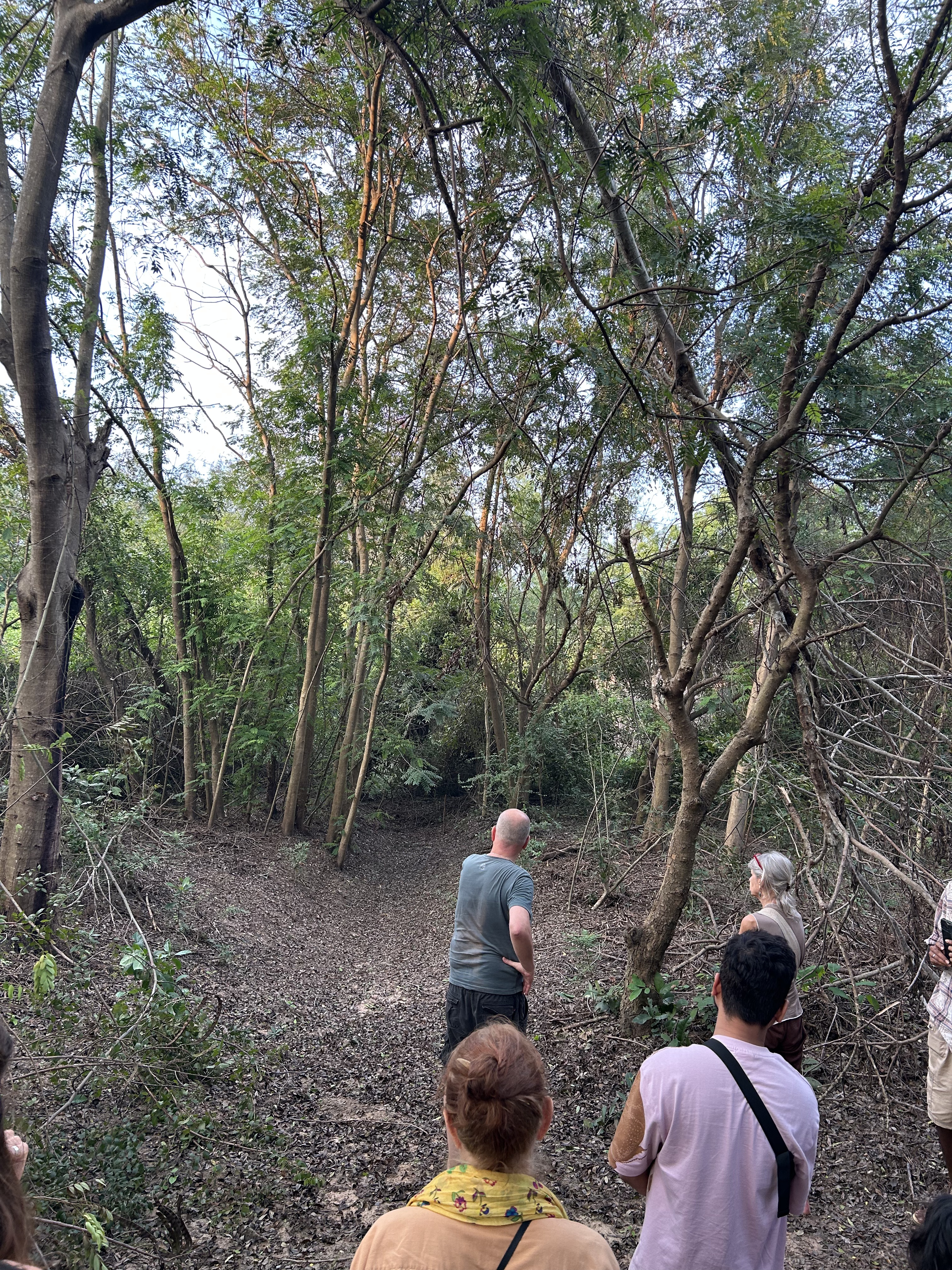
After the introductory talk, Aviram takes us on a tour of the campus and an exploratory walk in the forest. It’s remarkable to me that walking barefoot through the forest, while avoiding painful stones and roots, one is reminded of the intentionality required in each step—an apt metaphor for the care and mindfulness that defines this community.

Water Conservation Strategies

Sadhana Forest is, as the name suggests, a forest, but for a forest to thrive, one essential ingredient is needed: water. When Sadhana Forest began, it was little more than a barren wasteland, plagued by water scarcity like much of Auroville. Water conservation became the cornerstone of their reforestation efforts, and their strategy revolves around the Triple S method— Slow, Spread, Sink.

Aviram explains that the team strives to catch every drop of rainwater as close as possible to where it falls. Interestingly, in water conservation, low-lying lakes are a sign of failure in water conservation. Such lakes indicate that water has flowed to the lowest point of the slope rather than staying on the land where it fell—vital for nourishing the soil and replenishing the underground aquifer. To counter this, Sadhana Forest employs a method called on-contouring, maintaining water at its topographical height instead of allowing it to run downhill. This ensures that rainwater not only sinks into the soil to nourish plants but also replenishes the groundwater aquifer.

The success of these water conservation efforts is evident throughout Sadhana Forest. Aviram highlights that retaining water on the land has allowed for the natural regeneration of vegetation. Interestingly, he observes that natural regeneration fosters greater biodiversity compared to human-planted species. He likens it to designing one’s own home—wildlife, as the true inhabitants of the forest, can create an ecosystem tailored to their needs, rather than adapting to a pre-designed system imposed by humans. Indigenous plants, spread by wildlife through seeds and droppings, establish a harmonious and self-sustaining ecosystem far superior to human-centric reforestation.

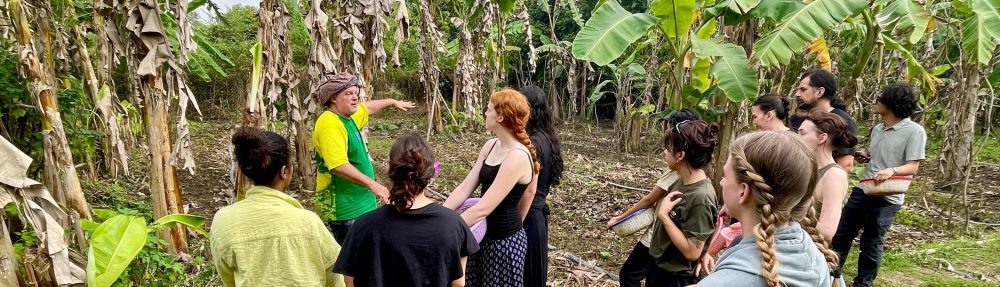
As we walked through the forest, Aviram pointed out various plants and explained their roles in water conservation. One striking example was vetiver, a grass with exceptionally deep roots that stabilize the soil and retain water. Similarly, the dodonaya plant thrives in arid conditions by capturing water from the air and storing it in its roots, helping to create moist, fertile soil. We also saw other water conservation techniques, including gabions (stone-filled metal cages), swales, and a man-made lake. The lake, while not ideal for the Triple S method, was a necessary adaptation due to the practices of a higher-elevation neighbor who doesn’t prioritize water conservation. Sadhana Forest has had to capture the water that runs off from this neighboring property to prevent it from being wasted.
Aviram pointing out a water conservation technique, a swale

During our visit, a curious tourist asked how Sadhana manages to address mosquitoes while maintaining their vegan and “do no harm” philosophy. Aviram explained that the key lies in controlling standing water, which disrupts mosquito breeding. Rather than killing mosquitoes, they simply ensure there’s no stagnant water for them to thrive. With a smile, he added that if any do appear, he prefers to swat them away gently rather than harm them.

Sadhana Forest’s water conservation strategies not only nurture a thriving ecosystem but also embody their broader values of harmony and sustainability. Their ability to transform a barren landscape into a flourishing forest is a testament to the power of intentionality and care for the Earth.

Fostering Sustainable Living

When we return from our forest walk, we are immersed in the heart of Sadhana’s community. Living at Sadhana Forest is a lesson in intentionality and simplicity. Every aspect of the community is designed to minimize environmental impact while fostering connection and joy.

The homes and dorms are constructed from renewable materials such as wood, granite, and tetrapacks (recycled milk cartons). Short-term volunteers sleep on rope beds, emphasizing the community’s low-impact ethos. Even everyday tasks like washing and cleaning reflect this intentionality—plates are cleaned using natural materials like coconut husks, ash, lemon water, and vinegar, ensuring all waste is biodegradable. Their handwashing stations are ingeniously simple, using cups with small holes that allow water to flow gently, paired with naturally derived soap. This clever design minimizes water waste while maintaining hygiene.

Sadhana Forest operates completely off the grid, a testament to its commitment to sustainable living. Aviram shared a nostalgic story about the community’s early days, when they used dynamo bikes to generate electricity before transitioning to solar panels and wind turbines. Although no longer in use, the bikes are preserved as a reminder of their humble beginnings. Today, all Sadhana sites around the world—whether in India, Kenya, or Haiti—are powered entirely by solar and wind energy, providing reliable electricity and hot water. While they occasionally face challenges during heavy monsoon seasons due to cloud cover, their resourcefulness ensures sustainability remains at the forefront.

The kitchen is also a hub of activity and efficiency, equipped with industrial-sized pots and pans and a large reverse osmosis water filter to maintain the highest standards of hygiene. That evening, we enjoyed a delicious vegan dinner made from locally sourced ingredients—a meal that reflected the community’s values of sustainability and compassion.

The Sadhana Forest community kitchen

After dinner, the team shared short videos detailing the mission and history of Sadhana Forest. The evening concluded with a powerful 45-minute documentary on veganism, which explored the devastating impacts of industrial agriculture on climate change, human health, and animal welfare. The statistics were staggering: 30 million deaths globally linked to lifestyle-related diseases, the overexploitation of 90% of the world’s fisheries, and the brutal realities of dairy and egg farming. The documentary was both eye-opening and transformative, reinforcing the message and values at the heart of Sadhana Forest.
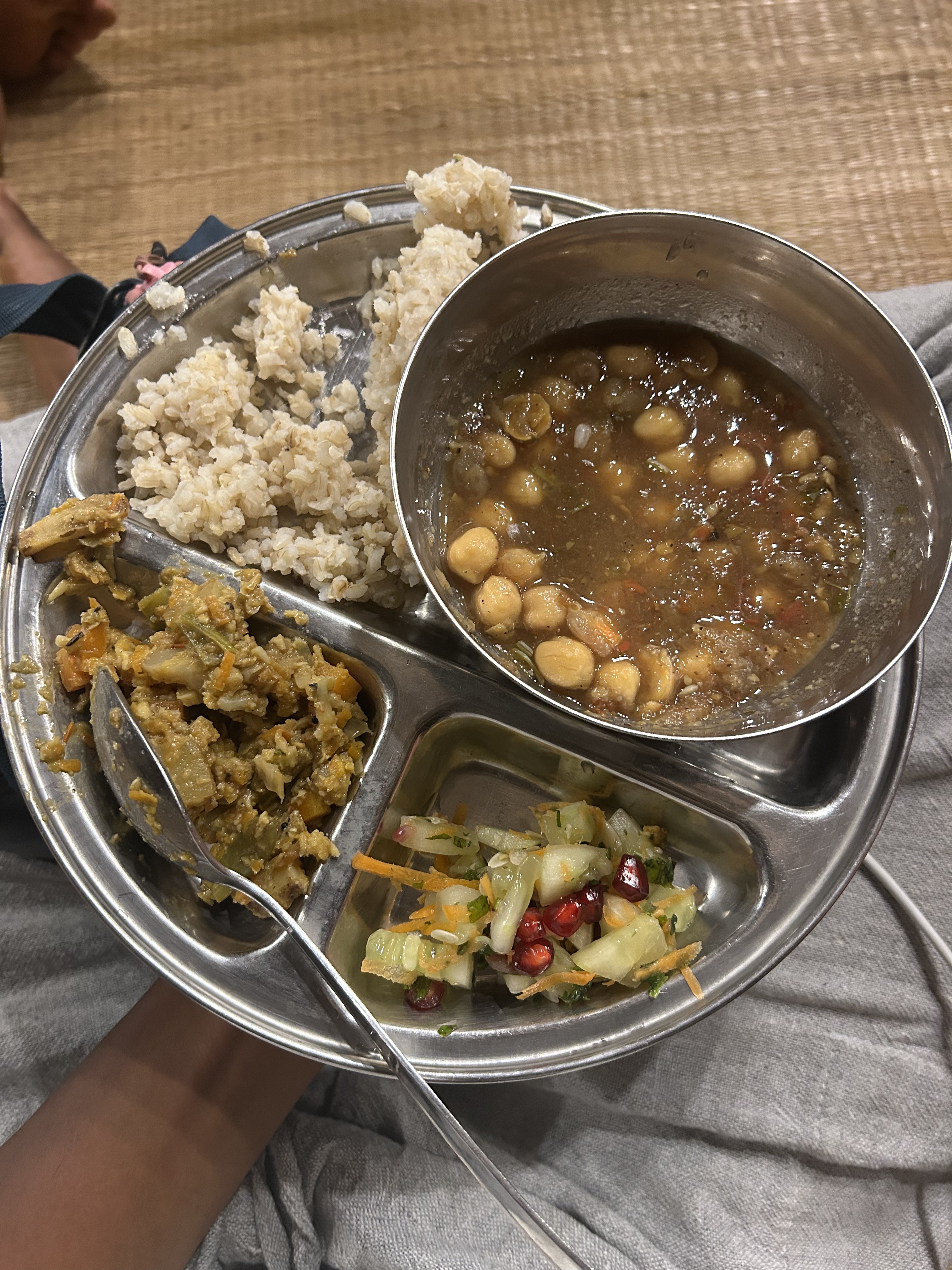
Our delicious vegan dinner provided by Sadhana Forest

The Values of Sadhana

At the basis of Sadhana is its vegan ethos of compassion. Aviram explains that veganism is more than just a diet; it’s an extension of their mission to live in harmony with nature and ensure that resources are used equitably and efficiently.

The first form of compassion is of course towards the land, which they seek to help prosper through their forestry, and from which they take no more than what they need. All of the buildings on the property are made from from natural materials. The second form of compassion is towards animals. Aviram makes it clear that the love of animals is central to Sadhana, and that no animal deserves to be tied, raped, or exploited in any way. I really appreciated that Aviram stressed the fact that animals have a right to live, even if they don’t give you something. It was nice to step out of the typical anthropocentrism, and he reminded us that part of Sadhana’s mission is to create a world without speciesism; other beings and nature are not just there to serve humans. This was reflected in the forest’s Guashala, a cow sanctuary for abused and abandoned cows. There, the cows are treated with the utmost respect with wonderful veterinary care, fresh water & food, & love. We were lucky enough to attend a cow connection workshop, where we bonded with a beautiful bull named Vishnu.

Our Cow Connection Workshop

The third example of compassion is compassion towards children. This was actually one of the most interesting and potentially controversial aspects of their philosophy. At Sadhana, they believe in natural learning & they call it “Unschooling”. Instead of sending their children to formal schools, they prioritize time spent with family and community, allowing learning to emerge naturally through curiosity and exploration. For example, if a child sees an airplane and asks about it, their parents might explain that people are flying through the sky from one place to another. This simple explanation could spark a deeper curiosity, leading the child to explore concepts like aerodynamics, engineering, or math.

I find this mindset inspiring—it celebrates freedom and the innate curiosity of children. When balanced with some structure or formal learning, it could provide a wonderful foundation for creativity and critical thinking. However, taken to its extreme, this philosophy can have drawbacks. I’ve heard anecdotal cases where teens raised in such environments struggled with basic skills, such as writing their own name. Nonetheless, Sadhana’s approach challenges us to rethink education and reminds us of the power of curiosity-driven learning.

Finally, Sadhana Forest embraces collaboration over competition, intentionally fostering an environment where individuals work together rather than competing against one another. This philosophy extends into their economic system, where they practice a gift economy—a model rooted in kindness, generosity, and the joy of giving. At Sadhana, everything is offered freely, with no expectation of reciprocity. Meals, education, and workshops are available to anyone who comes, all provided as acts of care and compassion.This approach profoundly disrupts the typical capitalistic incentives of greed and transactional exchanges. Instead, the gift economy shifts focus to the intrinsic value of giving and creates a space where every action is imbued with thoughtfulness and care. It encourages people to give not because they must, but because they wish to contribute to something greater than themselves.

Aviram, the founder, explains that Sadhana Forest is a place designed to remind people that kindness still exists in the world. By offering this generosity unconditionally, Sadhana hopes to inspire a deeper connection between people and their values. This is also why veganism, a core tenet of Sadhana, is framed as an extension of kindness—toward animals, people, and the Earth. In this way, the gift economy not only sustains Sadhana Forest but also embodies its mission of compassion and community, creating a living example of a world driven by care rather than commerce.

Sadhana’s Projects: Global Reach, Local Impact

Beyond forestry, Sadhana Forest offers a variety of innovative and impactful activities that reflect its broader mission. One such initiative is Children’s Land, a 2.7-acre space launched in 2009 to empower children to engage creatively with sustainability. Here, children initiate or participate in activities as they choose, fostering independent thinking and a deep connection to the natural world. This program has been met with enthusiastic feedback from children, parents, and teachers, inspiring Sadhana to expand its reach. Another cherished initiative is the Tea Hut, which serves free, vegan tea every weekday, embodying Sadhana’s commitment to inclusivity and generosity. The community also nurtures personal and global transformation through its University of Compassion, offering workshops and programs that align with its values of kindness and sustainability.

While Sadhana Forest began in India, its philosophy has transcended borders. In Kenya, the organization collaborates with the Samburu tribe to plant indigenous, drought-resistant food forests, ensuring biodiversity, food security, and shade for local communities. In Namibia, long-term volunteers work closely with local populations, committing to year-long stays to fully integrate and address community-specific needs. These global projects not only restore degraded ecosystems but also empower local people to reclaim and protect government-designated “wastelands” from encroachment. By doing so, Sadhana Forest fosters a deep sense of ownership and connection to the land.

These initiatives are unified by a single vision: to heal the Earth and cultivate compassion through reforestation, water conservation, and community building. Supported by individual donations, grants, and partnerships with organizations like UNDP and the Government of India, Sadhana Forest’s work has garnered global recognition. Whether through planting trees or empowering the next generation, Sadhana Forest remains a testament to the transformative power of sustainability, kindness, and collaboration.

Reflections on Community and Connection

Sadhana Forest offers a powerful model for addressing global challenges like deforestation, water scarcity, and social inequality. By combining ecological restoration with a philosophy of compassion, they demonstrate that sustainability isn’t just about planting trees—it’s about redefining our relationship with the Earth and each other. Their initiatives, from Children’s Land to global reforestation projects, are a testament to the transformative potential of intentional, community-driven action.

Take, for example, Amman, a former corporate professional from Bali, who left the comforts of a cushy job to join Sadhana Forest. His motivations stemmed from a deep commitment to veganism, a love for animals, and a yearning for a sense of community that capitalism failed to fulfill. Now, he spends his days planting in the wet season, mulching in the dry season, and caring for the cows in Sadhana’s sanctuary. Amman’s story reflects the larger ethos of Sadhana Forest: finding purpose and joy in simplicity, compassion, and shared effort.

On a personal level, my time at Sadhana Forest inspired me to reevaluate my own habits and assumptions. The intentionality of their work—from water conservation to vegan living—reminded me that small, thoughtful actions can lead to profound change. Every initiative, whether it’s teaching children about sustainability, empowering local communities to reclaim their land, or fostering kindness through a gift economy, serves as an invitation to think differently about how we live and what we value. My visit to Sadhana Forest was more than just a tour; it was a call to action and reflection. In a world often dominated by division and exploitation, Sadhana Forest stands as a beacon of possibility: a place where kindness, sustainability, and community thrive together.

How can you support Sadhana Forest? By becoming a regular donor. Aviram emphasizes that their primary source of income is individual donations, and while the size of the donation matters less, its consistency is key to sustaining their work. With tax-exempt status in multiple countries, supporting Sadhana is both impactful and accessible. I invite you to explore their programming and become part of this inspiring movement at the link here. Together, we can help Sadhana Forest continue to grow, heal, and inspire.

Yatra Arts Foundation: Empowering Communities Through Arts and Culture

By Kendall West

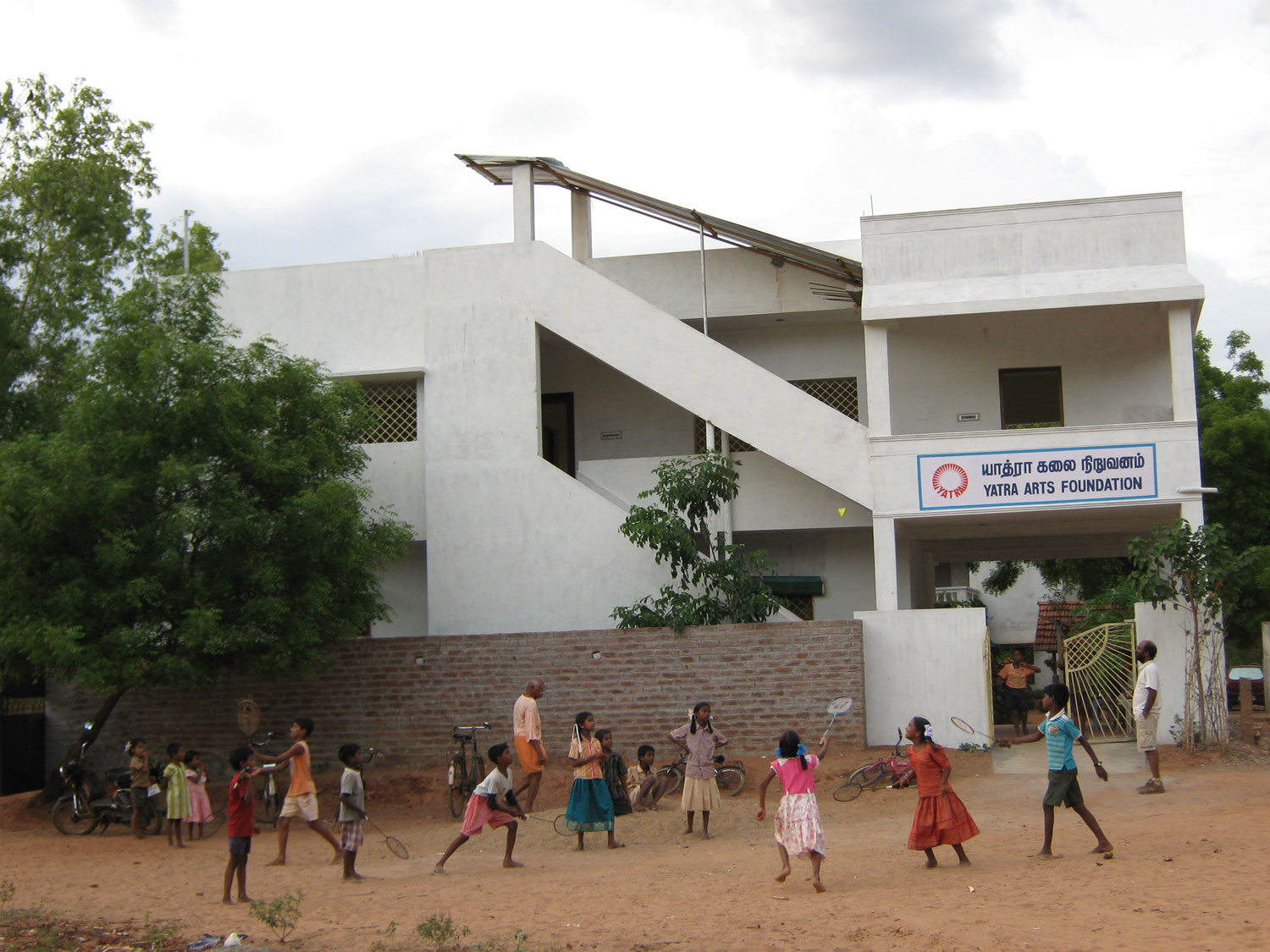
Nestled in the heart of Kuilapalayam, the Yatra Arts Foundation stands as a beacon of creativity and empowerment, transforming the lives of youth in Tamil Nadu’s villages through the enriching power of education and the arts. Founded by a visionary from this very village, Yatra bridges the gap between Auroville and the surrounding communities, fostering opportunities, preserving cultural heritage, and driving social development. At its core, Yatra embodies the belief that art is a tool for empowerment. Through street theatre, traditional dance, music, and modern educational programs, the foundation equips children and young adults with the means to express themselves, address societal challenges, and build a brighter future.

The Yatra Team, with founder Yatra, second from left

Preserving Heritage by Telling Stories

A cornerstone of Yatra’s mission is the preservation of traditional arts, and during our visit, we had the privilege of witnessing these efforts firsthand. We were captivated by a mesmerizing Bharatanatyam performance, where young girls—many of whom have been learning since they were ten years old—used intricate hand gestures (mudras), facial expressions, and precise body movements to tell powerful stories. This ancient dance form, steeped in history and meaning, showcased emotions such as joy, anger, and surprise, preserving the art of storytelling through movement and tradition.

Before Auroville’s establishment, many villages in Tamil Nadu had little access to education or the arts. Yatra has become a vital bridge, connecting these communities with opportunities for growth and development. Children, in particular, have been the most impacted, as they embrace change and learning with enthusiasm. Through its performances, classes, and workshops, Yatra ensures that these opportunities reach every corner of the village.

We were also treated to evocative Parai drumming demonstrations, which brought this traditional form of Tamil percussion to life. The resonant beats of the Parai, traditionally used to mark life events or draw crowds to performances, were not just musical but deeply practical, reminding us of its historical and cultural significance. These performances served as powerful reminders of the region’s rich artistic heritage and the importance of passing these traditions to future generations.

Girls practicing the Bharatanatyam

Art as a Catalyst for Change

Beyond preserving heritage, Yatra uses art as a catalyst for social and environmental change. Before we left, we were shown a compelling short film on the importance of waste sorting and proper waste management techniques. The film highlighted how waste, when sorted correctly, can be transformed into compost, offering valuable resources for the community while reducing landfill waste and preventing illnesses. It was a vivid example of how art—specifically film—can be used to spread awareness, educate, and engage communities in meaningful discussions about critical issues. The film not only underscored Yatra’s commitment to environmental conservation but also demonstrated the potential of the arts to inspire action and create lasting impact.

Yatra’s street theatre performances and films address a wide range of societal challenges, including cleanliness, solid waste management, environmental conservation, and alcoholism. After each performance, the foundation hosts open mic sessions, encouraging villagers to share their thoughts, voice frustrations, and collectively discuss solutions. This interactive approach fosters dialogue and empowers communities to think critically and collaborate to overcome challenges.

Modern Education Meets Cultural Preservation

In addition to its focus on traditional arts, Yatra offers a variety of modern educational programs that prepare youth for the future. These include after-school tuition classes, yoga sessions, painting workshops, puppet shows, and theatre classes, all designed to integrate life lessons with hands-on, enjoyable activities. By blending fun with learning, these programs engage students while teaching valuable skills, from environmental conservation to social responsibility.

Students in an after-school tuition session

Yatra’s work aligns closely with the United Nations Sustainable Development Goals (SDGs), particularly SDG 4 (Quality Education) and SDG 15 (Life on Land). Through initiatives like the Yatra Social Docu Series on YouTube, they reach both local and global audiences with impactful stories about pressing social and environmental issues. Collaborations, such as those with the Lufthansa Health Alliance, further amplify their reach, demonstrating the potential for art to drive systemic change.

As the foundation looks to expand its efforts, it remains deeply committed to its mission of fostering joy and learning through the arts, creating a ripple effect that benefits not just individuals but entire communities.

The Yatra Arts Foundation is growing rapidly, with its impact extending to new villages and communities. Their YouTube channel, Yatra Talkies, recently received the Silver Play Button for reaching a significant milestone of over 150,000 subscribers. The channel continues to share impactful stories, amplifying their message and engaging audiences worldwide. To explore their inspiring content, check them out at the link below:

Yatra Talkies YouTube Channel

What sets Yatra apart is its ability to inspire through joy and creativity. Whether it’s a child mastering the rhythms of the Parai, a young girl expressing herself through Bharatanatyam, or a community coming together to discuss an impactful film, Yatra proves that art is more than just a medium of expression—it’s a tool for transformation.

The Yatra Arts Foundation is not just an organization; it’s a movement. A movement that preserves heritage, addresses societal challenges, and empowers individuals to dream, create, and thrive. In an ever-modernizing world, Yatra serves as a powerful reminder of the enduring value of culture, community, and curiosity, lighting the way toward a brighter future.

Solitude Farm & Café: Preserving Nutritional Heritage One ‘Thali’ At a Time

By Naydeline Mejia

Started in 1996 by a group of Aurovilians, one of them being British-born Krishna McKenzie, Solitude Farm & Café is a natural farm in Auroville revitalizing the nutritional heritage of the Tamil Nadu region through revolutionary, anti-colonial agricultural practices.

Solitude’s natural farming modus operandi is inspired by the philosophy of Japanese farmer and philosopher Masanobu Fukuoka. Fukuoka is often celebrated for his contributions to permaculture and natural farming. Unlike organic farming, natural farming—also known as “do-nothing” farming—imitates the ways of nature. Zero fertilizers are added to the soil or given to plants. Instead, natural farming relies on microorganisms and earthworms to naturally decompose organic matter and nourish the soil. And just like in nature, there is no plowing, tilling or weeding done to the farm (Chandel and Jangilwad). 

“When we look at the [industrialized] agricultural practices we have today, we plow the land, we compress the soil, we put chemicals on it—we kill this soil,” says McKenzie. “And as we kill this soil, we destroy ourselves as cultures. We lose our wellbeing. We develop lifestyle diseases. We create climate change.”

Compared to organic farming, natural farming has a lower carbon footprint. It is also extremely inexpensive, relying on the resources provided by the earth (Chandel and Jangilwad). 

Our harvest of butterfly pea flowers and other crops native to Tamil Nadu.

Another benefit of natural farming: It celebrates native foods by relying on a region’s natural biodiversity. 

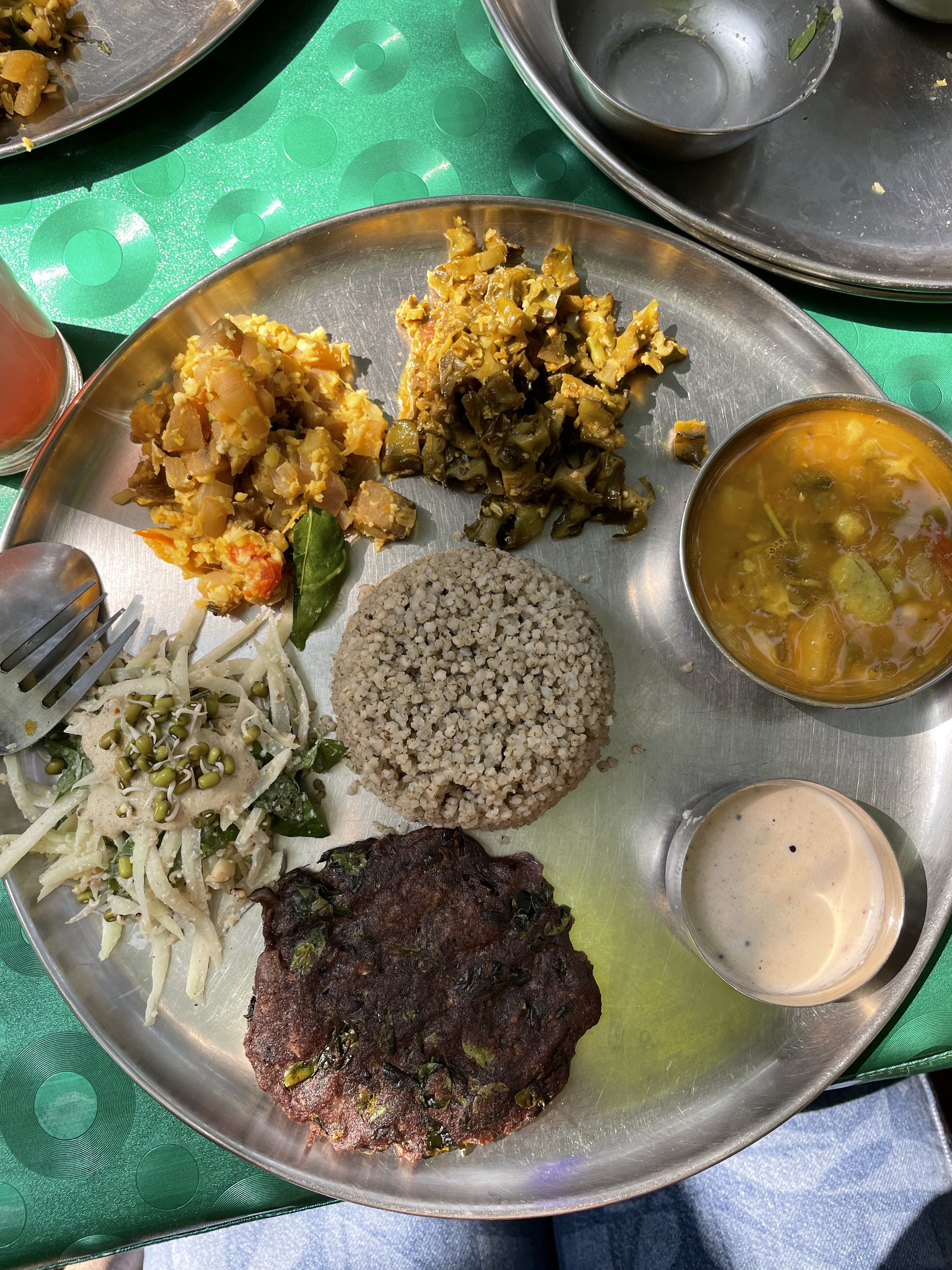
In 2008, with a need for financial durability and inspired by Fukuoka’s vision (McKenzie had the pleasure of meeting his hero in 2002, who championed natural farming on the barren land that were the farm grounds), McKenzie and his team turned to local foods, which grow easily and naturally, for their natural farm. The farm hosts a huge variety of weeds, edible flowers, fruits and grains native to Tamil Nadu like: papaya, guava, breadfruit, mangoes, okra, balloon vine, turkey berry, butterfly pea, hibiscus, millet, and red rice. These crops are then prepared and served at Solitude’s farm-to-plate café, often in their thali or daily plate from that morning’s harvest. 

When speaking about the café, McKenzie refers to it as a blessing for the organization. “It’s been the catalyst for us to understand [the importance of eating local foods],” he says. These crops are often undervalued as a result of the mass commercialization of goods, he continues, causing nutritional homogeneity, and thus the loss of cultural identity and food diversity. 

Preparing a salad from our harvest of native weeds and fruits alongside McKenzie from Solitude Farm.

In addition to preserving nutritional heritage through serving locally-grown meals, Solitude is also on a mission to educate future generations of natural farmers through their weekly farm tours, permaculture workshops and volunteer opportunities. The intensive three-day permaculture workshop introduces participants to permaculture field design and gives them the tools to start their own food forest or nursery. The month-long volunteer programs, meanwhile, allow volunteers to get more intimately involved with the organization—often assisting with educational programs, running farm tours, cooking in the café, and the making of ayurvedic powders. 

Revisiting Fukuoka’s philosophy, farming was more than just growing food, it was a spiritual way of living (Kaundal et al.). At Solitude, they’re not only preserving cultural heritage and a bounty of crops that would otherwise be forgotten, but honoring the gifts of Mother Nature.

Final salad featuring lemon zest and a peanut-dressing.
That day’s ‘thali’ or daily harvest plate.

Learn more about Solitude and their initiatives here: https://solitude.farm/

Eternal Divers Presentation


cropped-logo-eternal.jpg Eternal Divers

https://eternaldivers.com/

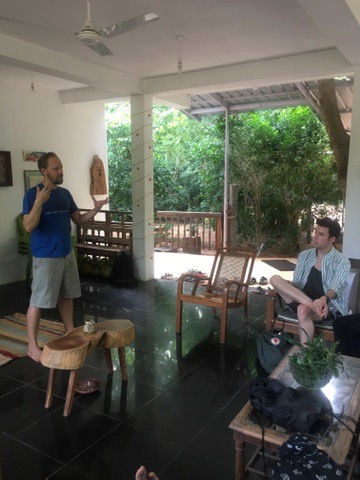
Eternal Divers is based just outside of the Auroville on the Bay of Bengal. The first thing we noticed as we approached the location is the beauty of the house, Eternity. Situated on the beach and surrounded by bush and sand, Eternity features a large, open patio that connects to the home and office of Jonas and Tracy of Eternal Drivers. Zeus, their grand Rottweiler greeted us with kisses and just a little bit of fur and slobber. The dog lovers amongst us were thrilled to meet him but we get situated quickly and open our hearts and ears to listen to “Joni” explain the mission of Eternal Divers and the issues that his team, Tracy and he are passionate about.

When Eternal divers first began, it was just another diving company and they wondered how to set themselves apart and make better use of their skills, talents and location. How to be a sustainable business and spread environmental concern and solutions is paramount for them. Yoni discussed something that caught his attention called “ghost nets” which are extremely concerning. A ghost net is a fishing net that has (most likely) become caught on something which makes it impossible for a fisherman to free it or has escaped the control of the fisherman and can’t be reeled back on to the boat. It is left behind, unattended and unchecked forever as it collects, catches and kills without consideration. In addition to the ghost nets, sewage, overfishing and erosion are all concerns for Joni and Tracy and their team. Joni told us that there is a visible line of sewage and ocean water and to help us understand just how detrimental ghost nets can be, he explained that ghost nets cause about 20, 000 US dollars loss per year. Nearby, a ghost net was discovered that had over 30 sharks caught in it and had been floating for what an estimated three years. Of course, nothing in a ghost net can be salvaged for food. It is just a true waste of resources.

Eternal Divers was enraged at the finding and asked us to consider what a tragedy this is when we reflect on the beauty and majesty of all the sea has to offer us. The pointless loss of life and the pollution caused by humans is unacceptable. Naturally, Eternal Divers found a way to expand the teaching and education of scuba and diving to the fisherman and villagers themselves to help them understand how precious their resources were and how carelessness could hurt their livelihood more than they had ever comprehend before.

We learned from them that what they are most proud of and would really like to continue, improve upon and increase the reach of is the education of the fisherman and villagers. Too many humans take the sea and all she has to offer for granted. What lies below the surface… or more importantly what is being harmed and killed off below the surface is unknown until we dive down and see for ourselves. All the incredible colorful life, both flora and fauna, are unseen, under-appreciated and unprotected. It is only through the education and the collaboration with locals that behavior change can occur. Seeing the deep for oneself may be the only way for many to understand what is at risk.

Within global communications, behavior change is the most challenging of all the goals. Behavior change, as in this instance, little to no money can be gained through the education of the locals. In fact, Eternal Divers may find that time and money are lost in their efforts; however, they feel that what India and the earth may gain is far more important if the sea and its life can be preserved through this tactic. The benefits of behavior change are often long-term rewards that seem less important in the moment. For example, a fisherman may be more concerned with how much money he can earn this week, as opposed to the concept that he may not be able to earn any money in a few years if the fish are either overfished or die off because of pollution.

Eternal Divers needs funding to help support the education of the locals, a strategic creative plan and social media revamping/attention, as well as social media viral campaign. I felt very strongly about joining their team and helping. The ocean and all the life in it and that it gives is incredibly important to me. Choosing my NGO was tough when I had to compare Eternal Divers to Marc’s Café, where I had so many ideas from the start, but I’ve loved hearing all about it from my classmate, Beatrice.


IMG_0856.jpg

Mason listens to the Eternal Divers presentation.

A Day With Disposable Cameras

By: Beatriz Salgado


My day started out with the usual morning breakfast at Morgan’s, scrambled eggs with toast and milk coffee. Then, I went to the Matrimandir for the first time, one of the most intriguing experiences yet, but I’ll leave that for another blog entry.

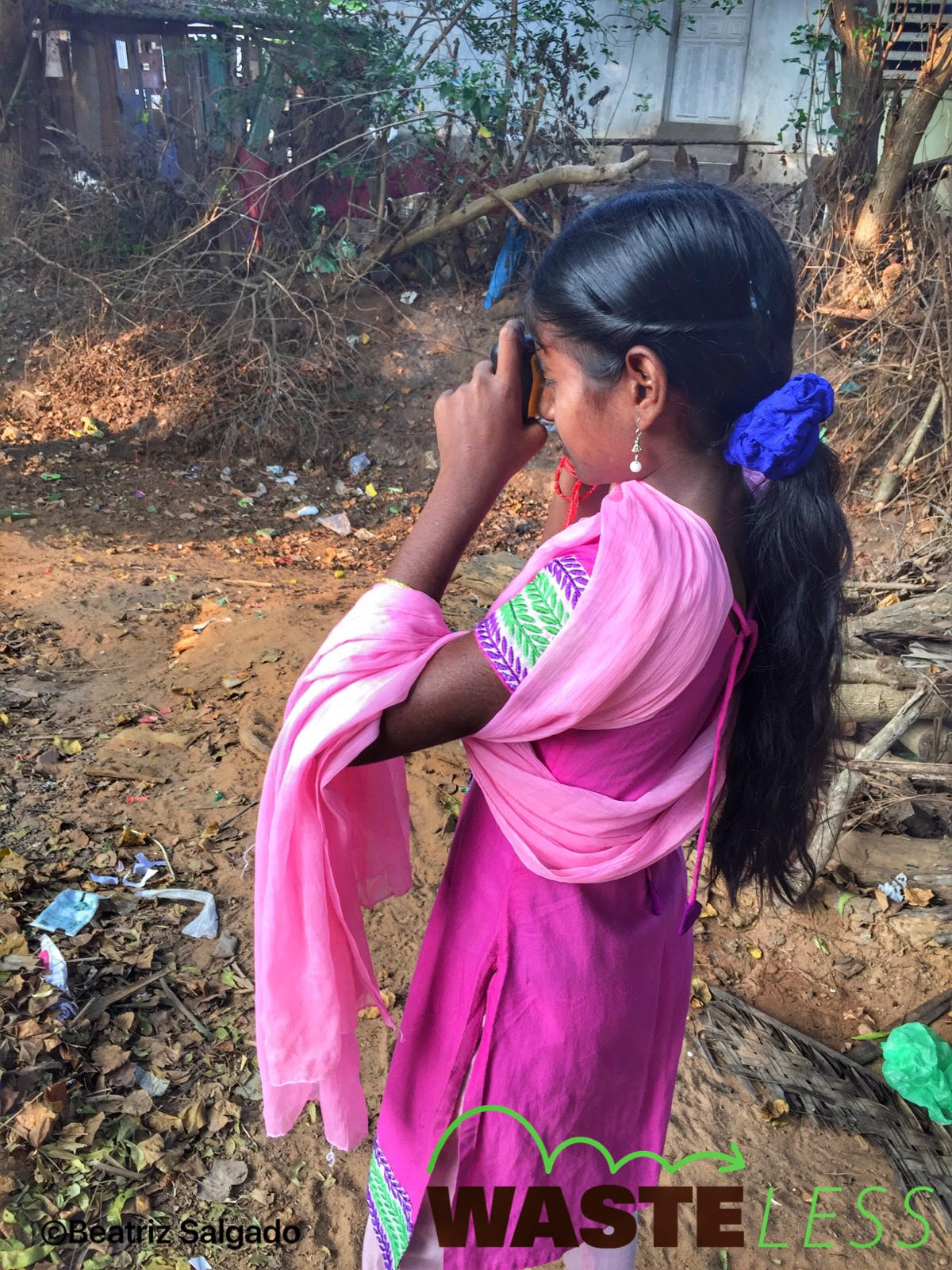
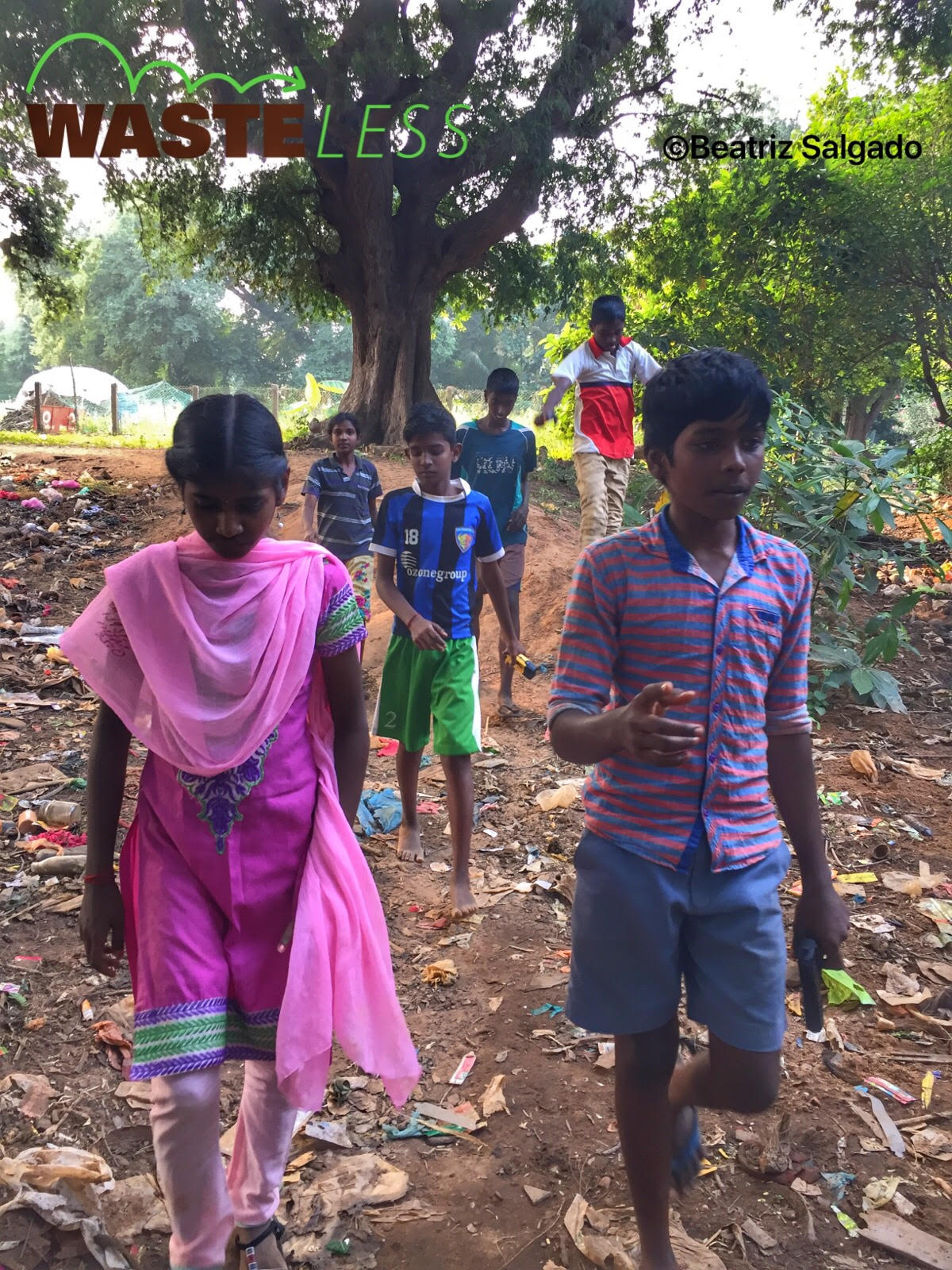
I’ve had an idea for my personal project before I even left for India. Working with children in Brazil and establishing a genuine relationship was always something I felt passionate about. So, my idea was basically to get children to walk around Auroville and take photos of something, I hadn’t really thought about what that something was until I started volunteering at Wasteless. I mentioned my idea with Rihbu, the organization’s founder, and thought he could help. He really liked the idea and thought it could be great if the project complemented Wasteless’ new educational program kNOw PLASTICS. Together we decided the kids would take pictures of plastics. They were to think about where they got their plastics? How did they use plastics? And where they threw their plastics away?

wastelesskids.jpg

I had already been to Aikiyam School the day before to observe the pilot testing for Wasteless’ new educational program, so I had met the principal of the school, Shankar and he said I could meet with the kids on Saturday afternoon. The next day, I got all my gear, which included three disposable cameras, a laptop, water bottle, my journal, and a charger and headed for Kulapalyum Road. While I waited for Shankar to confirm, I had a delicious lunch at Frites with my classmate Imani and later coffee and brownie at Marc’s café, an indispensable place to drink coffee while in Auroville.

Finally, I heard from Shankar and walked to Aikiyam School under the hot afternoon sun, not to mention it was winter. I went to the science room where the teacher and students were doing extracurricular work and waiting for my arrival. They usually have some activities during the weekends to keep the students busy. Before heading out for our photography exploration, I decided to talk to some of the students and interview them about plastics. Though they were a bit shy in the beginning, I was surprised by how much they knew about the issue.

To start our photography hunt, I divided them in groups, two girls, Deepa (13 years old), Roshini (13 years old) and two boys, Chandru (14 years old) and Chander (13 years old). Later, we met up with two other students, Arjun (13 years old) and Thiru (13 years old) who decided to join our expedition. I gave each group one disposable camera and explained to them the objective of taking the pictures.

wastelesskids2

The purpose of the assignment was to take photographs of plastics in their point of view by keeping in mind the three questions mentioned above. As soon as we stepped out of the school, they immediately started taking pictures of the waste they found right outside the school: plastic bottles, bags and even a CD! We walked along the main road and headed towards Kulapalyum village where the kids lived. As we strolled around, the students entered different shops and interacted with people explaining to them what they were doing and why they were taking photos of plastics. Then, we started heading to each of their homes. What was interesting to observe were the different perspectives they had on what was clean and dirty. One of the questions was if they thought where they lived was a little, medium or a lot dirty. Most of them answered little or medium and that it’s sometimes clean and sometimes dirty. I remember thinking, ok, so they live someplace decent. I was wrong though, what was surprising was their notion of somewhere clean turned out to be a completely different conception from my reality.

wastelesskids4

During the interview, they all answered that they threw their trash and plastics in dustbins in their homes and that they don’t throw waste on the streets. One student even said they separated organics from non-organics at his house and that after it was separated, the “people that do the duty comes to pick it up” (Arjun).

The small comfort that I did have, despite seeing those kids’ environment and their reality, was that they were still being kids and had so much fun taking photos with a simple disposable camera.

meandthekids

A Visual Throw Back

By Mia Windisch-Graetz

It’s been a week now since our arrival in Paris and apart from that little sun burn on the nose and a bunch of insider jokes, especially one thing remains: memories. Memories from a life-changing experience in India we will be telling our children about one day. No matter if they are in our mind or on the SD card of our reflex camera: we will keep them forever.

The slideshow below features some pictures I took during this amazing journey. Tip: You can also listen to some Bollywood classics to get even more into the Indian mood while watching.

This slideshow requires JavaScript.

Same same but different but still same. Or would you rather call it different different but same but still different? Anyway, I hope you enjoyed the visual throw back to a world different but ‘same enough’ to call it our own.

Nandri et bisou

‘We just can’t’

Two toilet paper rolls, six dresses, twenty-seven cold showers, no laundry load (hand-wash only), and 1.5 Gigabytes of internet. – All in one month. If you had told me that I would be able to ‘survive‘ this way before I left Paris, I never would have believed you.

Right after our arrival at the Chennai airport we went to a restaurant where we did not only have our first ‘real Indian‘ dinner but were also confronted with a ‘real Indian toilet’ for the first time. As soon as you entered the bathroom, the hygiene standards were not the same as we are used to back in Europe because there was no toilet paper instead you could only find a dirty bucket. Some of us went, while others kept saying ‘I just can’t, and waited until they arrived at the hostel. On the bus, some of us were dying to go to the loo because our bladders were about to explode.

Toilet, bed, toilet, bed. – While everyone was out and about visiting NGOs, I was running back and forth from my room to the toilet. Suddenly, I realized that the toilet paper was all gone, which gave me no other choice but to use my hands and a bucket.  And guess what: it was not too bad.

                                                               ***

When we found out that the washing machine broke down at our hostel, I asked myself: am I going to wear the same dirty clothes all week? Consequently, we had no other option than to hand wash our towels, dresses and underwear.

                                                               ***

During our stay in Auroville, the most problematic issue was that internet was almost non existent. Thus, we had difficulties communicating with our families, friends abroad, students from our group and the NGOS we were working for.

                                                                ***

This month was not about sitting in a classroom and learning about sustainable development from the books. We were actually living, breathing and talking sustainably. The problems we were confronted with lead us to find more sustainable solutions.

A question we could all ask ourselves after this month: how much toilet paper, water and energy did we actually save here?

By asking several students and according to the data I gathered from doing some research I found out that our group saved 38 toilet paper rolls composed of 38,000 sheets of toilet paper, which is equivalent to about 2 miles. Moreover, a standard toilet uses about 3.5 gallons of water per flush, a low-flow toilet uses 1.6 gallons whereas for squatting toilets only 0.21 gallons are needed. With the average person flushing about 8 times a day, (not accounting for the people who had diarrhea) we saved approximately 13 502.16 litres of water in total or the equivalent of a swimming pool.

Considering that none of us used a blow dryer or a washing machine, and as we were mostly cycling around with our bikes, we saved a great amount of renewable energy as well.

What will happen when we get back to Paris? Will we ever able to continue the ‘Aurovillian lifestyle?’ – This month, we made it happen, so the answer isDSC_0186: Yes we can.

by Mia Windisch-Graetz

NGOs Galore!

By Madeline Boughton

The aim of this NGO Practicum is for students to act as interns or consultants to various organizations, assisting with their communication needs. Since day 2 we’ve been touring and visiting non-governmental organizations (NGOs). In only six days we visited about 19 different organizations out of 23. Each day is packed with multiple units where they present their goals and missions to students and answer any questions we might have.

The overarching themes of the NGOs we will work with are health and human rights, environmental sustainability, alternative energy, and sustainable fashion. These broad terms include causes such as women’s empowerment, Dalit rights (formerly known as Untouchables), children, sustainable and ethical fashion, sustainable living, radio, solar energy, waste management, and more! This NGO practicum truly offers something for everyone’s interest or passion.

With so many “good causes” it is difficult to choose just one. I could easily choose about 3 places I’d be interested in working for. The other factor that could make choosing an organization difficult is matching an organization with student’s skill sets. Some organizations need assistance with website building, creating pamphlets and flyers or creating short videos to display on existing sites. Fortunately, there is a wide range of skills within the group and we also have “media mentors” that will assist us with technical questions and projects.

After a few days of visiting 5 organizations per day, most of us had an idea of where we want to work. The remaining organizations and speakers were essentially lectures and informative sessions on the functioning and practices in Auroville. Even though we will wind up doing a major project at only one organization, we are now well informed on almost all that Auroville has to offer in terms of advocacy and will use that information when completing our projects and final papers. Some of us are quite anxious to begin work right away. I have chosen to work at the ADECOM Network. This agency advocates for the rights of the Dalit community. I am happy to assist this agency in any way in helping shed light on discrimination against a vulnerable people. We will keep you updated on how our progress and projects turn out.

Thanks for reading!

Image

The Other Side of Sustainability

By Shannon Warren

This morning Auroville was abuzz with the whirring of chainsaws slicing into fallen trees, the frantic beeping of the suddenly plentiful rickshaws, and the general chaos of people trying to make sense of the destruction around them.  It has been three days since cyclone Thane hit Auroville and the devastation is still astounding.  The heat and humidity bring into sharp relief the lack of drinking water and electricity as people venture out in the glaring sun to procure necessities and try to clear debris from the roads.  Some of our group has experienced natural disasters and many of us haven’t (I am included in the latter group).  Certainly none of us expected anything like this when we came to India for a practicum in communications and sustainable development.  I suppose the thing about learning, about self-improvement, is that you must be confronted with the unexpected and unknown to progress.

The night of the storm, while I curled up afraid but safe in my sheets and behind sturdy brick walls, I listened to the howling winds, shattering glass, and falling trees as peoples’ homes and livelihoods were destroyed in a matter of hours.  The next morning I woke up in disbelief.  Just one day earlier we were carefree, hiking up to a temple on top of a hill and swimming in a beautiful freshwater lake.  That morning we were not only in an unfamiliar landscape and culture, but had just been through the worst cyclone that had ever hit Auroville, according to local sources.

Although the situation could have escalated to the point of hysteria very quickly, we chose instead to play cards by flashlight and sit together singing familiar songs, letting our apprehension out through laughter rather than tears.  Some of us ventured out on the roads, clad in our raincoats and ponchos, to see how the villages had been affected and to search for food and water.  After climbing through the fallen giants blocking the roads and seeing that being in a mud hut during a cyclone as opposed to a sturdy brick building made a world of difference, we knew that we had our work cut out for us the next couple days.

The next day, New Year’s Eve, we donned our work clothes, picked up machetes, and started chopping and clearing up the trees and debris around our pavilions.  Suddenly it seemed as if we were no longer a group of semi-strangers brought together by wanderlust and a course requirement, we were all kindred spirits, working together to realize a common goal.

While traipsing through the grass behind my classmates with my arms full of branches and my heart full of determination, it became clear to me that there are two sides to sustainability: the physical side that involves composting toilets and cold showers as well as the emotional support that comes from being a member of a community which takes care of all of its members as well as the physical space that it inhabits.

So, while it may not have been the lesson we set out to learn, we have all discovered the emotional side of sustainability over the past few days.  Although the people who live here may not have many of the comforts we enjoy back home, they do have one thing that many of us don’t: the sense of security and assurance that comes from living in a community where people are connected and take care of one another.   I think I’d take that over an iPad any day of the week.