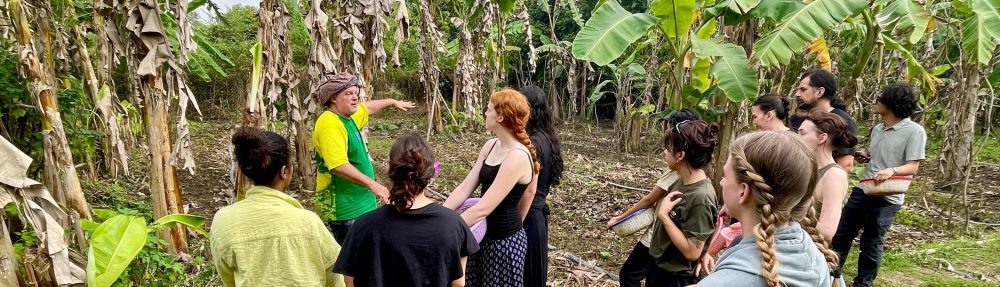
Coming to Auroville and listening to different residents reveals that there are as many projects and perspectives as there are represented nationalities. To help us understand the financial structure and functioning of Auroville, along with the intentions behind this, students attended a talk about the financial functioning and maintenance of Auroville.
Auroville is an international town created as a charitable foundation by an act of Parliament, based on a cooperative concept, where the city purchases for group, and everyone contributes. It has 3,000 residents, but has an economic aim to sustain an eventual population of 50,000. Right now, 30% of residents are Tamil from the local area, and there is pressure from the Indian government to promote the residency of more Indians because the population of Pondicherry is expanding so rapidly. Auroville management within the central foundation begins with the Governing Board, selected by the Indian government, which manages a Finance Committee, and under that is the FAMC Finance and Asset Management Committee. This last one is managed by Auroville residents, and it sets budgets, stewardships, and approves projects. Substructures to that include the Unity Fund, which is the accounting structure, followed by Financial Services, then followed by Executive Bodies, which are trusts. This then breaks down into the 800 commercial units and activities, who contribute 33% of their profits back into the Auroville budget. There are also 3 trusts set up for Bioregional Development in the local area outside of Auroville, for environmental, educational, and microfinance projects.
Auroville was founded with certain ideals of what a healthier, more equitable, peaceful, and sustainable future would be. For example, ninety percent of the trees in Auroville were a part of a reforestation effort that began with its founding 50 years ago, a testament to the residents’ ability to act on big picture dreams through small changes. The same can be said for Auroville’s finances. Auroville has a program they call the KIND System, which operates off of a cash-less accounting system passed through a card per each person. City Maintenance, the amount of money every citizen is entitled to, is intended to provide citizens with basic needs, including food, health, education. It is not meant to sustain all expenses, and will mostly meet the basic needs of a modest lifestyle, but will not cover habits such as consuming meat, drinking alcohol, smoking, or the purchasing of one time expenses, like an appliance.
Leadership in Auroville is on a volunteer basis, unpaid, with the hope that responsibilities will emerge from duty, and decisions will be from consensus. Those who are employed by City Services receive a small stipend, not a living wage. The city of Auroville only formally employs about 500 people, about 25% of the adult population. Because of the standards and regulations involved in becoming a citizen, including a set amount of volunteer hours, many people will choose to go elsewhere for seasonal work, unless they are able to run a successful commercial unit.
Per the Auroville philosophy, no one is supposed to own housing in Auroville. Almost all land is owned by the city trust, and people pay for stewardship. They can secure housing with the Housing Service with a contribution between $30,000 to $60,000 to the Unity Fund, and the Housing Service connects potential residents and developers. On a side note, if a resident decides to leave for an extended period, they must relinquish the housing between 3 and 5 years. There is a small Repatriation Fund for those who leave within the first five years of moving to Auroville, where they receive a small portion of their initial contribution back.
After reviewing the financial structure, spending, and philosophy, one can see that Auroville aims to contribute to achieving the UN Sustainable Development Goals #1 (No Poverty), #2 (Zero Hunger), #3 (Good Health and Well Being), #10 (Reduced Inequalities), #11 (Sustainable Cities and Communities).
 Our visit to EcoFemme was a much anticipated one for the group.


 Image Credit: Stella Sagini
 Image Credit: Stella Sagini
 Image Credit: Stella Sagini
 Image Credit: Stella Sagini
 Image Credit: Stella Sagini
 Image Credit: Stella Sagini
 Image Credit: Stella Sagini


 The building conveys this message of commitment to Tamil Nadu as it is completely adorned with artwork done by local children both inside and out, the welcoming facade is matched with a smiling staff made up of Indians from across India. Abel a program manager from Delhi guided the group through the building offering explanations about the artwork and crafts which cover the walls.
  He explained that SLI’s team is small made up of only six members each with a specific set of skills and tasks be it in the Research, service or commercial units of SLI. Across these units, the institute offers countless programs that focus on six main strategies for success: perspective building, skill-building, network building, social mobilization, social innovation, and knowledge creation. Through these strategies, the team produces programs to empower the disenfranchised from herbs for health, a program aimed at teaching farmers about local plants and their medicinal properties to sustainable tourism, a one-month intensive program aiming to help locals capitalize on India’s booming tourism market in a sustainable way. The Institute offers these programs not only to the disenfranchised but policymakers and business heads to affect the most change having given workshops at The World Bank, OCTMP (Orissa Community Tank Management project, The Ekam Foundation, and many others. SLI has trained over 3500 community leaders, more than 400 officials in the R&D Department and had its pedagogy adopted across schools in Tamil Nadu. SLI’s commitment to the population of Tamil Nadu extends beyond class, race, and gender rather they are a small group set out to make a big difference.


 Over the span of 20 years, she has manufactured a sustainabl
 Obviously, agriculture is dependent on these water sources, and thus, so too is the community, but as water becomes increasingly more scarce, how can this community remain at all self-sustaining? Priya is desperate for this answer, her commitment is to Auroville first, and she has made every effort to keep the population fed even switching to crops that require less water and digging more wells throughout her property. She is realistic in her position; however, claiming outright, she
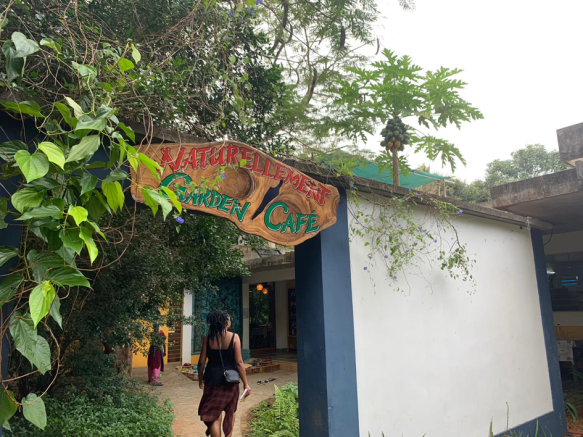 Scalzo, Sophia. Naturellement, Entrance. December 2019.
 AUP Sustainable Development Practicum in Auroville, India