Philosophical Auroville

Here’s a taste of the rich Indian philosophy that underlies the mission of Auroville, with words and wisdom provided by Deepti Tewari:

I think it’s fair to say that many of us are critical of Auroville. However, it’s hard not to be deeply attracted to the spirit of its aim, especially when put so eloquently by Deepti (seriously, I could listen to her describe the intricacies of a #2 pencil and I’d be fascinated).

She spoke of Brahman, the god spirit that exists in everything, the essence of the universe, that all of us are and can become. It’s a belief that everything then is connected and worth our utmost respect and care. It’s about thinking holistically, striving to balance internal and external, global and local, spiritual and mental, individual and collective, etc. etc. etc. Everything is one.

It makes me think of a zero, or a perfect circle, or a cypher. And that’s what sustainable development is about, or at least should be about. Auroville has its flaws and contradictions, which Deepti acknowledged, but it continues to venture forward. The people here keep trying, striving for the north star. And that’s the imperfect journey it takes to become a god.

Utopia, in its etymology, implies both perfection and the unattainable. Even though it’s unattainable, we have to try. Right?

Dystopian Paradise

Day 5 in Auroville. We met Deepti on Saturday morning, and we all left fairly awed. She’s lived in Auroville since she was 19, teaches at a local school and is entirely self-educated—as she put it, “I just read a lot.” During the course of her 2-hour talk about—well, really, about whatever we wanted and needed to know about Auroville—she threw around references to Descartes, the French Revolution, the Buddha and John Milton, and impressed us all with her eloquence and enthusiasm. While explaining the philosophical foundations of Auroville—a village that fancies itself emblematic of “universal” values, tolerance and realization of the Divine Consciousness chief among them—she maintained that the specific provenance of the town’s ideals was irrelevant. Call Auroville communist, socialist, Marxist, Leninist, Rawlsian, cosmopolitan, liberal, even a “hippie enclave”—a rose by any other name still smells as sweet. Auroville is, in other words, just Auroville, and to try to make sense of it by assigning it a specific political or philosophical box is the wrong approach. Auroville bridges the past and the future; it celebrates human unity; it provides, as Deepti mentioned, an outlet for people who hate the direction the world is heading (and, as she also admitted, you’d have to be blind to be completely satisfied with the direction the world is heading). Auroville is for everyone, and it belongs to no one. Continue reading

“You may say that I’m a dreamer…”

I have been bit by a few mosquitoes, the electricity in my room does not usually work and having long hair is not conducive to taking cold showers, but thus far India has been absolutely amazing! It is literally a breath of fresh air…Sooo relaxing.  Even with all of the minor inconveniences taken into account, I have never felt so at ease.

I would describe Auroville and Pondicherry as a combination of the spirituality of Avatar and the village lifestyle of The Jungle Book with a childlike innocence and friendliness of Peter Pan.  I love seeing groups of Indian women together dressed in their colorful saris.  Occasionally you will see one walking, balancing a basket or something of the sort on their head without hands.  There are cows and dogs everywhere and we even saw monkeys playing in the trees.  The largest monkey advanced from the group to sit on the edge of the stone cliff to tell us to keep our distance.

Territorial Monkey

Territorial Monkey

Last night we went to a concert at Auroville’s Youth Center. If there was ever a place the Lost Boys from Peter Pan existed, this is it.  The Youth Center was packed with Aurovillians and visitors for a concert of local bands. There are adult sized teeter-totters, giant swing sets, huge tables, a comfortable covered lounge, a kitchen, a stage for a band and ladders and ropes to climb up in the trees, all of which are centered around a blue, yellow, purple and white mosaic floor. It felt like I walked through a time warp back to the 60’s.  They were serving pizza, mango bars, vegan cake and Kampuchea (fermented mushroom tea) to enjoy during the concert.  Everyone watched, but I was surprised how little dancing or energy there was.  It is possible we were staring in Footloose, because that didn’t stop Robin, Brian, and I from busting a few moves.

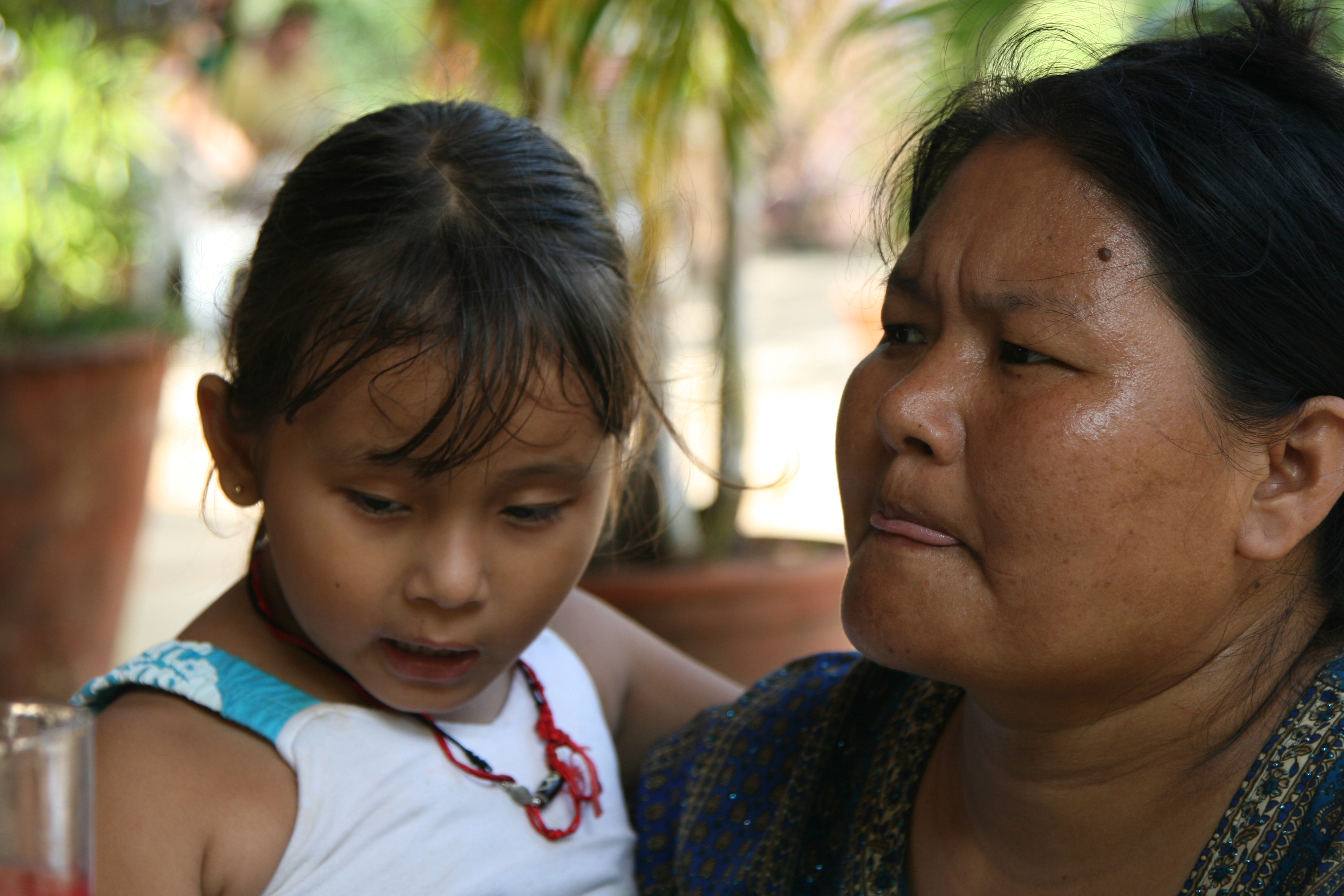
Yesterday morning, we went to the Last School in Auroville and the Mohanam Cultural Center in the afternoon.  Deepti, a member of Auroville and teacher at the school spoke to us about Auroville and the spiritual history of India.  While some people viewed everything she was saying as idealistic and kept an objective view, I was completely absorbed by the community she described.

Deepti

She told us Auroville’s goal is to generate a spiritual collectivity that is based on brotherhood or the equality of the soul, where people, “take advantage of all discoveries from without and within.” Referring to the world today she said, “We don’t think we own air, but more and more we are beginning to think we own water.”  She says that Auroville doesn’t belong to anyone and the material creations produced by the community are shared.  Auroville and India in general are such relaxing places, that I can understand how easy it is to focus on your spiritual self.

The Last School Classroom

The school she teaches at has a classroom that lets in so much light, I felt like it only had three walls.  The walls were almost completely made of windows and the one opened into a green terrace with a large Bodhi tree, which is the tree Buddha sat under to reach enlightenment.  The school was actually designed around the tree and the atmosphere mirrors the teaching method.  The school emphasizes that there is no authority and that everyone learns from each other.  This is based on the premise that Aurovillians thrive on self-education.

Deepti spoke of Darwinism saying that many people believe in evolution.  She said why would we assume, that as imperfect, disharmonious creatures, we are finished evolving?  Auroville believes that we are still evolving and therefore should strive for spiritual perfection.  She says, “Most people who come to Auroville are very post-modern in thought.  They don’t fit into a social category”, and that they are looking to escape the problems of the world so they come to Auroville to work on a model society.

Where she realizes this is a work in progress, and that each individual of the community is a work in progress, I still cannot help but admire the experimental community and hope that such a community becomes a framework for civilization in the future.

Bodhi Tree

India and her Beautiful Contradictions

Chaos. For me, the most striking thing about India is her lack of apparent order. Cars and buses play chicken with rickshaw and motorcycle drivers, striking fear in the hearts of Western passengers. The locals don’t seem to notice, nor do the cows and dogs that lay in the middle of the lane.

A roadside store selling tobacco, soda, and portable phones has positioned a single alter at the front door. On it are beautifully decorated images of Ganesh, Buddha and Jesus. The warm air is infused with scents of incense and curry that compete with the odors of sewage and animal droppings. Women in bright orange, purple, and green saris carry large buckets water and loads of sticks atop their heads. Rising from the ground behind them is an ad for a high-end jeweler.

Along the roads are people’s homes, shacks made from others trash and the natural resource of banana leaves. While the sun sets in the distance, women cook dinner in the door entrances, children play in the mosquito-infested water, and dogs and goats pick at the plastic bags and rotting food.

Poverty juxtaposed with great wealth. Life dances with death. This is the beauty of India.

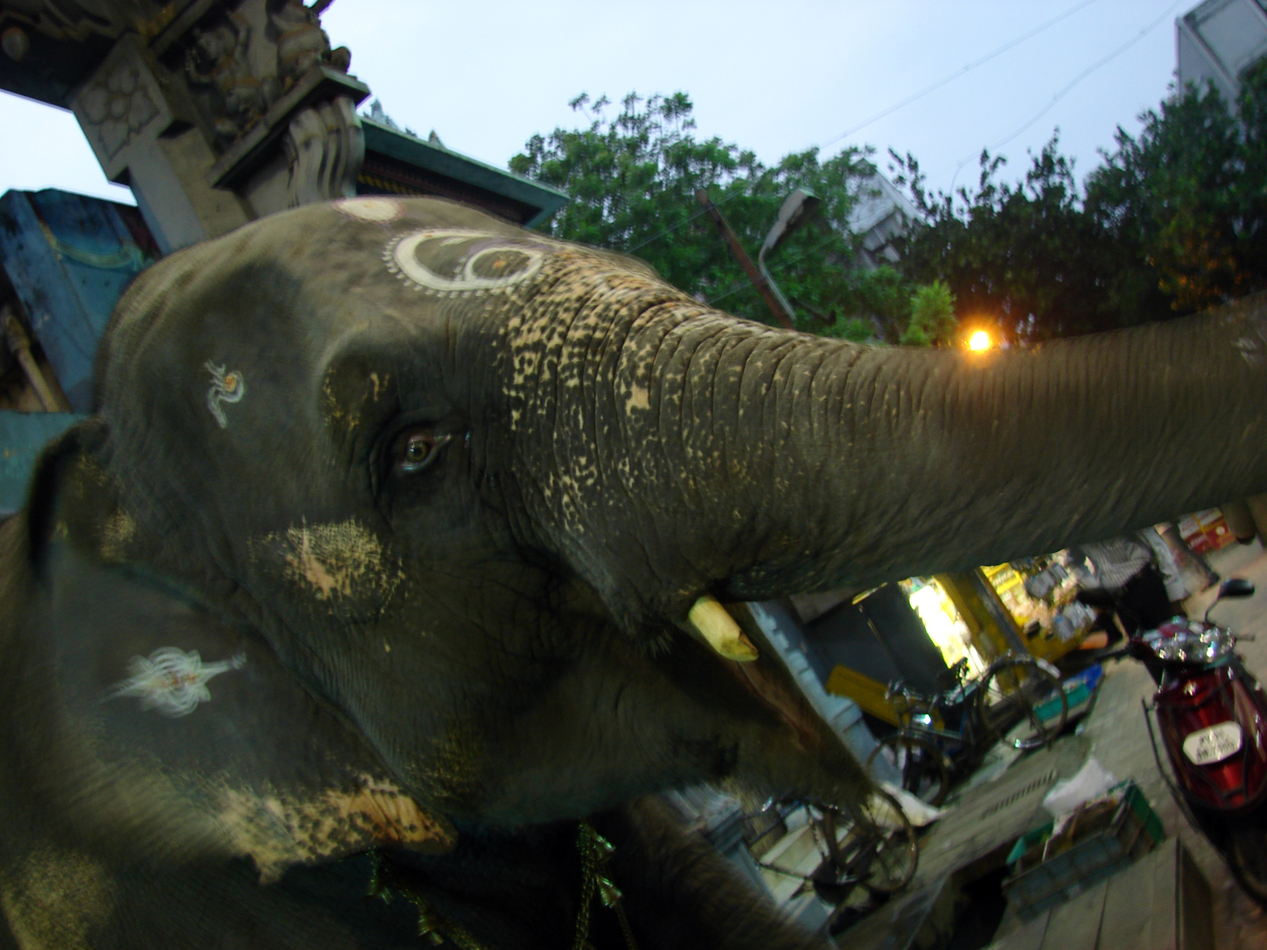
Holy Elephant in Pondicherry, India

For a Westerner—someone raised to follow the rules, to be disciplined, to create order when none exists—the visceral experience can be quite disconcerting and confusing. Yet, there is a certain “je ne sais quoi” about the chaos here. Oddly, it seems to bring a sense of peace—the kind that comes with accepting imperfection and living in the moment.

— Jennifer Conway


The one about arrivals and first-days.

And so– here we finally are.  After about 12 hours in transit, we have finally made it to India.

After arriving in Chennai at around 3:30 in the morning, we headed south, towards Auroville, in an 18 passenger bus.  With not enough space inside of the vehicle, our friendly and reliable drivers helped to secure our luggage to the top of the bus.  We drove 1.5 hours south, and stopped in a beautiful village called Mamallapuram where we are breakfast and visited several beautiful stone temples.

By the time we headed towards our guest residence, it started pouring rain.  We pulled over and bartered for a tarp to protect all of our luggage, which was still on the roof of the bus.  Luckily we were able to get one up, and made it to the to the guest house, safe and sound.

A long journey, a beautiful day, and many more adventures ahead.  Too tired to articulate, I cut my film footage from the day in to a video-blog.  I hope you enjoy it!

Food in Tamil Nadu

Walking through indian markets, the colors and smells of the local spices will most likely be the first thing that pops up. Being of indian heritage and having traveled to India many times, I was extremely excited to be part of the Auroville Practicum this year. Besides capturing instants with my camera, one of the major attractions of my travels is also tasting local foods.

As soon as we reached Auroville, I realized that we would be eating in restaurants at least twice a day. I was going to make the best out of this opportunity and my appetite never wained during the course of the month there. The first week was spent acclimatizing ourselves with the surroundings and visiting sites of Aurovillian units that we would potentially be interested in working for.
Along the way, we also took the opportunity to try as many restaurants as possible. One of our first encounters with local food was at the Mohanaman Centre. The centre is devoted to offering space for children to play sports and engage in cultural activities. The manager there invited us to a typical south indian lunch. All 21 of us sat around the huge casseroles of prepared daals, rice, papads and vegetables eagerly waiting to be served on our individual banana leaves. This was the first time (during this trip at least) the students were faced with the situation of having food in front of them and no utensils. That did not bother us, as we delved into the dish wiping it clean and licking our fingers full or rice and daal.
During the first week we continued to indulge into the southern indian flavors. We ate thalis filled with raita, sambar (southern lentils), subji (assorted vegetables) and many delicious pickles and chutneys to spice up the palate.
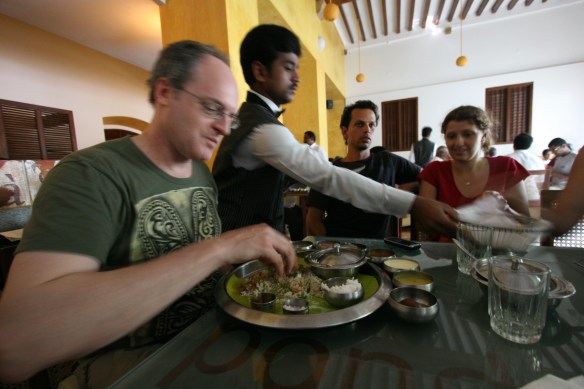
Charles trying his hand at a vegetarian thali, Pondicherry.

As you may be aware of by now, Auroville is a vibrant international community. The international aspect of this town fully reflects in the area’s gastronomy. Auroville’s strive towards becoming fully organic offers the community a variety of diverse, clean, fresh and tasty vegetables. Most restaurants offer a fully organic cuisine using vegetables and fruits farmed locally. Auroville being international as it is, offers french cuisine at the Town Hall, organic vegetarian mediterranean (and indian) food at La Terrace, italian food at New Creation and north indian food at Hindus Valley, the Visitors’ Centre, Solar Kitchen, Roma’s and israeli and greek food at Well Café.

We spent the majority of our time alternating between these restaurants. Hindus Valley offers typical north indian food, serving chapatis with subji and daal for lunch everyday. The restaurant is based on the gift economy model, meaning people contribute what they can towards the bill. The Town Hall, right next to the financial services office, offers a mix of indian and french food. The french owner is proud to propose different french dishes everyday and it is one of the nicest terrace of Auroville with a great view of the Matrimandir.

The Terrace is one of my favorites. Owned by a Spaniard Marc, it offers a mix of western organic delights. The palak pasta remains one of the best dishes I ate in Auroville. Right under La Terrace is the Solar Kitchen. This restaurant has a cantine feel to it as many Aurovillians go in and out for a cheap lunch. You go through the line, fill your plate with the chapatis, daals and raita, take your lemon water and eat in a very crowded, noisy, yet familial atmosphere.
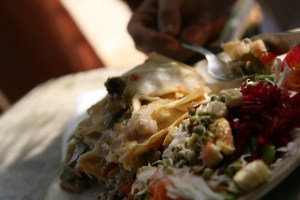
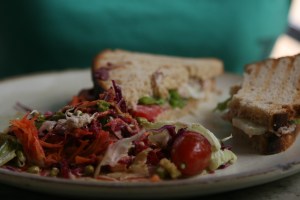
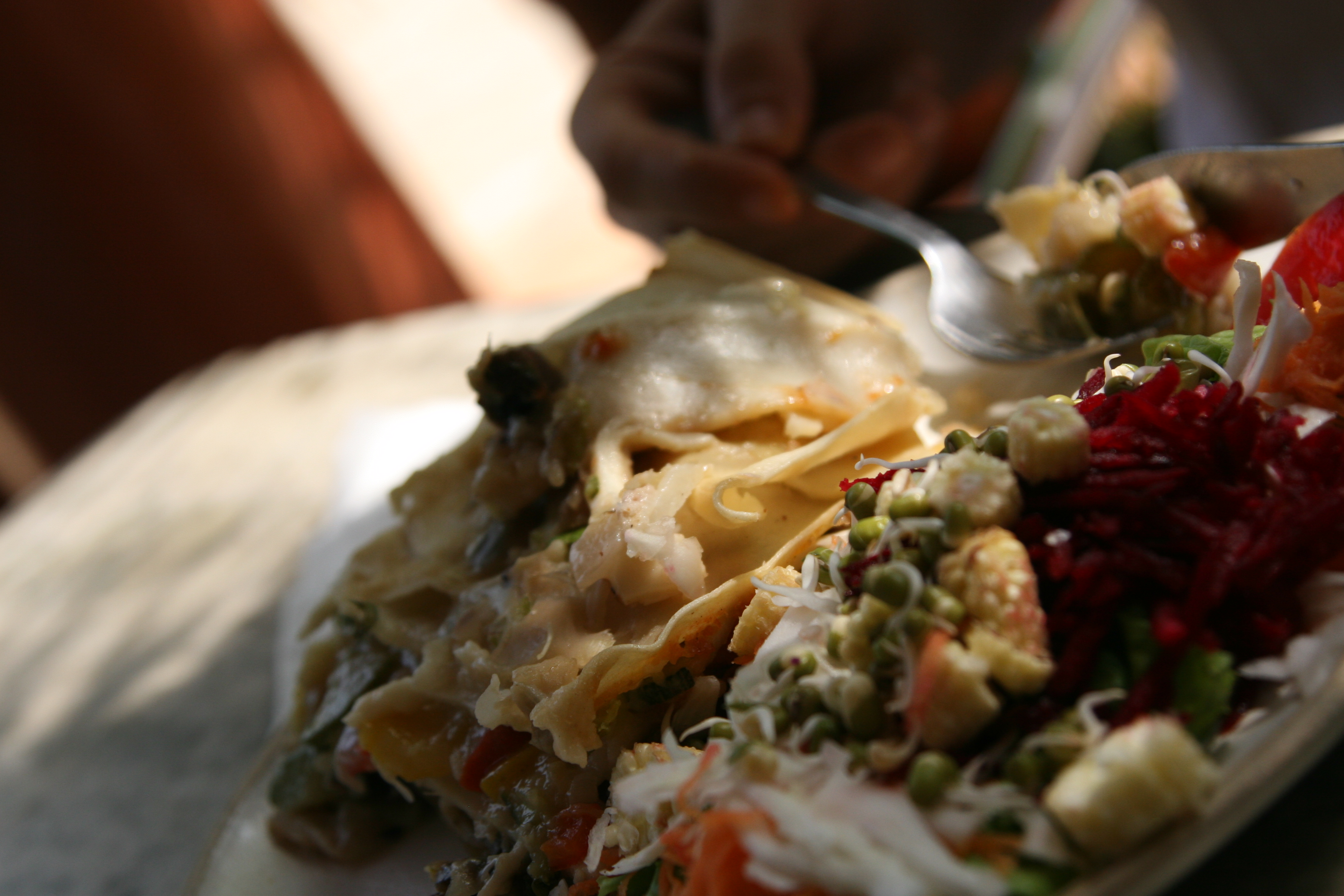
Veggie Lasagna and Sandwich at La Terrace.

Auroville is full of surprises. Although very far from Italy, I ate some of the best pizza in my life here in Auroville at New Creation. Ironically, the restaurant is run by a group of frenchmen, but rest assured the chef is fully Italian. There, you can find vegetarian, vegan and sea food pizzas as well as all sorts of traditional and authentic italian pastas. I highly recommend the “unfolded calzone”, otherwise known as… a pizza. One of the most interesting assets of this restaurants is its long outdoor terrace giving it a very summer-like feel, especially when the chef theatrically speaks in italian during his breaks. The Visitors’ Centre was often our go-to for a quick indian meal. Situated right next door to the American and Tibetan Pavilions, we got to know the place so well that some of us no longer looked at the menu before ordering.

Working at Upasana, I often went for lunch to the next door israeli restaurant Well Café. I enjoyed the variety of mediterranean, greek and israeli foods there and found the mint water very refreshing after riding around in the sun all day. Well Café also had a Japanese guest chef and we were invited to a special organic vegetarian sushi night, a bit strange but very interesting. Although we didn’t really enjoy the jam session at Solitude Farm, the food there was remarkable. Once again, organic veggies accompanied with refreshing tea filled our stomachs. Towards the end of the trip, we ate a completely raw vegan dish, served with Kamboucha, a mushroom based drink supposed to revitalize the body and a vegan chocolate mousse for desert:
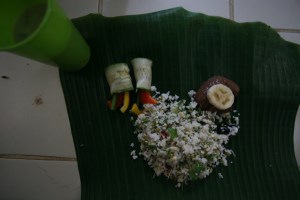
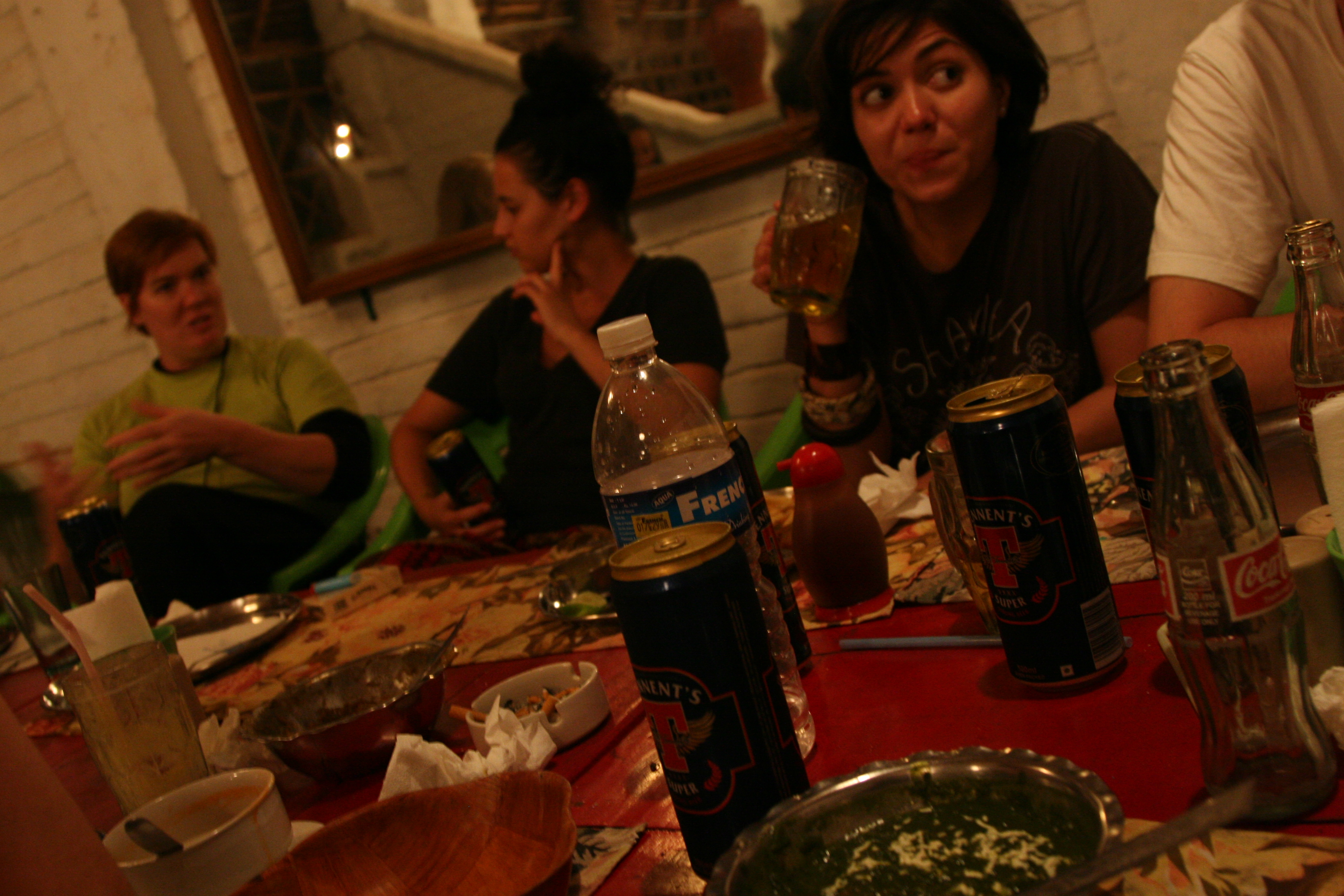
Not all restaurants were fully organic and healthy however. Many of us liked to sit at the Ritchy Rich café and indulge in a ice cream coffee full of creamy ice cream and a hefty dose of caffeine. We also stumbled across a restaurant called Beach Café on the border of Auroville, just outside the town. This meant the Beach Café was not imposed the alcohol restrictions of Auroville and that you were sure to find someone from our group there every night enjoying an indian meal and a “Strong Beer”. Trust me, it was strong.
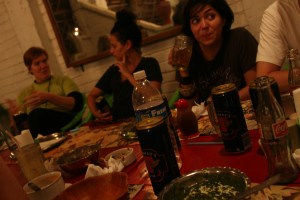
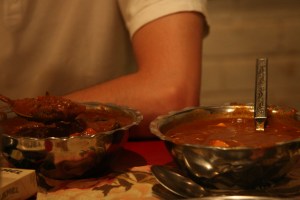
Auroville offers a variety of restaurants. Everywhere you go you are offered very fresh and organic vegetables, making you feel rather healthy after a month. For my part, my favorite restaurant was one Martanda and Catherine took us to on the side of the East Coast Road (ECR). There, we ate street indian food: dosas, idlis, paranthas, and half-boiled eggs. I tried nearly everything on the menu that night and found the half-boiled egg experience rather interesting. The half-boiled is just another name for a fried egg, but there is a special way to eat it. As I observed Martanda chow down his food I wanted to try the half-boiled before I left. At that restaurant, the food was served fast, extremely fast. The quickness of the service unconsciously made us eat quicker and more. The half-boiled egg is the perfect example of this. You are served a fried egg and are supposed to put the whole egg in your mouth, wait for the yoke to burst and then just swallow the entire egg without chewing… After the whole experience, some tobacco pan and nice cup of chai is very much appreciated for the digestion process to begin.

Throughout the trip, I found that Pondi street food was the most exciting. You would just stand and wait for sizzling hot, spicy and flavorful food and follow it up with a piping hot chai. However, it is nearly impossible to eat street food and not have stomach ache for a few days, the price you pay for the fun you have… So coming back to Auroville and its organic lifestyle was very soothing, for the stomach and for the soul.

A shot at the Pondicherry Market

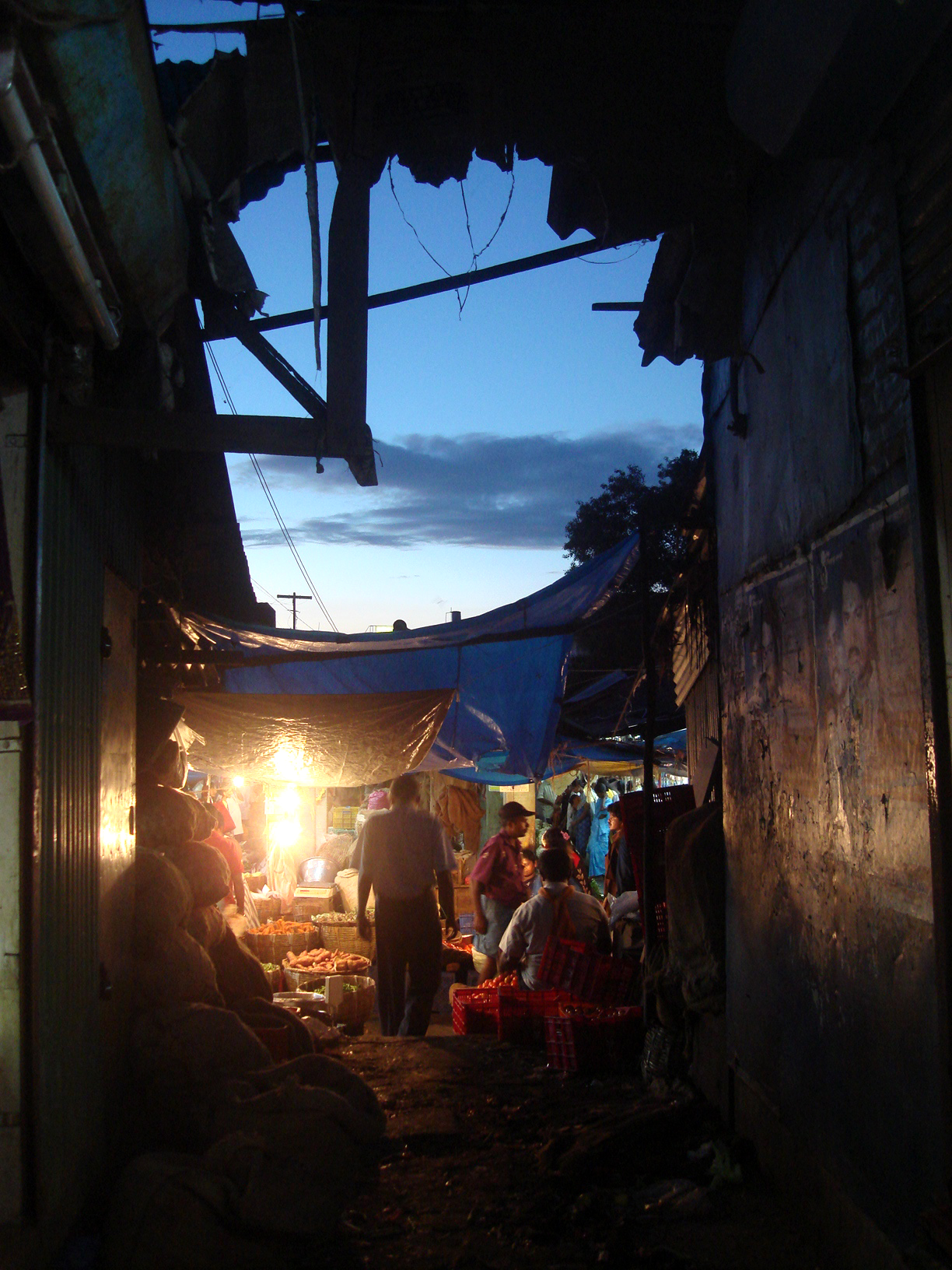
I wandered around through the market at dusk and saw a piece of the sky.  The market was bustling, people shoved past me with a variety of things; plastic bags filled with colored powder for Kolam, handfuls of vegetables, flowers, you name it.  I lingered in front of this shot for a couple of seconds while tourists haggled for the best prices on fabrics and saris adorned with sequins and beads in a variety of noisy colors.  The market was a multi-sensory experience which was a bit overwhelming at times, but a great and lasting memory.

– Courtney Weeks

A Portrait of Kalsang

Kalsang is one of the Aurovillians that inspired me the most during my stay in Tamil Nadu. Originally from Tibet, her family was targeted by the Chinese government because of their willingness to spread the Tibetan language and culture within Tibet. In order to save his children, Kalsang’s father brought four out of the eight brothers and sisters across to Dharamsala, India.

There, they would get a proper education and be able to learn all about the Tibetan culture. The Chinese government killed many Tibetans attempting to maintain a sense of national identity in their own country, including Kalsang’s mother… Living in Dharamsala, Kalsang attended the Tibetan Children’s Village School. At the age of 15, Kalsang went on an exchange program to Auroville. Like many others, she fell in love with the surroundings and started planning her return to the city of Dawn.

In 1994, Kalsang packed up her bags and settled in Auroville. Leaving Dharamsala was no easy task and her brothers and sister did not understand her decision. Although it created tensions with her siblings, Kalsang knew that she belonged in Auroville. At first, she thought she was attending an International Institute for the Environment and was surprised not to be taking courses when she moved to Auroville. She quickly discovered that she needed to learn how to ride a bicycle, a motorbike and then find a job. Kalsang has worked for many units in Auroville including the Matrimandir Nasri (rose garden) and has lived in 7 different communities. Over the years, she adapted and integrated the Aurovillian community, which was rather exclusive at the time.

From 1995 onwards, Kalsang worked closely with the Tibetan Association Group. She helped frenchman Claude, who is the first contact with Tibetans in Auroville due to his affinity with Tibet and the Tibetan culture, lead workshops and spread Tibetan culture within the Aurovillian community. In 1997, construction for the Tibetan Pavilion started and Kalsang and her partner Namgyal moved into the Pavilion in 2000. The Tibetan Pavilion is build following the Kala Chakra Mandala and embodies Tibetan culture in Auroville. Before construction even started, plans of the building were sent to his Holiness, the Dalai Lama, for approval. Initially, Kalsang planned to place a large statue of Buddha in the atrium, but the Dalai Lama being aware of Auroville’s stance on religion, advised to place a calm and soothing fountain instead.

Kalsang has struggled to get to where she is today. By running the Tibetan Pavilion, first pavilion of the International Zone of Auroville, Kalsang vows to modernize and spread the Tibetan culture throughout India and the rest of the world. She says the concept of welcoming anyone who wants to learn about it will never change. Due to her hard work, the Tibetan community has gained a lot of respect in Auroville. In 2003, her daughter Jang Chup was born in Auroville. The more time I spent with the Tibetan family, the more I realized how special this child is. Jang Chup grounds the family and represents the future of Tibetan culture in Auroville. Born in India, she is conscious about being Tibetan. At the age of 6, she talks about freedom, the Chinese violence in her motherland and already speaks english, tibetan, tamoul, hindi, some sanskrit and is learning french. Jang Chup represents the future of the modern tibetan culture. She lives in India, is very aware of the significance of being Tibetan and through her schooling will be able to modernize the Tibetan culture with the new generation of Tibetans living in exile in India. As she says, “Happy to be born in India but proud to be Tibetan”.

Kalsang with her daughter Jang Chup.

The Dalai Lama has played a huge role in Kalsang’s life. In 2009, his Holiness inaugurated the Tibetan Pavilion in Auroville and met Kalsang for the third time. Kalsang believed that this would be the day she could rest, move on. She had created the pavilion and was now ready to work elsewhere in Auroville. However, the Dalai Lama told her “it is only the beginning of your mission”.

Initially surprised, Kalsang now admits she agrees with his Holiness. “I feel it’s true”, says Kalsang.

Kalsang is dedicated to spread and participate in the modernization of Tibetan culture. Everyday, she strives towards raising the awareness of the difficulties Tibetans face. One of her current projects is to bring children from the Tibetan Children’s Village School to Auroville every year, entirely funded by the Tibetan Pavilion and alumni. In hopes that Kalsang will inspire the new Tibetan generation as much as she did Jang Chup, I urge anyone who visits Auroville to stop by the Tibetan Pavilion for a chat and and a cup of chai with Kalsang, her partner Namgyal and little daughter Jan Chup. Anyone who does so will be sincerely inspired and moved by Kalsang’s ongoing efforts.

Collective Meditation around Atrium Fountain, Tibetan Pavilion.

by Pushan Chawla Bhowmick

Auroville, when things happen for good

During this awesome month in Auroville, I worked for the internet-based community radio – Auroville radio. This was an amazing experience that I shared with Chloé, a French journalist working there for two years now, and Andrea, the Italian founder of the site. As a former working journalist in written press, I enjoyed the new feeling of having a microphone, interviewing people using sounds and no written words. Discovering the technical aspect of the job in editing was also something very gratifying. I managed to present, with Chloé, the news in French three times, every Thursday and to do a program on Auroville waste management or how Auroville has to change its behaviour toward this issue to ameliorate the situation. Overall, I appreciate the experience more than the words can tell. I learned, I had fun, I meet new, interesting and challenging people, and I am ready to live the whole thing again whenever the occasion comes.

Auroville is something unfinished; maybe this is why we want to go back.

Here are the links to listen to the programs I did.

Auroville News 24.12.2009
Auroville News, 31.12.2009
Auroville News, 04.01.2010
Auroville News, 07.01.2010

For more Auroville radio, please visit http://www.aurovilleradio.org/

– Sonia Terrab