India Has a Stray Dog Problem and It’s Breaking My Heart (Warning: Graphic Images)

This little guy has been spotted in several areas of Auroville, emaciated and starving.

This little guy has been spotted in several areas of Auroville, emaciated and starving.

I’m a serious dog lover and the situation I found as I arrived in India has been eating away at me. It’s breaking my heart, more and more every day. It doesn’t matter if I’m walking through Auroville, sitting at the hostel, or eating at a restaurant, stray dogs are everywhere.

We visited a recycling center outside of Pondicherry and this little guy followed me around.

We visited a recycling center outside of Pondicherry and this little guy followed me around.

I’ve visited cities where stray cats are running rampant, but never have I ever seen so many helpless dogs. From the absolutely tiniest puppies to full grown matted muts, they are emaciated, hungry and in need of a loving home. Most of the free-roaming dogs are of an ancient canine race known as the Pariah Dog, which exist all over Asia and Africa. In addition to being scavengers who live mostly on human-created garbage, they are often kept as pets by rural and urban slum households.
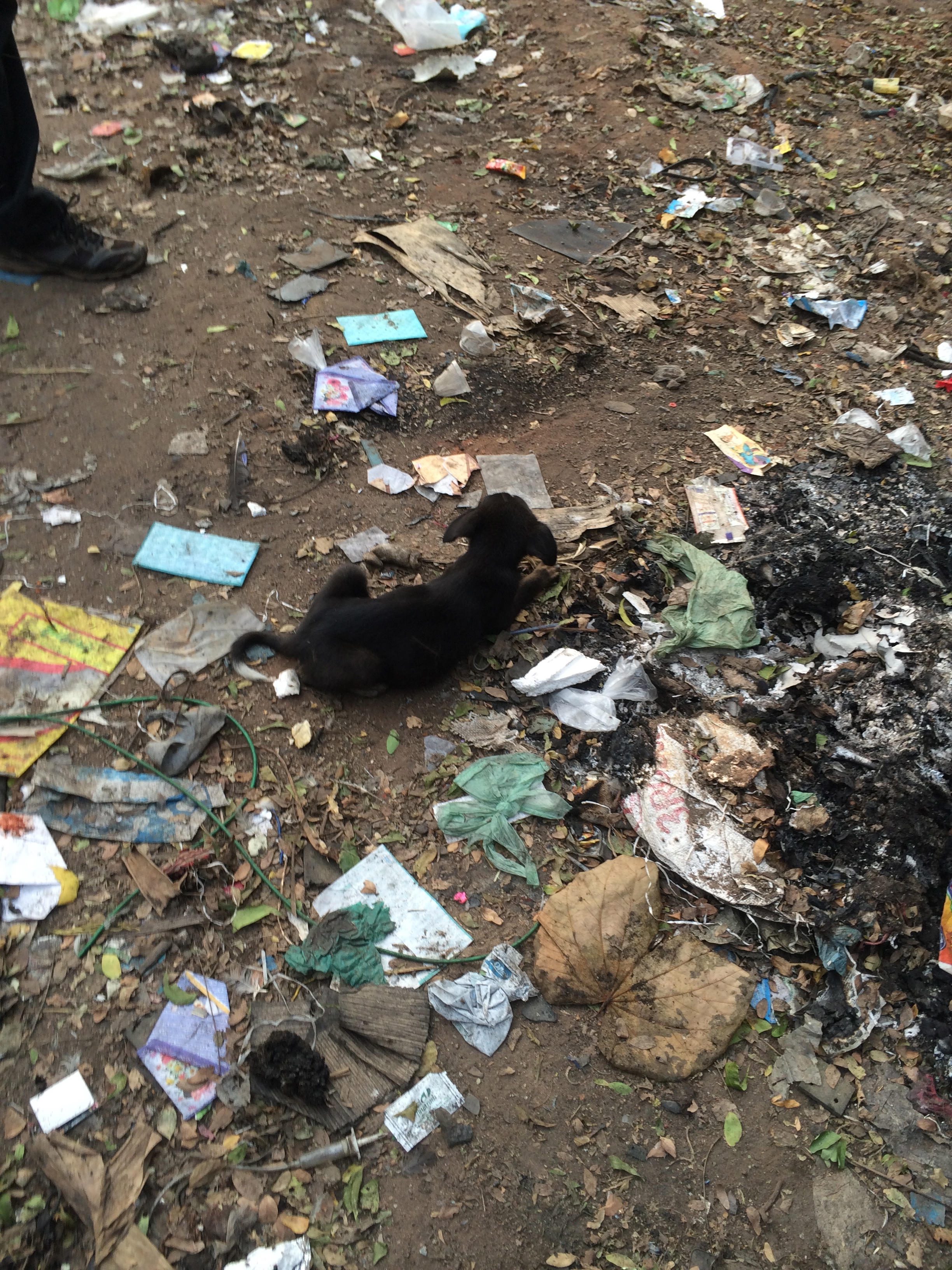
Stray dogs are often found eating garbage to stay alive. This was taken at the Pondicherry dump.

Stray dogs are often found eating garbage to stay alive. This was taken at the Pondicherry dump.

Most of the dogs I see roaming around are covered in mange, fleas and ticks with chunks of hair missing all over and dark bloody scabs. They are also typically very thin with most of their ribs popping out. Every time I see one of the dogs, my initial instinct is to run over and give them the best petting of their life, but I restrain myself. I want to feed all of them and take them home to give them all the life my dog has. Every dog deserves a warm fluffy bed, fresh food, water and basic health care.

This dog hangs around our hostel and occasionally sneaks up the stairs near our rooms. The sadness in this dogs eyes is overwhelming.
This dog hangs around our hostel and occasionally sneaks up the stairs near our rooms. The sadness in this dogs eyes is overwhelming.

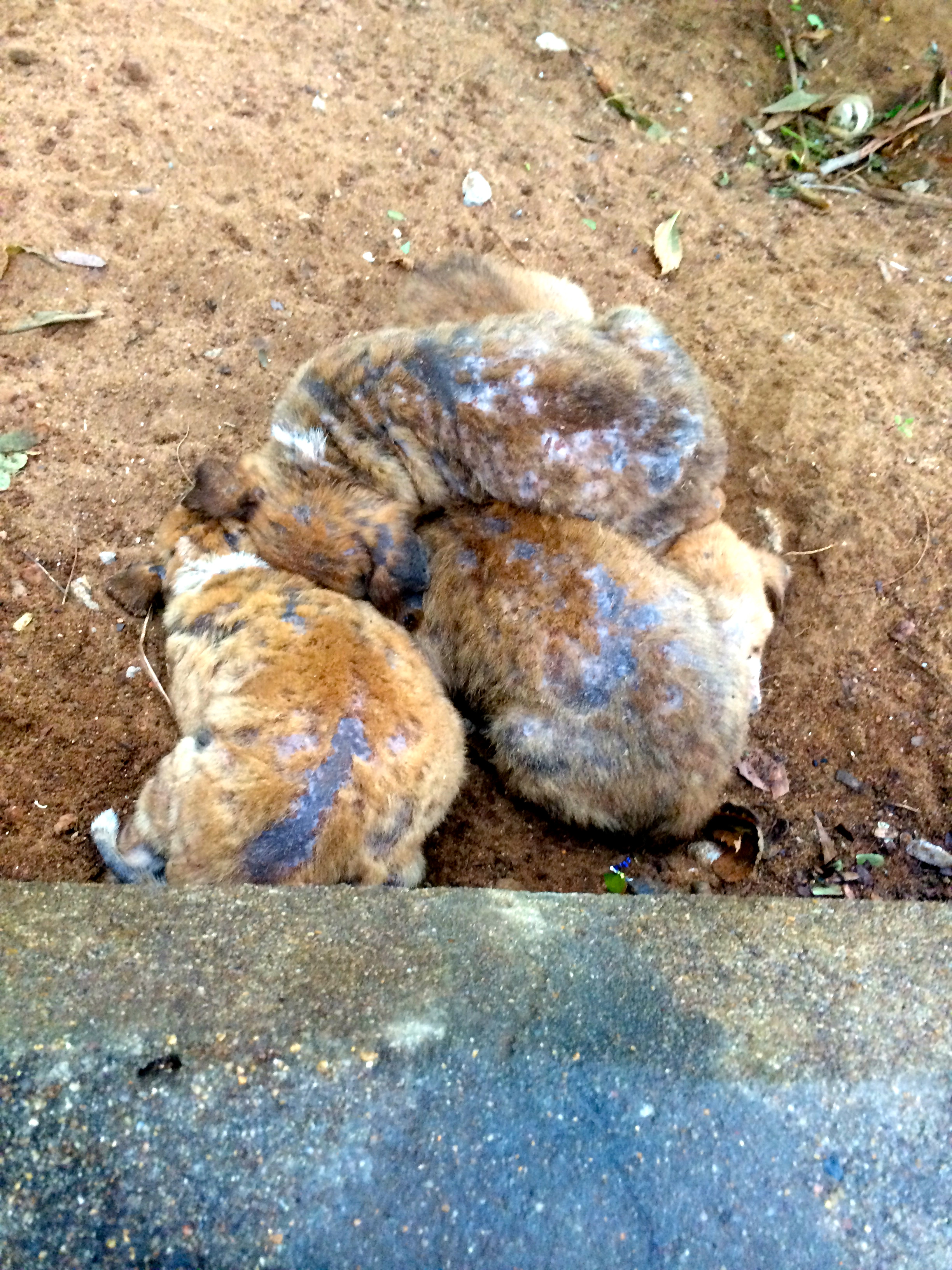
These four pups were on the side of a walk way in Malappuram, India. They were just fighting to stay warm.

These four pups were on the side of a walk way in Malappuram, India. They were just fighting to stay warm.

It’s not uncommon to see an adult dog lying with her freshly birthed puppies on the sides of the roads or near food markets. It’s so sad to see them struggling from the second they are born. The outlook for their lives are so grim.

I saw this mom and her babies lying on the side of the spice market in Pondicherry.

I saw this mom and her babies lying on the side of the spice market in Pondicherry.

India is home to nearly 30 million stray dogs and in 2012 WHO estimated that India had around 20,000 rabies cases. These numbers are not only heart breaking, but should be an alarming wake up call to the Indian government to create change. The Animal Welfare Board of India (AWBI) has been trying to implement the recently approved National Rabies Control Pilot Project, however due to lack of governmental funds and outdated policies, the program has remained stagnant. NGO’s around the country are working hard, but without needed funding, cannot fully implement the program. It’s very expensive to vaccinate and sterilize the dogs, not to mention that there are so few NGO’s in comparison to the excessive amount of dogs. It takes a lot of effort to control the disease and the overpopulation.

With a population of over two billion people, millions of which have no guaranteed food, water or shelter, it may be hard to justify spending precious time and resources on saving the dogs of India. But, all hope is not lost. In the nation’s capital of New Delhi, police officers have been dispatched to safely collect and find homes for hundreds of street dogs. The dogs will be given proper care and veterinary attention before they begin training to become service dogs. The thought is to control the street dogs, giving them purpose by engaging them with society to benefit the people.

I’m not sure if this issue will ever be fully resolved, but with the right plan of action and support, many dogs could be saved and sheltered.

-Alexa Pizzi

Slowing down; making space

sunset, auroville 31 dec 2014
31/12/2014 :: Glimpsing the last of this sunset through the palm trees, I slipped off my bike and found a spot to have a seat ; pausing just long enough to catch my breath, take this snapshot, and indulge in the peace and quiet of the moment.
   Earlier this morning during sunrise yoga, we worked to bend and twist through anything that needed to be released, both physically and emotionally, before the start of the new year. Each person was encouraged to identify her own internal toxins and empowered via this practice (and lots of laughing) to let it all go. Easier said than done, of course, but still quite an effective practice worth repeating often. Simply directing attention to the presence of this physical/emotional/psychological waste helped to shift the paradigm of what it might mean to really work through this often-uncomfortable process of making peace with the past in order to clear more open space for the present and/or future.
   With only a few minutes between the end of yoga and the start of my “commute” to work, I was soon flying over the red-rocky backroads of Auroville on my bike en route to Aikiyam School in New Creation. Getting to the gate of the school exactly on time at 8h45 was nothing less than a sweat-soaked miracle; but there to welcome me was Shankar the school’s Head Master. Fortunately since he already gave me a walking tour of the campus yesterday afternoon, we were able to get straight to work on the task at hand which included taking inventory of the school’s communication collateral and evaluating their presence online.
   When the bell rang at 12h45, I was invited to join the staff and students for lunch where I got to meet other volunteers from Europe that had been working at Aikiyam for several months. Although it was certainly an inspiring discussion, the most energetic and entertaining exchange came from the group of 4th grade boys who crammed around the small table under the banyan trees with us to “be cool” as they said; boasting loudly to their friends that they were “especially invited” to join us for lunch that afternoon. Like any other group of fourth grade boys anywhere else in the world, the tall tales these boys were spinning were truly hilarious and seemingly endless until the bell finally rang to get us all up and moving again; beaming over our shoulders at each other as we spread back out over the small campus and got back to work.
 IMG_8667
   After work, I went to meet Kalsang at the Tibetan Pavilion for some meditative “karma yoga” volunteering which involved setting out hundreds of small bowls along every conceivable edge of the complex, including every ledge and window sill in sight. After all the bowls were set, we went around and coiled tiny cotton wicks into each bowl and then filled them all with oil in preparation for the evening’s New Year’s Eve festivities. During this experience, I learned from another volunteer about her family’s meditative traditions regarding the use of similar oil candles and am still deeply inspired by how this ritual can be used in such a quotidian, reflexive way. This time of transition, from the end of one year to the beginning of another, invites us all to slow down and make space for the possibilities present in the here, and now; in both the inhale and the exhale.
Suzanne

A Story To Be Told Part 1

“Some lose all mind and become soul, insane. Some lose all soul and become mind, intellectual. Some lose both and become accepted”
This saying of Charles Bukowski was the first thing that came to my mind after the presentation of Karthikeyan, the founder and the director of “Sirsti Village.”
Sirsti Village is trying to establish a self-sustainable, inclusive and eco-friendly village, which provides a family atmosphere where people with intellectual disability and the marginalized could be equally active contributors.
Karthikeyan who spent 15 years in an orphanage, mentioned in his speech how when he grew older and left the orphanage, a part of the mainstream “normal” folk found jobs and felt integrated into society, while his intellectually disabled siblings were still not accepted and were treated with pity rather than empathy in the society. This behavior of underestimating the ability of his friends and brothers as he insisted calling them, motivated him to start the “Sirsti Foundation”.

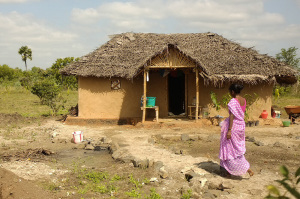
Sirsti Village's land near Kunamangalam village in Tamil Nadu.

Sirsti Village’s land near Kunamangalam village in Tamil Nadu.

Since we arrive to Auroville we had the chance to meet and explore a world of extraordinary projects of sustainable development and passionate innovators with complete realization of environment and human beings. Sirsti Village was able to raise several questions in my mind: firstly the relation between sustainability and social responsibility when we address a sensitive and critical issue as the disabled and marginalized people in India and many developing countries. Secondly, the potential connection between a nobel purpose and a sustainable project. Thirdly, the necessity of creating a sustainable project in the case of Sirsti Village as an effective and suitable strategy or as a supportive policy for fundraising.
Without a hesitation, Sirsti Village was my first choice of the organizations that I would like to work with, not only because of all the mentioned queries, but also because of the deep stories that Karthikeyan was not able to tell in a 30 minutes presentation. The stories that we could imagine with conditions of life to an intellectual disabled person in any context and anywhere on this planet.

My colleague Martin from Linnaeus University and I who chose Sristi Village to work with have the opportunity to visit the village.
We arrived to the main office of the foundation which is 40 Km far from Auroville to find Karthikeyan waiting us with the members of the village and the volunteers. We had a real and effective discussions regarding our contribution to the foundation, the stories of the members with a lot of joyful and optimistic comments of Karthikeyan. Every member in the village has a unique story to tell and that is what suddenly give you a new relation with a project or a work. It is not only the visual project that we are supposed to produce at the end, it is a position of responsibility when it comes to a project that you believe in and you really care about the people who you work with and who essentially trust you. Therefore, the most memorable idea that sticks to my mind at the end of the visit is the understanding of the social context that generates these projects and the recognition of the importance of the human being existence as an end and not a mean in the process of sustainable development generally.

L. A

It takes time and a whole village

After two weeks of visits to social enterprises and organisations in and around Auroville, I feel a lot closer to understanding what management models may effect sustainable social change. Though each one was unique in its operations and services, the recurring learning is that:

Effective change takes time. Deepti shared with us how the Auroville we see today is nothing like it was 45 years ago when the first settlements began. The transformation of a barren near-desert into the verdant and productive village we walk today took years of experiments and passionate effort from peoples of over 50 nations. The change was not immediate and yet you get the sense that it started with the first step towards achieving the vision for Auroville and it is still in process. This same energy that builds on small steps is evident in the other organisations.

The first time the Auroville Village Action Group (AVAG) offered loans to its self-help groups, only one group came forward and to take only 500 rupees (€6.50). Anbu, who manages the organisation, recalls the experience with a laugh but at the time it was disheartening. However they persisted with the community, assuring them that the loans would free them from exorbitant money lenders and offering other services for personal and social development. Years later, they are now lending out hundreds of thousands of rupees to over 800 self-help groups.

The other key learning reminds me of an over-used African proverb that says it takes a whole village to raise a child. Watching the Auroville entrepreneurial and social support networks, there is every indication that in turn, it takes every child to change a village. The interconnectedness between the organisations, and how they complement each other’s services to serve the community, is outstanding.

Krishna, manager of Solitude Farm that is set up to come to a point of agriculture with non-action.

Krishna, manager of Solitude Farm that is set up to come to a point of agriculture with non-action.

The Auroville Botanical Garden does landscaping work for individuals and organisations in the community and supplies seedlings and seeds to farmers. Solitude Farm gives free meals to children in one school twice a week. Some of the self-help groups of AVAG work at the Bamboo Centre, making bamboo crafts and jewellery. The men’s self-help groups make blocks at the Earth Institute, which supplies building materials for most of the construction in Auroville. Mason & Co (Craftsmen of Chocolate) is consulting with Wasteless to help them design a transportation device with a cooling system. Wasteless in turn consults with Unltd Tamil Nadu that provides business development and mentorship services to the social enterprises.

There is no perceptible competition between organisations; each one stems from the passion of an individual to meet a need. And it would seem like once that need is met, there is no need to duplicate that service, instead another organisation forms to meet a different need. A guest I spoke to, who is exploring the possibility of settling in Auroville has already identified the need she would meet if she chose to stay; that of stray, neglected dogs that roam the village.

In contrast, none of the organisations outside of Auroville boasted of cooperation with another NGO. Each one is working in seclusion from the others and yet trying to effect change in the same community.

There sure is a lesson to be drawn from the Aurovillian organisations and I wonder if this model to social change can be replicated and scaled up from a commune like Auroville, to a nation or at least a larger community.

 — P.Otali

The Greater Cause

Today, on the 30th of December we all finally had to decide which organization we wanted to work with. This was, for many reasons, not an easy choice to make. During our first two weeks in India we’ve visited over 30 organizations, which are all working with fundamental and great issues. At every organization we’ve been welcomed with so much love and warmth, that a few of us have shed a tear now and then. The passion of the people in the different organization has been heartfelt and having to choose one cause has been difficult, because so much help is needed.

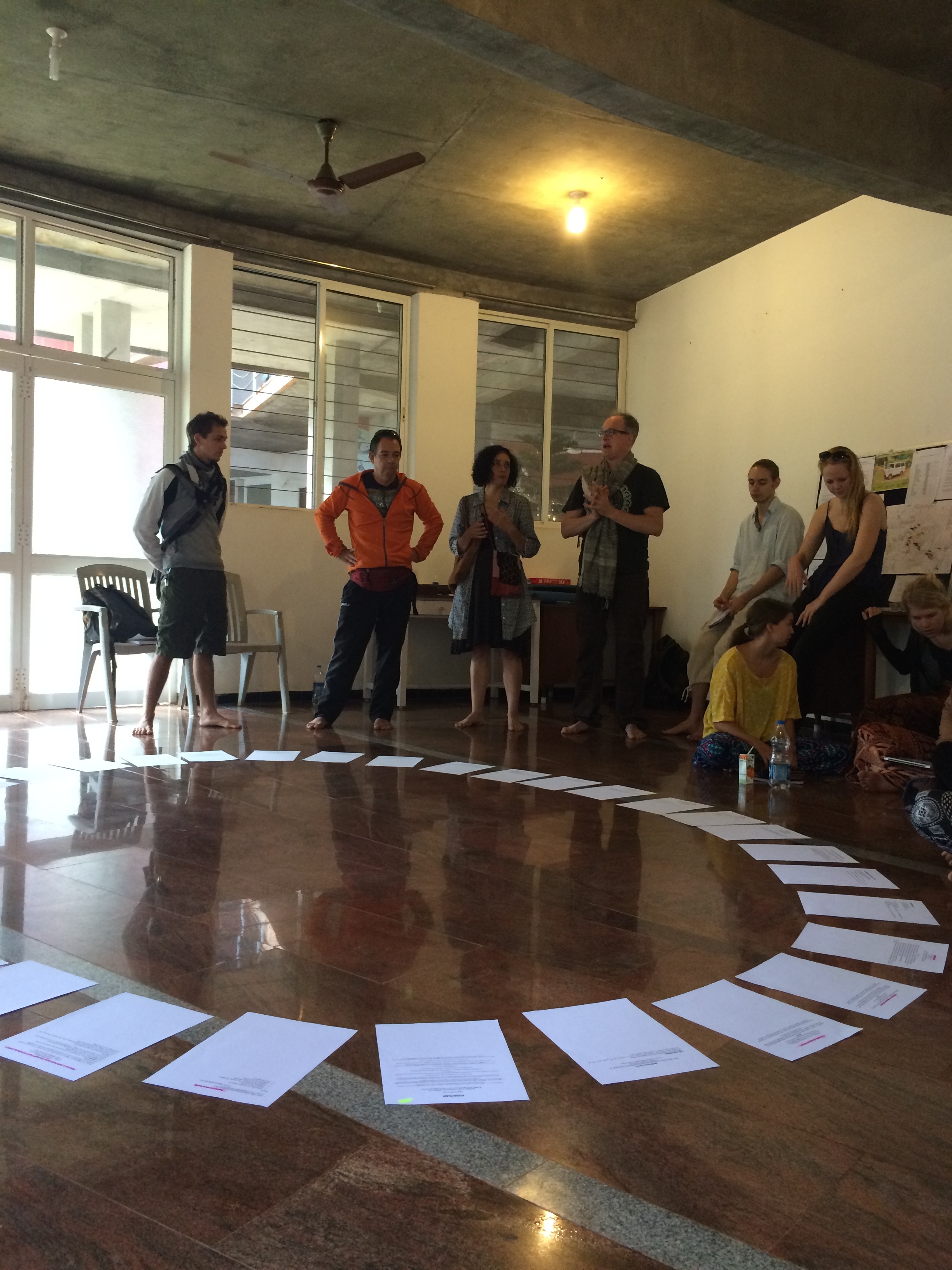
Today, when we all entered the “yoga room”, where we’ve been gathered many times before, one couldn’t help but notice the anxiety that was present this morning. On pieces of paper were written the names of the different organizations that we’ve visited or who have been speaking about their organizations to us. We each had to write our name at 2-3 organizations that we wished to work with according to preference.

IMG_5712

Some of us were lucky and we get to work with the organizations that we listed as our first priority. Other were, however, not so fortunate. When you’ve set your heart and mind to work for a certain cause, it is a disappointment to realize that others may be better suited for the job. Tanya said to the remaining group of people, who were left disagreeing on the matter, that they should shift their perspective of the situation:

“When the Tsunami hit India all the NGO’s involved claimed to have territory over certain aspects of the disaster, instead of viewing the situation as a possibility to work together for a greater cause.”

Throughout the first couple of weeks in India we’ve become aware of the struggles that all these NGO’s are facing everyday and we’ve felt their heartache. We’ve become so eager to help, because we’ve seen so much despair, that we’ve almost forgotten the greater purpose with our visit: to aid some of these struggling NGO’s in their fight. And they are all fighting: for education, for money, for more sustainable means of agricultural, for children’s rights, for better health care conditions, for more sustainable energy, for human rights etc. With that in mind everyone left the “yoga room” content and eager to embark upon the third phase of our visit: the phase where we will get the opportunity to help and learn from these astonishing, compassionate and selfless people who are trying to make the world a better place to live.

IET

December 24, 2014 we visited Martina at Naturellement. Naturellement is a social enterprise, which Martina originally did not attend to open, as she is a teacher by trade. Martina started out by selling jams when she was not teaching, but eventually her success lead her to open a café. Martina continues to be inspired by the ladies who make their livelihoods through the café. (Check out Martina’s full story and food products at http://www.naturellement.in/)

Martina explained to us her strategy for a happy work place for all the women involved. Martina welcomes women to work at her restaurant from any background. In India, there is a very prominent caste system and often people from different castes will refuse to interact with each other. Martina has created a workplace environment that fosters positive interactions between these women despite their differences. Martina promotes group interactions through movie nights, team meetings and other fun activities. Martina also fosters healthy habits in her employees through jump rope workouts during breaks and by teaching about alternatives, such as swapping brown rice for white rice.

Martina also talked about the some challenges she faces working with so many women from different backgrounds. She shared with us that just recently several of her employees had been making fun of another employee and despite many conversations about bullying it did not stop. In order to maintain the ideals of a positive working environment, Martina was forced to talk about firing employees until the bullying stopped. Although it might seem harsh, so many women in the local villages are trying to find employment who would be willing to maintain delicate balance of a positive working environment. Martina, being the kind-hearted women she is, informed us that before firing anybody, she would first find them another job with a local business. I was inspired by Martina and her dedication to helping the women of India, while also demanding positive attitudes and respect from her employees. I have worked for several companies in the past and always appreciate a boss who demands respect and unity between all employees in order to make work a positive experience.

In addition to learning about the great job Martina is doing with her employees by facilitating a healthy and positive working environment, we also experienced the delicious food at Naturellement. The cheesy vegetable lasagna and salad was ranked by many of the AUP students as one of the best meals we have had so far in India!

Photo courtesy of Paige Nelson

Photo courtesy of Paige Nelson

R.K.H.

Educating Through the Arts

Back on December 22, our visit to the Yatra Arts Foundation began with beautiful kolams as we entered.

Beautiful kolam at Yatra.

Beautiful kolam at Yatra.

We watched Yatra Srinivassan’s short film “Maattram” about the dangers of illness and environmental damage from garbage, and heard about other programs that Yatra runs including after school tuition for children to get help with homework. On weekends, children can learn in many arts programs including painting, classical or folk dance, and the Saraswati veena. Four girls gave us a fantastic demonstration of both classical and folk dance. One girl was professional enough to dive off stage to have her skirt fixed and then jumped right back into the dance!

Yatra Arts dance students

Yatra Arts dance students.

After finishing our scheduled visits for the day, we were invited to visit a village that night to see a street theater performance by Yatra’s company of very talented actors.

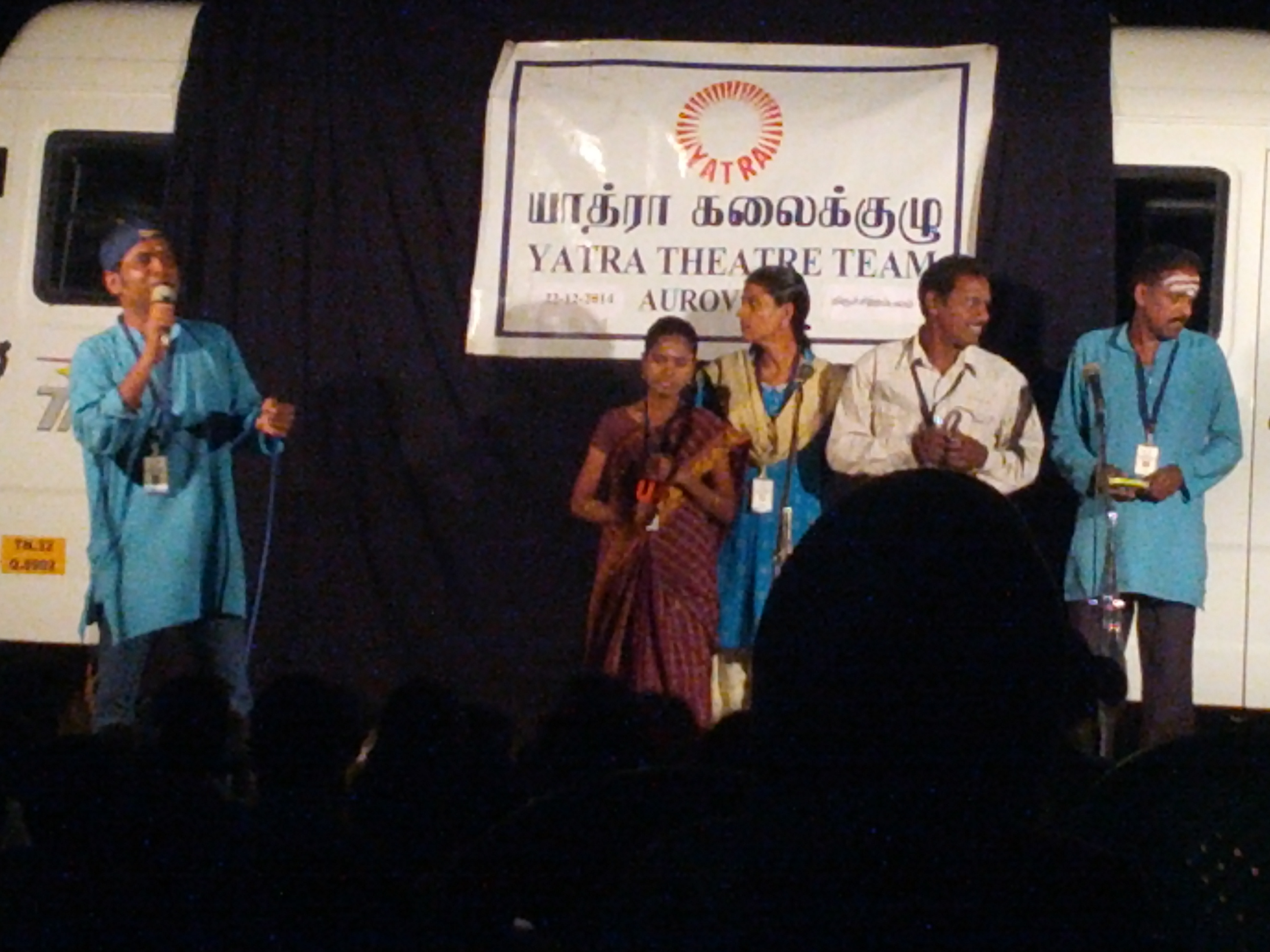
Finding the village was a challenge in itself, and our taxi had to stop briefly for directions. But once we were off the main road you could hear the theater. In a quiet countryside, the loudspeakers carried the Yatra Theatre Team’s amplified performance further than I would have expected. But once we turned the last 

The Yatra Theatre Team

The Yatra Theatre Team

corner, we found them right away. The lights lighting their stage were simple shop lights. The sound system was an electric drum and effects set, three wired microphones, two speakers, and an amplifier. Their backdrop and backstage was the van they had arrived in, draped with their theatre’s name. It was a simple set up, but very effective – especially if the cheers and responses from the village children were anything to go by.

There were musical performances, including dances by some village children, and Yatra helped them discover some dance moves if they were struggling. Some of the women standing with me saw me kind of bobbing along with the children dancing and tried to get me to dance a little more. I did for a little bit, and they laughed. It was interesting to see the women laugh so freely when they had been so reserved when we first arrived. There was an adorable baby girl who played peek-a-boo with me and my pashmina while her mother watched the show.

Then came the all Tamil, no subtitled, live version of Maatram. This time, instead of garbage being the culprit it was dirty water. Once the cricketer son appeared on stage and said, “Hi daddy!” and “I have strong body,” the english ended. The kids were laughing and hopefully learning along with their parents and other villagers who wandered into the performance.

This short clip, in Tamil with some muttered english translation that is not really necessary to understand, shows the good bacteria in the water and the bad bacteria. Listen for how the children react. 

As we were leaving, the taxi driver told us we had just left a Dalit village. As I spend the next few weeks here, I am looking forward to learning more about this caste divide and to see how what I saw in that village compares with what I learn.

See Yatra’s short films here : http://www.yatramultimedia.org/videos/

Learn more about Yatra Arts here : http://yatraarts.org/

Yatra’s blog of this event : http://www.yatraarts.org/yatra-theatre-team-presents-giramathuvassam-a-street-theatre-performance-on-water-and-sanitation-in-saanimedu-village/ 

By Felicity Foster

Opportunities for a Creative Education

22 December 2014

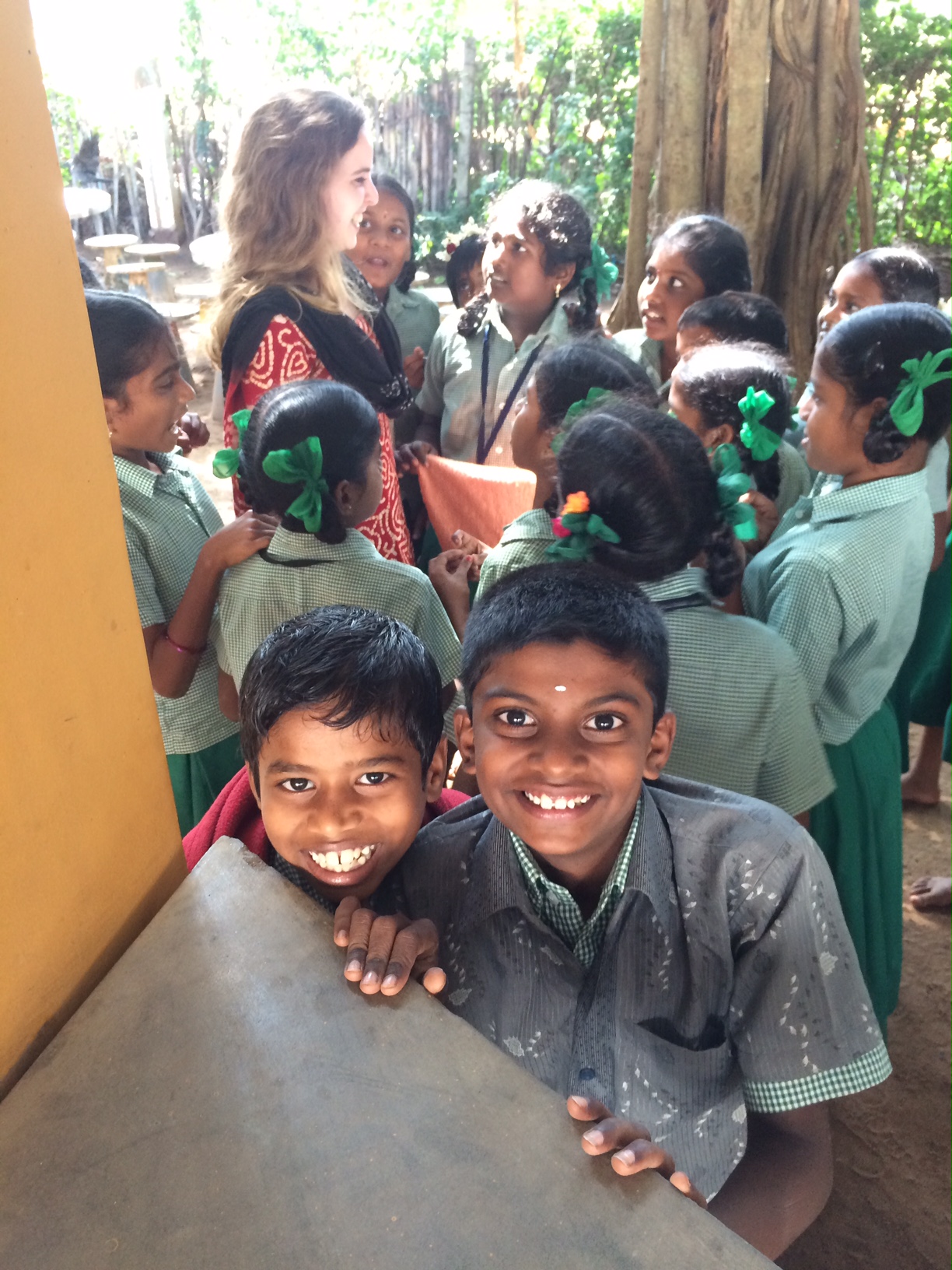
On Tuesday, we visited several NGOs that had foundations in education – whether vocational, elementary, or health-wise.  I think it was interesting to examine the Indian system, and particularly how these NGOs worked to satisfy the needs that are not met through government schools.  In Indian government schools, children are taught “fundamental” subjects – math, science, etc. that will maximize employability.  An education in art or music or other creative outlets isn’t offered, and children have to go to other after-school “tuitions” or weekend institutions for these expressions.  This sheds some light on the nature of their culture, in other words, many parents are purely interested in measuring a subjective “success” of their children, whom many want to study to become doctors or other highly-specialized professions.  At the Aikiyam School, our speaker (the school’s principal) told us that most parents just want to know their child’s grade, not necessarily how they are developing otherwise.  There is a clear emphasis on the academic performance of the children, since many parents want their children to have promising, respectful careers that will both be a mark of pride and support for the family.  While this notion is understandable, children – around the globe – benefit from creative outlets where they can grow and express themselves creatively.  Children, and adults, also effectively learn from “play.”  In the Tamil villages, this idea is also two-fold, since there is a need to preserve the Tamil culture in a context of increasing globalization.  In my communication courses, there were many discussions relating to Western cultural imperialism, so I understand there is great importance on smaller states to preserve and promote their unique cultures and traditions, which is so often expressed through dance, music, and art.  Instead of letting Western, especially American, influences dominate the society, local customs should be celebrated, embraced, and communicated so that the culture can be sustained.  Since the government schools don’t provide for this (and since many families cannot afford to choose otherwise), the work and efforts of these NGOs is admirable.  When there are other rapid social and health issues, like water scarcity, sanitation, etc., the creative needs of children could easily be neglected.  However, we encountered a variety of truly passionate individuals who are working hard to empower children, specifically those whom are disadvantaged, but even more globally, to empower a collective group of individuals whose culture is under threat, which is very inspiring.

//CH

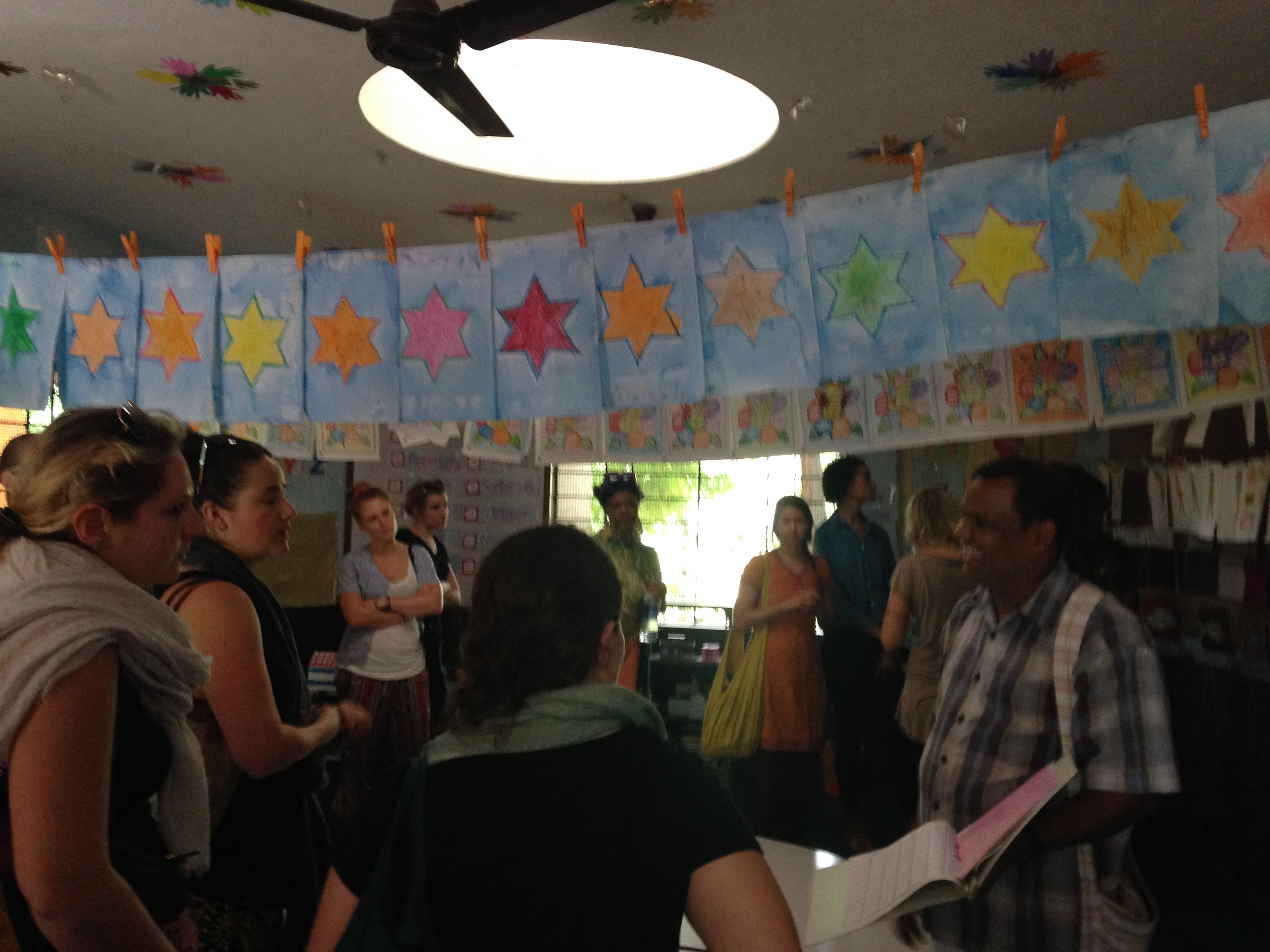
Aikiyam School tour & lecture

Aikiyam School tour & lecture

Eco Femme: Eco-Positive Menstrual Hygiene Management and Education in Auroville

f55eaed8ff1dd1f016bd8f45bc42560becofemme-2

Yesterday, we visited the Auroville Village Action Group (AVAG) right outside of Auroville in the neighboring village of Irumbai to hear a talk from Jessamijn Miedema, the co-founder of Eco Femme. Eco Femme is a social enterprise focused in the area of hygiene management, working to spread awareness about eco-positive menstrual practices. The company has created a product line of premium washable cloth pads as an alternative to disposable sanitary napkins.

Eco Femme works with women and girls in rural Tamil Nadu in Southern India to provide education on how to manage their menstruation in a healthy and dignified way. Miedema discussed how they were looking to increase the livelihood of self-help groups for women and did so by having a team of 28 women from the village, 10 of which are full time jobs, produce the pads on site.

deval--621x414 ecofemme

In order to produce eco-friendly sanitary napkins, Eco Femme had to do a lot of research. They started by conducting a focus group of about 300 women to figure out how women were actually experiencing menstruation. In India there is a strong taboo around menstruation. For example, there is an association with uncleanliness; women are not able to go to temple or walk the dog while menstruating. This was very interesting to me coming from a Western culture where menstruation is very much a part of growing up. Unlike India, where I grew up in the US, pads and tampons were readily available for young girls, as well as medication for associated illnesses and education on how it all works.

In India, girls and women have limited body literacy and often do not have the proper materials to take care of them during that time of the month. Without the necessary products and information, I can only imagine that life for young Indian women comes to a complete halt during the few days a month when she is menstruating.

Half of women are using disposable pads and the other half are using old folded cloth. The government was providing girls in school with disposable sanitary napkins, but with no place to dispose of them. This along with many other aspects has caused a massive waste issue. This is why Eco Femme started producing washable pads. The pads are sold in India, as well as internationally. They started a program, Pad for Pad, where any time a pad was purchased internationally, a donation of 80 rupees would be donated to purchase a washable pad for an adolescent girl.

The washable pads seem like an adequate solution to the disposable method. The pads, which come in varying sizes, cost around 220 rupees, which is around three Euros and last for about 75 washes. The most interesting part of the discussion was when Miedema showed us the pad that was created to resemble the old cloths that women were using, however more efficient and leak proof. When these particular pads are unfolded they just look like a square of material, so when hung on a clothesline to dry, would not attract unwanted attention or cause any embarrassment. I thought this was very perceptive of the girls’ and women’s’ needs, while remaining culturally sensitive.

foldable

Eco Femme is continuing to encourage females to take better care of their bodies and the Earth and creating a safe space for girls to talk and share personal stories about menstruation. This is a huge issue facing young women in rural India and I’m excited to see the lasting effects of this company and its campaigns.

By Alexa Pizzi