A Day With Disposable Cameras

By: Beatriz Salgado


My day started out with the usual morning breakfast at Morgan’s, scrambled eggs with toast and milk coffee. Then, I went to the Matrimandir for the first time, one of the most intriguing experiences yet, but I’ll leave that for another blog entry.

I’ve had an idea for my personal project before I even left for India. Working with children in Brazil and establishing a genuine relationship was always something I felt passionate about. So, my idea was basically to get children to walk around Auroville and take photos of something, I hadn’t really thought about what that something was until I started volunteering at Wasteless. I mentioned my idea with Rihbu, the organization’s founder, and thought he could help. He really liked the idea and thought it could be great if the project complemented Wasteless’ new educational program kNOw PLASTICS. Together we decided the kids would take pictures of plastics. They were to think about where they got their plastics? How did they use plastics? And where they threw their plastics away?

wastelesskids.jpg

I had already been to Aikiyam School the day before to observe the pilot testing for Wasteless’ new educational program, so I had met the principal of the school, Shankar and he said I could meet with the kids on Saturday afternoon. The next day, I got all my gear, which included three disposable cameras, a laptop, water bottle, my journal, and a charger and headed for Kulapalyum Road. While I waited for Shankar to confirm, I had a delicious lunch at Frites with my classmate Imani and later coffee and brownie at Marc’s café, an indispensable place to drink coffee while in Auroville.

Finally, I heard from Shankar and walked to Aikiyam School under the hot afternoon sun, not to mention it was winter. I went to the science room where the teacher and students were doing extracurricular work and waiting for my arrival. They usually have some activities during the weekends to keep the students busy. Before heading out for our photography exploration, I decided to talk to some of the students and interview them about plastics. Though they were a bit shy in the beginning, I was surprised by how much they knew about the issue.

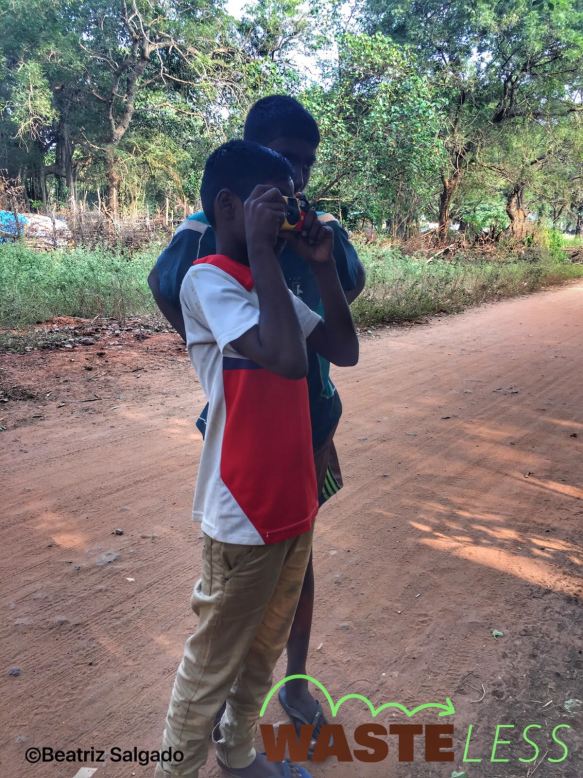
To start our photography hunt, I divided them in groups, two girls, Deepa (13 years old), Roshini (13 years old) and two boys, Chandru (14 years old) and Chander (13 years old). Later, we met up with two other students, Arjun (13 years old) and Thiru (13 years old) who decided to join our expedition. I gave each group one disposable camera and explained to them the objective of taking the pictures.

wastelesskids2

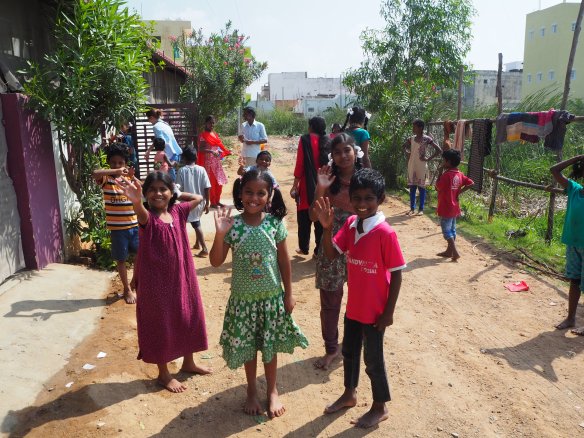
The purpose of the assignment was to take photographs of plastics in their point of view by keeping in mind the three questions mentioned above. As soon as we stepped out of the school, they immediately started taking pictures of the waste they found right outside the school: plastic bottles, bags and even a CD! We walked along the main road and headed towards Kulapalyum village where the kids lived. As we strolled around, the students entered different shops and interacted with people explaining to them what they were doing and why they were taking photos of plastics. Then, we started heading to each of their homes. What was interesting to observe were the different perspectives they had on what was clean and dirty. One of the questions was if they thought where they lived was a little, medium or a lot dirty. Most of them answered little or medium and that it’s sometimes clean and sometimes dirty. I remember thinking, ok, so they live someplace decent. I was wrong though, what was surprising was their notion of somewhere clean turned out to be a completely different conception from my reality.

wastelesskids4

During the interview, they all answered that they threw their trash and plastics in dustbins in their homes and that they don’t throw waste on the streets. One student even said they separated organics from non-organics at his house and that after it was separated, the “people that do the duty comes to pick it up” (Arjun).

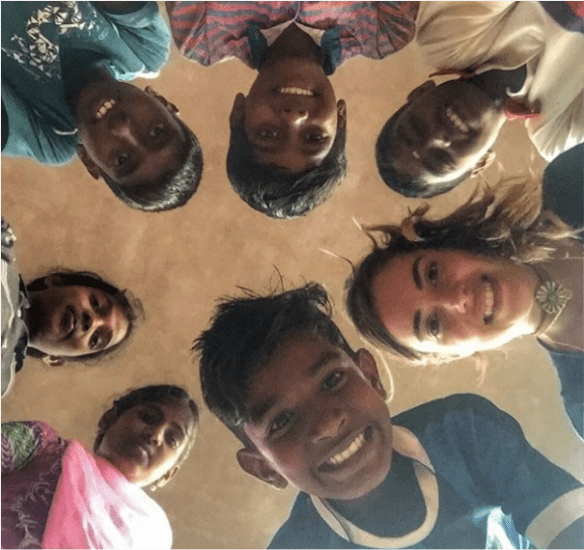
The small comfort that I did have, despite seeing those kids’ environment and their reality, was that they were still being kids and had so much fun taking photos with a simple disposable camera.

meandthekids

A Letter To No-one

Never to be Sent

My Dearest Family,

Who I love more than anything.

I’ve thought a lot about what I would tell you, the things I knew you wanted to hear, the things I know you don’t. I’ve realized there is no point in having secrets from the people I love the most, but I also know there are some things that are too painful to hear.

I’ll start with an analogy.

In dive training we were taught that a drowning man will always cling to the highest point— unfortunately for his savior, it is the head. He will dunk you under in a chest seizing game of chicken; so you train to remain calm, to hold your breath until the drowning man can get his own. Working in development is like going out into a riptide. At one point you lose your footing, then your buoy, without such things you start to question if you can float yourself. You are engulfed by waves, frantic energy tries to drag you under before you can even reach the man you are trying to save. When you get to him you’ve lost all your tools, and you are there, naked, hoping that you can hold your breath long enough.  Long enough to save him, to give him respite from the salt water gushing into his lungs: long enough to survive the pressure building in your chest: long enough for yourself, to keep yourself free from the salty flooding.

I feel like the drowning man myself sometimes, praying for respite as I am dragged farther from the shore, farther from familiarity.

Please don’t fret over my explanation, it is myself at my lowest point. Sometimes I ride the waves, I float for hours on calmer waters; knowing that if I don’t, if I keep kicking— I too will drown. To save something for yourself, I think that is the hardest part of development, that and the feeling of being naked in front of a drowning man.

Even as I sit here, I accidentally make eye contact with a man on the side of the road— he braiding elastic rope as I look over my lunch. He’s there every day, his place set in the stone of his life and I’ve never seen him make a sale. Sitting by the side of the road, braiding this rope is all he has, so he does it each day.

The only thing I recognize in this uncomfortable place is the sweet eyes of a dog, who visits me for food I no longer have, stays for a good rub and then meanders away to stare sweetly at somebody else.

All dogs seem familiar to me—even those that stare with guarded, alert eyes; ready to snap for some reason or another.

If dogs are the same everywhere, if cows have the same kind eyes, are humans not too?

Are we just the same? The best and the worst of us? Am I not the same as the man who braids rope on the side of the street? Who braids everyday but never makes a sale?

The best and the worst of humanity is in each of us, so how can I not feel fraternity for this man? For the drowning man?

Is it the ego that jumps in the way? That screams ‘I am not like anyone else!’ Is it the ego that separates us from the worst of human kind— murders and manipulators, those that knowingly feed off of others’ ignorance? The thieves who comprehend the harm they are doing? Should we not celebrate the ego then— the thing inside of us that separates us from knowing depravity? The thing that screams “I am not like him!”

But is it not also the ego that separates us from the man on the street? That whispers ‘I am not like him’ comfortingly in our ears?

In these moments I’ve turned to the words of the Mother, while alien, she provides a semblance of comfort:

… you are made up entirely of something which is the forces of Nature expressing a higher Will of which you are unconscious.

    ‘Only, one doesn’t understand this except when one can come out of one’s ego, though it be only for a moment; for the ego – and this is its strength – is convinced that it alone decides. But if one looks attentively, one notices that it is moved by all sorts of things which are not itself. . . .

    ‘From the minute you become unconscious of the Unity – unity of Force, unity of Consciousness and unity of Will – well you no longer have the perception which makes you quite separate from others, so that you do not know what goes on in them, they are strangers to you, you are shut up as it were in your own skin, and have no contact with others except quite externally and superficially. But this happens precisely because you have not realised in yourself the perception of this oneness of Consciousness, Force and Will – even of material vibrations’” 

So do we celebrate or lament our ego?

Is it our greatest strength or our most crippling weakness?

My dearest family,

These are the thoughts I cannot share, for if I did they would break your heart. So they shall remain a secret, familiar only to myself.

-Your loving daughter

Second in Line: Women’s Rights

Imagine you have prepared a delicious meal for your family.

The aroma of the freshly prepared dinner fills the room, your mouth waters with anticipation. You have not eaten since breakfast and you have spent the last two hours preparing your favorite dish for your family. You begin serving the meal, first to your sons, then to your husband, and lastly to yourself. To your dismay, you watch as the food disappears before your eyes. By the time you are finally able to serve yourself, the best food has been served to the men of the family and all that is left for you to eat is meager handful of rice.

For many women in India, this scenario is a common experience that stems from deeply held cultural beliefs that perpetuate discrimination against women. Viewed as the future of the family, sons are believed to be the most hardworking and deserving, and it is believed that they should be fed first with the best food available. It is considered a wife’s duty to her family to serve herself last, eating only what is remaining after the men and the others have eaten. Often this amounts to very little or no food at all. Ironically, while women are expected to be the primary providers of health and nutrition for their families, it is the same women who suffer the greater extent from hunger and poverty.

These deeply held beliefs rooted in religious doctrine, practices, legal systems, and cultural traditions require that women across India give up their individual rights and sacrifice their personal well-being for the benefit of their husbands, families, and community. Generally, it seems that these issues are deeply related to a lack of education and understanding. Many women are prohibited from gaining a proper education and are denied a voice in society. We have visited several NGOs working in Auroville to minimize gender discrimination, one of which being the Life Education Center (LEC). The LEC is an NGO that seeks to combat gender discrimination by empowering girls through education in order to build their self-confidence, self-worth, and to give them a voice in their families and within their community. While this NGO seeks to empower women during their time spent at the LEC, their programs are aimed to help these women develop skills and confidence that are sustainable and continuously developed beyond their time spent at the LEC.

The LEC was established in 1991 and has since provided a safe learning environment for women from Auroville and the surrounding villages. The LEC’s mission is to support women’s empowerment through education, seeking to “bring social change through a change in consciousness.” At the LEC, young women are provided a safe educational space where they learn skills and tools that enable them to continue their personal growth even after their time spent in the LEC. The LEC currently offers vocational training programs as a means to provide an opportunity to earn a livelihood and to help support their families. This vocational training program is a means to bring identity and dignity to women who are often oppressed and considered inferior by society. At the LEC, women are encouraged to connect to their inner creativity and consciousness, and to use their work as a way to reflect, build confidence, and express themselves through their craft. Not only do they offer a means for women to learn technical skills, they also offer entrepreneurial skill development programs, collective quilting classes, health and nutrition workshops, cooking classes with a focus on sustainability, and a career development program that helps young women in the college application process.


Eating With Your Hands

By Sam McKeown

Upon an aluminum plate sits a fragrant mélange of bottle squash kootu, vegetable curry, and seasoned rice. My belly rumbles from the scents of mustard seed, onion, turmeric, and coriander powder that perfume the air. My colleagues and I sit patiently upon the wood floor awaiting the completion of the prayer. Under the supervision of Devi, head of the Life Education Center, we’ve prepared our meal with careful consideration for the three doshas—pita (fire), kapha (water), and vhata (air). In traditional South Indian cuisine, each meal is meant to combine ingredients that help balance the dosha within the body, thus attaining both physical and spiritual balance.

By participating in the preparation of our meal, we’ve not only exchanged laughs, techniques, and stories, but also a small piece of our personal culture. For some, cooking represents a reflection of the self, a means for us to share small, non-verbal pieces of information of our personal journeys. Where did you learn to salt the water before you boil it? Why do you cook the onions first? Why do you use sunflower oil versus olive oil? For others, cooking is a source of anxiety, an exploration of opposing elements that threaten at any moment to taint the flavor of your meal and thus your self-representation. In a broader sense, cooking is a codification of collective values that has been and is continually reinforced generation after generation. Regardless of what cooking means for you, it can unanimously be considered a form of communication. An equally important form of non-verbal communication, however, is eating.

Upon my aluminum plate sits a small, plastic spoon. I glace around the room and notice that our Tamil hosts aren’t eating with the spoons, but rather their hands. Despite having eaten with my hands several times during the course of my stay in Auroville, there’s always a brief moment of anxiety before I begin. Being American and having seen a few different parts of the world, South India has been the first time I’ve experienced the culturally normative practice of eating with your hands. But what drives the fear behind this interaction with food? Is it fear of being thought of as messy, as I inevitably get rice on my nose every time I eat with my hands? Is it that most Western cultures have effectively created an implicit fear to the sense of touch in eating through reinforcing the use of utensils? Or is it simply a fear of trying something new? Perhaps it is a combination of the three. I take a breath and dig my hand, specifically my right, into the rice that has been doused in curry and kootu, scoop, and eat. The texture is both foreign and familiar at the same time, a texture I expected but still can’t necessarily put into words. It’s not slimy; it’s not hard or rough; it’s possibly a little sticky and creamy.  I glance around the room again and realize that not a single person has reacted to the rice that has clung itself to my right nostril. What has seemed to me a personal victory of overcoming neophobia to others is the simple act of eating.

When interacting with cultures inherently different than our own, eating is a meta-lingual exchange that can reveal an underlying dialogue. By picking up the spoon, I’ve reinforced my own culture and therefore my otherness from my hosts. By eating with my hands, there is the removal of a small but noticeable barrier between my cultural subjectivity and acceptance. The flavors of the meal are strong but complementary, subtle hints of spice balanced with the tangy acidity of tamarind. Before I’ve  realized, my plate is completely empty, my belly is satisfied, and my doshas presumably balanced. A collective lull has settled over the group, one that seems to transcend conventional cultural boundaries—the ubiquitous satisfaction of a good meal.

Indian Nature

5:45am. En route for a visit of the spectacular Kaliveli Lake. We encountered a roadblock and had to resort to a tight ride-share with Boomi and naturalist guide Shankar to access the wetlands. Flocks of Dalmatian Pelicans, egrets, heron, cormorants, painted ducks, flamingoes, along with dozens of other species make the critical watershed of Kaliveli Lake their winter sanctuary.

The Possibility of Auroville

It has been three weeks since our arrival in Auroville. To some extent, we were expecting to enter a highly conceptual space, with a meaning that transcends our understanding. It turns out that our lives back home themselves have become more conceptual than ever before. Each in our own way, we have already made up our minds about what Auroville means. Either we hate it or love it, or generally struggle to understand how to evolve in such a system. To me, Auroville has been a complete experience, with many lessons to bring back home, in the hope of making it a better place.

Among the lessons I already wish to bring back with me, the fact that Aurovillians share such a profound mutual respect for each other is the one that struck me the most. As a born-and-raised Parisian, this is more than enough to surprise me, even make me uncomfortable. Quickly though, I realized that this mindset, deeply inspired by The Mother, was the difference that made Auroville so powerfully positive. At this point, never mind the utopia: a place where people truly live in harmony and in peace with each other, without the fear of confrontation or aggressiveness is possible. It may be due to our short time here — maybe after a while Auroville would not seem like such a peaceful, harmonious place after all — but in my case, feeling the positive energy around me incited me to do the same with others. Much more than in Paris, I consider other people with more care. Auroville enhanced my sense of sonder — the sudden realization that people around us have the same vibrant, complex lives as ourselves. Suddenly, I realize that I greet people in a different way, with a positivity and genuine concern for their well-being that I have only rarely experienced before. The lesson here is that my interaction with others has a deep correlation with how people interact around me. Seeing the negativity around Paris takes a toll on my ability to emphasize with others, makes me numb to their feelings or struggles. Auroville, at least in this aspect, shows the true example that human beings should follow. My wish is to bring back this sense of sonder to Paris with me, and make it last as long as possible. Hopefully this change makes me a better person. Someone whose empathy is not driven by self-interest, like the majority of the people I met in France’s capital. If Auroville is considered an open-field experiment, I say it can be considered an experiment of the self as well. The ultimate question that Auroville asks, however, is if such a space can — and should — be allocated solely for the purpose of enlightenment in a third world country. I believe that my classmates have many opinions on that matter, as we discussed this problem at length. In the end, the possibilities that Auroville offers for the rest of the world remain endless, only if this mindset or respecting each-other was transferable literally anywhere else. I still do not think that even Auroville has what it takes, despite the strongest willingness to come together — which shows that determination alone does not make an alternative township. But if I, at least, tried to replicate this model within my own community in Paris, this would be a victory for a slightly better world. Like a tree growing in the middle of a barren land, it would be nothing short of a miracle.

Burning those masala dosas!

By Patricia Molinos


On the second day of this new year at 6:30am two buses were already at the parking lot waiting for those who had signed up for the early morning Gingee trip. Our first stop was for breakfast at Sristi Village, and since the driver did not know the way and I have been going there the past weeks (it is the organization I am working for), our trip coordinator Sacha Elder asked me to sit in the front and give the chauffeur directions. I was one of the few who did not sleep on the way. “What if we miss the left we must take because I’m not paying attention!!”, I kept repeating to myself, so phone in my hands with Google Maps opened (just in case :-p), I stayed focused on the road. We finally made it to Sristi Village and our sleepy faces vanished away as we were served some South Indian traditional breakfast prepared by the residents and staff of the village. It was delicious! Karthik created this inclusive village for intellectually disabled people in 2013, where he aims to train them in farming so that in the future they can have an independent and dignified life generating their own income. His goal is to give an opportunity to the 355 kids in need of special education living in the surrounding villages near Kunamangalam (between Pondicherry and Mailam). We ended our visit planting a tree together with some members of the community and we headed back to the buses.

After almost another hour and a half on the road, we reached Gingee, in Villupuram District (Tamil Nadu). “Ah! It’s not that high!”, we all said as we were taking water bottles and some snacks and sandwiches Sacha had bought for us. Only a few minutes later we realized we were wrong…What a climb! The stairs were the steepest I had ever witnessed, some of them being more than half a meter tall! The more we climbed the more monkeys we found. Some of them did not notice our presence and continued playing, while others kept their eyes on us following all our moves. We were told not to take the snacks out of our bags while climbing, since it would not be the first time monkeys steal food from the hikers’ hands. After taking several breaks under some shadows we found on the way, we finally made it to the top of the Gingee Fort Hill with our now sweaty t-shirts. From there we could have a 360-degree beautiful vision and many angles we could take good pictures from. The views were awesome!

The fort was originally built by the Chola dynasty during the 9th century and modified during the 13th century. It was under the control of different regional powers like the Kurumbar, the Nayaks, the Marathas, Bijapur sultans, the Moghuls, Carnatic Nawabs, the French and the finally the British in 1761. As Sacha explained, the fort is closely associated with Raja Tej Singh, who lost his life there when trying to revolt against the Nawabs of the Carnatic who ruled this region of South India between 1690 and 1801.

fullsizerender-7We met in front of the buses again around 1pm and headed to an ancient temple that is only five minutes away from the Gingee Fort. The group made it to the heart of the sacred building, where we received the blessing of two temple men with some kinds of crystal-sugar cubs, an azafrin rounded mark on hour foreheads, incense and some words they pronounced.

It was a really awesome day that combined both culture related learning, amusement, and also some intense exercise, very convenient to try to make up for all the masala dosas, dals, lassis, and Gobi Manchurians that we all are eating quite regularly here 😉

The Function, Fear, and Freedom of Education

by Elizabeth McGehee

My eyes wandered from a burning candle beneath a portrait of The Mother to a row of her books lined along a dusty metal bookshelf. I intended to pick up something to read that might enlighten my spiritual thinking, to be thematically in touch with the Aurovillian philosophy… I flipped through and a paperback titled “Think on these Things” by Krishnamurti stood out to me. The book was instructing me to carry out my very own will: to think. And “things” seemed to be very obscure, so I was curious to discover what these “things” might possibly be. So I pulled it out in a cloud of dust and added it to my small stack.

Secretly, my secondary reasoning for choosing a book like this was to help me doze off and fall asleep with, perhaps, some peace of mind or clarity in thought. I wasn’t prepared for what would in fact be a jolting kickstart in my train of thought—following every phrase my mind concocted sweeping questions: “Why is this so? How is this so? What if…” And the “what if” posed the most daunting search for an answer.

Krishnamurti begins by speaking of education. I was enticed by this topic, but slightly intimidated to dive into it. It is of the most controversial issues of the present, and has become stretched and twisted and inextricably stuck to other great controversies: money, jobs, human rights, discrimination. Education was stripped of its essence as a basic human right, and became an issue of selectivity and accessibility. Thus, those who do not have an advantage in the aforementioned elements will be the deprived: people who are straddling or beneath the poverty line, people of color, people from underdeveloped regions, people who are intellectually and/or physically disabled, women and girls.

But the way Krishnamurti deconstructs the ideologies of education paints a very comprehensive picture of what it truly means to be educated. In our current and collective mindset, to be educated is to reach the “gateway to success”. Yet, we must consider: how does this mindset define success, and what are the meanings we associated with the state of being successful? Today, success is recognized in materialism – luxury, wealth, the ability to indulge. These achievements, however, exist temporarily; they are unfulfilling, shallow, and are proponents of competition. This notion of competitiveness is of great importance to Krishnamurti’s theoretical analysis of education, for to be in competition with others is to lock yourself up, to be fearful, and thus to be unfree. And this is the key to understanding what it means to be truly educated – it is to be free.

The function of education should be to understand the whole process of life, “with all its subtleties, with its extraordinary beauty, its sorrows and joy”. To be able to truly learn is to think freely, to learn about and understand yourself without being fearful, so that you can discover the true beauty of life in the world and how you exist within it. The function of education is not merely academic.

And this process seems, to us, to be a basic human right—we are always told to “be true to ourselves”. It appears that as long as you are a breathing, conscious human being, you are capable of this process of self-discovery and nonconformity. But what happens when you are taught to do the opposite? To confine yourself within a box of stereotypes and labels?

When a man is told not to cry, this is because he must “act like a man”. But, to cry is to express one’s sadness, and to feel it throughout the body, and to recognize that it is real. And only by expressing it can you truly understand that there is something sad within you, and by recognizing its existence can you begin to try and asses it, cope with it, and heal. But by being given a formula to live by (in this instance, to be “masculine”) you are told to take a part of your true self and suppress it, suffocate it, until that part of yourself no longer exists. And this leaves humanity fractured: anxious, insecure, and fearful. And there is no freedom in being fearful.

For the last two weeks in Auroville, I witnessed the incredible effort to bring about this freedom: I witnessed women helping other women work towards being free from the deeply rooted fear that persists throughout where they’re from in the villages. Through educational programs and activities, The Life Education Centre (LEC) aims to help village women recognize their own potential—their abilities, talents, strengths, and rights—so that they could begin paving a path towards a freer, more sustainable lifestyle.

The daily life of a woman from a small village is essentially limited to staying in the house, preparing food, taking care of the family, and only going out to take care of the livestock or the garden. Starting from childhood, women are relegated solely as the caretaker of their fathers, their husbands, and their children. I interviewed one of the women who studied and worked at LEC. Her name was Saravaneshwari, and she spoke about how her brother was educated because he was a boy, and that she was told by her parents, “stay at home, don’t go anywhere” except to milk the cows. Since coming to LEC, she was able to grow the parts of her that were shut away for many years. She learned how to interact with people, something that once made her feel scared and unconfident. She came to learn embroidery, computer skills, and to ride a scooter. She now has a job and makes an income, helping her to be independent and feel more comfortable in her daily life.

The women partake in workshops that teach them about medical care, reproductive health, post-trauma awareness, and counseling to help grow their knowledge about the importance of personal health and how to go about receiving treatment. Through their My Education program (“Yen Kalvi” in Tamil), women learn basic subjects like math, english, and computer skills to contribute towards their skills that could serve in the workplace. LEC has recently implemented an entrepreneurial skills development program to teach women about the processes inherent in building a start-up, like managing finances and facilitating a business strategy. This helps them to realize their capacities and follow their dreams of starting a business.

“There is a need from within inside that’s already there”, says Devi, who organizes the programs at LEC. “And the girls don’t even know if it’s okay to express that need”. Through the provided education tools, LEC not only teaches women practical and useful skills to help them be independent, but also guides them to look deeply within themselves so that they understand what they need to feel confident, empowered, and true to themselves. Women learn to express how they feel, discover what they love, and understand that they have the right to learn about themselves and the world around them. And from this comes a profound and true sense of freedom.

Environmental Catastrophe

After a breath taking presentation at the conference room at Wastless by Ribhu Vohra who is the co-founder of Wastless organization which focuses on waste crises and approaches to solve it. We discussed the waste crises and Wastless’s role in educating a new generation that cares about the environment. One thing Ribhu said that captured me was “I want to educate a new generation that when they want to elect a new Indian governor, to choose the one who cares about the environment and the mother nature”. Ribhu also talked about recycling and how there are only few places that recycle because not all citizens separate compostable waste from non-compostable waste.

img_6681

Mixed Waste dumped in the dumpsite in Pondicherry

Ribhu decided to show us the crises or, as I would call it, the catastrophe with our own eyes. AUP students visited the dumpsite in Pondicherry and on the way, we visited the recycling workshop where Indian women separate compostable waste from non-compostable waste. Ribhu gave us a lecture while we were in the dump, where the garbage of Pondicherry’s one million residents and Auroville’s residents is dumped in the 25-acre dump yard! None of us could breath and the smell was awful. Security men asked us not to take photos as none of the governors want to show this to the world, yet I was able to capture few photos with my phone, as every time I hold my camera the security guard would shout at me.

img_6691

Separated compostable waste

img_6702

An Indian woman holding a plastic item after separating compostable waste from non-compostable waste.

Explaining this catastrophe from a scientific matter; the waste decomposes and it generates heat and highly flammable methane gas. The gas combusts, igniting other materials: paper, plastics, rubber, cloth. The waste then smolders in a low-temperature fire, producing massive amounts of smoke, and generating persistent organic pollutants (POPs), including dioxins, furans and polychlorinated biphenyls (PCBs), which rank among the most hazardous substances known to man. Such toxins are consumed by and accumulate in wildlife and livestock at the site such as cows and chickens, then transfer the toxins to humans through eggs, meat and milk, as Ribhu explained. Regarding this information, we can imagine the number of illnesses and the risk of cancer facing the residents and the future generations.

img_6708

The dumpsite in Pondicherry

The situation raises several questions: What were the authorities thinking when they decided to create a massive open dumpsite? The site violates several provisions of the government’s garbage management regulations. The rules prohibit the open dumping and uncontrolled burning of mixed waste. In other words, the dumping and burning of mixed waste are punishable offenses yet no one is doing any action. As citizens of the world, we MUST take care of our world, not only for us but for our children. Which made me recall this quote by Arthur C. Clarke “This is the first age that’s paid much attention to the future, which is a little ironic since we might have one!”

By Nehal AbuMarahiel

To the Mother we all Share

by Elizabeth McGehee

As humans, we are endlessly fostering relationships between ourselves and those who surrounds us. This process is an innate part of our collective social being; it is how we thrive and find our own identities by communicating with one another.

And while it is through social relationships that we find the means to define our “social selves”, we constitute our physical existence in relation to our environment, to the material world in which we live. As humans create – cultivate, industrialize, digitalize – we realize our existence, we transcend ourselves, by testing our limits and paving our way into the future.

We must, however, think critically about how these relationships affect us depending on which “kind” of material which we choose to relate to. And it is safe to assume that, in today’s society, we have forgotten about the most important tangible element with which to have a relationship, and that is Mother Earth. 

dsc00191

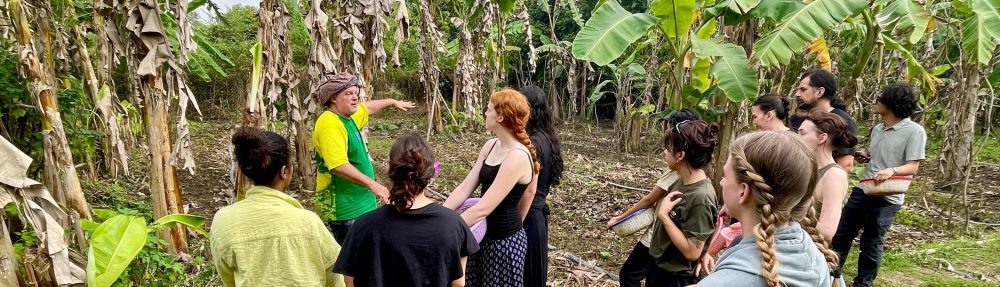
A man named Krishna reminds us of this grave misfortune as we follow in his path, winding beneath a forest of towering banana trees which comprise a portion of his 6-acre “Solitude Farm”. He is dynamic, very literally down-to-earth, and speaks with passion when talking about nature and permaculture, a form of sustainable agriculture. It is through teaching us about this method that Krishna leaves us feeling hopeful despite knowing that we have lost touch with nature.

15877738_10208249107168075_1142263699_o

We must reject industrialized farming, he says, and recognize the beautifully complex and unmodified gifts of nature. We must cultivate these gifts in a way that values and appreciates them – in a way that is natural and nourishing to the earth. By doing this, we can simultaneously nourish ourselves in the purest, most wholeful way possible, because “it is our birthright to be well”, says Krishna.

15878016_10208249104568010_1880275028_o

In following the model of permaculture as a means of being well, we must start at the very literal roots of the process. “Soil comes first” Krishna explains, as it is the basis for a civilization. To have healthy people, we must have healthy plants, and this is only possible if we have healthy soil. By composting and refraining from clearing natural debris, soil becomes rich and porous, creating a sustainable basis for plants to grow continuously, eventually creating a self-sustaining ecosystem. Permaculture avoids modes of organization used in regular farming, so nature is left undisturbed to flourish on its own.

primary-ethics-permaculture-001

We must value each and every part of the plants once they have grown. We must make use of the roots, the stems, the bark, the leaves, the petals. In saying this, Krishna mentions Ayurveda, an ancient traditional Hindu system of medicine dating back to 5000 b.c., whose therapeutic remedies “developed through daily life experiences with the mutual relationship between mankind and nature”.

15878099_10208249210490658_1886296022_o

Krishna picked a small blue flower whose botanical name is Clitoria Ternatea. The roots, seeds, leaves, and petals have diverse Ayurvedic properties and are used for medicinal purposes. It can be applied externally, made into a paste and applied to calm inflammations or used as a natural “anti-age” cream. When consumed, (extracted into a tea, eaten raw, or frying the seeds) it cleanses the bladder and relieves indigestion. The “medhya” herbs improve vision, as well as memory and learning abilities; it can also be used to help treat children with impaired cognitive functions in developmental stages. One can gather from the flower’s name that it’s properties might be beneficial for a woman’s reproductive organ; this assumption is spot on, as it helps to lighten a heavy period, prevent or treat uterus prolapse by strengthening pelvic muscles and ligaments, and sooth vaginal infections. 

vgl08_1

So as nature provides us with these miraculous gifts, we must show our devotion by using them to their full potential, letting nothing go to waste. By doing this, we have a chance to restore our relationship with Mother Nature. We have a chance to remember that every little leaf and every drop of water connect to something much greater – and that is our source of life. Mother Nature does not speak or walk, but she drinks, breathes, flows, soaks in the sun, and grows to live like we do. And without her, there would simply be no “we”.


We ended our visit with a delicious and diverse “farm-to-plate” lunch. Each day, they serve a “Thali” dish, which is comprised of small portions of food—different salads, chutneys, masala, rices, and dahl—straight from Solitude Farms—and, the ever-present staple of Indian dishes, a warm and fluffy piece of naan.    

DSC00202.JPG