One Person’s Trash is Another’s…Livelihood?

By Jeomar Montelon

Our class recently toured Pondicherry’s Kurumbapet dump yard with EcoPro, a local NGO, to become familiar with the city’s trash problems. As we walked over bubbling puddles of methane gas caused by the decomposing trash, most of us covered our mouths to prevent the smell from entering our noses and mouths. Some of us even went as far as wearing sunglasses, despite the sun setting behind the horizon. Although having lived in two world cities where there are bad smells on a good day and vile smells every other, the odor from this mid-sized south Indian city’s trash site was a little nauseating, even to me.
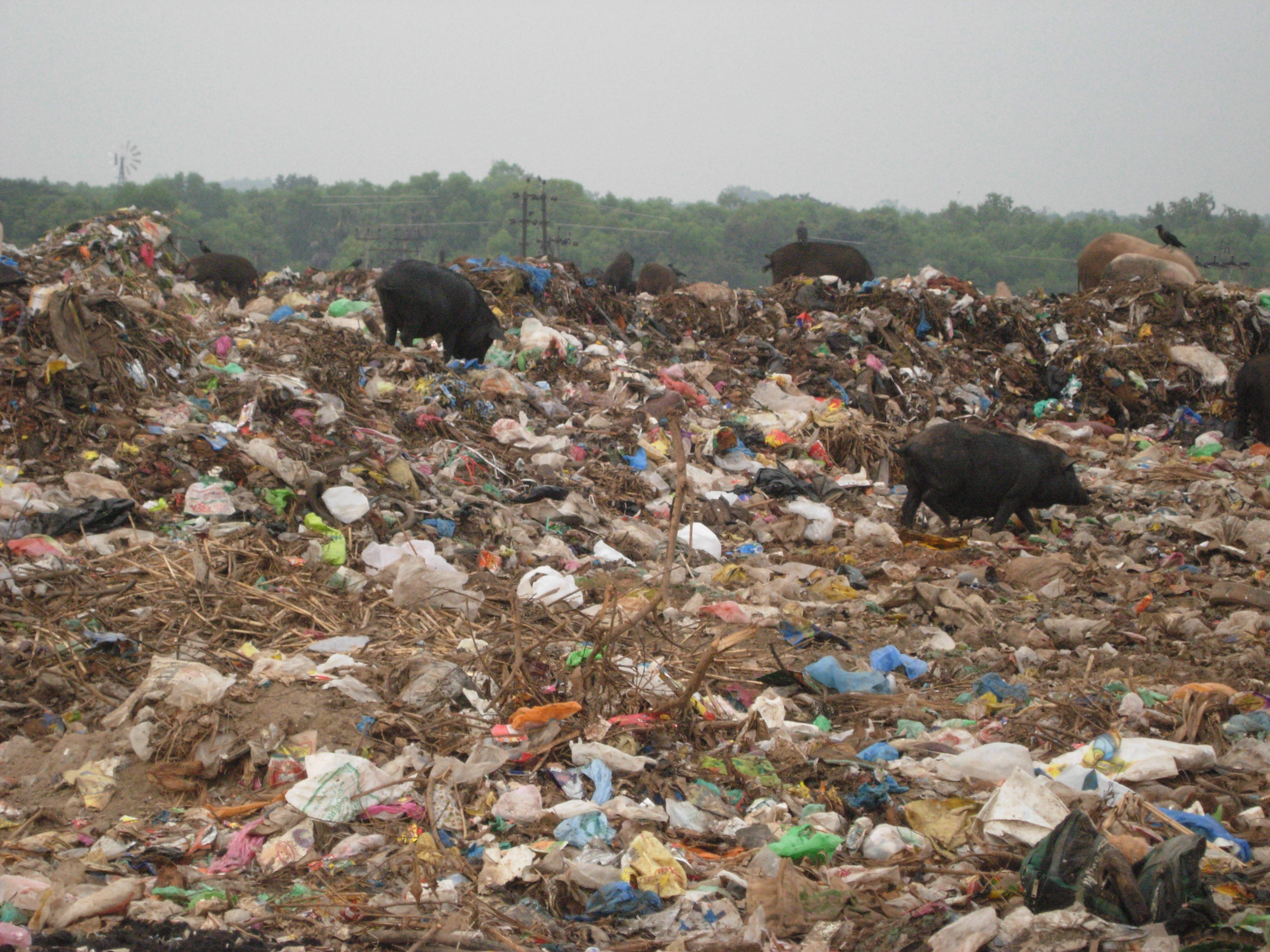
Pondicherry’s Kurumbapet dump yard

At one point during our tour, three little children appeared over one of the waste mounds, curiously observing the oddity that was us in a place like this. As our conversation with the NGO continued, the children gradually came closer to us, as though they were timid animals feeling out the strangers before them. Before I knew it, they were within an arm’s length of us; we could have hugged them had we wanted.

Pondicherry’s Kurumbapet dump yard

Had it not been for the tattered clothing and sludge-covered feet, one would have assumed from their cheerful and easygoing dispositions that they were just ordinary children mischievously playing amongst the city’s trash — but they weren’t. They were gypsy trash collectors; a social status in India lower than the Dalit (untouchables). For these three young children, their job is to roam the dunes of waste hoping to find anything of value that they can collect and exchange for Rupees to support their family and community. Holding their trash-collecting bags, they smiled at us and giggled secretly amongst each other as we gave them candies and empty plastic bottles, one of the prized articles found in the landfill.
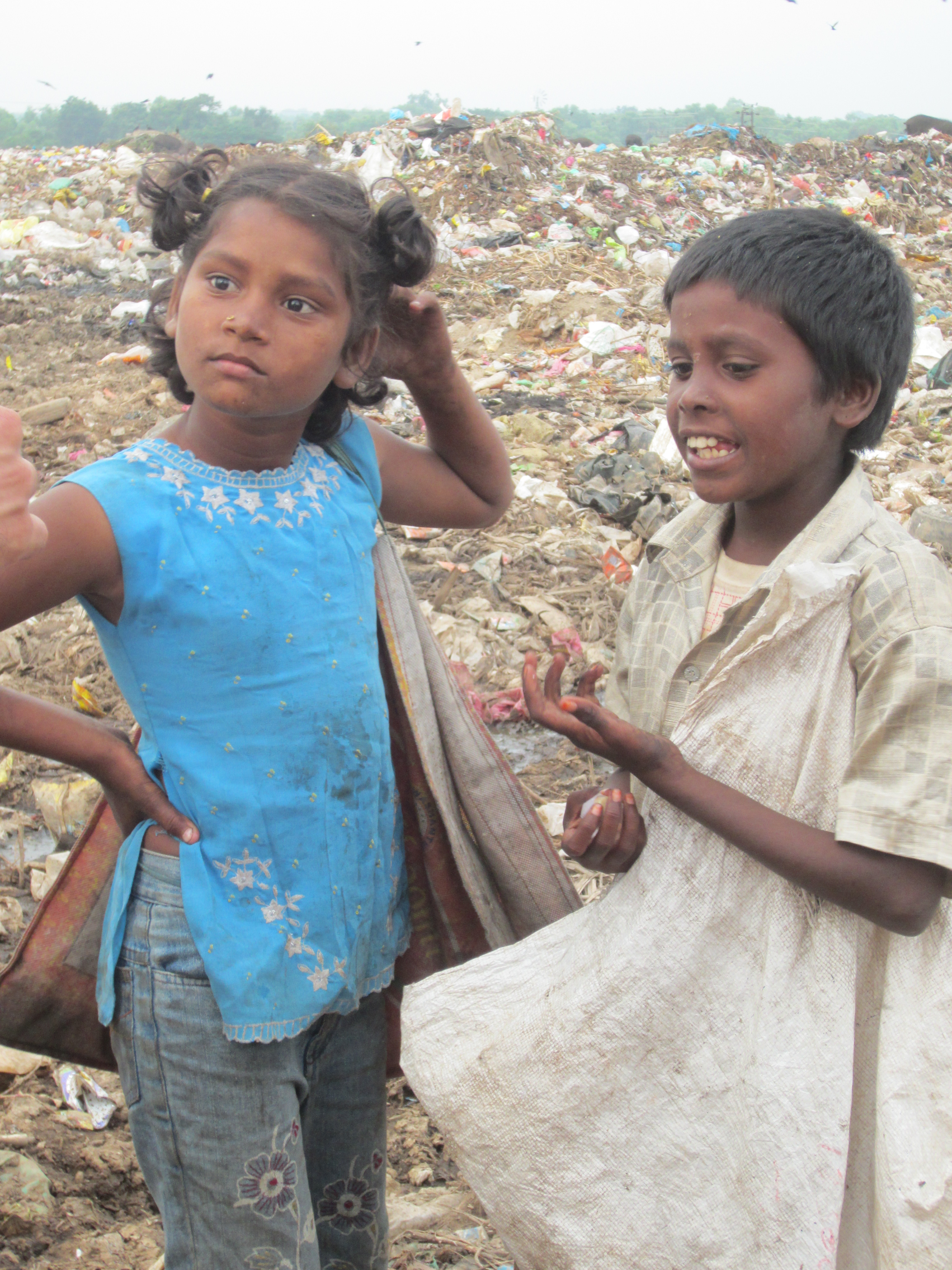
Trash-collecting children at Pondicherry’s Kurumbapet dump yard. Photo by Chantelle Lusebrink

I was astonished at how they were unfazed by the very smell that kept reminding me of where I was with every breath I took. I guess it’s safe to assume they were used to it. At that moment I remembered something a friend once told me: If you are born an American, consider yourself the luckiest person on planet Earth. A title like that weighs a lot when you’re the select few chosen in a genetic lottery. Suddenly, I got that knot in the throat one gets when you feel you’re about to cry. I didn’t even understand why. It could be because of what I was witnessing at that moment, and maybe a feeling for something I didn’t even understand­ — and never will.

Trash-collecting child at Pondicherry’s Kurumbapet dump yard

Later that day, some colleagues and I discussed revisiting the Pondicherry landfill to give the children some shoes, maybe even a hot meal for their little tummies. For me, this dialogue engendered a promise I’d like to accomplish while here. There are few personal promises I make to myself that when fulfilled, I feel thoroughly satisfied. Most promises we make in life relieve only temporary feelings of superficial requirements we think are necessary. Our time here in Auroville is brief; let’s hope we can create a benevolent memory for ourselves by doing our best to help as many people as we can.

Few will have the greatness to bend history itself; but each of us can work to change a small portion of events, and in the total; of all those acts will be written the history of this generation.
– Robert F. Kennedy
The American Pavilion

By Robert Barnes

The American Pavilion was designed by University of Washington students to be a sustainable house. They designed the building, travelled to Auroville, and built the pavilion in six months. It is a very well designed building, a little rough around the edges (it is, afterall, basically a prototype), and almost self-sufficient.

The pavilion is almost entirely off the electrical grid. Solar panels collect energy from the sun and store it in batteries which can last several days depending upon use. The limit to the solar electrical system is 2,000W, which severely limits the use of heavy draw equipment like washers, hair dryers, and blenders (anything that draws a lot of electricity to start or function). There are outlets in the bathroom, connected to the city electrical grid, that can handle heavy draw electronics. There are limitations on even this, however. The city currently cuts power twice a day for two hours each time, during which these outlets don’t receive power. For daily life electronics, such as computers and fans, the electricity cuts are never noticed.

The bathroom was originally designed with a composting toilet, a toilet that converts non-liquid bodily waste into compost and filters liquid bodily waste. These were designed as two separate sit down toilet seats. A person can poop in one and pee in the other, but doing both at one toilet seat breaks the system. There is also a splashing problem due to the shallow bowl design of the liquid waste section of the toilet. The people running the pavilion adapted the compost sit down toilet to the traditional Indian squat toilet. The benefits of this toilet is that changing toilet seats is not necessary, there is a small ridge that separates the two sections of the toilet so the waste does not mix. This is the first time I’ve seen a squat toilet more convenient to use than a sit down toilet. To “flush” either toilet, a scoop of sawdust is poured into the solid waste hole to cover things and a spray hose is used to wash down everything else. While it is traditional in India for people to use the hose to clean themselves after using the toilet, the compost system is able to handle toilet paper and tissue. About the only solid thing related to bodily waste it cannot handle is tampons that have plastic in them, these have to be burned.

The potable water system is self-contained. Rain water is collected and stored for later use for drinking and washing. The potable water from this system is notably free from bacteria and parasites that plague many travelers in India. The showers and washing machine use only unheated water and is usually cold, though on hot days it can be on the cool side instead of cold. There is one faucet that has hot water. This is because a lot of water is wasted waiting for the hot water to come out after turning the knob, so the hot water faucet for the building was situated directly below the water reservoir to minimize waste while waiting for the water to turn hot. Waste water, including liquid waste from the bathroom, goes through a marsh filtration system before being used to grow crops. The marsh system used here is similar to the one used by the cities of Martinez and Arcata in California state. The marsh plants and habitat, either manmade or natural, filters nitrates, nitrites, toxins, and metals out of the water and it becomes clean enough to drink. Environmental and food regulations in California prohibit the use of reclaimed water like this from being used for humans or crops to be eaten by humans, though humans can eat animals that eat crops watered with this water. There doesn’t seem to be any regulations regarding this in India. The reclaim water is used for crops after it goes through the marsh. Besides the natural (and cheap) filtration of this system, it also provides habitat for animals and plants as well as being able to help restore lost or damaged marsh and wetlands.

Crops are grown on site using the reclaim water after it’s filtered through the marsh. These crops provide a notable portion of the food consumed in the pavilion, though actual figures for this have been rather elusive so far. Coming after the crops are cows. There are many cows in the area, and they just kind of wander and eat whatever is tasty for them, which can often be what the poor humans find tasty as well. The pavilion’s answer to this are two dogs that live on site. The dogs’ primary responsibility is to keep the cows away from the crops as well as away from the roads. A secondary job they do is to bark at trespassers (it often seems like anything that moves). I’ve never seen one of the dogs actually bite a person, but I’ve seen them climb to an elevated position and bark constantly at someone until they eventually leave. A little tidbit regarding the dogs is that if you run towards the gate, the dogs will run after you and then end up in a wrestling match with each other.

The roof design for the pavilion is rather odd, but functional and economical. It’s also rather intriguing or attractive to those who like innovative architectural designs. Each of the buildings (four bedrooms and bathroom) have their own separate roof. Above all these buildings is a larger megaroof that covers everything but leaves a significant amount of space between the individual building roofs and the site roof. The megaroof provides shade over the entire site and the gap between building and site roofs provides for cool air circulation, keeping the rooms noticeably cooler than the surroundings.

While a lot of sustainable or renewable materials were used in the construction of the American Pavilion by the University of Washington students, the people here at the site have decided to build another sustainable house based upon the design of the American Pavilion but using a lot more sustainable or renewable material than the original building. The new building is a good example of how a prototype build by an outside group can be adapted by local people with more daily life knowledge of the environment and resources and a superior structure or object can be created that would have been beyond the capabilities of either group by themselves.

Merry Christmas from India!

By Chantelle Lusebrink

Wile we may not have the hope of anything close to a white Christmas or a Christmas tree, we do have sweeping vistas of the Indian Ocean’s warm waters lapping sandy shores and busy country roads endlessly dotted with rows of coconut groves and brightly colored houses in fuchsia and electric orange. All things considered, and after you’ve heavily sprayed yourself with DEET to ward off the local mosquito population, this isn’t a bad way to spend Christmas.

Hurtling down the dirt country roads by Moped, dodging cows, dogs and sari-clad women carrying bundles of wood for the evening cooking fires, the sun begins to set here on Christmas Eve in Auroville, India and while it may seem worlds from what we’re used to, Christmas is still found here.

Few Indians, though colonized by the British and the French —as in the case of Pondicherry and its surrounding areas —have converted to Christianity (roughly 3 percent to 6 percent of the country’s population identifies themselves as Christian or about 24 million people), according to information by the U.S. State Department. Instead, the majority prefer to keep their local heritage and religions alive through Hinduism, predominately. Despite this, or perhaps because of this, Christmas is readily found in India, be it a curiosity, a symbol of the other or simply just a way to drive sales as tourist season picks up.

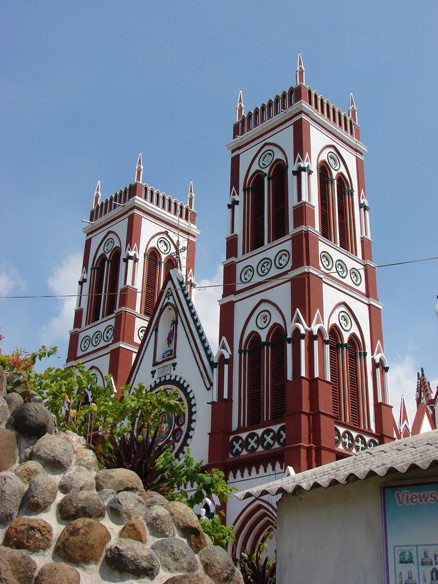
In India sale signs and gleeful Santa Clauses are still found waving in front stores downtown and local tradesmen are producing their wares in bulk to accommodate the tourists. While we may be limited in our decoration colors, predominately red, white and green, Christmas in India is as colorful as the silk saris worn by the women here. Even the ornamentation of Sacred Heart Church’s nativity and building in the city of Pondicherry are dripping in colors rarely seen outside the tropics.

Sacred Heart Church Pondicherry, India

Pint-sized Santa costume...no problem fitting down the chimney here!

But it goes further than just the decoration of Christmas and the child-sized Santa Claus outfits, displayed in every other window of side street shops. Education about their past, their present and their future is also important in the cities and among the villages that had been colonized and today, lay so near to the international township of Auroville. As an expression of human society and development Auroville attracts people from all walks of life, religions and cultures throughout the world, said Nick Klotz, an Australian living in India and a volunteer at the Mohanam Cultural Center in the village of Sanjeevi Nagar that hosted a morning Christmas event and play about Jesus.

“Here, the learning for children, is not just of one religion but to learn about many of them,” Klotz said about the morning’s festivities. “While there are no Christians, nor will there be Christians in this village we are still near to Auroville and there is a population that celebrates, just as there is a population that celebrates in Pondicherry because of its roots to French colonization.”

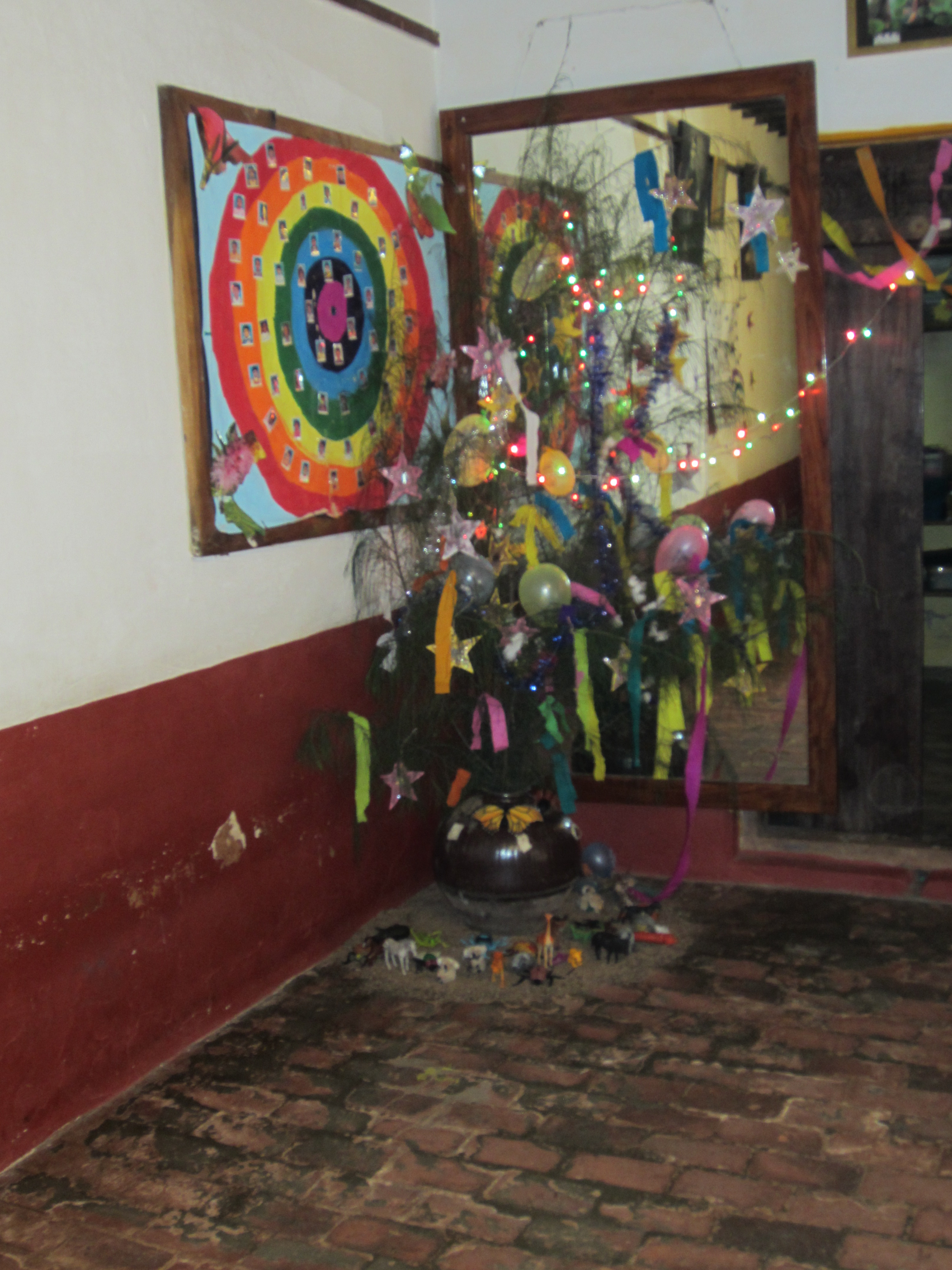
Christmas tree at the community center

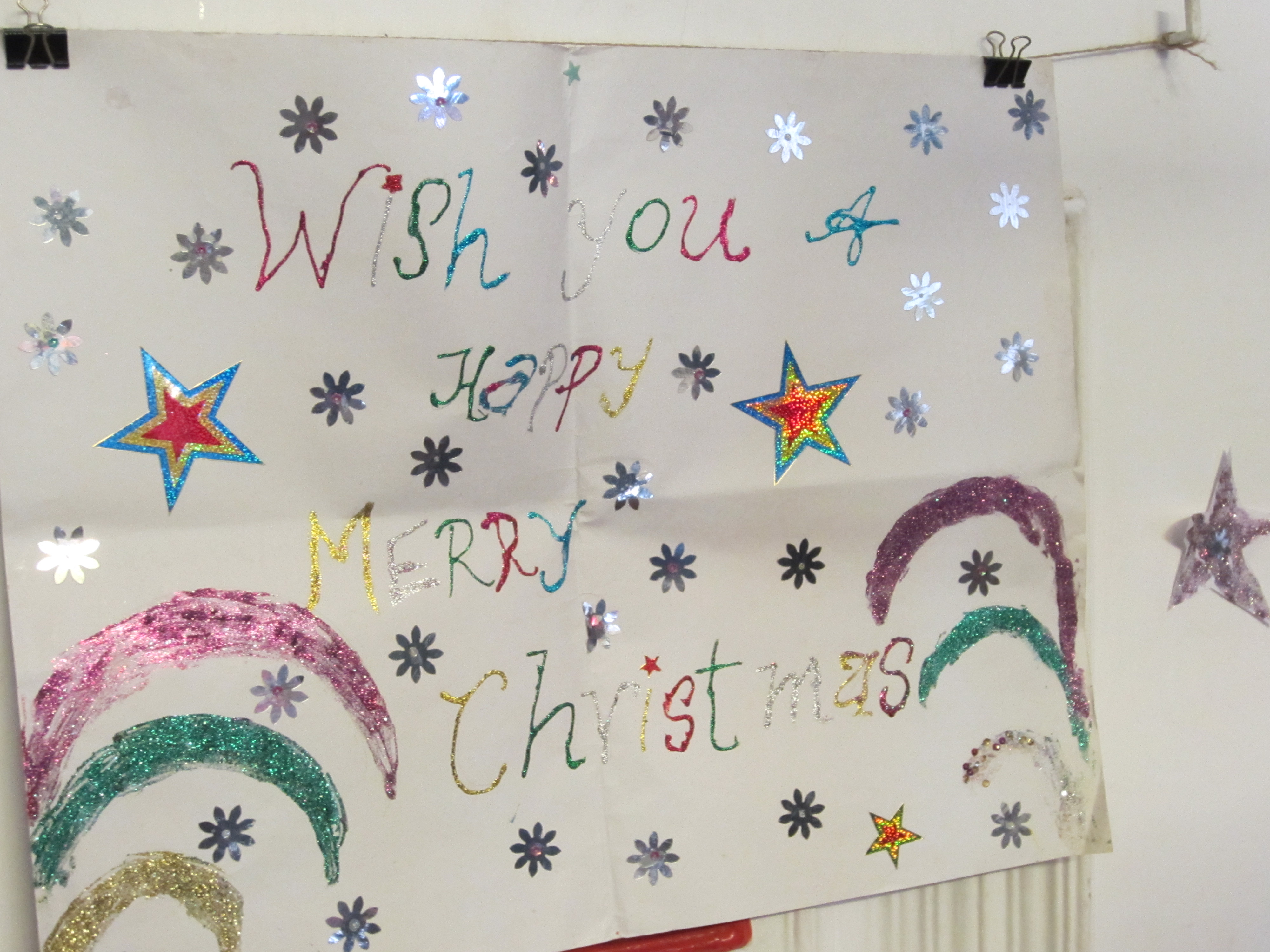
Poster for Christmas at the community center.

The children’s play focused on Jesus’ trial and crucifixion, so it was more about the Easter story of Jesus rather than his birth but it provides context for the children as to why this figure is so important to the others that live in the area. They also sang Christmas carols and decorated crafts.

“Indians are very absorbed in religion and they also really like a party, especially one with religious connotations,” he said. “So this is a fun event for them.”
Many of us share in this same type of education around the world, this cross cultural exchange of knowledge, spirit and culture that helps us better understand our place in the world and how others fit with us. It is a privilege to watch the celebration of something so foreign to this culture and watch how it fits into their perspective.

Watching the sun sink below the tree line of thick palms, the sky illuminates with lavender and bright orange. The smell of coconut, saffron, jasmine and curried spices fill the air, instead of the smells emanating from the family turkey, Christmas cookies and homemade pies.

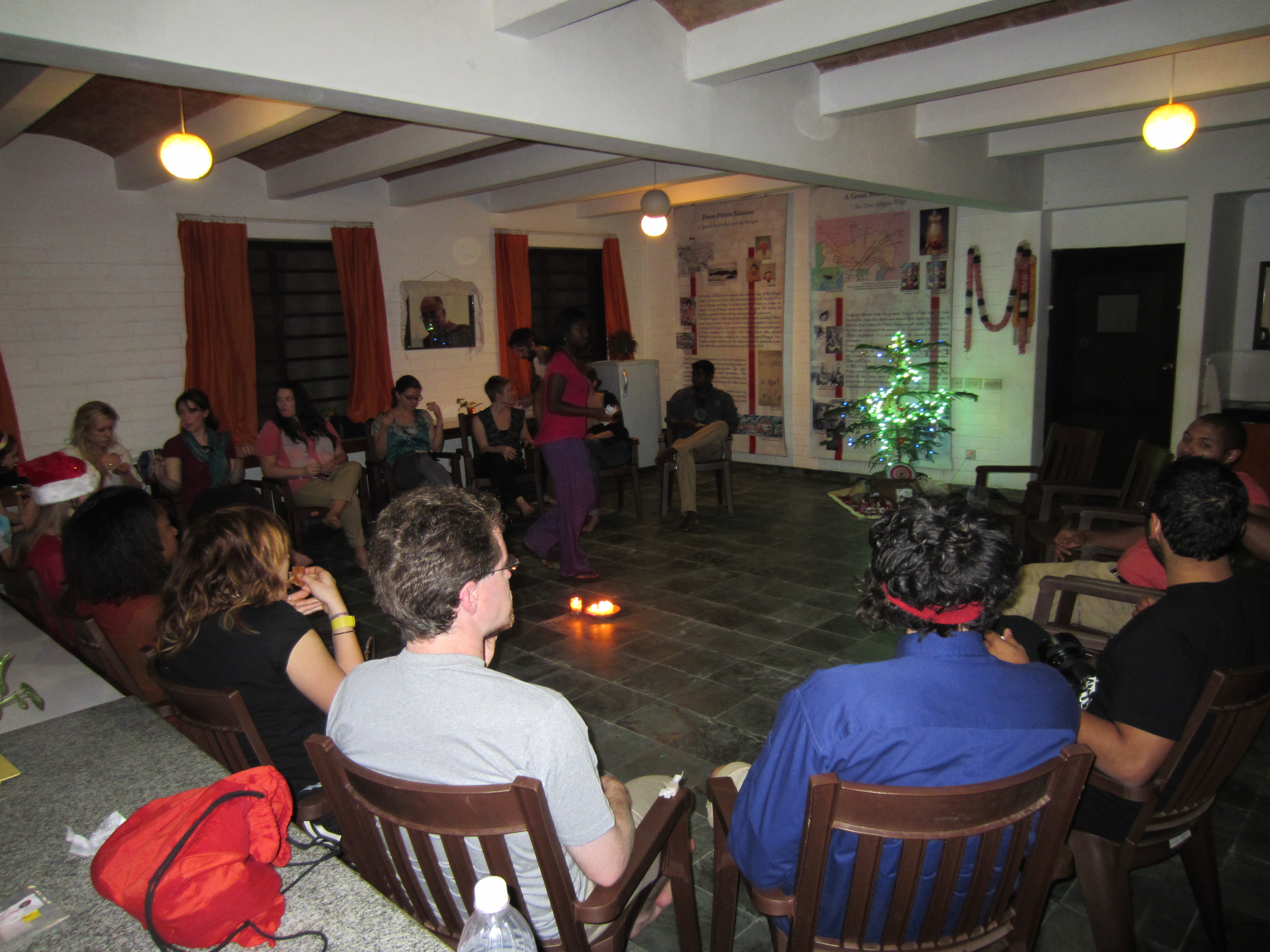
While many of our families were waking and preparing for guests, we celebrated our Christmas Eve beside a lovely tree decorated by the residents here at the Tibetan Pavilion in Auroville, replete with shimmering lights, and of course, packages under the tree for our White Elephant gift exchange. For me, the sounds of Christmas in India will come back to Paris with me in the form of Baul ‘n’ Beyond a greatest hits compilation, which I’m sure will get plenty of use now and for many years to come.

White Elephant gift exchange.

From India, what we wish for our friends, family and patrons of this blog is a wonderful holiday filled with treasured memories for years to come. Merry Christmas!

You Know Your Cow Like You Know Your Kid

India 1 355

By Mariel Sites

Upon arriving in Chennai from our long (long!) plane ride from Paris, we piled into a bus heading into Mamallapuram. As the sun was rising, I was way too excited to sleep on the bus so I gazed forward out the window towards all the Indian country had to offer me. Like a child, I turned to my friend Madeline, excitedly pointing and shouting “A cow! A cow!” She quickly responded “Where? I don’t see any cow!” (I have to admit I was a bit worried that I may have started to hallucinate from Malaria pills or lack of sleep!) But as the big orange sun continued to rise over the Indian horizon, I started seeing more of them (real cows, not hallucinations).  And as I looked closer I began to notice that the cows weren’t marked in any way. I had heard about the sanctity of cows in India but I wasn’t exactly sure how they functioned in everyday society. Were the cows wild? Did they belong to someone? Why were they loose in the street? I didn’t see any kind of brands on these cattle, nor colored ropes or markings of any kind. I turned to our unofficial guide and local Aurovillian, Perumal, and asked him how people knew which cow was theirs. He promptly replied, “Well, you know your cow like you know your kid”. He told me that during the day, people let their cows roam free in the village and use their milk to drink and manure mixed with hay to create floors in homes. When cows become too old to produce milk they are turned out and allowed to wander through the streets, living out their last days in peace. Coming from Texas, I am familiar with people owning a couple hundred head of cattle at a time, and meticulously making sure each one is branded with the ranch’s symbol. In my mind, all cows looked alike and I would have never thought that a person would equate the knowledge of their cow to that of their child. This was the beginning of a series of realizations and understandings that I’ve had in just these first few days. It is amazing to learn about differences and similarities between my home culture and this one. Coming from a small town in West Texas, I saw Paris as “exotic”, never thinking I would ever have the opportunity to visit India! The more time I spend here in Auroville and the surrounding villages, the more I begin to understand (or at least try to understand) their way of life.
Today we had an especially interesting presentation given by Ribhu Vohra from Soma Waste Management, who explained some obstacles faced by his waste management initiatives. He described the dangers of both burning the trash (releasing toxic fumes into the air) and dumping trash in the street (contaminating the drinking water and attracting insects). He explained that people often are just not motivated to pick-up the trash, and when asked to recycle they simply don’t have the time or energy. One interesting solution to this problem that was suggested was the idea of hiring adolescents to ride bicycles around the villages, giving cash for recyclables on the spot. By going door-to-door, the women would simply have to hand over their plastics and metals to the boys, who would then pay the women in cash. Although recycled bottles and milk cartons don’t bring in an abundance of income, these women have the opportunity to possibly make enough money to pay for a meal for their family by simply separating their waste. This is just the tip of the iceberg of one of the many sustainable practices that I’ve come into contact with here, and it’s only day seven! I can’t wait to learn more about these exciting initiatives and how I can get involved to help!

Grow

By Rachel Hardy

This used to be a cashew plantation, I thought to myself, staring at the tall forest around me. If I hadn’t been told that, I would have never known.

Standing in the middle of the Evergreen Forest in Auroville, I paused to glance around me. Trees towered above my head, leaves carpeted the ground around my feet, a woman sat reading in one of the open-air guest houses; I was a far cry from the busy city life of my familiar Paris, a city where I had begun to feel quite stagnant in life. I inhaled deeply and smiled; the fresh air seemed to begin my personal renewal.

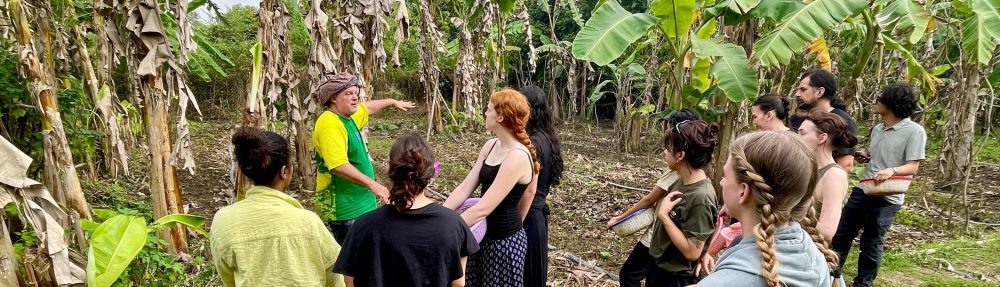
While following a path through the underbrush, I happened to overhear a conversation between Sasha Elder—our Aurovillian chief of sorts—and one of the other students. Sasha described the hunting adventures of his youth when the area used to be a cashew plantation years ago. He reminisced about his childhood as he pointed out landmarks; I was fascinated at the change one piece of land could undergo in a matter of fourteen years. When describing the relatively young landscape and the goals of the forest management team, Sasha stated, “In order to be sustainable, it must grow.”

Though Sasha’s remark was simple, it struck me as more profound than an unassuming observation on the future of the forest. Yes, the forest needed to be managed properly to reinstate the indigenous tropical evergreen forest in an area that hadn’t seen such vegetation in years. As our forestry expert Dave said, trees had to be planted and thinned, biomass had to be encouraged, and careful watering schemes had to be implemented in order for healthy forest growth and development to occur.

But perhaps Sasha’s statement went a bit deeper. Sasha meant to describe the evergreen forest but had also inadvertently defined the purpose of every individual in the practicum. While we’re here to give back to the community, we’re also here to grow personally. Every person we meet in India contributes another piece to our life landscape and teaches us a lesson. Every experience deepens our understanding of the world and brings us closer to the purpose we’re meant to fulfill. Our own growth is vitally important to our lifelong individual sustainability.

Personal planting, growth, pruning and change allow the growth necessary to create meaningful and sustainable lives. My wish is that each of us can grow from this experience in a way where if someone were to hear our life story, he would think, That person used to be very different, but if I hadn’t been told that, I would have never known.

Stick no bills

By André Lavergne

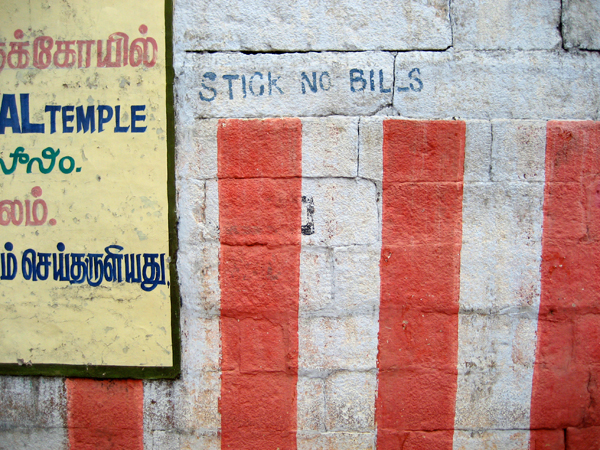
One of the first photos I took upon arriving in India was of a brick wall opposite the thousand year old temples and bas relief of Mamallapuram. I took it because it recalled a topic I’d researched this summer as part of a course called Visual Practices of the Urban: Global Paris, namely the governing of mark-making in public space. (Project notes can be seen here.) Having come to communications by way of art and design, my investigations into things cultural, economic and political are often whetted by encounters with the visual. In Paris, the notice “Défense d’afficher – Loi du 29 juillet 1881” is a familiar sight all over walls, be they private or public, and harkens back to the 3rd Republic, freedom of the press and the Déclaration of human rights after the French Revolution. Upon encountering the words “Stick No Bills” in Mamallapuram, I wondered what they might simultaneously be hiding and revealing of Indian visual culture and history. This curiosity set the course for the next few day’s exploration, as I attempted to gain some understanding of how the residents of Tamil Nadu communicate visually in and around the spaces they inhabit.

Our drive from Chennai to Mamallapuram and then to Auroville led us through rural areas where it was often difficult to determine where one village ended and the next one began. The roads we travelled were flanked by a patchwork of advertising far more dense than one might see on a typical American road trip. Long rows of roadside kiosks were covered in Vodafone red or DoCoMo brown, indifferent to the fact that few if any of these vendors sell any mobile products at all. Every usable surface of every village shop seemed to have been put to work in the service of marketing, obscuring the buildings themselves and leaving little room for the shops’ distinguishing caracteristics, names or signage. It may be said that, in small villages, shops tend to be distinguished by their owners and their placement, rather than signage. Locals perhaps don’t need signage the way someone arriving there for the first time might. Nevertheless, there seemed to me something predatory about the pervasiveness of the ads, as if the shop owners had become dependent on this form of revenue and advertisers were only too happy to seize the opportunity to dominate the landscape and, in some cases, brand entire villages.

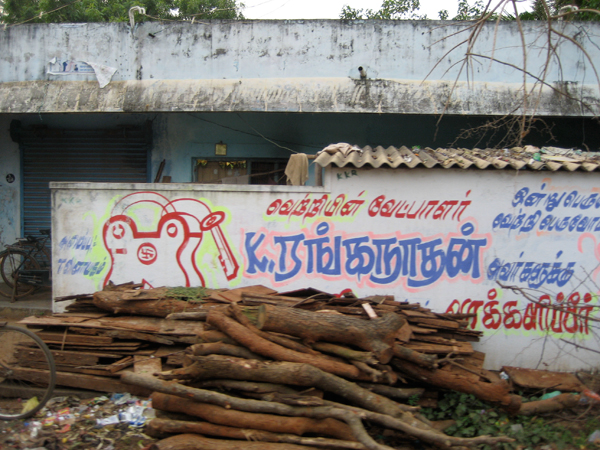
Padlock & Key: symbol of the All India United Democratic Front.

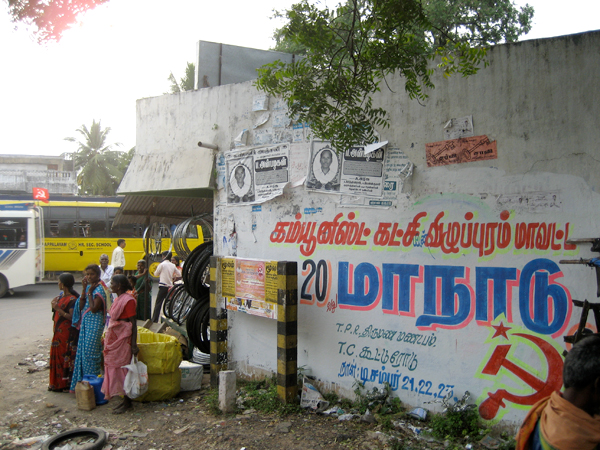
The tension between private space and advertising is playing out in another interesting way in the villages surrounding Auroville. Increasingly, the walls around properties and sometimes those of the houses themselves are painted with text in Tamil and large symbols such as a padlock and key, spectacles, two leaves, a drum, a rising sun or scissors. The sight of the hammer, sickle and star being used in a similar way provided a clue to understanding these messages. The definitive answer came from a large rally held on our fourth night here. Organizers draped a popular intersection in red hammer and sickle flags and filled the air with their amplified voices. These were the signs of electioneering. Indian political parties employ symbols they’ve previously registered with the government, in order to sign their messages and promote themselves. These are different from logos in that their form is not so strictly formalised. They are reproduced by laborers of varying skill levels all over the country, and so the way they are drawn can differ considerably from one application to the next. It is the use of any representation of the object that is protected, and not a specific drawing of it, because what matters is that no other party can use an image of that object once it has been registered, be they scissors, a mango or a bicycle. And once a party gets permission from a property owner to use a wall, the symbol is reproduced as large and as frequently as the surface will allow.

At least one town we visited is uneasy with this visual takeover. Balu, an organizer at the Mohanam Cultural Center located in Sanjeevi Nagar village expressed concerns over the practice of political parties buying their way into the town’s public sphere. He advocates for an alternative that would involve the local crafts people in a project to repaint the entire village in a way that communicates its traditions and creative practices. For his idea to be successful, Balu will have his own form of campaigning to do. He will have to compete directly with the financial incentives offered by the political parties, and convince his community that their walls have another kind of value altogether.

Spectacles: symbol of the India National Lok Dal party.

Eggplant: symbol of an unregistered local party, according to Lakshmi, a villager.

Hammer, Sickle & Star: symbol of the Communist Party of India (Marxist).

Happy here and happy there

Billboard in Pondicherry

Billboard in Pondicherry

By Katie Finnigan

Someone told me there are two grand narratives of happiness in American culture: the One the Road story about the wanderer who seeks self-fulfillment by striking out on his own; and the It’s a Wonderful Life story about the connector who finds contentment by surrounding him (or her) self with loved ones.

In India, I’m feeling pulled between the two.

We’ve only been here four days, but I’ve already been inspired and amazed. On day one, I visited temples over 1,000 years old. On day two, an elephant blessed me, twice. On day three, I learned to ride a motor scooter on bumpy dirt roads. On day four, I met the creative and passionate leaders of six grassroots organizations working to improve the lives and expand the minds of the villagers here. This is my second time in India and I doubt it will be my last. When I’m here, every day is like the past four: I always learn something new.

During the day, surrounded by palm trees, painted elephants and four-armed Hindu gods, I almost trick myself into forgetting that it’s Christmas back home, but at night, I remember everything I’m missing.

Two days ago was the first anniversary of the day my fiancé asked me to marry him. Two days from today will be Christmas. On Christmas morning, my fiancé, parents, brother, sister and dogs will be together opening presents under the tree. On Christmas Eve (Dad’s side) and Christmas day (Mom’s side), my pack of uncles, aunts and cousins will get together, like they do just a few times a year, for dinner and presents. They’ll be there, but I’ll be here, almost halfway around the world.

And even though I’m surrounded by friends, I find it almost overwhelmingly lonely to be away from my family and fiancé at Christmas. I’m stuck between the wanderer and the connector. When I’m here I’m missing home, but if I were at home I’d miss experiencing here.

There’s a Dutch word, gezellige. It’s hard to translate in English, but it means something close to cozy, warm, comfortable, homey, and loving. Right now, all I’m craving is gezellige. I want to curl up on a couch on a cold day, in front of a warm fire, playing board games with my fiancé, with my dog on my lap and a cup of hot cocoa in my hand. And I’d love to be sitting on a floor in front of a Christmas tree opening presents with my family. But at some point, I’d get bored of gezellige and my wanderlust would kick back in.

In India in general, and Auroville in particular, there is a belief in the unity of concepts that appear to be binary opposites. Science and religion, for instance, are just two perspectives on a single truth. I’m on a journey to find the unity between the wanderer and the connector, the point where I can be both without missing either. I’m hoping to find some insight into my own narrative of happiness this Christmas in Auroville, and perhaps find a spot where I’m not so pulled between staying and wandering.

Poster at True Colors, an Auroville NGOs that works with children

Searching for a perfect world

Plato’s Republic, Thomas Moore’s Utopia and….Sri Aurobindo’s Auroville?  Perhaps not the answer I would have filled in yesterday, but after an engaging talk from Deepti Tewari, a local teacher and longtime Aurovillian, it makes a lot of sense.  What I made from Deepti’s words is that Auroville at it’s core is a society that realizes that things in this world are not perfect and they are committed to trying to improve it.  Though we may have found political systems better than kings and dictators and agreed on certain human rights inherent to all humans, we certainly have not reached a society where every person and their individual rights are protected. Auroville is an experiment trying to get closer.

Though not connected to any religion, Auroville is a very spiritual place, where each practices a yoga, a way or system, to try to evolve spiritually and become better individuals, neighbors, citizens and a better community.  As described in its charter, Auroville is a place of “unending education, of constant progress, and a youth that never ages.”  After nearly 45 years of existence, Deepti stressed that the town is still far from being a utopia.  But everyday the people here are striving to be better.

So far we’ve really seen some proof of this desire.  We explore the town and are met with smiles, and friendly responses to questions.  We are able to leave our valuables in our rooms unattended without fear that they will be taken, and walk around without nervousness that we’ll be harassed.  We see genuine desire from all of the Aurovillians we meet, I can say personally from Sacha, Luc and Kalsang, to help us feel settled in quickly so that logistical things like phone cards and scooters are taken care of and we are able to dive deeper into the real purpose of our visit.

The three days that we’ve spent here have left me full of hope and inspiration to complete a project that will have a positive and meaningful affect on the community.  There is much to learn from the attitude of the Aurovillians on their search for a better way of living.


temple-ing and elephant blessings

If you ever wondered what happens in Auroville at 4:30 am, then here’s a quick breakdown: pitch-black darkness and quiet. But then the soundtrack kicks in: dogs barking and perfectly-audible chanting from the village nearby. Nothing to worry about, you just have to twist and turn in your bed for a couple of hours until the sun rises. Then you can either stare at the ceiling or, if you’re lucky enough to live in the International Pavilion, you can go up in the tree-house and treat yourself to some early morning reading. The only downside is that you have to re-read the same sentence over and over again, because you can easily be distracted by the beauty of nature waking up.

When alone-time “I don’t think it’s appropriate to wake up my roommates at 6 am” ends, group activities start. Yoga is number one on the list. Our yoga session accomplished two main goals: relieving the post-travel tenseness and helping us discover muscles we didn’t even know existed in our bodies.

The day continued with an info-sesh that combined cultural trivia with more serious stuff. I won’t go through the innumerable fun India facts and fascinatingly complex mythology, because hey, we are more than tourists, we are here to do an important job and we should focus on that. Today we learned about our role and the purposes of the practicum: it’s all about gaining work experience within an academic frame. But there are millions of questions that we are not able to answer yet. The key word is sustainability and all our thoughts are supposed to revolve around it. There are a lot of “how’s” involved in the equation, but there wasn’t enough time to ponder the information because we had to get going.

Hello Pondicherry, hello madness, hello “how the hell do I cross the street without getting killed”. We also had our first NGO visit: Sahodaran Community Health Oriented Development Society. Ganesh gave us a very comprehensive overview of the organization: they help members of homosexual and transgender communities in any way possible. Discrimination of these groups is highly encouraged by cultural practices but also by Indian laws, so besides the advocacy involvement, this organization provides a safe haven for anyone who seeks it. There are numerous services available, such as doctors, counselors reachable in person or via phone, but most important a hang-out area to do anything, be it watching TV or dressing in drag.

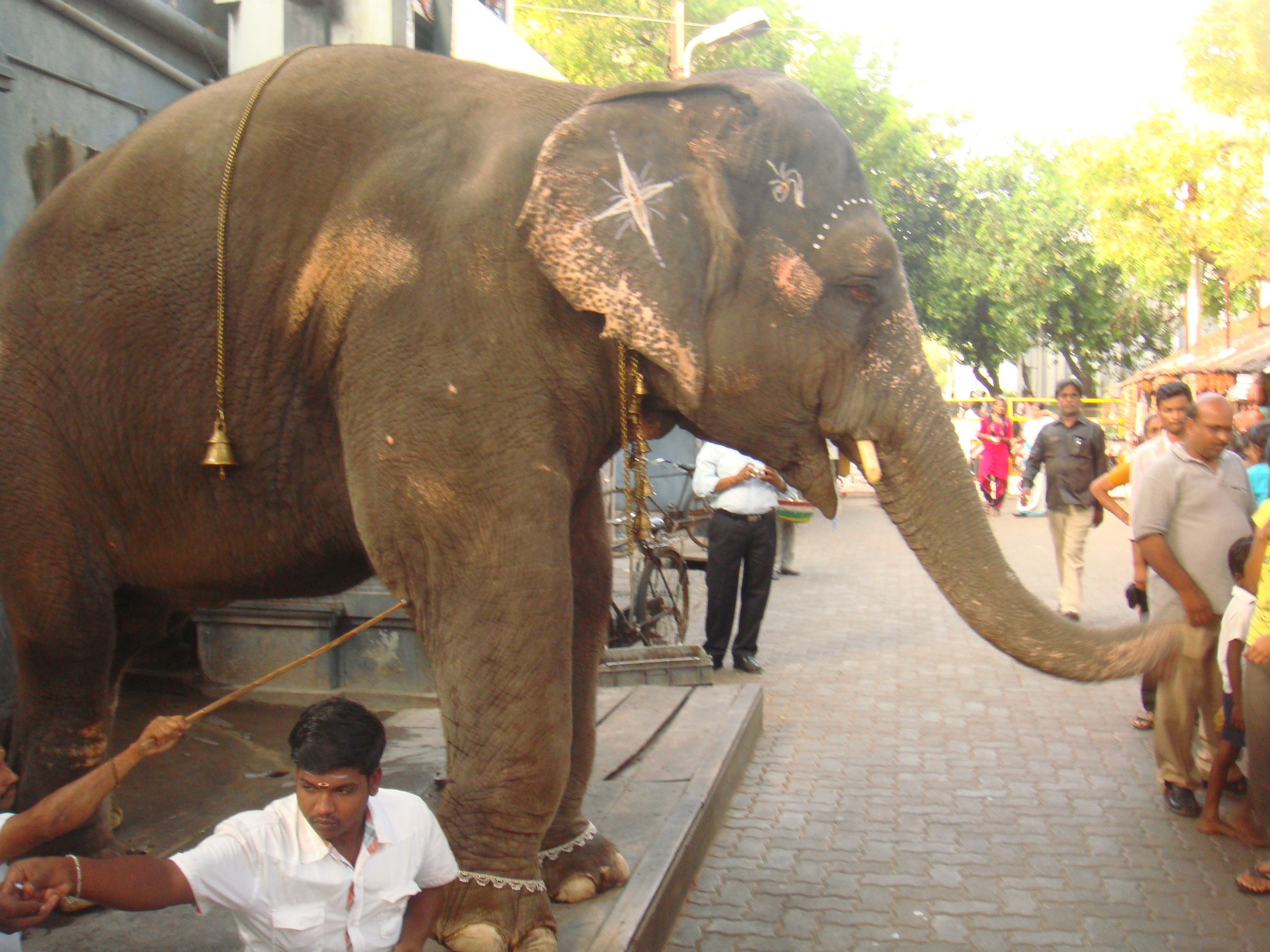
It was soon time for touristy stuff in Pondicherry. We had a choice between visiting the temple and shopping in the market. Besides providing a moment of total culture shock, the temple proves that mixing religion with business isn’t necessarily a bad idea. The welcoming committee is an elephant offering its blessing by placing its trunk on your head (for a small fee, of course). As connoisseurs of local culture, we take our shoes off before entering only to have them kicked out of the way by a very angry young little boy. We can’t just leave them there, we have to give them to him and pay for the service. The main event arrives: we finally enter the temple. As beautiful as it is, it’s equally overwhelming: an explosion of colors and constant hustle. There are pictures of deities all over the walls, people praying and the exit is through the gift shop. Next stop: the burial place of Auroville’s emblem: the Mother. This time the shoe deposit service is free and the interior is much calmer. We went through the vivid garden until we reached the central area where we found a beautiful tomb decorated with fresh flowers surrounded by people mediating.

The day came to an end with a walk along the promenade. We saw the ocean, we enjoyed the sound of the waves and we rewarded ourselves with a break at a nice terrace. Hello India, hello all types of learning, hello tomorrow’s new adventure.

Image

Sorana Ionascu

Moving Mountains

by Deborah First-Quao

As soon as we got out of the airport it was clear that we were no longer in Paris anymore, simply by the way each car that surrounded our bus honked incessantly. But the noise was very worth it because it kept us awake  long enough to witness some of the most beautiful and rare collaboration of man and nature’s workmanship.

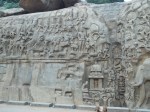
The Mahabalipuram Monuments in Tamil Nadu  are listed on UNESCO’s list of World Heritage sites. They go way back to the  7th century. They are a masterpiece, each  mountain being carved out to represent significant scenes in the Hindu Religion from time past. But they will continue to live on in my heart, imprinted forever as moving mountains.

What makes them so beautiful and moving to see is the majestic way they stand as an example of how man and nature can work together. This is something so rare, in a world of climate change and global warming which has been caused by man’s particularly egoistic quest to prove his mastery over nature.

But we are always humbled when we see things that we cannot explain or take credit for. For example, not far from the temple sits a big boulder that balances on just a tiny surface of ground. One would think that at any moment it will shake loose and roll down, considering that it is situated precariously on a downward slope. The guide tells us that the god Krishna put this “butter ball” there and it has not moved for centuries, despite earthquakes, cyclones and tsunamis.

This object is humbling to humanity, who cannot compare any art to that which nature creates herself. This lesson in humility was learned by great kings, such as the one whose story the tour guide recounted to us. The carvings on one of the temples tell the story of a great king who had a great empire and owned lots of wealth. He told people that if they made a wish he would surely have the power to grant it. One of the gods disguised himself as a little boy and told the king that he wanted a portion of land that he would measure with only 3 steps. The king granted it and when the day came, the god put one foot on earth and one in the sky and just with that, he had no place left to lay his third step. Looking down at the king he laughed, reminding the king of how much he had promised. The king, understanding his lesson bowed his head, and asked the god to use it as a stepping stone. The god did, driving his head into the ground. The king is known for his great sacrifice and the carvings live on today to remind us all about the vanity of man.

These days, man does not work with nature anymore – he tries to recreate it, manipulate it, force it, but not work with it. Hopefully, this time in India, in all the things we see – from the relentless post card sellers, to the beggar with the monkey in the red dress who does tricks for a penny,  the hoardes of women dressed in red and gold saris, or the leper who waits outside the temple grounds,  the wandering goats, and the jet lagged tourists, we this generation can reflect on this principle of life, so we can make our future truly sustainable.