Stick no bills

By André Lavergne

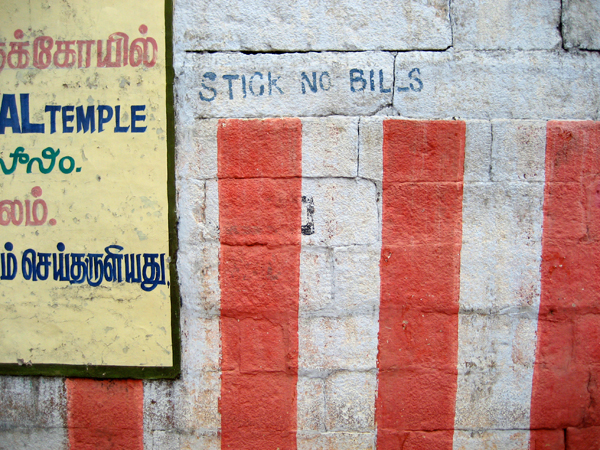
One of the first photos I took upon arriving in India was of a brick wall opposite the thousand year old temples and bas relief of Mamallapuram. I took it because it recalled a topic I’d researched this summer as part of a course called Visual Practices of the Urban: Global Paris, namely the governing of mark-making in public space. (Project notes can be seen here.) Having come to communications by way of art and design, my investigations into things cultural, economic and political are often whetted by encounters with the visual. In Paris, the notice “Défense d’afficher – Loi du 29 juillet 1881” is a familiar sight all over walls, be they private or public, and harkens back to the 3rd Republic, freedom of the press and the Déclaration of human rights after the French Revolution. Upon encountering the words “Stick No Bills” in Mamallapuram, I wondered what they might simultaneously be hiding and revealing of Indian visual culture and history. This curiosity set the course for the next few day’s exploration, as I attempted to gain some understanding of how the residents of Tamil Nadu communicate visually in and around the spaces they inhabit.

Our drive from Chennai to Mamallapuram and then to Auroville led us through rural areas where it was often difficult to determine where one village ended and the next one began. The roads we travelled were flanked by a patchwork of advertising far more dense than one might see on a typical American road trip. Long rows of roadside kiosks were covered in Vodafone red or DoCoMo brown, indifferent to the fact that few if any of these vendors sell any mobile products at all. Every usable surface of every village shop seemed to have been put to work in the service of marketing, obscuring the buildings themselves and leaving little room for the shops’ distinguishing caracteristics, names or signage. It may be said that, in small villages, shops tend to be distinguished by their owners and their placement, rather than signage. Locals perhaps don’t need signage the way someone arriving there for the first time might. Nevertheless, there seemed to me something predatory about the pervasiveness of the ads, as if the shop owners had become dependent on this form of revenue and advertisers were only too happy to seize the opportunity to dominate the landscape and, in some cases, brand entire villages.

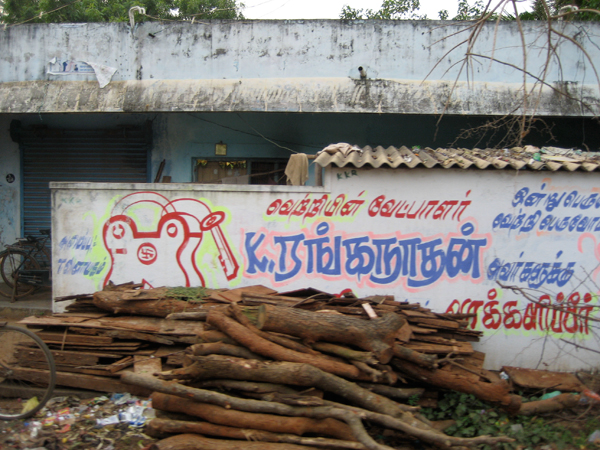
Padlock & Key: symbol of the All India United Democratic Front.

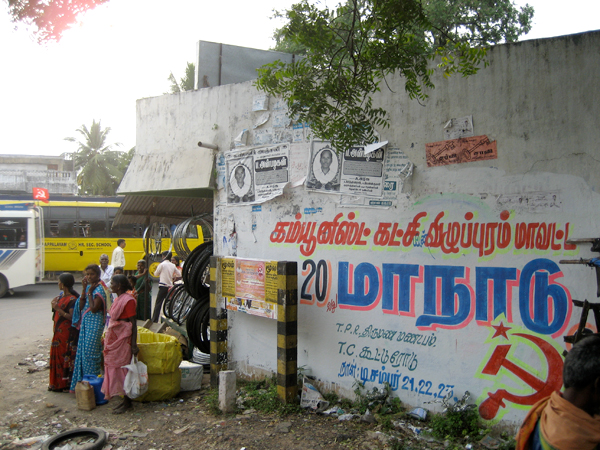
The tension between private space and advertising is playing out in another interesting way in the villages surrounding Auroville. Increasingly, the walls around properties and sometimes those of the houses themselves are painted with text in Tamil and large symbols such as a padlock and key, spectacles, two leaves, a drum, a rising sun or scissors. The sight of the hammer, sickle and star being used in a similar way provided a clue to understanding these messages. The definitive answer came from a large rally held on our fourth night here. Organizers draped a popular intersection in red hammer and sickle flags and filled the air with their amplified voices. These were the signs of electioneering. Indian political parties employ symbols they’ve previously registered with the government, in order to sign their messages and promote themselves. These are different from logos in that their form is not so strictly formalised. They are reproduced by laborers of varying skill levels all over the country, and so the way they are drawn can differ considerably from one application to the next. It is the use of any representation of the object that is protected, and not a specific drawing of it, because what matters is that no other party can use an image of that object once it has been registered, be they scissors, a mango or a bicycle. And once a party gets permission from a property owner to use a wall, the symbol is reproduced as large and as frequently as the surface will allow.

At least one town we visited is uneasy with this visual takeover. Balu, an organizer at the Mohanam Cultural Center located in Sanjeevi Nagar village expressed concerns over the practice of political parties buying their way into the town’s public sphere. He advocates for an alternative that would involve the local crafts people in a project to repaint the entire village in a way that communicates its traditions and creative practices. For his idea to be successful, Balu will have his own form of campaigning to do. He will have to compete directly with the financial incentives offered by the political parties, and convince his community that their walls have another kind of value altogether.

Spectacles: symbol of the India National Lok Dal party.

Eggplant: symbol of an unregistered local party, according to Lakshmi, a villager.

Hammer, Sickle & Star: symbol of the Communist Party of India (Marxist).

Happy here and happy there

Billboard in Pondicherry

Billboard in Pondicherry

By Katie Finnigan

Someone told me there are two grand narratives of happiness in American culture: the One the Road story about the wanderer who seeks self-fulfillment by striking out on his own; and the It’s a Wonderful Life story about the connector who finds contentment by surrounding him (or her) self with loved ones.

In India, I’m feeling pulled between the two.

We’ve only been here four days, but I’ve already been inspired and amazed. On day one, I visited temples over 1,000 years old. On day two, an elephant blessed me, twice. On day three, I learned to ride a motor scooter on bumpy dirt roads. On day four, I met the creative and passionate leaders of six grassroots organizations working to improve the lives and expand the minds of the villagers here. This is my second time in India and I doubt it will be my last. When I’m here, every day is like the past four: I always learn something new.

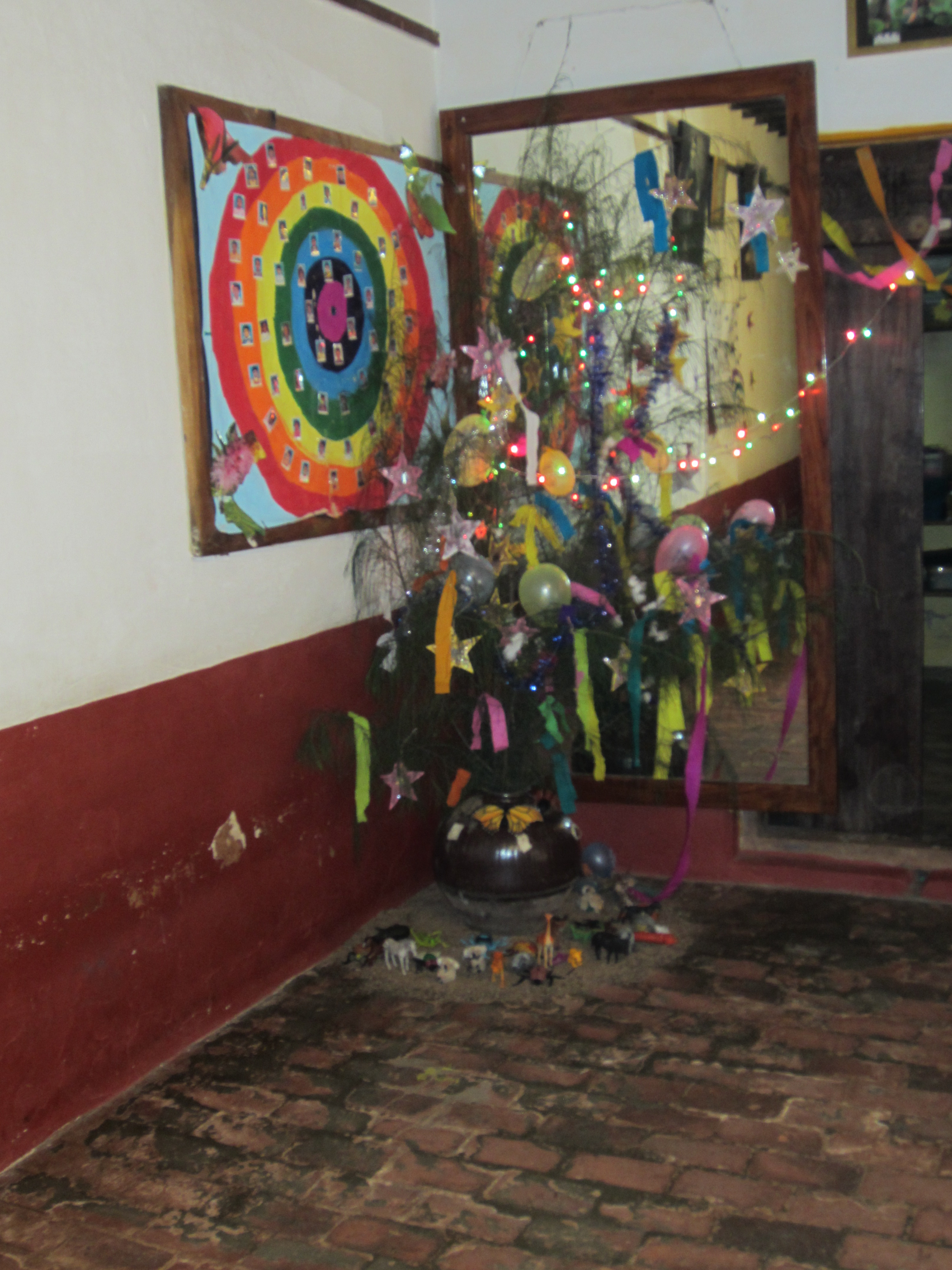
During the day, surrounded by palm trees, painted elephants and four-armed Hindu gods, I almost trick myself into forgetting that it’s Christmas back home, but at night, I remember everything I’m missing.

Two days ago was the first anniversary of the day my fiancé asked me to marry him. Two days from today will be Christmas. On Christmas morning, my fiancé, parents, brother, sister and dogs will be together opening presents under the tree. On Christmas Eve (Dad’s side) and Christmas day (Mom’s side), my pack of uncles, aunts and cousins will get together, like they do just a few times a year, for dinner and presents. They’ll be there, but I’ll be here, almost halfway around the world.

And even though I’m surrounded by friends, I find it almost overwhelmingly lonely to be away from my family and fiancé at Christmas. I’m stuck between the wanderer and the connector. When I’m here I’m missing home, but if I were at home I’d miss experiencing here.

There’s a Dutch word, gezellige. It’s hard to translate in English, but it means something close to cozy, warm, comfortable, homey, and loving. Right now, all I’m craving is gezellige. I want to curl up on a couch on a cold day, in front of a warm fire, playing board games with my fiancé, with my dog on my lap and a cup of hot cocoa in my hand. And I’d love to be sitting on a floor in front of a Christmas tree opening presents with my family. But at some point, I’d get bored of gezellige and my wanderlust would kick back in.

In India in general, and Auroville in particular, there is a belief in the unity of concepts that appear to be binary opposites. Science and religion, for instance, are just two perspectives on a single truth. I’m on a journey to find the unity between the wanderer and the connector, the point where I can be both without missing either. I’m hoping to find some insight into my own narrative of happiness this Christmas in Auroville, and perhaps find a spot where I’m not so pulled between staying and wandering.

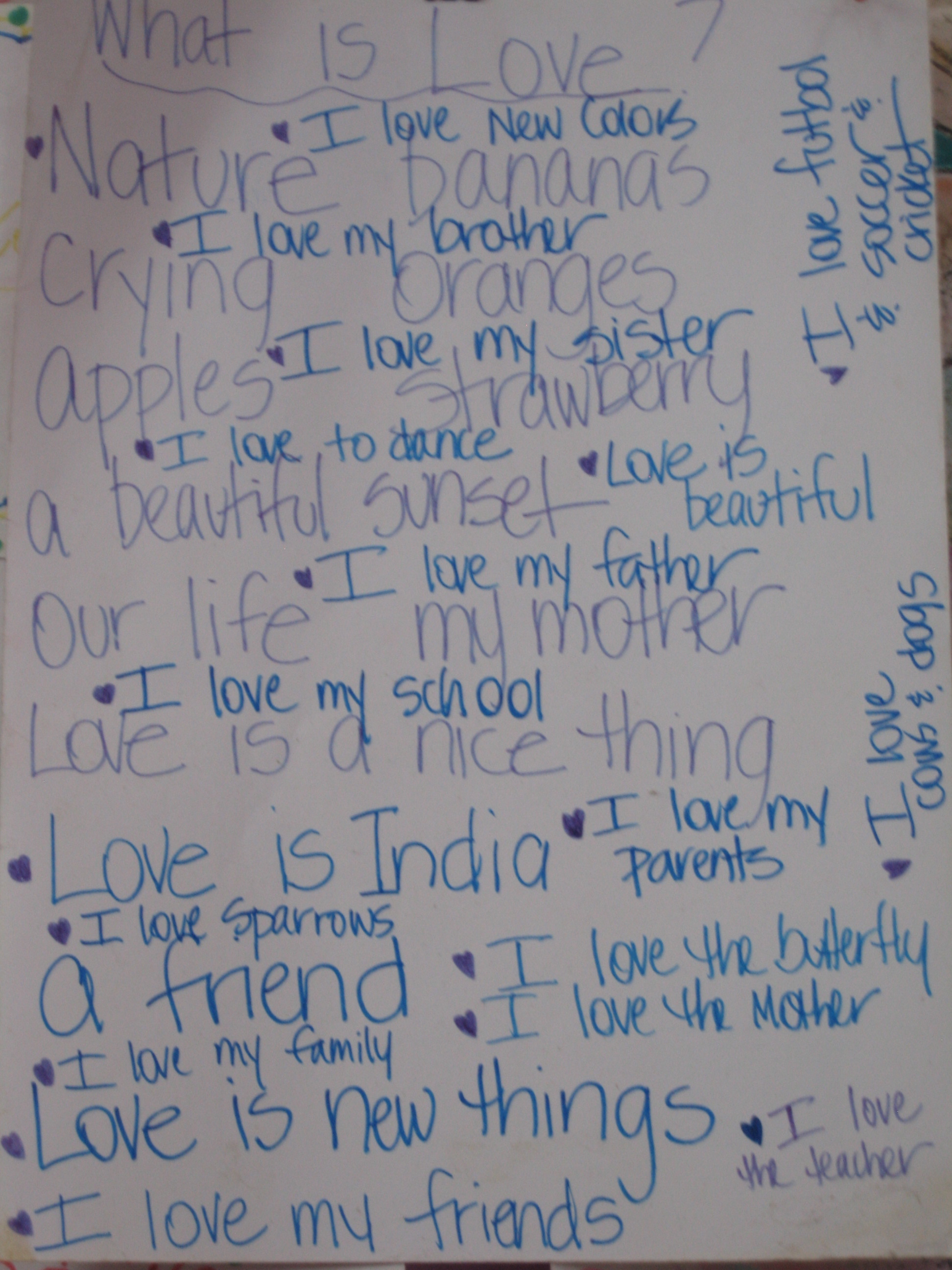
Poster at True Colors, an Auroville NGOs that works with children

Searching for a perfect world

Plato’s Republic, Thomas Moore’s Utopia and….Sri Aurobindo’s Auroville?  Perhaps not the answer I would have filled in yesterday, but after an engaging talk from Deepti Tewari, a local teacher and longtime Aurovillian, it makes a lot of sense.  What I made from Deepti’s words is that Auroville at it’s core is a society that realizes that things in this world are not perfect and they are committed to trying to improve it.  Though we may have found political systems better than kings and dictators and agreed on certain human rights inherent to all humans, we certainly have not reached a society where every person and their individual rights are protected. Auroville is an experiment trying to get closer.

Though not connected to any religion, Auroville is a very spiritual place, where each practices a yoga, a way or system, to try to evolve spiritually and become better individuals, neighbors, citizens and a better community.  As described in its charter, Auroville is a place of “unending education, of constant progress, and a youth that never ages.”  After nearly 45 years of existence, Deepti stressed that the town is still far from being a utopia.  But everyday the people here are striving to be better.

So far we’ve really seen some proof of this desire.  We explore the town and are met with smiles, and friendly responses to questions.  We are able to leave our valuables in our rooms unattended without fear that they will be taken, and walk around without nervousness that we’ll be harassed.  We see genuine desire from all of the Aurovillians we meet, I can say personally from Sacha, Luc and Kalsang, to help us feel settled in quickly so that logistical things like phone cards and scooters are taken care of and we are able to dive deeper into the real purpose of our visit.

The three days that we’ve spent here have left me full of hope and inspiration to complete a project that will have a positive and meaningful affect on the community.  There is much to learn from the attitude of the Aurovillians on their search for a better way of living.


Healthy Plate Update

Perhaps you’re curious about the food here in Auroville.  We’ll there are a plethora of options from very traditional Indian cuisine to more elaborate western dishes.  One offering that has caught my interest, and that of a few others, is the “healthy plate” offered at the visitor’s center cafe.  The healthy plate offers a soup, starch, bean, salad and dessert — all for just 155 rupees, or roughly two euros twenty (3 US Dollars). Today’s selection included:

Pumpkin Soup

Baked Potatoes with Creamy Leek Sauce

Garbanzo Bean Salad

Carrot and Beet Salad

Fresh Pineapple


temple-ing and elephant blessings

If you ever wondered what happens in Auroville at 4:30 am, then here’s a quick breakdown: pitch-black darkness and quiet. But then the soundtrack kicks in: dogs barking and perfectly-audible chanting from the village nearby. Nothing to worry about, you just have to twist and turn in your bed for a couple of hours until the sun rises. Then you can either stare at the ceiling or, if you’re lucky enough to live in the International Pavilion, you can go up in the tree-house and treat yourself to some early morning reading. The only downside is that you have to re-read the same sentence over and over again, because you can easily be distracted by the beauty of nature waking up.

When alone-time “I don’t think it’s appropriate to wake up my roommates at 6 am” ends, group activities start. Yoga is number one on the list. Our yoga session accomplished two main goals: relieving the post-travel tenseness and helping us discover muscles we didn’t even know existed in our bodies.

The day continued with an info-sesh that combined cultural trivia with more serious stuff. I won’t go through the innumerable fun India facts and fascinatingly complex mythology, because hey, we are more than tourists, we are here to do an important job and we should focus on that. Today we learned about our role and the purposes of the practicum: it’s all about gaining work experience within an academic frame. But there are millions of questions that we are not able to answer yet. The key word is sustainability and all our thoughts are supposed to revolve around it. There are a lot of “how’s” involved in the equation, but there wasn’t enough time to ponder the information because we had to get going.

Hello Pondicherry, hello madness, hello “how the hell do I cross the street without getting killed”. We also had our first NGO visit: Sahodaran Community Health Oriented Development Society. Ganesh gave us a very comprehensive overview of the organization: they help members of homosexual and transgender communities in any way possible. Discrimination of these groups is highly encouraged by cultural practices but also by Indian laws, so besides the advocacy involvement, this organization provides a safe haven for anyone who seeks it. There are numerous services available, such as doctors, counselors reachable in person or via phone, but most important a hang-out area to do anything, be it watching TV or dressing in drag.

It was soon time for touristy stuff in Pondicherry. We had a choice between visiting the temple and shopping in the market. Besides providing a moment of total culture shock, the temple proves that mixing religion with business isn’t necessarily a bad idea. The welcoming committee is an elephant offering its blessing by placing its trunk on your head (for a small fee, of course). As connoisseurs of local culture, we take our shoes off before entering only to have them kicked out of the way by a very angry young little boy. We can’t just leave them there, we have to give them to him and pay for the service. The main event arrives: we finally enter the temple. As beautiful as it is, it’s equally overwhelming: an explosion of colors and constant hustle. There are pictures of deities all over the walls, people praying and the exit is through the gift shop. Next stop: the burial place of Auroville’s emblem: the Mother. This time the shoe deposit service is free and the interior is much calmer. We went through the vivid garden until we reached the central area where we found a beautiful tomb decorated with fresh flowers surrounded by people mediating.

The day came to an end with a walk along the promenade. We saw the ocean, we enjoyed the sound of the waves and we rewarded ourselves with a break at a nice terrace. Hello India, hello all types of learning, hello tomorrow’s new adventure.

Image

Sorana Ionascu

Moving Mountains

by Deborah First-Quao

As soon as we got out of the airport it was clear that we were no longer in Paris anymore, simply by the way each car that surrounded our bus honked incessantly. But the noise was very worth it because it kept us awake  long enough to witness some of the most beautiful and rare collaboration of man and nature’s workmanship.

The Mahabalipuram Monuments in Tamil Nadu  are listed on UNESCO’s list of World Heritage sites. They go way back to the  7th century. They are a masterpiece, each  mountain being carved out to represent significant scenes in the Hindu Religion from time past. But they will continue to live on in my heart, imprinted forever as moving mountains.

What makes them so beautiful and moving to see is the majestic way they stand as an example of how man and nature can work together. This is something so rare, in a world of climate change and global warming which has been caused by man’s particularly egoistic quest to prove his mastery over nature.

But we are always humbled when we see things that we cannot explain or take credit for. For example, not far from the temple sits a big boulder that balances on just a tiny surface of ground. One would think that at any moment it will shake loose and roll down, considering that it is situated precariously on a downward slope. The guide tells us that the god Krishna put this “butter ball” there and it has not moved for centuries, despite earthquakes, cyclones and tsunamis.

This object is humbling to humanity, who cannot compare any art to that which nature creates herself. This lesson in humility was learned by great kings, such as the one whose story the tour guide recounted to us. The carvings on one of the temples tell the story of a great king who had a great empire and owned lots of wealth. He told people that if they made a wish he would surely have the power to grant it. One of the gods disguised himself as a little boy and told the king that he wanted a portion of land that he would measure with only 3 steps. The king granted it and when the day came, the god put one foot on earth and one in the sky and just with that, he had no place left to lay his third step. Looking down at the king he laughed, reminding the king of how much he had promised. The king, understanding his lesson bowed his head, and asked the god to use it as a stepping stone. The god did, driving his head into the ground. The king is known for his great sacrifice and the carvings live on today to remind us all about the vanity of man.

These days, man does not work with nature anymore – he tries to recreate it, manipulate it, force it, but not work with it. Hopefully, this time in India, in all the things we see – from the relentless post card sellers, to the beggar with the monkey in the red dress who does tricks for a penny,  the hoardes of women dressed in red and gold saris, or the leper who waits outside the temple grounds,  the wandering goats, and the jet lagged tourists, we this generation can reflect on this principle of life, so we can make our future truly sustainable.

True Blood

Christoph Niemann, The New York Times

By Lindsay Hebert

“Just count to 10. It will be over before you know it. Come on, I’ll count with you. Ok…Breathe…One…Two…”

It was over at three.

That was my mom speaking. I am a 26-year-old woman who flew her mother from L.A. to Paris because she had to get a shot.

Continue reading

Arrival in India!

We arrived at Charles de Gaulle airport around 9h, met up, then spent at least half an hour in line getting our tickets. We did it in small scattered groups and didn’t have too many problems. The guy at the first class desk started helping economy passengers, but between each passenger he would go off and talk with his colleagues for 5 minutes. Our next stop was waiting over an hour and a half in line for security. There was a strike at French airports that day, which is probably why thigns were so slow. I heard the previous day, at another airport, no flights left until 13h. Our flight left late because of the delays and our connecting flight almost left without us.
We flew Qatar Airlines to India. On the first flight, the stewardess kept forgetting to give part of the meal to myself and the person sitting next to me, though everyone around us got their meals. Both of us also had broken headphones. The person next to me tried to look inside the pouch with magazines on the back of the seat, and the entire pouch came off the seat. On the second flight, I asked for a drink shortly after we got on and didn’t receive it until halfway through the flight a good 2 hours later. My seat tray also slid off the mounting rails. The stewardesses seemed hurried and distracted the entire flight.
We finally arrived in Chennai, India around 3h40. Going through immigration was a bit of a hassle for some people. Sometimes they’d be asked for information other weren’t, or they’d be harassed for simple mistakes like getting the date of arrival one day off because of the changing times. After going to pick up our luggage, we learned one girl’s luggage hadn’t arrived with us. It took a good 2 hours for her and the prof to get everything straightened out. The rest of us congregated, talked, shared snacks, and killed time. We were then told we had to go through customs and wait on the other side, despite people being in the bathroom while everyone else watched their luggage and the one girl still filling out forms and jumping through hoops regarding her lost luggage. We did eventually all pile into a tourist bus and left the airport.

India Calling

Eyes balls reddened, pulsing tightly against the contradictory cool of the night’s air.  It’s a blustery December night in Paris, as sure as the tides swing, the deadline season brings forth a nocturnal turn amongst the student species. Computer screens flicker over frustrated desks. Coffee rings and cigarette butts punctuate the sedimentary layers of notes, articles, journals and clippings, the metallic light freezing it all in its flustered chaos.  The eyes endure the tight weight of long days (and longer nights) glancing between reams of notes and a stark white rectangle, unrelenting in its alienating glow. Tome after tome, we read. Tip after tap, we type.  India feels like a long way away.

Scuttling around Paris with a burdenous school sack, weighed down throughout the working week with its accumulated materials, apparently real gravitas is supposed to hurt your shoulders. India India Tamil Tamil Nadu Nadu, meaningless flecks on a flooded mental radar. Paris, ordered by the ghosts of prestige, jealously jail us from fully realizing what is encoded in these words. What escapes conscious comprehension can be felt. India is screaming at us, its cries relegated to a dull drone by distracting demands, but we can feel what we are kept from knowing.

Sure enough, dates tick by as the 19th approaches. Our lenses of subjectivity wearily twist through fuzz to attempt a focus, to allure forth our dreams of Auroville into their full reign of significance. Anything India pops forth from the blur of modernity like gleaming sapphires in a torrent of gravel. Any bookstore serves as fertile ground for these indulgences, excited forays into sections of Kim or stolen glances into Lonely Planet guides you cant afford slowly tickle forth a burgeoning realization. Any amount of awkward stares from store clerks are endured for fleeting moments with these foggy windows of insight. Our impending adventure is slowly becoming real as the ripples of repressed enthusiasm reverberate into crescendo, echoing in to knowing.

Preparation meetings trundle forward in their course. The team’s grins gleam; excitable smiles are shared as we are relieved in the cathartic glee of our cluelessness, a tribute to our excitable openness, and perhaps, our greatest asset. Dutifully we prepare, collect our resources and equipment, and, collect ourselves to contribute our totality towards great-unknown experiences. I paid a man €145 to inject me with 3 tropical diseases, all for the cause.

My ears crook to the delicate shock of a beep, my pulsing red eyes lethargically follow. A new message just zapped into my email inbox, the blur reads ‘Monsoon Monsoon Warning Warning Power Power Cuts Cuts’.  Sh*t just got real and we couldn’t be happier for it.

Tim Capener

timcapener@gmail.com

Revisiting New Years in India

Finally back here in Paris, and seemingly fitting that I should finally be able figure out the Internet  on the last day of the first month of the year, I wanted to post the New Years video I made, which stubbornly wouldn’t upload for 31 days no matter what I tried.

Please take a look at my post from January 3rd, and then watch the video.  It’s so nice to be able to look back and think about where we were just before this new year, which is already shaping up to be better than last.  31 days later, I want to wish everyone the happiest and healthiest New Year.  And for the record, my room is still not clean.  Oh well. 🙂

https://aupindia.wordpress.com/2011/01/03/new-years-in-auroville/