A short visit in the world of development in the suburbs of Pondicherry: A donor – beneficiary story

As long as I recall there has been a critique on where all the foreign aid is going. The critics would say that aid is just a way of making the wealthy West wealthier. The Liberals on the other hand would consider aid as a way to integrate and develop the rest of the decolonized world.

The following is a true story of how the relationship between donors and beneficiaries is constructed. David and Paula, a couple from England, have been giving money every year to an NGO (Non- Governmental Organization) named Karuna. The organization in Britain receives money from thousands of generous people like David and Paula every year. The organization has certain values that they care about. In this story the focus will be on women empowerment and Dalit discrimination.

ADECOM is an NGO based in Pondicherry on the south east coast of India, in the region called Tamil Nadu. Despite the distance between the donor and the receiver, both organizations maintain a great relationship.

On their annual holiday, David and Paula decided to engage with reality. They have been giving money for 25 years. Finally they called Karuna, got a permission through ADECOM to visit the VTC (Village Training Center), and a few mouse-clicks later had organized a trip to India.

Finally on New-year’s day, the entire office at ADECOM was stuffed with people. David and Paula got the best chairs at the center. They were given a big golden necklace and were treated as VIPs. They listened to different speakers, who described the current situation and explained how the organization works towards future goals and visions for the society. The speeches turned out to be more of a question and answer session about the issues at hand.

After being offered a lunch, the car took them off to the VTC in the suburbs of Pondicherry. The women at the center are waiting. Now, finally their donors were coming, to see them sew. The women at the VTC explained in Tamil and demonstrated the skills. Some children ran around and the atmosphere was joyful. David and Paula got to talk to the women through an interpreter. They heard stories of how women without a prospect for a future actually had been empowered and the money coming in from the other continent was not in vain.

Some of the skills taught in VTC are sewing. The program is initiated to empower Dalit women in their struggle to find an income to survive on. In India today, 165 000 000 Dalits or “untouchables” are struggeling for survival. The discrimination is worst for women since both the gender- and the caste system works against them.

In the end Paula admitted that it had been very difficult for her in this situation. She felt like she had been an audience watching a show where women at the bottom of social ladder were forced to demonstrate their skills. In a perfect world this type of relationship wouldn’t be necessary. Not many organizations would let Westerners visit their projects. According to Paula, that’s because it leads to an uncomfortable situation between the donor and  beneficiaries when they meet.

The day ends with photos taken of everyone together at the training center. The mission is accomplished. The links in the production chain of aid are sealed. From the donor on the street giving money in London, through a Western organization, directly to an Indian organization and finally to the Dalit women in Pondicherry we have followed the relationships established. Later the clothes manufactured in the training center will be sold, providing an independent income for 50 women in rural India. The traditional view of just helping a few rather than none is accomplished, and the world continues its daily life like all of the other 364 days a year – but maybe with a few more smiles than before.

Carl Larsson, Linnaeus University, Sweden

At the ceremony in the suburb of Pondicherry. Here, the women at the center demonstrate their products from the village training center. David and Paula are looking at the outcome from the program they are supporting from England.   

Waste generation

Waste. Even the word brings a bitter taste to my tongue. There is too much littering and not enough reflection about it. We are all part of the process, whether we like to admit it or not. Although I consider myself aware of the problem and act on it in terms of recycling and avoiding plastic bags, I still have so much to learn.

But can I really make a difference? I have asked myself that question so many times. Wondering if my recycled milk cartons really save trees and whether the eco-friendly items I buy have less of an impact than the commercial products. Some people like to refer to life as a journey in which you constantly develop as a human being, and going to India has strengthened that interpretation of life for me.

The first time I became aware of the lack of knowledge about recycling is when I moved to New Zealand. They had no system of recycling, and when I asked my friends where I could deposit my plastic bottles they had no idea of what I was talking about. Coming to India has reinforced the feeling of how we humans destroy our planet without even thinking twice about it. In the end it does not matter where you come from or whether you recycle, it is the small things that count at the individual level.

Why carry your groceries home in plastic bags when you can bring your own bag? Why always take the car when the public transportation system is really good? Why leave non-biodegradable items in nature when you know they will litter our planet for hundreds of years? It is insane how easy it is to ignore these small steps toward a cleaner and healthier Earth, and how hard it is to change.

One of my favorite artists, Tracy Chapman, wrote a song on the subject and I cannot help but agreeing with her when she sing “Some claim to have crowned her a queen with cities of concrete and steel. But there is no glory, no honor, in what results from the rape of the world”.

Let us all contribute to a cleaner and healthier planet and start thinking about the small things. Stop putting the blame on others and examine your own behavior, for that is what will matter in the long run.

Small Steps – Eco-friendly bags

Eco Femme – Resusable cotton pads

WELLPaper – From waste to design

Bamboo Centre – Sustainable material for a wide range of products

Wasteless – “Reduce, reuse, and recycle”

Louise Jönsson Andersson, Linnaeus University, Växjö, Sweden

Aurovill(sust)ainable

Hello!
My name is Isabell Sundman and I am in my senior year in undergraduate studies in Development Communication at Linnaeus University, Sweden. 
What else you need to know about me is that Bob Marley’s sweet tunes of Sun is Shining is constantly playing in my head. Also, for me freedom is to walk barefoot but I shouldn’t here due to scorpions and venomous snakes.

There are as many definitions and perceptions of Sustainable Development as there are individual in Auroville. So by what means can one use communication to maintain the concept alive and functional within such unique place as Auroville?

When there is a lack of opportunities for Aurovilians to contribute their own knowledge into their community it could reduce chances of mainting the current culture of Sustainable Development. This culture is evident in Auroville’s vocabulary where alterations have been made.  For example taxes are referred to as contributions and instead of the word governance one talks around it without using an actual word. These changes are needed for Auroville to dissociate itself from the main stream society that lacks the values of human unity and universal solidarity which Aurovilians are searching for. Creating unique ways to communicate, contributes to sustainability by creating feelings of inclusiveness, this is what is applied by being a true Aurovilan, which appears to be of great importance and it is the sense of community that maintains the concept of Sustainable Development alive and functional within Auroville

Furthermore..
Auroville is without laws; the legal system dependence on the individual’s strive to behave as “a true Aurovillian”.  Social Pressure upholds Auroville and its culture. It retains people within the frames and insures that no one misbehave which in the worst case can lead to exclusion from the community. Communication is a useful tool to use when social pressure needs to be shared amongst people. I believe within Auroville there is an understanding of the importance of communications to guide human behavior.
Click on the link to discover how to become a true Aurovillian. http://www.auroville.org/vision/tobeatrueavlian.htm

Love, Isabell Sundman

Auroville

Hello Johannes writing.

Some thoughts and reflections from my first week in India, is that Auroville is a really cool and interesting place. You know when you get that feeling –why haven’t I done this before? That is the feeling I get being here in Auroville.  As I have experienced it so far this is a place with a lot of love and an aspiration for solidarity and happiness for everyone. Who would not want to visit a place like that?

I have met a lot of interesting people and my view of the world is getting clearer through this experience.  There are loads of different projects going on here in the spirit of better sustainable and alternative approaches. It is impossible to explain this place in a blog post, so I will just recommend a visit instead, to get a preview and more information you can watch this youtube-documentary http://www.youtube.com/watch?v=TrlYo75fSXU.

It has also been exiting to get to know this place and to realize that there are more searchers, spiritual people and philosophers out there trying to find a sustainable way to live a happy life filled with love. I hope you are also one of them otherwise become one. Love is cool, not tribal-tattoos and MTV 😉

Ps. Of course India with its heat, culture, geckos and beaches are attractions to see as well, but that is not unique to the same extent as Auroville is to me. This is why I focused on the community Auroville and its interesting people in this blog post.

To sum it up, so far very good, interesting and inspiring. It doesn’t matter to me that it sometimes feels like I am in the Dharma initiative in the TV-series Lost. Their village was even  called Dharmaville by the way, if I am not mistaken J But do similarities with them have to be a bad thing?

Take care // Johannes Öhlund, Auroville, December 25, 2013

From carrier of disease to carrier of life

Image

Human rights, humanitarian rights, legal rights, and basic human rights – as we say in Swedish – ‘kärt barn har många namn’ (a loved child goes by many names).

Another thing that goes by many names is uisce, vatten, eau, Wasser, agua, and acqua.

Water, something we take for granted. It is something everybody should be able to take for granted. We let it run & drop. We use over 100 litres to wash ourselves just because it’s nice. We forget how long the glass of water was standing there so we throw it out. We forget to take with us the empty refill bottle so we buy a new one. We fancy a bit of sparkling water with a taste of synthetic pineapple so we buy some.

Recognise yourself?

Lucky you!

Recognise that we are fortunate enough to be able to enjoy one of the most basic human rights that should be granted everyone – access to affordable and clean drinking water.

Imagine not being able to afford to buy clean drinking water. Imagine having to drink the water from the same place where you do your washing and attend to your other ‘needs’.

How long do you think you would stay healthy and have the strength to go to work and provide for your family? How easy would it be for you to concentrate on your studies? How long would you survive?

Lack of access to clean drinking water is a reality for millions of people in India (and around the world). Only a quarter of the population in India is provided with clean drinking water, only 67% treat their water despite the high risk of it being contaminated. 12% has no access to drinking water (www.unicef.org).

Cleansing power

Water has a special meaning in India. The Hindu culture believes in the physical and spiritual cleansing power of water. It is perceived as a carrier of life and destroyer of evil. It features in ancient tales and art – even the etymology of the word derives back to water – to ‘Indus River’.

So, close your eyes, imagine being a part of a movement that delivered water to all of India through taps. Taps that are strategically placed in communities and cities, where people could, for a cost lesser than that of bottled water, collect affordable and clean drinking water. Does it sounds too good to be true? Well it’s not.

amrutDhara is “a social enterprise for reducing the use of bottled water by offering a safe, cost-effective and environment friendly alternative” to all of India. It will not only have a massive impact on the health of people but also on the environment.

Get on board

amrutDhara needs supporters; they need some help with getting the Indian Government and policy makers onboard. They need people that can help them get a national campaign off the ground. Do you want to be a part of it?

All you need to do is connect to amrutDhara on Twitter and Facebook, share with your friends, talk about water, tweet about water, post pictures about water, write a song about water if you want – whatever – as long as you raise your voice!

Help make water a carrier of life instead of carrier of disease. Drink your next glass of water knowing that you are a part of enablingmillion of others to do the same!

//Angela Fjordmark, Linnaeus University

To find out more, visit http://www.amrutdhara.in

Image

Great Expectations: Day One of Our India Practicum Projects

Dec. 30, 2013

“Individuals and society are mutually dependent and influential. Better-informed individuals will create better-informed society even as the latter influences the behavior of the former.” JV Vilanilam, Development Communication in Practice

Everyone’s development communications projects started today. Twenty students will work for two weeks at 13 organizations with mainly education, social justice and environmental protection mandates. The students, in our first day without a set schedule for everyone, headed out to meetings with the heads of our chosen organization to discuss and outline a sustainable communication project to complete and handover before the end of the India Practicum. 

This year there is an undeniable dynamism and cohesive energy between the joint group of AUP and Linnaeus students that leads to a unison and flow of events, creating an admirably productive atmosphere. This relates to our projects in that this year they effortlessly got divided up between the group. There was no tug of war or tension during the choosing process and everyone was both pleased with their assignment and happy for their peers.

Excitement and anxiety meshed together as we began our work, trying to balance great empathy for each group’s work and with wanting to help detail a concrete final project that could be beneficial to each organization in the mid- to long-term.

Kristina and I met with Chandrah and Ribhu, the founders of Wasteless, and will focus on writing one grant proposal and working on an existing fellowship proposal as well as a social media manual and some promotional material for the larger-scale launch of an educational card game called Pick-It-Up. WasteLess is a non-profit organization that works, mainly through a class curriculum developed for children aged 6 to 13, to educate people on better practices for rubbish management and disposal. The work WasteLess does had my attention from the start and then Ribhu’s energy during a presentation to our class was very appealing. The defining element that cemented my decision to work with WasteLess was a very simple yet very key paradigm shift: the idea that we have of throwing something away doesn’t exist. You cannot dispose of things, they stay on our planet and this means “throwing away” has just become a vail for putting waste out of site, or making it someone else’s problem to deal with.

I look forward to seeing how each project wraps up and to embracing the spirit of cooperation and collaboration that exists among all the students staying at Mitra Youth Hostel. We are fortunate to have the opportunity to take this class in this setting and even luckier that randomness produced this amazing group of people to live this experience with.

–Natalie Weeks

Decision time

The 28th of December was decision making day.

We have been here for almost two weeks and have met so many passionate people. I would have wanted to work with all of them if I could. All the information that we had received was spinning in my head and I did not know how to choose. So I just went with what feel right. I was most drawn to an organization called Yatra Arts Foundation so they became my first choice. And that is exactly what I got! It is weird how you’re mind seems to have made up its mind without you even knowing. Yatra is an organization that works with after school programs for youth and there you can for example take dance, music and art lessons. They also have evening tutoring. One specific thing that I like is that they make videos and short films and try to educate in particularly young people about social issues.

I feel that I can help them within communication but also that they can simultaneously enrich my knowledge. The ways the issues in the films are portrayed are according to the model of edutainment. It is probably why I was so intrigued by the organization. To go from reading about it in books to see people using it in practice is very interesting. To use edutainment in a setting like this I feel can be very effective. To twist an important issue that people may not think about into something fun and amusing is a smart way to educate the public in a discreet manor. This allows the organizations to focus in a more joyful manner and not only focus on the negative aspects, especially when it comes to children. So my hopes are that I will be able to help them and meet their needs and also that I will learn not only from my own projects but also the organization. They seem to be such wonderful people and you can really see how passionate they are about their work. It is a beautiful thing to see, that they do not think it is boring to go to work every day but instead look forward to it. This seems to be a common thread with all the NGO´s we have had the chance to visit.

It was a bitter sweet feeling choosing just one organization. I was so happy to get the opportunity to work with Yatra but at the same time I feel bad for the organizations that did not get picked. Hopefully they will want to participate next year and we´ll have the opportunity to work with them then.

Check out the video below of Yatra Arts Foundation!

http://www.youtube.com/watch?v=8EXgEP89vug

/Damla Mol Linnaeus University

A Morning at LEC

I have chosen to volunteer at LEC (Life Education Centre) for my communication project during this practicum. The center provides educational programs for young women, allowing them to develop skills and self-confidence. My project is twofold: I will be reconstructing the organization’s website and also crafting a proposal for a UN grant to end violence against women. I had briefly met Harini, the head of LEC, and Oga, a volunteer who often comes to Auroville, during our visit 10 days ago. Today was the first time that we actually sat down and discussed the project in details.

I met Sofie, a Linneas University student who is also working on the project, and we jumped on her scooter, riding through the thick forest on bumpy dirt paths and finally arriving at LEC. We arrived a bit early, and slowly walked through the gates, trying to find a familiar face. It was 9:15am, and the girls were chanting their morning prayer in a small, screened in rotunda. A woman leading the prayer saw us and motioned us inside. We took off our shoes and timidly sat down on the yoga mats arranged in a circle around incense, flowers, and two portraits: one of Sri Aurobindo and the other of the Mother. The girls were probably not sure what to make of us, as they giggled and whispered behind their raised, colorful scarves.

IMG_5592

The coordinator passed out music sheets, leaving Sofie and I out, as we do not speak any Tamil. Despite the total language barrier, I was amazed at how it was still possible to decipher the girls’ social roles within the group by observing the tone of their voices and gestures used in their exchanges. I noted the roles of the comedian, the leader, the shy girl, and the bully. The leader scolded the shy girl for being off pace in the chanting, and the bully rebuked in her defense. The coordinator quickly brought everyone back to focus and they continued with their chanting. It was amazing to see how concentrated the girls were during the songs. We sat there listening to them practice, unsure of our position in this situation, until Harini arrived and called us to the meeting.

She explained one part of the song to us. There were two girls bantering back and forth, one girl was telling the other to get out of bed and stop being lazy, and the other was proclaiming her love for her bed and that it was too cold to get up. These prayers are sung from December 15th to January 15th – during the period of what Christians would equate to as “penitence”. This tradition is of Dravidian origin, which shares many beliefs with Hinduism.

It was overall an interesting way to start the morning, feeling like an outsider in one sense yet privileged to have been invited into their tradition in another.

– Lara Heskestad, The American University of Paris

To Karma Yoga or not to Karma Yoga?

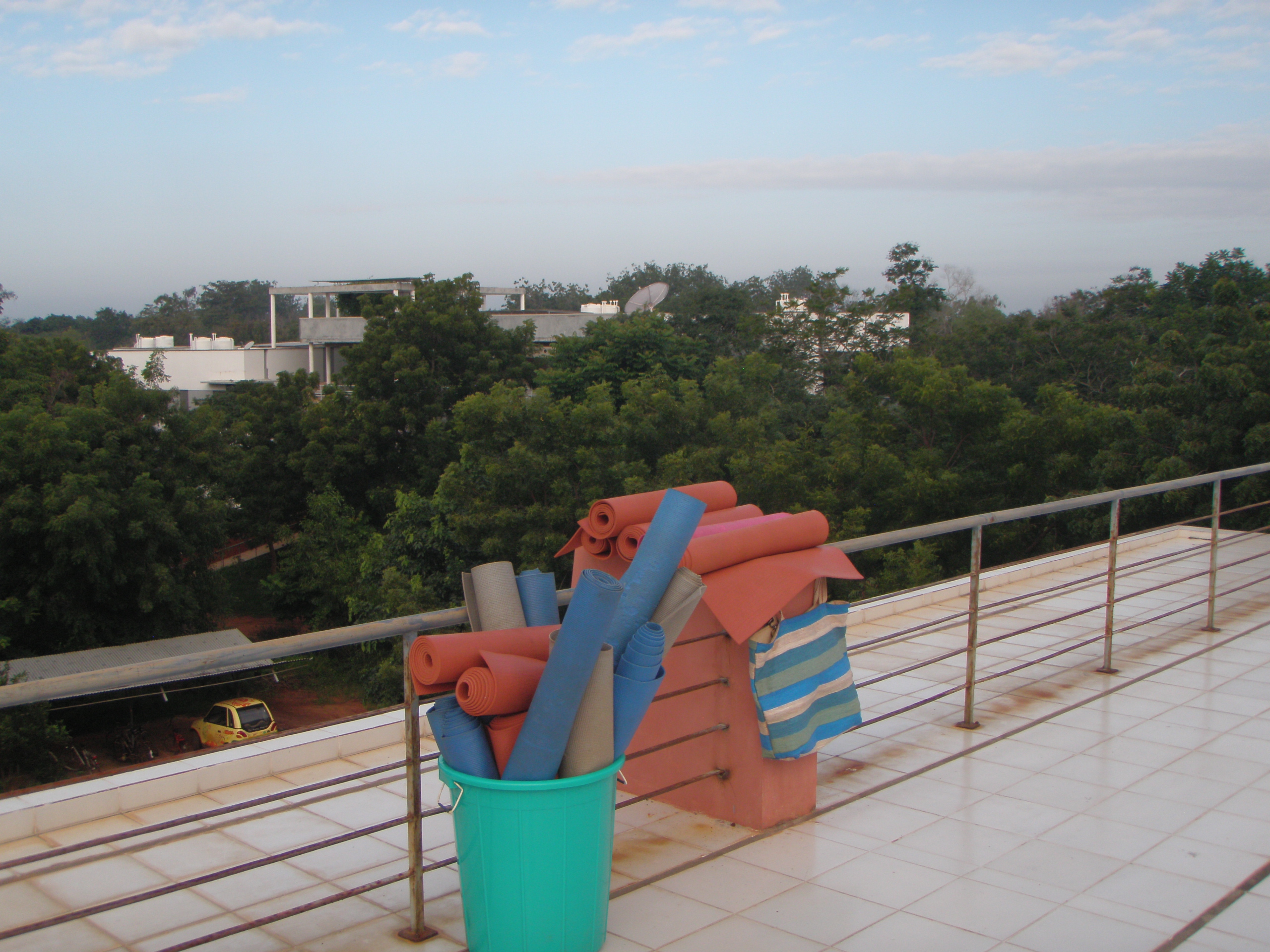
Our yoga mats on the rooftop at Mitra Youth Hostel

Our yoga mats on the rooftop at Mitra Youth Hostel

For the past two weeks, my first activity in the morning has been Yoga on the rooftop of our hostel with our lovely teacher Natasha and some of my adventure-mates. Yesterday, as I was transitioning from one asana to the next one, I was reflecting on a kind of Yoga that is followed in Auroville and that I find particularly interesting in the framework of sustainable (self)development. I am talking about Karma Yoga. By an approximate definition, “Karma” means action and Karma Yoga is the Yoga of work, the way of good works, aimed to a greater good; the work of Mother Teresa for example. It means to unify body, mind and soul through action and practice. So it isn’t simply doing some stretching exercises in a gym, but it also doesn’t necessarily entail devoting one’s life to healing the sick and helping the poor. From what I have experienced so far in Auroville, Karma Yoga means to help, heal and share as part of our everyday actions, wherever these might take place.

Reading about or even seeing people involved in socially responsible work often does inspire us momentarily, but after some time we are back to the same place from where we had begun. There are so many things that come into play when people want to bring change into society. And change doesn’t inherently equal a positive force, it can also be negative. It all depends upon the human intention behind it. In its turn, human intention is dependent on the underlying motivation. Unless we are motivated to do something, the seeds of intention just do not germinate in us. According to the theory of reasoned action, if people evaluate the suggested behaviour as positive, and if they think that their significant others want them to perform such behaviour, this results in a higher motivation and they are more likely to do so. Karma Yoga is but one such motivation to do good to society. It is a means to give something back to society. It is a way of changing behaviour for the common good. We shouldn’t just learn from society and move on in a selfish learning process. We need to ask ourselves “What good have I brought to society?” When the answer is a long deafening silence then it isn’t a sustainable practice. Learning about sustainable development also means learning to bring about incremental positive change in our own lifes.

Imagine how easy life would be if we all started helping, healing and sharing with each other and in the process continuously and positively influence one another. This is in essence what I see sustainable development striving towards. And it is what many units in Auroville, especially the social enterprises, are working for. I believe that society worldwide needs such enterprises not for economic reasons alone but for socio-cultural empowerment as well. Hence, as future managers, directors and administrators, it becomes our responsibility to lead all kind of actions with a perspective of giving back to society. It all depends on us and on whether we can fill the gap between what we want and how we behave.

In conclusion, there is one piece of advice that I would like to share with those who think that it is too hard, if not impossible, to make a difference. This was given too us during a lecture in Auroville about choice architecture by Minhaj Ameen, a sustainability consultant in the fields of renewable energy, agriculture and waste management (and a lot more!). First, commit to one change in your life that will align you with your core values. Then, connect with projects and initiatives that will help you implement that change and you will start to unconsciously make decisions for a sustainable (self)development together with the other people involved. So I say let’s all Karma Yoga!

Mia Marzotto, American University of Paris

In a landscape of burning plastics

Pondu Landfill

Click to enlarge

In India, almost all the waste goes to landfills, since people are really bad at recycling. In fact, half of what goes to the landfills in India is organic waste that should have been composted. A consequence of the lack of waste segregation is that PET-bottles, paper packaging and other items that should be recycled are contaminated by rotting food, making the items worthless.

In the midst of all the garbage, cows and dogs and a large flock of crows are feeding. Their presence make the scene feel surreal to me. I imagine cows should be on green meadows, not on dump sites? The surrealistic feeling is enhanced by a thick, toxic smoke coming from a number of small fires at one end of the dump. People in search of recyclable metals have set piles of electronic waste on fire in order to melt away plastic components and free the metal. Tomorrow they will come here to go over the ashes with magnets.

Pondi Landfill

Click to enlarge

Just next to a big cow, I see an old woman picking up some aluminum foil and putting it into a sack. We walk over to her. Turns our she’s 70 years old. She earns her livelihood from finding recyclable items like paper, plastic and metal on the dump and selling them to a local scrap dealer. In a day she earns about 100 rupies (approximately 1 Euro or 1.6 USD). Just one step away from where she stands is a big red plastic bag. The color indicates that it contains medical waste from a hospital, in other words syringes. We ask the woman if she’s afraid to injure herself. Oh no, she replies, pointing to her flip-flops, implying that they are sufficient protection for her feet. And then she shows us how she’s using a small metal stick when digging in the garbage.

I shudder at the sight of it. She’s not even wearing gloves. Personally I’m terrified of dirty needles and the risk of being infected with HIV or Hepatitis – or for that matter catching any disease from bacteria that might thrive on a landfill. I’m only centimeters away from accidentally stepping on a dead puppy. I tighten the scarf covering my nose and mouth, but I cannot shut out neither the stink nor the pain in my heart from all that I see. In my sturdy jogging shoes I head back to the rented bus that will take me home to my neat and tidy hostel room. But the Pondicherry Landfill stays on my mind. The old woman in the orange sari has no rented bus to take her home tonight.

A short film clip from the landfill


Post written by: Åsa Ljusenius, Linnaeus University